What Is the SaaS Model? A Guide for Decision-Makers

TL;DR:
- The SaaS model hosts applications in the cloud, accessed through subscriptions, without local installation. It offers faster deployment, predictable costs, automatic updates, and scalable infrastructure managed by providers. Success depends on deliberate governance, understanding data ownership, and ongoing customer success management to reduce churn and maximize growth.
The SaaS model is defined as a software delivery method where applications are hosted by a provider in the cloud and accessed by customers through a subscription over the internet. No local installation is required. No hardware ownership is needed. By 2023, SaaS became the primary application deployment model globally, overtaking on-premises software across industries. That shift signals a fundamental change in how organizations buy, use, and think about software. The SaaS market is projected to expand from $315.68 billion in 2025 to $1.13 trillion by 2032, making it one of the fastest-growing segments in enterprise technology.
What is the SaaS model: architecture and delivery
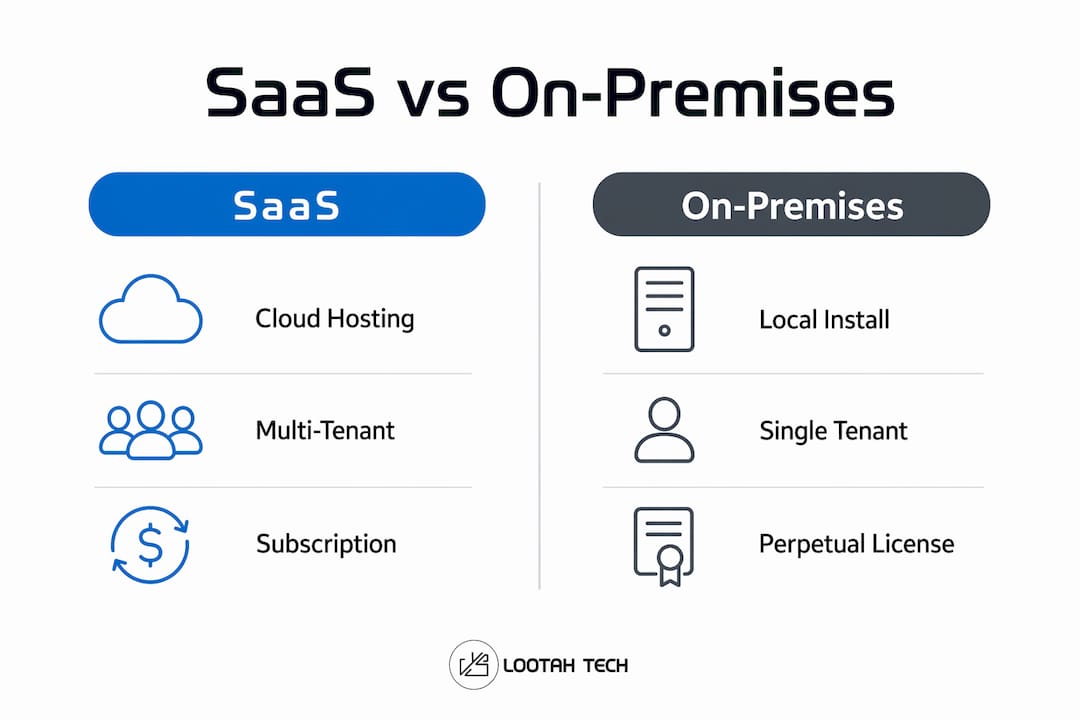
Software as a service is built on two core technical pillars: cloud hosting and multi-tenant architecture. Understanding both is necessary before evaluating any SaaS solution.

Multi-tenant architecture allows a single software instance to serve multiple customers at the same time. Each customer's data remains isolated, but the underlying infrastructure is shared. This design reduces the provider's cost per customer and enables faster feature rollouts across the entire user base simultaneously.
Cloud hosting means the provider manages servers, databases, security patches, and uptime. Your IT team does not touch the infrastructure. That responsibility transfers entirely to the vendor, which is why SaaS products can be deployed in days rather than months.
The licensing model is equally distinct. Traditional on-premises software requires a large upfront perpetual license fee plus ongoing maintenance contracts. SaaS replaces that with a recurring subscription, typically billed monthly or annually. The table below compares the two models across the dimensions that matter most to decision-makers.
| Feature | SaaS | On-premises software |
|---|---|---|
| Deployment time | Days to weeks | Months to years |
| Upfront cost | Low or none | High capital expenditure |
| Updates | Automatic, provider-managed | Manual, IT-managed |
| Infrastructure ownership | Provider | Organization |
| Scalability | Immediate, subscription-based | Requires hardware procurement |
| Data control | Shared cloud environment | Full internal control |
Pro Tip: Before signing a SaaS contract, request the vendor's Service Level Agreement (SLA) for uptime guarantees and data residency policies. These two clauses determine your actual risk exposure, not the marketing sheet.
For organizations evaluating enterprise application deployment, SaaS now represents the default starting point rather than one option among many.
How does the SaaS business model generate revenue?
The SaaS business model generates revenue through recurring subscription fees, and that predictability is its defining financial advantage. Providers track two core metrics: Monthly Recurring Revenue (MRR) and Annual Recurring Revenue (ARR). Predictable MRR and ARR enhance financial forecasting far beyond what traditional license sales ever allowed. Investors value SaaS companies at higher multiples precisely because revenue is contractually locked in rather than dependent on one-time deals.
Most mature SaaS providers do not rely on a single pricing tier. SaaS companies combine base subscription fees with usage-based tiers and one-time implementation fees for enterprise clients. This hybrid approach balances predictable cash flow with the ability to capture more revenue as customers grow.
The economic logic behind SaaS also reframes the vendor-customer relationship. A shift from upfront payment to continuous value delivery means customers can cancel at any time. That single fact forces providers to keep improving the product every billing cycle. Vendors who stop delivering value lose customers immediately, not at the end of a five-year contract.
The most common SaaS pricing structures include:
- Per-seat pricing: Each user pays a fixed monthly fee. Predictable for both sides. Common in productivity and collaboration tools.
- Usage-based pricing: Customers pay based on consumption, such as API calls, data processed, or transactions completed. Scales directly with customer activity.
- Tiered pricing: Feature sets are bundled into tiers (Starter, Professional, Enterprise). Encourages upgrades as customer needs grow.
- Freemium: A free base product drives adoption. Revenue comes from converting free users to paid plans.
Customer success management is critical in SaaS because low switching costs make churn a constant threat. A customer who does not see clear value within the first 90 days will cancel. That reality makes the post-sale experience as important as the sale itself.
How do SaaS companies grow? Sales models and Product-Led Growth
SaaS companies use two primary sales motions: low-touch and high-touch. Each suits a different customer segment and price point.
Low-touch sales rely on self-service. Customers sign up, explore the product, and upgrade without speaking to a salesperson. This model works for products priced below $500 per month where the value is immediately obvious. High-touch sales involve dedicated account executives, custom demos, and negotiated contracts. Enterprise deals above $50,000 per year almost always require high-touch engagement.
Product-Led Growth (PLG) is now considered the leading strategy for SaaS customer acquisition in competitive markets. PLG means the product itself drives adoption. Free trials, freemium tiers, and viral sharing features bring users in organically. The product proves its value before any sales conversation happens.
The four growth levers SaaS companies use most effectively:
- Reduce time to value. The faster a new customer experiences the product's core benefit, the lower the churn risk. Onboarding flows, in-app guides, and pre-built templates all serve this goal.
- Expand within accounts. Selling additional seats or features to existing customers costs far less than acquiring new ones. Net Revenue Retention (NRR) above 100% means existing customers are growing faster than others are leaving.
- Build referral loops. PLG products often include built-in sharing mechanics. Each new user who invites a colleague becomes a distribution channel.
- Invest in customer success. Managing churn is the biggest profitability challenge for new SaaS operators. A dedicated customer success team that monitors usage data and intervenes before cancellation is not a cost center. It is a revenue protection function.
Pro Tip: Track your Net Revenue Retention rate monthly. An NRR above 110% means your existing customer base is growing on its own. That metric matters more to investors than new customer acquisition numbers.
For teams thinking about growth through web applications, PLG principles apply directly to how you design onboarding and feature discovery.
What are the advantages and challenges of the SaaS model?
SaaS delivers clear business advantages: lower upfront costs, automatic updates, and reduced IT infrastructure burden. These benefits explain why organizations across healthcare, finance, and logistics have moved core operations to SaaS platforms. The ability to scale enterprise applications without procuring new hardware is a genuine operational advantage, not a marketing claim.
The advantages are real, but so are the trade-offs. Decision-makers who treat SaaS as universally superior to on-premises software make costly mistakes.
Advantages:
- No capital expenditure on servers or data centers
- Updates deploy automatically across all users
- Access from any device with an internet connection
- Subscription costs are predictable and budget-friendly
- Providers handle security patching and compliance certifications
Challenges:
- Internet dependency creates operational risk. A connectivity outage stops work entirely for cloud-only tools.
- Ongoing subscription fees accumulate. Over a five-year period, total SaaS spend often exceeds what a perpetual license would have cost.
- Data privacy and sovereignty concerns arise when customer data sits on third-party servers, particularly under regulations like GDPR or UAE PDPL.
- Vendor lock-in is real. Migrating years of data out of a SaaS platform is expensive and time-consuming.
- Security responsibility is shared, not eliminated. Organizations still own the risk of misconfigured access controls and weak user credentials.
The right decision depends on your data sensitivity, internet reliability, and total cost of ownership calculation over a three to five year horizon.
Key Takeaways
The SaaS model delivers the most value when organizations align subscription choices with clear business goals, monitor churn and NRR monthly, and treat customer success as a core revenue function rather than an afterthought.
| Point | Details |
|---|---|
| SaaS definition | Cloud-hosted software accessed via subscription, with the provider managing all infrastructure. |
| Multi-tenant architecture | One software instance serves many customers; data isolation is mandatory for security and compliance. |
| Hybrid revenue models | Combining subscriptions, usage fees, and implementation charges optimizes cash flow across customer segments. |
| Product-Led Growth | PLG reduces acquisition costs by letting the product prove its value before any sales conversation. |
| Churn is the core risk | Low switching costs mean customers leave fast; customer success investment directly protects recurring revenue. |
The SaaS decisions most organizations get wrong
Working with organizations across industries, I have seen the same pattern repeat. A leadership team evaluates a SaaS platform, focuses entirely on the feature list and the monthly price, and signs a contract without asking two questions that actually determine success: Who owns the data if we leave? And what does our customer success engagement look like after month three?
SaaS governance is not a technical problem. It is a business strategy problem. The organizations that get the most from SaaS treat their vendor relationships like partnerships, not utilities. They negotiate SLAs, they monitor usage data, and they assign internal owners to each platform. The ones that struggle treat SaaS as a set-and-forget purchase.
The other mistake I see consistently is underestimating the total cost of a fragmented SaaS portfolio. Buying ten separate tools that each solve one problem creates integration debt, security gaps, and a monthly bill that nobody fully tracks. The better approach is to map your software needs against a consolidated architecture before signing anything.
SaaS is not going away. The market trajectory makes that clear. But the organizations that win with it are the ones that govern it deliberately, not the ones that simply adopt it because everyone else has.
— YS
How Yslootahtech supports your SaaS adoption
Building a SaaS product or integrating one into your operations requires more than a subscription. The user experience layer determines whether your team actually uses the tool or works around it.
Yslootahtech brings deep expertise in UX/UI design and custom application development to organizations building or adopting SaaS solutions across the UAE and beyond. Whether you are designing a SaaS product from the ground up or improving the interface of an existing platform, Yslootahtech's team works with your business goals, not against them. Contact Yslootahtech to discuss how your next SaaS initiative can be built for adoption, not just deployment.
FAQ
What is the SaaS model in simple terms?
The SaaS model is a way of delivering software where the provider hosts the application in the cloud and customers access it through a subscription. No installation or hardware ownership is required.
How does SaaS differ from on-premises software?
On-premises software is installed locally and requires upfront licensing fees and internal IT management. SaaS is cloud-hosted, subscription-based, and maintained entirely by the provider.
What are the main SaaS pricing models?
The most common SaaS pricing structures are per-seat, usage-based, tiered, and freemium. Most enterprise SaaS platforms combine two or more of these into a hybrid model.
What is Product-Led Growth in SaaS?
Product-Led Growth is a customer acquisition strategy where the product itself drives adoption through free trials or freemium access, reducing reliance on traditional sales teams and lowering acquisition costs.
What is the biggest risk of adopting SaaS?
Churn and vendor lock-in are the two primary risks. Customers can cancel at any time due to low switching costs, and migrating data out of a SaaS platform after years of use can be expensive and disruptive.