What Is Hybrid Cloud? A 2026 Guide for IT Leaders

TL;DR:
- Hybrid cloud combines private on-premises and public cloud environments through orchestration, enabling workload mobility based on cost, performance, and compliance. It relies on management tools, dedicated connectivity, and container orchestration like Kubernetes to unify operations, supporting regulatory, AI, and legacy workloads efficiently. Most enterprises view hybrid cloud as a strategic destination rather than a temporary stage, offering cost savings and optimized resource utilization.
Hybrid cloud is a computing environment that combines private on-premises infrastructure with public cloud services into a single, orchestrated platform where workloads move freely based on cost, performance, and compliance requirements. For IT professionals evaluating modern architecture options, understanding the hybrid cloud definition means recognizing it as more than a deployment model. It is a deliberate strategy for managing where data lives, how applications scale, and what your organization pays for compute. Platforms like Microsoft Azure, AWS, and Google Cloud all offer native hybrid integration tools, and the demand for this architecture is accelerating as AI workloads push the economics of pure public cloud to their limits.
What is hybrid cloud architecture made of?
Hybrid cloud architecture is defined by the orchestration layer that connects private and public cloud environments, enabling data and workloads to move between them without manual intervention. Without that orchestration layer, you have two separate environments. With it, you have a unified platform.
The main components break down into four categories:
- Private infrastructure: On-premises data centers and private clouds running workloads that require low latency, strict data sovereignty, or consistent performance. This is where regulated financial data, healthcare records, and legacy enterprise applications typically live.
- Public cloud services: Compute, storage, and managed services from providers like AWS, Microsoft Azure, and Google Cloud. These handle burst capacity, development environments, and globally distributed workloads.
- Orchestration and management layer: Tools like VMware vSphere, Red Hat OpenShift, and Azure Arc that present both environments as a single control plane. This is the technical core of any hybrid deployment.
- Connectivity fabric: Dedicated private network circuits guarantee security and low latency between on-premises systems and public cloud endpoints. Relying on the public internet for mission-critical traffic introduces unacceptable risk.
Containers play a central role in making hybrid cloud practical. Kubernetes and software-defined data fabrics abstract the physical location of compute resources, so an application running on-premises and one running in AWS can share the same deployment pipeline and monitoring stack. This abstraction is what allows organizations to treat hybrid cloud as one environment rather than two.
Pro Tip: Before selecting an orchestration platform, map every workload by its latency sensitivity, regulatory classification, and cost profile. That inventory drives every architecture decision that follows.

How does hybrid cloud differ from public cloud and multi-cloud?
The terms hybrid cloud, public cloud, and multi-cloud appear together constantly, but they describe fundamentally different architectures. Confusing them leads to poor platform choices and misaligned vendor contracts.
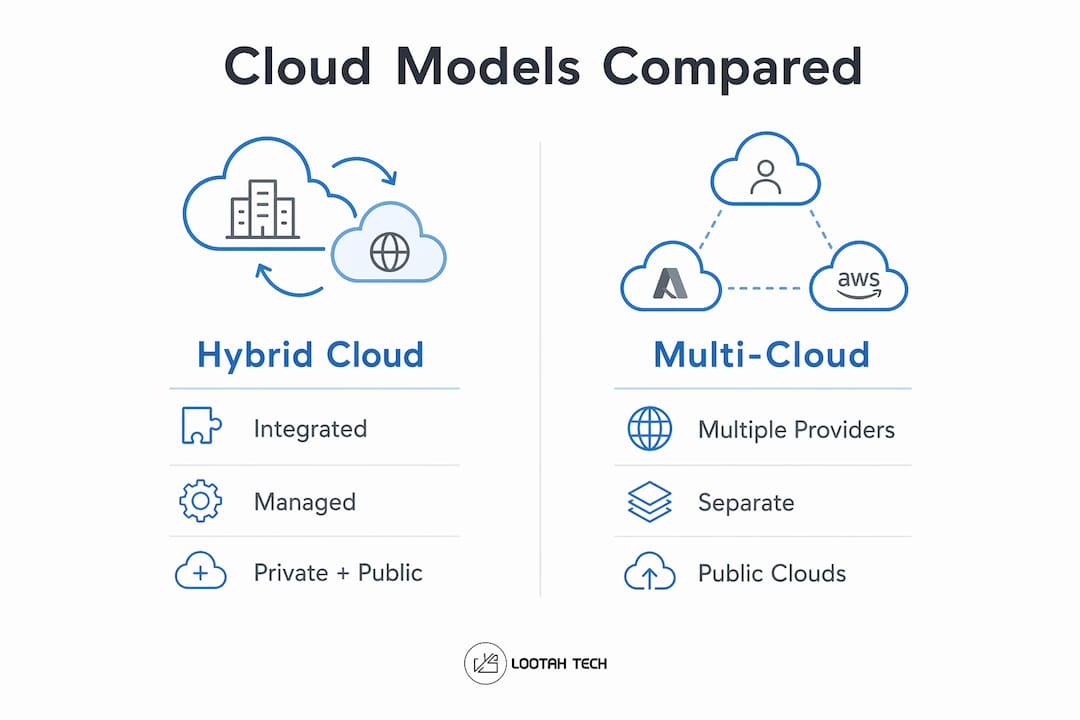
Hybrid cloud is an integrated, managed environment combining private and public clouds, while multi-cloud refers to using multiple public cloud providers without a unified management layer. That distinction matters operationally. A multi-cloud strategy might mean running separate workloads on AWS and Google Cloud with no shared orchestration. A hybrid strategy means your on-premises systems and your public cloud resources are actively coordinated. Understanding this difference is critical for designing interoperable IT strategies that scale.
The table below clarifies the three models side by side:
| Model | Infrastructure | Management | Best for |
|---|---|---|---|
| Public cloud | Third-party provider only | Provider-managed | Startups, dev/test, elastic workloads |
| Multi-cloud | Multiple public providers | Separate per provider | Vendor redundancy, best-of-breed services |
| Hybrid cloud | Private and public combined | Unified orchestration layer | Regulated industries, AI workloads, legacy apps |
A full public cloud migration makes sense for organizations with no regulatory constraints and no latency-sensitive workloads. Most enterprises do not fit that profile. For a deeper look at how AWS, Google Cloud, and Microsoft Azure overlap in practice, the cloud vendor comparison from Lemsubs breaks down where their services converge and diverge. The hybrid model exists precisely because the public cloud alone cannot satisfy every workload requirement at an acceptable cost.
What are the key benefits of hybrid cloud for business?
The business case for hybrid cloud is grounded in measurable outcomes, not architectural preference. 50% of organizations optimized costs after adopting hybrid cloud, and 45% increased IT capacity without adding capital expenses. Those numbers reflect the core value proposition: you get public cloud elasticity without paying public cloud prices for every workload.
The primary benefits for IT decision-makers include:
- Cost optimization through elastic capacity: Burst workloads move to public cloud during peak demand, then return to on-premises infrastructure when demand drops. You pay for public cloud compute only when you need it.
- AI workload economics: AI workloads running fully in public cloud can cost 60% to 70% more than comparable on-premises setups. Running AI training on owned hardware and inference on public cloud is a direct cost control mechanism.
- Latency and performance control: A three-tier hybrid approach places public cloud at the elasticity layer, on-premises infrastructure at the consistency layer, and edge computing at the AI latency layer. This architecture handles real-time processing requirements that pure public cloud cannot meet.
- Regulatory compliance and data security: Hosting workloads where most suitable gives organizations direct control over where sensitive data resides. Financial services firms in the UAE and EU, for example, can keep customer data on-premises while running analytics in public cloud.
- Legacy application support: Applications that cannot be refactored for cloud-native deployment continue running on-premises while new services are built in public cloud. This avoids forced migrations that carry high risk and cost.
Hybrid cloud examples in practice include a bank running its core transaction system on-premises while deploying fraud detection models in AWS, a hospital keeping patient records in a private data center while using Google Cloud for medical imaging AI, and a retailer handling peak holiday traffic through Azure burst capacity while its inventory system stays on local servers. For strategies on getting the most from this architecture, the guide on cloud infrastructure optimization covers cost and performance levers in detail.
What challenges come with hybrid cloud implementation?
Hybrid cloud delivers real advantages, but the implementation complexity is significant. Organizations that underestimate it end up with management silos, security gaps, and costs that exceed what a simpler architecture would have produced.
The main challenges are:
- Networking demands: Connectivity between on-premises and public cloud must be reliable and low-latency. This typically requires dedicated circuits like AWS Direct Connect or Azure ExpressRoute rather than standard internet connections.
- Management complexity: Proactive workload governance and advanced orchestration are required to prevent environments from drifting apart. Without automation, teams spend excessive time on manual configuration and troubleshooting.
- Security surface area: Every integration point between private and public environments is a potential attack vector. Identity management, encryption in transit, and consistent policy enforcement across both environments are non-negotiable.
- Skill requirements: Operating a hybrid environment requires expertise in both on-premises infrastructure and cloud-native services. Most organizations need to invest in training or bring in specialists.
The organizations that succeed with hybrid cloud treat it as a platform engineering problem, not a procurement decision. They define clear workload placement policies before deployment, automate governance with tools like HashiCorp Terraform or Ansible, and establish unified observability across both environments using platforms like Datadog or Dynatrace.
Pro Tip: Implement a workload classification framework before migration. Assign every application a tier based on latency, compliance, and cost sensitivity. This prevents ad hoc placement decisions that create technical debt.
Staying current on where this architecture is heading matters as much as the initial deployment. The 2026 cloud computing trends analysis from Yslootahtech covers the shifts in hybrid adoption patterns that IT leaders should factor into their planning now.
Key takeaways
Hybrid cloud succeeds when organizations treat orchestration as the core investment, not an afterthought, and align workload placement with cost, compliance, and performance requirements from day one.
| Point | Details |
|---|---|
| Orchestration defines hybrid cloud | The management layer connecting private and public environments is what separates hybrid from simply having two clouds. |
| AI economics favor hybrid | Public cloud AI workloads cost 60%–70% more than on-premises equivalents, making hybrid the cost-effective path for AI at scale. |
| Cost and capacity gains are proven | 50% of adopters report cost optimization and 45% gain IT capacity without additional capital spending. |
| Multi-cloud is not hybrid cloud | Multi-cloud uses multiple providers without unified management; hybrid cloud requires integrated orchestration across private and public environments. |
| Implementation requires governance | Workload classification, dedicated connectivity, and automation tools are prerequisites for a hybrid deployment that stays manageable. |
Why hybrid cloud is the architecture I keep recommending
I have worked with enough enterprise IT teams to know that the "cloud-first" mandate sounds clean in a boardroom and gets complicated fast in production. The organizations that moved everything to public cloud in 2019 and 2020 are now the ones quietly repatriating workloads because the economics stopped making sense, particularly as AI infrastructure costs became a real line item.
What I find compelling about hybrid cloud in 2026 is that it is not a compromise. It is the mature architectural choice for organizations that have moved past the novelty of cloud and are now focused on running it like a business. The three-tier model, public cloud for elasticity, on-premises for consistency, and edge for AI latency, reflects how workloads actually behave rather than how vendors want to sell them.
The mistake I see most often is treating hybrid cloud as a temporary state on the way to full cloud migration. For most enterprises, especially those in regulated industries or running serious AI workloads, hybrid is the destination. The future of enterprise cloud computing points toward more hybrid adoption, not less, as AI infrastructure costs and data sovereignty requirements continue to grow.
My practical advice: stop asking whether to go hybrid and start asking which workloads belong where. That question has a defensible, data-driven answer. The architecture question largely answers itself once you have done that analysis.
— YS
How Yslootahtech supports your hybrid cloud strategy
Adopting hybrid cloud is an architectural decision with deep implications for your applications, data pipelines, and user interfaces. Yslootahtech works with IT teams and decision-makers across the UAE and beyond to design and build the digital infrastructure that hybrid cloud environments demand.
From custom application development built to run across private and public cloud environments, to website development and UX/UI design for cloud management platforms, Yslootahtech delivers end-to-end solutions tailored to your workload requirements. If your organization is evaluating hybrid cloud adoption or needs to modernize applications to take advantage of a hybrid architecture, contact Yslootahtech to start with a strategic consultation.
FAQ
What is the hybrid cloud definition in simple terms?
Hybrid cloud is a computing environment that connects private on-premises infrastructure with public cloud services through an orchestration layer, allowing workloads to move between them based on cost, performance, and compliance needs.
How does hybrid cloud work technically?
Hybrid cloud works by using orchestration tools like Red Hat OpenShift or Azure Arc to create a unified management plane across private and public environments, with dedicated network connections and container technologies like Kubernetes enabling consistent workload deployment across both.
What are the main benefits of hybrid cloud for enterprises?
The primary benefits include cost optimization through elastic capacity, regulatory compliance by keeping sensitive data on-premises, and AI workload cost control, since running AI fully in public cloud can cost 60% to 70% more than on-premises alternatives.
What is the difference between hybrid vs public cloud?
Public cloud uses only third-party provider infrastructure managed entirely by the vendor, while hybrid cloud combines private on-premises systems with public cloud services under unified orchestration, giving organizations direct control over workload placement.
What are real-world hybrid cloud examples?
Common examples include banks running core transaction systems on-premises while deploying fraud detection in AWS, hospitals keeping patient records in private data centers while using Google Cloud for medical imaging AI, and retailers using Azure for peak-season burst capacity alongside on-premises inventory systems.