What Is Digital Onboarding for HR Leaders in 2026

TL;DR:
- Digital onboarding involves structured, technology-driven processes that support new employee integration over 90 days. It enhances retention, accelerates productivity, and improves understanding through milestone-based content and interactive tools. Successful implementation requires cross-departmental collaboration, strategic measurement, and personalized experiences to avoid overload and foster genuine connection.
Most HR leaders assume digital onboarding means sending a welcome email and a PDF employee handbook. That assumption is costing companies real money. What is digital onboarding, exactly? It is the use of digital tools, automated workflows, and structured milestone-based content to integrate new employees from the moment they accept an offer through their first 90 days and beyond. Done right, it directly affects whether your new hire stays past the probation period, reaches full productivity faster, and feels genuinely connected to your organization. This article breaks down the process, benefits, best practices, and metrics you need to make it work.
Table of Contents
- Key takeaways
- What is digital onboarding and how the process works
- Benefits of digital onboarding you can actually measure
- Digital onboarding best practices and common pitfalls
- Measuring digital onboarding success
- Choosing the right digital onboarding tools
- My honest take on where digital onboarding fails
- Build better onboarding with Yslootahtech
- FAQ
Key takeaways
| Point | Details |
|---|---|
| Digital onboarding spans 90 days | Structure milestones at Day 1, 15, 30, and 90 to support progressive, manageable integration. |
| Retention is the real ROI | Digital onboarding increases retention by up to 25%, making it a strategic workforce investment. |
| Avoid information overload | Drip-feed content aligned to milestones to reduce cognitive load and improve comprehension. |
| Cross-functional ownership is non-negotiable | HR, IT, and hiring managers must collaborate for a consistent, friction-free new hire experience. |
| Measure comprehension, not just completion | Track quiz scores, time-to-productivity, and feedback, not just whether modules were clicked through. |
What is digital onboarding and how the process works
Digital onboarding is the structured process of integrating new employees into your organization using technology at every stage. This includes automated task workflows, e-signature tools, interactive training modules, video introductions, and cloud-based HR platforms. It is not simply a digital version of your paper forms. It is a deliberately designed experience that guides a new hire from offer acceptance to full productivity.
Understanding the digital onboarding process means recognizing its phases. Effective digital onboarding programs typically span 90 days, with structured milestones at Day 1, 15, 30, 45, and 90. Each phase has a different purpose.
- Pre-boarding (before Day 1): The new hire completes paperwork digitally, receives equipment and access credentials, watches a culture video, and connects with their manager via a brief call or message.
- Day 1 introduction: Focus is on orientation, system access, and team introductions. Compliance training and tool walkthroughs happen here, but lightly.
- Days 15 to 30: Role-specific training deepens. The new hire completes knowledge checks, attends structured one-on-ones with their manager, and gets clarity on 30-day goals.
- Days 45 to 90: The employee demonstrates independent output, completes any remaining certifications, and contributes to team projects.
One distinction worth making: virtual onboarding refers specifically to onboarding delivered remotely, often via video conferencing. Digital onboarding is the broader category. It encompasses both remote and in-person employees using digital tools throughout the process. A hybrid employee could be onboarded digitally even if they visit the office on Day 1.
Benefits of digital onboarding you can actually measure
The business case for digital onboarding is no longer abstract. 60.8% of HR leaders report increased early attrition, and 29% say high attrition occurs within the first 90 days of hire. That window is exactly where digital onboarding does its heaviest lifting.
Here is what a well-designed digital onboarding process delivers:
- Higher retention rates. Digital onboarding increases retention by 25% through personalized experiences that make new hires feel prepared and valued from the start.
- Faster ramp-up times. AI-powered onboarding tools reduce time-to-readiness by an average of four days. At scale across hundreds of annual hires, that is a significant operational gain.
- Reduced HR workload. Automating administrative tasks like form collection, benefits enrollment, and compliance acknowledgments frees your HR team for conversations that actually require a human.
- Better comprehension of policies and culture. Interactive onboarding content yields 40% higher completion rates and better comprehension compared to static documents.
- Stronger social integration. 70% of new hires report satisfaction when they form a workplace friendship early. Digital onboarding can facilitate this through team introductions, social channels, and buddy programs built into the platform.
The benefits of digital onboarding extend to the employee experience, too. New hires who go through a structured digital process feel less anxious on Day 1 because they already know what to expect, where to log in, and who their contacts are.
Pro Tip: Build a "before you arrive" digital packet that includes a team org chart, a short manager intro video, and parking or login instructions. Sending it five days before start date consistently reduces first-day questions and anxiety.

Digital onboarding best practices and common pitfalls
The single biggest mistake organizations make with digital onboarding is treating it as a one-department problem. Effective onboarding requires cross-functional integration of HR, IT, and hiring managers. When IT does not provision accounts before Day 1, or when a manager has not reviewed the onboarding schedule, the experience breaks down immediately.
Here are the digital onboarding best practices that make the biggest difference in practice:
- Start pre-boarding early. The pre-boarding phase reduces administrative burden and gives the new hire a positive first impression before their official start. Send login credentials, complete tax forms, and share a welcome message at least one week early.
- Drip-feed your content. Do not drop everything in Week 1. Milestone-aligned content delivery eases cognitive load and improves retention of policies and procedures.
- Use interactive formats. Replace static PDFs with video explainers, scenario-based quizzes, and clickable walkthroughs. This approach is especially critical for remote and hybrid employees who lack the incidental learning that happens in a physical office.
- Maintain human touchpoints. Schedule video check-ins at Day 3, Day 14, and Day 30. No platform replaces a 15-minute manager call where the new hire can say, "I am confused about this."
- Add a searchable Q&A or knowledge base. Repetitive HR questions decrease by 20 to 30% when onboarding includes searchable answers, freeing your team for higher-value work.
The most common pitfall is information overload in Week 1. New hires simply cannot absorb your entire policy manual, compliance training, IT security protocols, and culture deck in five days. Sequence your content so each module builds on the last and aligns with what the new hire actually needs at that moment in their role.
Measuring digital onboarding success
Most organizations track the wrong thing. They monitor whether employees completed each module. Completion is the floor, not the ceiling. What you actually want to know is whether your new hires understood the content and can apply it.
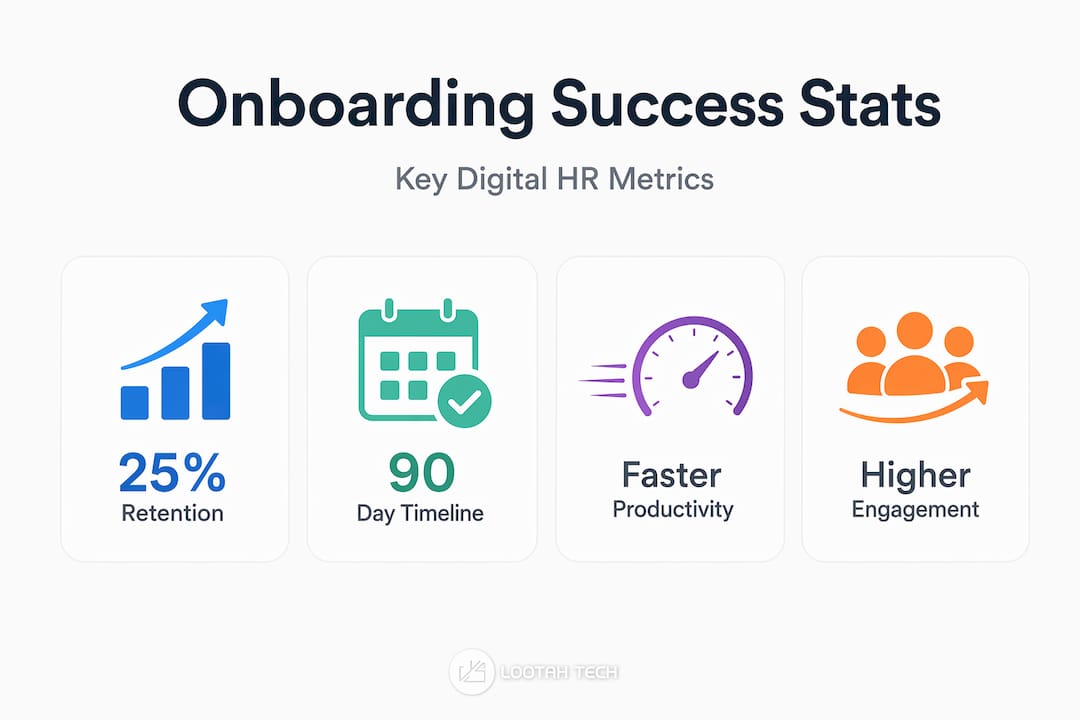
Here is a straightforward measurement framework to assess and improve your digital onboarding program:
| Metric | What it tells you | How to measure it |
|---|---|---|
| Comprehension rate | Whether content is actually understood | Quiz scores embedded in training modules |
| Time-to-productivity | How quickly new hires contribute independently | Manager assessment at Day 30 and Day 90 |
| Retention at 90 days | Whether onboarding supports early engagement | HR data comparison pre/post program launch |
| HR question volume | Efficiency of self-service resources | Helpdesk ticket counts during onboarding period |
| Employee satisfaction score | Overall new hire experience quality | Post-onboarding pulse survey at Day 30 |
Real-time feedback loops allow you to adjust content based on new hire progress. If your quiz scores on a particular compliance module are consistently low, that is a signal to redesign the content, not to blame the cohort. AI tools can now surface these patterns automatically, flagging which modules generate the most confusion or the lowest engagement.
Monitoring digital transformation KPIs alongside onboarding metrics gives leadership a fuller picture of how workforce programs contribute to organizational efficiency.
Choosing the right digital onboarding tools
The market for onboarding technology ranges from full-suite HRIS platforms to standalone microlearning tools. Choosing well depends on your organization's size, existing systems, and how remote your workforce is.
| Tool type | Best for | Key trade-off |
|---|---|---|
| Full HRIS with onboarding module | Enterprises with complex HR workflows | High cost and longer implementation time |
| Dedicated onboarding platforms | Mid-size companies focused on experience | Less integration with payroll or benefits |
| Interactive content builders | Teams creating custom microlearning | Requires internal content design capacity |
| Identity verification tools | Regulated industries needing compliance | Narrow in scope; needs to integrate with other tools |
| Communication and social platforms | Strengthening culture and belonging | Limited structured learning capabilities |
When evaluating any tool, prioritize three things: automation of administrative tasks, native integration with your existing HR and IT systems, and a user experience that works equally well on mobile and desktop. Biometric and identity verification tools are becoming more relevant for industries with strict compliance requirements, including financial services, healthcare, and government-adjacent sectors.
Understanding digital innovation at a strategic level helps you make smarter technology decisions rather than buying platforms that duplicate functionality you already have.
My honest take on where digital onboarding fails
I have worked with organizations that spent considerable budget on onboarding platforms and still saw new hires leave inside 60 days. The technology was not the problem. The problem was that managers were not actively involved after Day 1. The platform was assigned, the videos were watched, and then the new hire sat in silence waiting for direction that never came.
In my experience, digital onboarding fails when organizations mistake automation for connection. The purpose of automating administrative tasks is to free up human bandwidth, not to replace it. Your new hire does not want to watch six more compliance videos. They want their manager to ask, "How is this week going? What is confusing you?" That conversation costs 15 minutes. What it buys in loyalty and clarity is substantial.
The other pattern I see is treating onboarding as a 30-day program when it is fundamentally a 90-day journey. The second and third month are where culture gets built or lost. Employees who reach Day 90 with clarity about their role, positive relationships with at least two colleagues, and confidence in their tools are the ones who stay. The technology should support that arc, not just check boxes in Week 1.
— YS
Build better onboarding with Yslootahtech
Off-the-shelf onboarding platforms work until they do not. When your organization grows, hires across multiple regions, or has compliance requirements specific to your industry, you need an onboarding system built around your actual workflows, not a generic template.
Yslootahtech designs and develops custom onboarding applications and digital portals that integrate with your existing HR systems, deliver role-specific training sequences, and give HR leaders real-time visibility into new hire progress. Whether you need a mobile-first onboarding app, a web-based employee portal, or a fully integrated digital transformation program built on scalable architecture, the team at Yslootahtech can design and deploy it. Reach out to discuss how a purpose-built digital onboarding solution can reduce your early attrition numbers and get new hires to full productivity faster.
FAQ
What is digital onboarding in HR?
Digital onboarding in HR is the process of using technology, including automated workflows, digital forms, interactive training, and communication tools, to integrate new employees from offer acceptance through their first 90 days. It replaces paper-based processes and supports both remote and in-person employees.
How long does the digital onboarding process take?
A well-structured digital onboarding process spans 90 days, with key milestones at Day 1, 15, 30, 45, and 90. Each milestone shifts focus from orientation and compliance to role performance and cultural integration.
What are the main benefits of digital onboarding?
The core benefits include a 25% improvement in retention, faster time-to-productivity, reduced HR administrative workload, higher training comprehension through interactive content, and stronger early social connection among new hires.
What is employee onboarding vs. digital onboarding?
What is employee onboarding in the traditional sense refers to the general process of welcoming and training a new hire, which can be paper-based or in-person. Digital onboarding specifically uses technology to automate and structure that process, making it scalable and measurable.
How do you measure digital onboarding success?
Track comprehension rates through embedded quizzes, monitor 90-day retention, measure time-to-productivity, and run pulse surveys at Day 30. Completion rates alone are not a reliable indicator of whether your onboarding program is working.