Cybersecurity Improvement Steps for Business Leaders

TL;DR:
- Cyberattacks pose a significant threat to organizations of all sizes, with small and medium businesses especially vulnerable to costly breaches.
- Implementing foundational cybersecurity measures—such as governance, asset management, multifactor authentication, and incident response planning—are essential for effective defense.
- Regular testing, staff training, and careful framework integration ensure a resilient security posture that evolves with emerging threats.
Cyberattacks are not a distant risk for large corporations alone. Cybercrime losses reached $16.6 billion in 2024, with small and medium businesses bearing the brunt of ransomware campaigns and data breaches that cost an average of $4.44 million per incident. If you run a business or manage IT operations, taking concrete cybersecurity improvement steps is no longer optional. This article gives you a practical, framework-grounded roadmap covering preparation, execution, detection, and recovery so you can protect your organization without wasting resources on controls that won't hold.
Table of Contents
- Key takeaways
- Core cybersecurity improvement steps to start with
- Executing foundational security controls
- Detection, response, and recovery
- Avoiding the most common pitfalls
- My honest take on where organizations actually fail
- How Yslootahtech supports your cybersecurity goals
- FAQ
Key takeaways
| Point | Details |
|---|---|
| Start with governance | Secure executive sponsorship and define risk appetite before deploying any technical controls. |
| Build on CIS IG1 first | Implement all 56 foundational CIS Controls v8.1 safeguards before moving to advanced measures. |
| MFA and EDR are non-negotiable | Multi-factor authentication and endpoint detection stop the majority of common attack vectors. |
| Train staff continuously | Annual security training fails; microlearning and simulations significantly reduce human error incidents. |
| Test your recovery plan | Documented incident response plans only work if you run tabletop exercises before an attack happens. |
Core cybersecurity improvement steps to start with
Before you touch a firewall setting or deploy a new tool, you need a clear picture of where your organization actually stands. Most security failures don't happen because companies lack technology. They happen because nobody mapped what they were protecting or who was responsible for protecting it.
Build your governance foundation
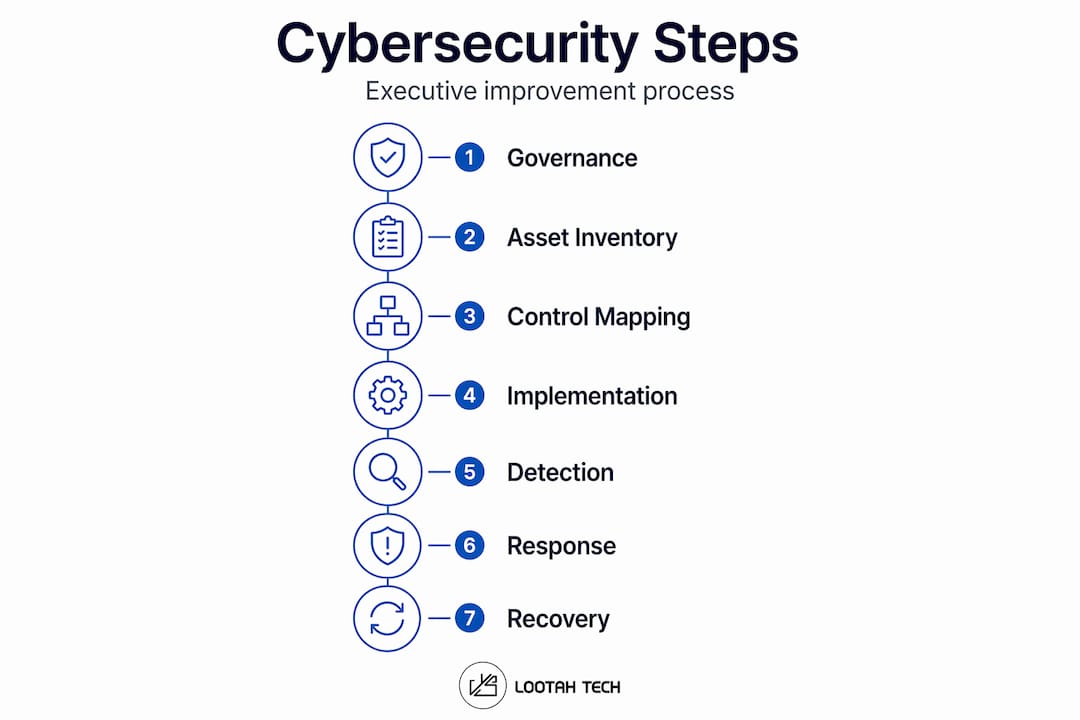
Governance is the cornerstone of any sustainable cybersecurity program. That means an executive sponsor who owns the risk, documented policies with named accountable roles, and a defined risk appetite that guides every spending and prioritization decision. NIST CSF 2.0 formalized this by adding a dedicated GOVERN function, which signals that executive sponsorship and role clarity are prerequisites, not afterthoughts. Without this layer, your technical controls will drift, lose funding, and eventually fail.
Know what you own
You cannot protect assets you haven't cataloged. Following CIS Controls IG1 guidance, every organization should maintain an up-to-date inventory of hardware and software assets. This does not need to be complex. A structured spreadsheet with device type, owner, operating system version, and software licenses is a legitimate starting point for smaller teams.
Here is what your preparation phase should include before moving to execution:
- Asset register: Every device and software application, including cloud services and shadow IT
- Risk assessment: Identify threats relevant to your industry, map likely attack paths, and score impact
- Framework selection: CIS Controls v8.1 for technical controls, NIST CSF 2.0 for governance and lifecycle structure
- Defined risk appetite: Written statement approved by leadership on what risk levels are acceptable
- Tool baseline: Identify gaps in endpoint protection, identity management, and logging before buying anything new
Pro Tip: Map CIS Controls directly to NIST CSF functions at the start. Integrated framework mapping reduces duplication by 40% and improves metric consistency by 60%, saving your team significant rework later.
Executing foundational security controls
With governance in place and your asset inventory complete, you can move into implementation. This phase is where most organizations either build real security or create the illusion of it. The difference comes down to sequencing.

NIST CSF 2.0 recommends a 90-day initial roadmap that prioritizes governance and assessment first, then foundational controls, with full conformance taking one to three years. Resist the pressure to skip ahead.
Here are the steps to implement your foundational controls in order:
-
Secure configuration on all devices. Disable default credentials, remove unused services, and apply configuration baselines to every workstation, server, and network device before connecting them to your environment.
-
Implement multi-factor authentication across all accounts. Start with administrator and privileged accounts, then extend to all staff. MFA alone blocks the overwhelming majority of credential-based attacks.
-
Enforce a strong password policy. Require minimum 12-character passwords, prohibit reuse of the last ten passwords, and deploy a password manager to remove friction that drives workarounds.
-
Patch and update software on a defined schedule. Critical patches should deploy within 24 to 48 hours of release. Non-critical patches should follow a weekly or biweekly cycle. Automate where possible.
-
Deploy endpoint detection and response (EDR) tools. EDR goes beyond traditional antivirus by monitoring behavior, not just signatures. Prioritizing EDR deployment alongside MFA delivers the highest return against ransomware specifically.
-
Control who has access to what. Apply the principle of least privilege across user accounts, applications, and systems. Remove access immediately when employees change roles or leave. Audit permissions quarterly.
-
Segment your network. Separate critical systems, such as finance and operations databases, from general staff workstations. Segmentation limits how far an attacker can move if they breach one layer.
Pro Tip: Don't try to complete all seven steps in the first month. A phased approach starting with the foundation before scaling to advanced capabilities outperforms attempts to implement too many controls simultaneously.
For a structured executive view on prioritizing these controls, the cybersecurity risk reduction guide from Yslootahtech walks through a prioritized five-step workflow designed for leaders managing limited IT resources.
Detection, response, and recovery
Implementing preventive controls is only half the work. No environment is fully breach-proof. What separates organizations that survive attacks from those that collapse under them is how quickly they detect, contain, and recover.
-
Continuous monitoring: Deploy a Security Information and Event Management (SIEM) tool to aggregate logs from endpoints, servers, and network devices. Configure alerts for high-priority events such as failed login spikes, unusual data transfers, and unauthorized software execution.
-
Immutable backups: Store backups offline or in write-once cloud storage so ransomware cannot encrypt or delete them. Test restoration monthly, not annually. Many organizations discover their backups are broken only after an attack.
-
Incident response plan: Document your response procedures before you need them. Include roles, communication chains, containment steps, forensic preservation procedures, and escalation paths. A plan sitting in a folder is not the same as a plan your team has practiced.
-
Tabletop exercises: Run scenario-based simulations at least twice a year. Walk your leadership and IT team through a ransomware scenario or a business email compromise event. These exercises reveal gaps in your plan that documentation alone cannot surface.
-
Recovery objectives: Define your Recovery Time Objective (RTO) and Recovery Point Objective (RPO) for critical systems. Knowing that your finance system must be back online within four hours shapes every backup and failover decision you make.
Pro Tip: Cyber resilience strategy elements like immutable backups and tested incident response plans work together. Neither is effective in isolation. Budget for both from the start.
Avoiding the most common pitfalls
Understanding the steps to improve cybersecurity is easier than actually sustaining the effort. Here is where most organizations stumble, and what to do instead.
"Skipping foundational controls to implement advanced security technology is one of the most expensive mistakes an organization can make. The gaps you leave at the base become the entry points attackers exploit first." — Cybersecurity practitioners consistently validate this in post-breach analyses.
The most common pitfalls break down as follows:
-
Skipping IG1 to chase advanced tools. Skipping baseline CIS IG1 safeguards and pursuing advanced controls leaves exploitable gaps that sophisticated tools cannot compensate for.
-
One-and-done security training. 95% of cyber incidents involve human error, yet most businesses still rely on annual compliance-style training sessions. Microlearning delivered in short weekly modules and phishing simulations build genuine threat recognition over time.
-
No executive ownership. When cybersecurity is treated as an IT department problem rather than a business risk, budgets shrink, decisions stall, and accountability vanishes. Governance without named executive ownership rarely survives past the first budget cycle.
-
Framework overload. Trying to comply simultaneously with NIST, ISO 27001, SOC 2, and CIS Controls without a mapping strategy leads to duplicated effort and inconsistent controls. Start with one framework, map others to it, and use the enterprise cybersecurity best practices guidance to build a consistent program.
-
Ignoring third-party risk. Vendors and partners with access to your systems expand your attack surface significantly. Include vendor risk assessments in your security program from the beginning, not as a later add-on.
My honest take on where organizations actually fail
I've seen organizations spend six figures on security tools and still get breached through an unpatched VPN appliance running outdated firmware. The technology was not the problem. The governance was. Nobody owned the patching decision. Nobody had written authority to enforce it. That is the pattern I see repeatedly when working with businesses at various stages of their security journey.
In my experience, the organizations that make the most meaningful cybersecurity progress in the shortest time are not the ones with the biggest budgets. They are the ones with a senior leader who genuinely understands that cybersecurity is a business risk function, not a technology function. When that mindset is in place, prioritization gets clearer, resources follow, and the teams doing the work feel backed.
What advanced teams often get wrong is trying to scale too fast. They implement a SIEM before their log sources are configured properly. They deploy zero trust architecture before finishing their asset inventory. The result is a sophisticated-looking security program with holes at the foundation. A guide to cybersecurity improvements that doesn't tell you to slow down and check your base is doing you a disservice.
The human factor deserves more honest attention than it typically gets. Security awareness training is treated as a compliance checkbox in too many organizations. What actually works is short, frequent, scenario-based learning that puts staff in realistic situations and teaches them to recognize phishing attempts, social engineering, and data handling mistakes in context. That is not glamorous. But it reduces incidents.
— YS
How Yslootahtech supports your cybersecurity goals
If your cybersecurity improvement plan includes updating or building digital products, the security of those products matters as much as your network controls. Vulnerabilities in custom applications and websites are among the most exploited attack vectors in business environments.

Yslootahtech builds secure digital products from the ground up. The team's application development services incorporate security practices at every stage of the development lifecycle, including threat modeling, secure coding standards, and access control architecture. For organizations that need to close gaps in their web presence, the website development services prioritize both performance and protection. And because poor user interface design can lead to security workarounds by frustrated users, Yslootahtech's UX/UI design approach builds security workflows that staff actually follow. Reach out to Yslootahtech to discuss how your digital infrastructure can support your broader cybersecurity strategy.
FAQ
What are the first cybersecurity improvement steps for a small business?
Start by completing a hardware and software asset inventory, securing executive ownership of cybersecurity as a business risk, and implementing multi-factor authentication on all accounts. These three actions close the most common attack vectors before any advanced tools are needed.
How long does it take to implement a cybersecurity improvement program?
Initial foundational controls can be deployed within 90 days using a phased approach. Full program maturity following frameworks like NIST CSF 2.0 typically takes one to three years depending on organizational complexity and resource availability.
Why is human error such a major cybersecurity risk?
95% of cyber incidents trace back to human error, including phishing clicks, weak passwords, and misconfigured systems. Annual training does not build lasting skills. Continuous microlearning and phishing simulations produce measurably better outcomes.
What is the difference between CIS Controls and NIST CSF?
CIS Controls v8.1 provides specific, prioritized technical safeguards organized into implementation groups. NIST CSF 2.0 provides a governance and lifecycle structure with five functions. Using both together, mapped to each other, gives your program both strategic direction and technical specificity.
How do I know if my cybersecurity improvement steps are working?
Track metrics tied to your controls: patch compliance rates, MFA adoption percentage, mean time to detect and respond to incidents, and results from tabletop exercises. Improvement in these numbers over time confirms your program is maturing in the right direction.