Tech strategy planning: blueprint for business transformation

TL;DR:
- Organizations with a clear tech strategy are 23% more profitable than those without one.
- Effective tech planning aligns investments with business goals, improving performance and customer satisfaction.
- Most strategies fail due to poor execution and misalignment, not the plan itself.
Organizations with a clear tech strategy are 23% more profitable than those without one. Yet most business leaders still treat technology investments as a series of one-off purchases rather than a coordinated plan. The result is wasted budget, disconnected systems, and teams pulling in different directions. Tech strategy planning changes that. It gives you a structured way to connect every technology decision to a real business outcome, whether that's cutting costs, growing revenue, or serving customers better. This guide breaks down exactly what tech strategy planning is, why it matters, and how to build one that actually works.
Table of Contents
- What is tech strategy planning?
- Why tech strategy planning matters for business leaders
- Key steps in effective tech strategy planning
- Measuring success: Performance metrics and overcoming barriers
- Why most tech strategy plans fail—and what actually works
- Take the next step with expert tech solutions
- Frequently asked questions
Key Takeaways
| Point | Details |
|---|---|
| Align tech with goals | Tech strategy planning ensures technology investments support business growth. |
| Boost profitability | Companies with a clear tech strategy are substantially more profitable. |
| Follow proven steps | Use a structured approach—assessment, alignment, execution, measurement—for best results. |
| Track and adapt | Measure KPIs regularly and adjust your strategy to stay ahead of changes. |
What is tech strategy planning?
Tech strategy planning is not about picking the latest software or chasing trends. It is a deliberate, structured process that connects your technology investments to your business goals. Think of it as a bridge between where your organization is today and where leadership wants it to be in three to five years.
Here is a clean definition worth anchoring to:
"Tech strategy planning is a structured process to align technology investments and capabilities with business objectives, serving as a roadmap from current state to future vision over 3-5 years."
This is fundamentally different from tactical tech purchases. Buying a new CRM because a competitor uses it, or upgrading servers because the old ones are slow, are reactive decisions. Tech strategy planning is proactive. It starts with business priorities and works backward to identify which technologies will move the needle.
A well-built tech strategy typically covers four core components:
- Assessment: A clear picture of your current technology landscape, including gaps, redundancies, and risks
- Alignment: A direct mapping of technology capabilities to specific business goals such as growth, efficiency, or customer experience
- Execution: A prioritized roadmap of investments, projects, and timelines with assigned ownership
- Measurement: Defined KPIs and review cycles to track whether the strategy is delivering results
Leaders who explore innovative approaches to technology planning often discover that the biggest gains come not from new tools, but from better alignment of existing resources. The framework matters more than the technology itself.
One important distinction: tech strategy planning operates at the organizational level, not the project level. It is not a single IT project plan. It is the overarching logic that guides every technology decision your organization makes over a multi-year horizon. Without it, even well-executed individual projects can fail to create lasting business value because they are not connected to a larger direction.
Why tech strategy planning matters for business leaders
The business case for formal tech strategy planning is not theoretical. The numbers are direct and hard to ignore.
The profitability gap is real. Organizations with aligned tech strategy are 23% more profitable than those without one. That is not a marginal improvement. For a company generating $10 million in annual revenue, that gap represents $2.3 million in additional profit. The difference is not better technology. It is better planning.

But here is the uncomfortable reality: only 47% of enterprises actually meet their stated strategy objectives. That means more than half of organizations that invest in strategy planning still fail to execute it effectively. The strategy document exists. The outcomes do not follow. This gap points to execution and alignment problems, not planning problems.
For small and mid-sized enterprises, the impact is equally measurable. Aligned IT planning produces a 20% cost reduction and a 15% increase in customer satisfaction. These are outcomes that directly affect competitiveness and survival in crowded markets.
| Metric | Impact with tech strategy |
|---|---|
| Profitability increase | +23% |
| Enterprises meeting objectives | 47% |
| SME cost reduction | 20% |
| Customer satisfaction gain | 15% |
What drives these results? A few consistent factors:
- Technology investments are tied to revenue or cost outcomes, not just IT performance
- Teams across departments share a common understanding of priorities
- Budget allocation reflects strategic importance, not just urgency
- Leaders can measure whether technology spending is working
Exploring digital solutions for business growth becomes far more productive when there is a strategy behind the selection. Similarly, decisions to modernize IT infrastructure carry more weight when they are connected to a three-year business objective rather than a maintenance cycle.
The bottom line: tech strategy planning is not an IT exercise. It is a business performance lever that directly affects your bottom line, your customer relationships, and your ability to compete.
Key steps in effective tech strategy planning
Knowing that tech strategy planning matters is one thing. Building one that works is another. Here is a practical sequence that moves from diagnosis to execution.
- Assess your current state. Before planning where to go, understand where you are. Audit your existing technology stack, identify redundant systems, map out integration gaps, and document security vulnerabilities. This is your baseline.
- Align with business priorities. Sit with your C-suite and department heads. What are the top three to five business goals for the next three years? Every technology initiative you plan must connect directly to at least one of those goals. No connection, no priority.
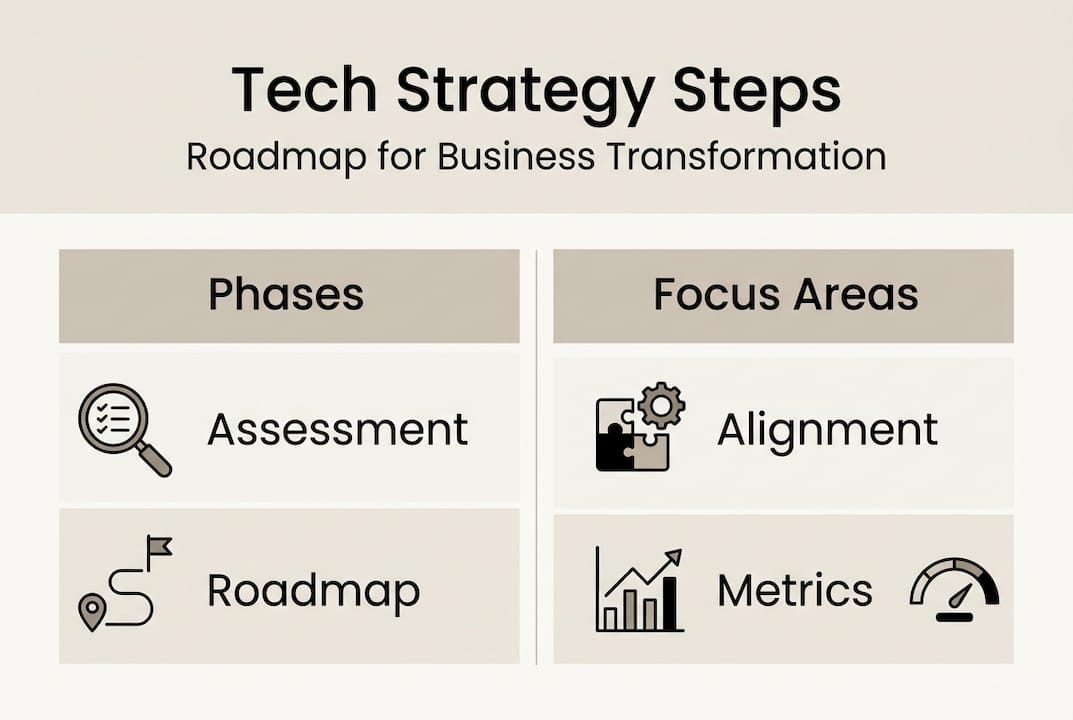
- Build your execution roadmap. Translate aligned priorities into specific initiatives with timelines, budgets, and owners. A good digital transformation roadmap sequences initiatives so that foundational work happens before advanced capabilities are layered on top.
- Stay current on what is possible. Your roadmap should reflect technology trends for 2026 and beyond, not just what was relevant when you started planning. AI, cloud, and automation capabilities are evolving fast.
- Plan for deployment, not just development. Many strategies stall because leaders underestimate implementation complexity. Understanding application deployment steps early prevents costly delays and scope creep during execution.
As tech strategy planning serves as a roadmap from current state to future vision, the quality of your roadmap determines whether the journey is smooth or chaotic.
| Phase | Key output | Common mistake |
|---|---|---|
| Assessment | Technology audit report | Skipping legacy system review |
| Alignment | Business-to-tech priority map | Letting IT lead without business input |
| Execution | Phased project roadmap | Overloading year one |
| Measurement | KPI dashboard | Setting metrics after launch |
Pro Tip: Run a stakeholder alignment workshop before finalizing your roadmap. Strategies that skip this step consistently underperform because teams execute against different assumptions about what success looks like.
Measuring success: Performance metrics and overcoming barriers
A strategy without measurement is just a wish list. Once your plan is in motion, you need clear metrics to know whether it is working and honest processes to course-correct when it is not.
The most effective KPIs for tech strategy planning fall into four categories:
- Financial return: ROI on technology investments, cost savings from automation or consolidation, and total cost of ownership reductions
- Operational efficiency: Time to market for new products or features, process cycle times, and system uptime percentages
- Customer impact: Customer satisfaction scores, digital channel adoption rates, and service resolution times
- Strategic progress: Percentage of roadmap milestones completed on schedule and budget variance across initiatives
Review these metrics quarterly, not annually. Waiting a full year to evaluate progress means you lose twelve months before catching a problem.
Now for the hard part. Only 47% of enterprises meet their strategy objectives, and the barriers are predictable. Unclear objectives leave teams guessing about priorities. Poor communication between IT and business units creates misaligned execution. Lack of executive sponsorship means the strategy loses funding and attention when competing pressures arise.
Practical strategies for overcoming these blockers:
- Assign a named executive sponsor for the entire tech strategy, not just individual projects
- Hold monthly cross-functional reviews that include both business and technology leaders
- Create a simple one-page strategy summary that every team member can reference
- Build flexibility into your roadmap by reserving 15-20% of budget for emerging priorities
Reading digital strategy tips can sharpen your approach to stakeholder communication. Understanding efficiency metrics helps you select KPIs that actually reflect business performance rather than just IT activity. And when the plan calls for infrastructure changes, IT modernization strategies provide a practical lens for sequencing those investments.
Pro Tip: Tie at least one KPI directly to revenue or cost for every major initiative. When metrics connect to money, they get executive attention and budget protection.
Why most tech strategy plans fail—and what actually works
Here is the uncomfortable truth we have seen repeatedly: most tech strategies fail not because the plan was wrong, but because the organization was not ready to execute it. The document was solid. The culture was not aligned.
The real gap sits between C-suite vision and team-level execution. Leadership approves a three-year roadmap. Middle managers interpret it through the lens of their existing workloads. Frontline teams receive instructions that feel disconnected from any larger purpose. By the time initiatives launch, they are already diluted.
Checklists and frameworks will not fix this. Cultural buy-in will. The organizations that consistently execute their tech strategies treat the strategy as a living conversation, not a static document. They revisit it in team meetings. They celebrate small wins publicly. They connect daily work to the bigger picture.
Our advice: pursue quick wins in the first 90 days. Pick two or three initiatives that are low-cost, high-visibility, and directly tied to a business pain point. Early momentum builds credibility and keeps stakeholders engaged. Revisiting your overhauling transformation roadmaps approach with this lens can shift the entire trajectory of your strategy.
Stop waiting for the perfect plan. Start experimenting, measure what happens, and adjust. Action beats analysis every time.
Take the next step with expert tech solutions
Understanding tech strategy planning is the foundation. Executing it with precision is where real transformation happens.

At YS Lootah Tech, we work with business leaders across industries to turn strategy into measurable outcomes. Whether you need application development services to bring your roadmap to life, website development solutions that align with your digital goals, or end-to-end guidance from digital transformation experts who understand both technology and business, we are here to help. Our team specializes in building solutions that connect directly to your business objectives, so every investment delivers a return you can measure. Reach out to explore how we can support your next phase of growth.
Frequently asked questions
What is tech strategy planning in simple terms?
It is the process of aligning technology decisions with your business goals to guide investments over several years, so every tech choice supports a real business outcome.
What are the benefits of a tech strategy?
Businesses with a tech strategy are 23% more profitable, and smaller organizations typically see a 20% cost reduction along with a 15% improvement in customer satisfaction.
How often should a tech strategy be reviewed?
Review your tech strategy at least once a year, and do a lighter check quarterly to catch misalignments before they become costly problems.
Why do most tech strategies fail?
Most fail because of poor communication and weak alignment between teams, which is why only 47% of enterprises actually meet their stated strategy objectives.