Strategic guide to top cybersecurity trends for 2026

TL;DR:
- Cybersecurity threats in 2026 are driven by rapid AI-assisted attacks and expanding attack surfaces.
- Shadow AI and unmanaged agentic AI tools pose significant governance and data security risks.
- Dwell time for attackers is about 14 days, emphasizing the need for rapid detection and response.
Global information security spending is projected to reach $244.2 billion in 2026, a number that signals more than budget growth. It signals urgency. Threat actors are moving faster, attack surfaces are expanding through AI and cloud adoption, and the window for detection is shrinking by the day. For IT decision-makers and cybersecurity leaders, 2026 is not a year to react. It is a year to lead. This guide maps the most critical trends reshaping enterprise security, translates them into strategic priorities, and gives you a clear framework for protecting your organization before the next incident forces your hand.
Table of Contents
- Key cybersecurity threats reshaping 2026
- Agentic AI, shadow IT, and the rise of unsanctioned tools
- Cloud security and third-party risk: A 2026 reality check
- Speed and adaptation: Espionage, dwell time, and organizational response
- A leader's perspective: What most trends reports get wrong
- Take the next step in cybersecurity strategy
- Frequently asked questions
Key Takeaways
| Point | Details |
|---|---|
| Rising cyber threats | Exploitation of vulnerabilities and third-party supply chain risks are escalating in 2026. |
| AI and shadow IT risk | Unmanaged generative AI tools are introducing new risks requiring urgent governance. |
| Cloud priorities | Cloud security spending and focus on third-party resilience are at an all-time high. |
| Faster attacks | Attackers now move at unprecedented speed, demanding quick response and detection. |
Key cybersecurity threats reshaping 2026
The threat landscape in 2026 is not just bigger. It is structurally different. Attackers are combining automation, AI-assisted reconnaissance, and access broker networks to move from initial compromise to full deployment in hours, not weeks. Understanding which vectors are gaining ground is the first step toward allocating your defenses correctly.
Vulnerability exploitation is now the leading initial access vector, accounting for 40% of all incidents. Attackers are targeting public-facing applications with missing or broken authentication at a rate that has jumped 44% year over year. This is not a sophisticated zero-day problem. In most cases, it is a patching and configuration discipline problem.
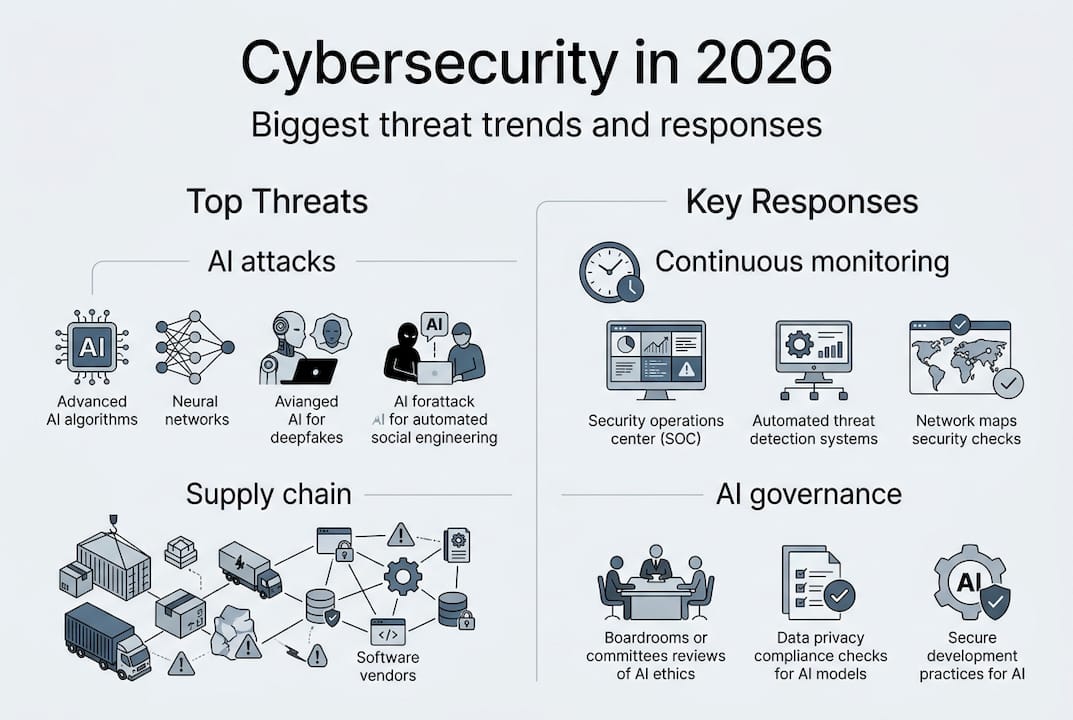
Supply chain compromises have nearly quadrupled since 2020, reflecting how deeply interconnected enterprise ecosystems have become. A single compromised vendor can serve as a gateway into dozens of client environments simultaneously.
| Attack type | Share of incidents | Trend since 2020 |
|---|---|---|
| Vulnerability exploitation | 40% | Sharply rising |
| Access broker handoffs | Growing rapidly | New category |
| Supply chain compromise | Significant share | Nearly 4x increase |
| Phishing and credential theft | Persistent | Stable to rising |
Key threat vectors your security team must prioritize:
- Unpatched public-facing applications with authentication gaps remain the easiest entry point
- Access broker ecosystems where credentials are bought, sold, and handed off in seconds
- Third-party software dependencies that introduce hidden vulnerabilities into your own stack
- Misconfigured cloud environments that expose sensitive data without triggering traditional alerts
Building enterprise cybersecurity best practices around these vectors means shifting from perimeter defense to continuous exposure management. It also means staying current on technology trends for 2026 that directly influence how your attack surface evolves.
Agentic AI, shadow IT, and the rise of unsanctioned tools
AI has changed the game for defenders. It has also changed it for attackers, and for your own employees in ways you may not have fully mapped yet.
Agentic AI refers to AI systems that can take autonomous actions, execute multi-step tasks, and interact with external services without human approval at each step. These tools are increasingly built on no-code platforms, meaning any employee can deploy a capable AI agent with no IT involvement. That is a governance gap hiding in plain sight.
Agentic AI introduces unmanaged attack surfaces through no-code platforms, and Gartner explicitly calls for cross-functional governance to manage both sanctioned and unsanctioned agents. Without that governance layer, your security posture is only as strong as your least informed employee.
The numbers are striking. Across enterprise environments, 57% of employees use personal generative AI tools for work tasks, and 33% upload sensitive organizational data into those tools. That data does not stay in your environment. It trains external models, sits in vendor logs, and potentially surfaces in ways you cannot audit or retrieve.
Shadow IT is not new, but shadow AI is a different scale of risk. Traditional shadow IT meant an employee using an unapproved project management app. Shadow AI means an employee feeding your client contracts, financial models, or internal communications into an external large language model.
Best practices for reducing shadow AI risk:
- Inventory all AI tools in use across departments, not just IT-approved ones
- Classify data sensitivity before any AI integration is allowed to proceed
- Establish an AI acceptable use policy with clear consequences for violations
- Monitor data egress for patterns consistent with bulk uploads to external endpoints
- Train staff regularly on what constitutes sensitive data in an AI context
Pro Tip: Build your AI governance committee with representatives from legal, HR, finance, and operations, not just IT. The tools spreading fastest are in business functions, not engineering teams. Visibility requires presence in those conversations.
For organizations handling regulated data, this is also a compliance issue. Reviewing your data security in AI environments framework now is significantly cheaper than a regulatory investigation later.
Cloud security and third-party risk: A 2026 reality check
Cloud adoption is accelerating, and so is the spending required to secure it. Cloud security is growing at 28.8% in 2026, the fastest segment within the broader security market. That growth reflects both the scale of migration underway and the complexity of securing environments that span multiple providers, regions, and service models.

The shift from on-premises to cloud changes your risk profile in ways that are not always intuitive.
| Security dimension | On-premises | Cloud |
|---|---|---|
| Perimeter control | High, physical boundary | Shared responsibility model |
| Misconfiguration risk | Moderate | High, self-service provisioning |
| Visibility and logging | Centralized | Distributed, requires tooling |
| Patch management | Internal control | Vendor-dependent for managed services |
| Third-party exposure | Limited | Extensive, API and integration heavy |
The third-party dimension deserves particular attention. Third-party compromises have nearly quadrupled since 2020, and cloud environments amplify this risk because of how deeply integrated vendor services have become. A SaaS tool your marketing team adopted without IT review could be the entry point for your next breach.
Steps to strengthen third-party and supply chain security:
- Conduct a full vendor inventory and classify each by data access level and criticality
- Require security questionnaires and SOC 2 reports before onboarding any new vendor
- Implement least-privilege access for all third-party integrations, revoke access immediately on contract end
- Monitor vendor environments for breach notifications and respond with predefined playbooks
- Run tabletop exercises that simulate a supply chain compromise to test your response readiness
Staying ahead of cloud computing trends means understanding not just what cloud enables, but what it exposes. Organizations that treat data security for business as a strategic function rather than a compliance checkbox consistently outperform their peers in breach resilience.
Speed and adaptation: Espionage, dwell time, and organizational response
The most unsettling shift in 2026 is not the sophistication of attacks. It is the speed. Access-broker handoffs now occur in 22 seconds, and the median dwell time across investigated incidents is 14 days. That 14-day window is your entire detection and response budget before attackers have typically achieved their objective.
Espionage-motivated attacks are driving a significant portion of this acceleration. Nation-state and affiliated threat actors are not interested in ransomware paydays. They want persistent, quiet access to intellectual property, strategic plans, and communications. They are patient in planning but fast in execution, which makes them uniquely difficult to catch with signature-based detection alone.
What this means for your organization:
- Behavioral detection must supplement or replace signature-based tools in your SOC
- Threat intelligence feeds need to be operationalized, not just subscribed to
- Incident response playbooks must be tested quarterly, not annually
- Lateral movement detection is critical because initial access is often not where damage occurs
- Privileged account monitoring should be continuous, with anomaly alerts tuned to your environment
Pro Tip: Automate your first-response triage. When an alert fires at 2 a.m., your team should not be manually correlating logs. Automated playbooks that isolate, log, and escalate within minutes can compress your effective response time from hours to under 15 minutes.
Reducing dwell time is one of the highest-return investments a security team can make. Every day you cut from attacker persistence is a day less of potential data exfiltration, lateral movement, and damage.
A leader's perspective: What most trends reports get wrong
Most cybersecurity trends reports do the same thing. They catalog the newest attack techniques, highlight alarming statistics, and implicitly suggest that buying the right tool will solve the problem. We think that framing is part of the problem.
The organizations that consistently recover fastest from incidents are not the ones with the most advanced tooling. They are the ones with the clearest internal communication, the most practiced response teams, and a culture where security is everyone's responsibility, not just IT's. Innovative tech strategies matter, but they amplify a strong foundation. They do not replace one.
Security by design means building controls into systems from the start, not bolting them on after a breach. Staff training that happens once a year is theater. Cross-department collaboration where finance, legal, and operations understand their role in the security posture is what actually moves the needle. The next big threat will always arrive. Your job as a leader is to build an organization that can absorb it, adapt, and keep moving.
Take the next step in cybersecurity strategy
The trends covered in this guide are not future concerns. They are active risks shaping your organization's exposure right now.
At YS Lootah Tech, we work with IT leaders and security teams to translate strategic awareness into practical protection. Our AI and machine learning solutions help you govern AI adoption without blocking innovation. Our secure application development practice builds security into every layer of your digital products. And our cybersecurity experts are ready to help you assess your current posture and build a roadmap that matches your risk profile. Reach out to start the conversation.
Frequently asked questions
What is the biggest cybersecurity threat in 2026?
Vulnerability exploitation is the primary initial access vector in 2026, accounting for 40% of incidents and particularly targeting public-facing applications with missing authentication controls.
How should organizations manage AI-related cybersecurity risks?
Organizations should implement cross-functional AI governance and monitor both sanctioned and unsanctioned tool usage. Agentic AI governance requires visibility across all departments, not just IT, to prevent shadow AI and data exfiltration.
Why has supply chain risk increased so sharply since 2020?
Supply chain compromises have nearly quadrupled due to increased digital interconnectivity, API-heavy cloud environments, and the expanding use of third-party software dependencies across enterprise stacks.
What is the average dwell time for attackers in 2026?
The median dwell time is 14 days, with access-broker handoffs occurring in as little as 22 seconds, leaving organizations a narrow window for detection and containment.