Prove Master Data Management in 90 to 120 days for IT and business

Master data management (MDM) creates and maintains a single, trusted view of your core business data so every system and team works from the same authoritative records. The measurable payoff is fewer duplicate customer files, cleaner analytics, and audit-ready data. Frameworks like the Gartner MDM Maturity Model, the ISO/IEC 5259-3 quality standard, and disciplined governance turn that outcome from an IT project into a business capability. We work with companies building data management foundations.
TL;DR:
- Most organizations should start with a single domain, like customer or product data, and limit initial scope to keep complexity manageable.
- Automation in profiling and monitoring is essential to prevent drift and catch issues early as the volume of master data grows.
- Clear ownership, executive sponsorship, and well-defined governance policies are crucial for preventing common MDM program failures.
- Before scaling, organizations need to run a pilot that achieves specific, measurable goals, such as reducing duplicate rates by a targeted percentage within 90 days.
- Security measures like role-based access control and compliance monitoring are vital to protect sensitive master data in centralized MDM implementations.
Table of Contents
- What Is Master Data Management in an Enterprise Context?
- What Are Examples of Master Data Domains?
- Why Does Master Data Management Matter for the Business?
- What Are the Four Types of MDM Implementation?
- How Does the MDM Lifecycle Actually Work?
- Who Owns Data Governance and Stewardship in MDM?
- What Causes MDM Programs to Fail, and How Do You Avoid It?
- How Do You Measure MDM Success and Maturity?
- What Does a Realistic MDM Implementation Roadmap Look Like?
- How Does a Partner Like Yslootahtech Support MDM Programs?
- What Security and Privacy Issues Come Up in MDM?
- What Tools and Technologies Support MDM?
- How Should Organizations Manage Change During MDM Rollout?
- Practitioner Lessons: What Actually Moves the Needle
- Ready to Build Your MDM Foundation?
- Sources
- FAQ
What Is Master Data Management in an Enterprise Context?
Master data management is a discipline, not a single piece of software. It combines policy, defined roles, and technology to make sure a company's most important reference data, the records everyone depends on, stays accurate, consistent, and traceable to one source of truth.
That distinction matters because most organizations already have a dozen systems that each think they own the truth. Your ERP has a customer list. Your CRM has a different one. Your billing platform has a third. None of them talk to each other, and none of them are wrong exactly, they're just out of sync. MDM does not replace ERP, CRM, or data lakes. It sits alongside them, pulling records together into what practitioners call a golden record, a canonical, deduplicated version of an entity (a customer, a product, a supplier) that other systems reference through a shared identifier.
According to SAP's explainer on MDM, the practice follows a defined lifecycle: collect, standardize, match and merge, approve, publish, and monitor. That lifecycle is what separates MDM from a one-time data cleanup project.
A few things MDM is responsible for, in plain terms:
- Assigning a canonical identifier to each master entity so systems can reference it consistently
- Reconciling conflicting attribute values (which address is current, which name is correct)
- Publishing the approved, "golden" version back to connected systems
- Tracking lineage so anyone can trace a data point back to its source
What Are Examples of Master Data Domains?
Not every piece of data qualifies as master data. Transactional records (an individual order, a single invoice line) change constantly and don't need golden-record treatment. Master data describes the stable entities that transactions reference again and again.
The domains most organizations manage first:
- Customer: name, billing address, tax ID, contact hierarchy, used across sales, billing, and support
- Product: SKU, specifications, pricing tier, category, used across e-commerce, inventory, and marketing
- Supplier: legal entity name, payment terms, certifications, used across procurement and finance
- Location: site codes, addresses, geocoordinates, used across logistics and facilities management
- Asset: serial numbers, maintenance history, depreciation schedule, used across operations and finance
- Chart of accounts: general ledger codes and cost centers, used across every financial system in the company
A retail chain and a hospital network will prioritize wildly different domains. The retailer probably cares most about product and location data because that drives inventory accuracy. The hospital cares more about provider and patient-adjacent master data because that drives compliance and care coordination. Picking the wrong domain first is one of the more common reasons an MDM initiative loses momentum before it proves anything.
Why Does Master Data Management Matter for the Business?
The business case for MDM isn't abstract. It shows up in specific, trackable numbers. When customer records get reconciled into a single source, service teams stop pulling up three different versions of the same account. When product data is standardized, e-commerce catalogs stop showing conflicting prices across channels.
Pro Tip: Track your duplicate rate before you start any MDM initiative. It's the single easiest number to show executives later as proof the program worked.
Organizations typically watch a handful of KPIs to gauge whether MDM is paying off:
- Duplicate rate: the percentage of records identified as redundant across systems
- Data quality score: a composite measure of accuracy, completeness, consistency, and timeliness
- Time to reconcile: how long it takes to resolve a conflicting record across systems
- Adoption rate: how many downstream systems actually consume the golden record instead of maintaining their own copy
Beyond the numbers, MDM improves trust in analytics and AI outputs. If a machine learning model is trained on customer data riddled with duplicates and inconsistent formatting, its predictions inherit those flaws. ISO/IEC 5259-3 frames this directly: a formal data quality management system makes the inputs to analytics and ML auditable and repeatable, which is what lets a business actually trust the output. A finance team that spends two days a month manually reconciling vendor records, for instance, often finds that time collapses to hours once matching and publishing are automated.
What Are the Four Types of MDM Implementation?
Choosing an MDM approach is really a decision about how much control you want versus how fast you need results. The four recognized models trade off against each other in predictable ways.
- Registry style: MDM holds only pointers and match keys, not the full record; source systems keep ownership. Fast to deploy, minimal disruption, but the "golden record" is really just a cross-reference, so it offers limited authority over conflicting data.
- Consolidation style: Data is pulled from source systems into a central hub for reporting and analytics, but the hub doesn't push changes back. Good for building a trusted analytical view quickly, but source systems remain independently editable, so drift creeps back in.
- Coexistence style: The hub both consolidates data and pushes updates back to source systems, though source systems can still edit locally between syncs. This is the common middle ground for mid-size and large enterprises that need real synchronization without a full architectural overhaul.
- Centralized style: The MDM hub becomes the system of record; source systems consume from it rather than maintaining their own master copies. Highest control and lowest long-term drift risk, but it demands the most upfront integration work and organizational buy-in.
Registry and consolidation styles suit organizations that need a quick win or a reporting layer, particularly during a pilot phase. Coexistence and centralized styles suit organizations ready to commit to publishing workflows and stricter governance. The operational implication is straightforward: the more centralized the model, the more your source systems have to change how they write data, not just how they read it.
How Does the MDM Lifecycle Actually Work?
The lifecycle SAP outlines, collect through monitor, maps to specific technical building blocks most implementation teams will recognize.
- Discovery and profiling: Automated profiling tools scan source systems to inventory fields, formats, and quality issues before anything gets touched.
- Standardization and cleansing: Records get normalized, addresses formatted consistently, names cased correctly, codes mapped to a shared taxonomy.
- Matching and merge: A matching engine compares records across systems using rules or probabilistic scoring to identify likely duplicates.
- Approval workflows: A workflow engine routes ambiguous matches to a human data steward for a decision rather than auto-merging blind.
- Publishing and synchronization: Approved golden records get pushed out through APIs to connected systems, often coordinated through a data catalog that tracks what's published where.
- Monitoring: Automated checks watch for schema drift, new duplicates, and rule violations on an ongoing basis rather than waiting for the next cleanup project.
Pro Tip: Validate your matching rules on a small, representative sample before turning them loose on the full dataset. Fivetran's guidance on data quality management makes the point well: start with conservative match thresholds that avoid false merges, then relax them gradually as governance maturity improves. A single aggressive rule can silently merge two different customers into one record, and untangling that after the fact is far harder than preventing it.
Who Owns Data Governance and Stewardship in MDM?
MDM software alone doesn't sustain trusted data. Governance is what keeps the golden record golden after the initial cleanup project ends. Without clear ownership, quality drifts back to where it started within a year, sometimes faster.
Governance in an MDM program typically defines:
- Policies and standards: rules for what counts as a valid address, an acceptable product code, a complete customer record
- Approval workflows: who signs off on merges, deletions, and attribute changes before they publish
- Data owners: business leaders accountable for a domain's accuracy (a VP of Sales owning customer data, for example)
- Data stewards: the people doing day-to-day quality checks, resolving matching exceptions, and enforcing standards
- Data custodians: IT staff responsible for the technical systems that store and move the data
- Escalation paths: a defined route for disputes, like two regional teams disagreeing on which supplier record is correct
The OECD's work on data governance makes a broader point that applies just as well inside a single company: governance only works when stakeholder engagement and clear accountability are built in from the start, not layered on after problems surface. Access control matters here too. Not every steward should have merge authority, and not every system should write directly to the golden record. A structured governance framework usually pairs each role with explicit permission boundaries.
What Causes MDM Programs to Fail, and How Do You Avoid It?
Most MDM failures aren't technology failures. They're organizational ones. Gartner's research is blunt about this: MDM is a sociotechnical effort, and programs that treat it as a pure software rollout tend to stall regardless of how good the matching engine is.
The recurring failure patterns:
- Missing executive sponsorship: without a senior leader accountable for outcomes, the program loses funding priority the moment budgets tighten.
- Unclear ownership: when two departments both believe they own "the customer," conflicts never get resolved, they just accumulate.
- Change fatigue: rolling out new data entry standards to hundreds of users without training breeds workarounds that quietly reintroduce bad data.
- Overmatching: overly aggressive matching rules merge distinct records, creating a mess that's harder to fix than the original duplicates.
- Scale limits and drift: rules tuned for 50,000 records often behave differently at 5 million, and nobody notices until reports start looking wrong.
Pro Tip: Run your matching rules against last quarter's real data before go-live, not a clean synthetic test set. Production data always has the edge cases synthetic data doesn't.
The mitigations that experienced teams rely on are unglamorous but effective: start with one domain, secure a named executive sponsor before writing a project charter, assign ownership in writing, and build automated monitoring so drift gets caught in days rather than discovered during next year's audit.
How Do You Measure MDM Success and Maturity?
Measuring MDM success requires both a snapshot (are the numbers good right now) and a trajectory (are we more capable than we were six months ago). The KPIs from earlier, duplicate rate, data quality score, publish latency, and adoption, cover the snapshot. Gartner's maturity model covers the trajectory.
| Maturity level | What it looks like | Typical focus |
|---|---|---|
| Initial | Ad hoc fixes, no formal ownership | Firefighting data issues as they appear |
| Developing | Basic standards exist, inconsistently applied | Building initial data quality rules |
| Defined | Documented policies and workflows in place | Formalizing governance and steward roles |
| Managed | Metrics tracked, monitoring automated | Measuring quality and reducing drift |
| Optimizing | Continuous improvement embedded in operations | Refining rules as business needs evolve |
A team stuck at "Initial" shouldn't be setting KPI targets that assume "Managed" capabilities, like sub-hour publish latency. Match your reporting cadence to your maturity level too: monthly quality scorecards make sense once you're past "Defined," but weekly firefighting reviews are more honest at "Initial" or "Developing."
What Does a Realistic MDM Implementation Roadmap Look Like?
Gartner's own guidance frames the roadmap as assess, formulate vision, build roadmap, pilot, then scale. In practice that breaks down into concrete phases most teams can start within a quarter.
- Assess current maturity and scope: Run a data quality audit on candidate domains and map which systems currently claim ownership of overlapping data.
- Define the vision and business case: Tie the initiative to a specific, measurable outcome, like cutting customer service escalations tied to bad account data.
- Prioritize one domain: Pick the domain with the clearest business pain and the smallest number of source systems, customer data is the common starting point.
- Pilot with defined success criteria: Set a target duplicate reduction and a deadline, typically 90 to 120 days, and treat the pilot as a real deliverable, not a proof of concept nobody reviews.
- Iterate and expand governance: Formalize steward roles and approval workflows based on what the pilot revealed about where conflicts actually occur.
- Scale to additional domains: Apply the lessons from the pilot's matching rules and workflows to product, supplier, or asset data next.
- Embed operations: Move from project mode to standing operations, with monitoring dashboards and a recurring rules review cadence.
Each phase should produce a tangible deliverable: an audit report, a signed business case, a pilot scorecard, a governance charter, and a monitoring dashboard. Skipping the deliverable is usually how a phase quietly never finishes.
How Does a Partner Like Yslootahtech Support MDM Programs?
A technology partner may support the technical side of MDM programs, including application development for publishing APIs, enterprise integration between ERP and CRM systems, and data protection controls for access management. Many companies build governance policy in-house, since that requires deep institutional knowledge, but bring in a partner for integration engineering and pilot delivery.
A typical engagement starts with a discovery session to map current systems, followed by a scoping workshop, then a focused pilot on one domain. For more on how governance and analytics connect to these outcomes, see Yslootahtech's work on digital optimization for business leaders and data analytics impact.
What Security and Privacy Issues Come Up in MDM?
Master data often includes some of the most sensitive information a company holds: customer contact details, tax identifiers, payment terms, sometimes health or financial attributes depending on the domain. Centralizing that data into a golden record concentrates risk right alongside the benefit. A breach of a well-consolidated customer master touches every downstream system at once, not just one silo.
Access control has to scale with centralization. In a registry-style deployment, exposure is limited because the hub only holds pointers. In a centralized deployment, the hub holds the actual data, which means every integration point becomes a potential attack surface if it isn't locked down. Role-based access, so a marketing analyst can read customer segments but not edit tax IDs, is standard practice, not an optional layer.
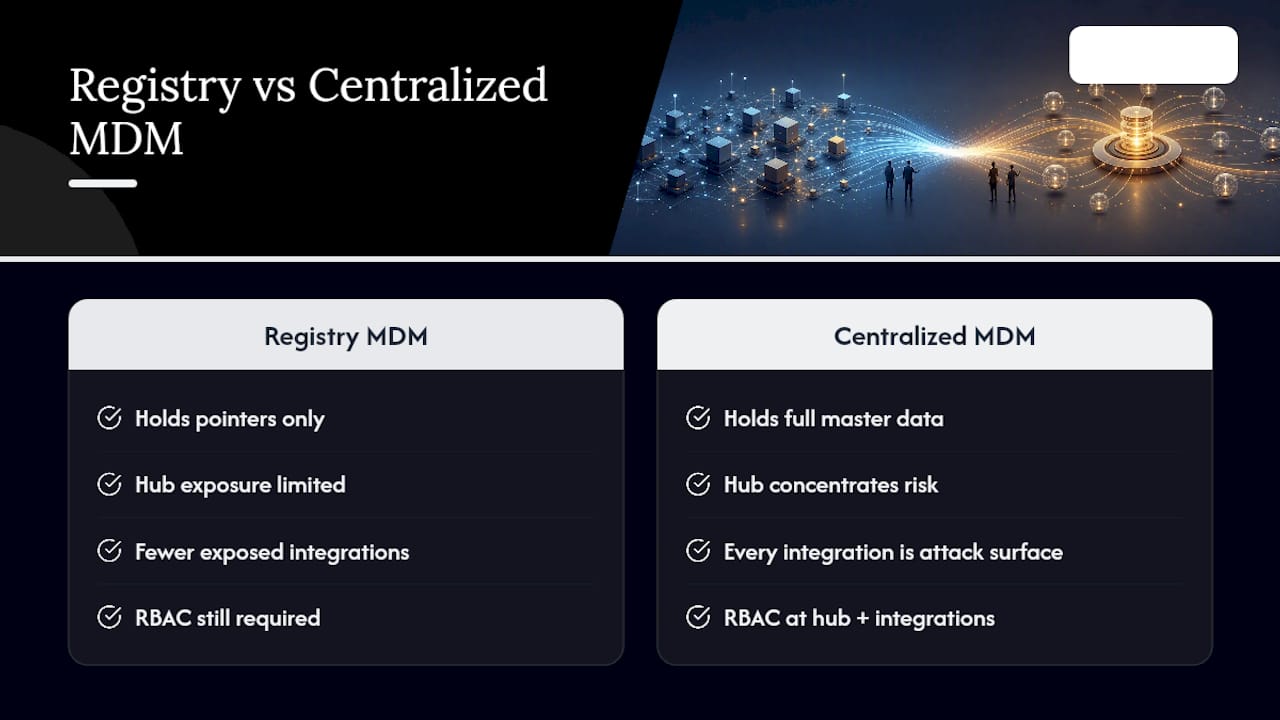
Privacy regulations add another dimension. Consent status, data retention limits, and right-to-erasure requests all have to be tracked at the master record level, because deleting a record from one system while it survives in three others defeats the purpose of "right to be forgotten." Encryption in transit and at rest, audit logging of who accessed or modified a golden record, and clear data retention schedules are baseline requirements for any MDM platform handling personal data. Yslootahtech's data protection service addresses exactly this layer, securing the access and publishing points that sit around the master data hub.
What Tools and Technologies Support MDM?
MDM technology breaks down into a handful of functional categories rather than a single product type, and most enterprise deployments combine several.
Profiling tools scan source systems to surface format inconsistencies, missing values, and outliers before any cleansing begins. Matching engines apply deterministic rules or probabilistic scoring to identify likely duplicate records across systems, the component most responsible for getting the golden record right. Workflow engines route ambiguous matches and approval decisions to human stewards, keeping automation from running unchecked. Data catalogs track lineage and metadata so teams know where a given attribute originated and where it's published. APIs and integration layers handle the actual publishing of golden records back to ERP, CRM, and analytics systems in something close to real time.
Fivetran's guidance on data quality tooling makes a strong case for automating profiling and monitoring rather than relying on periodic manual audits: automated pipelines catch schema drift and rule violations as they happen instead of during the next scheduled review, which is usually months too late. The trend across these categories is the same one reshaping most enterprise software: less manual reconciliation, more continuous, rules-based checking running quietly in the background.
How Should Organizations Manage Change During MDM Rollout?
The technology side of MDM is often the easier half. The harder half is getting hundreds or thousands of employees to change how they enter, edit, and reference data every single day.
Change management for MDM starts with communicating why the change matters in terms specific to each team, not a company-wide memo about "data quality initiatives." A sales rep cares that duplicate customer records mean commission disputes get resolved slower, not that the duplicate rate improved by some percentage on a dashboard nobody on the sales floor sees. Training has to cover the new entry standards concretely: what an acceptable address format looks like, when to flag a record for review rather than create a new one, who to contact when something looks wrong.
Resistance usually shows up as workarounds, a team quietly maintaining its own spreadsheet because the new system feels slower. The fix isn't more mandates, it's finding out what the spreadsheet does that the new process doesn't, and closing that gap. Organizational impact also extends to job roles: data steward is frequently a new, formally defined responsibility layered onto someone's existing job, and it needs real time allocation and management recognition, not just a title. Programs that survive past year one almost always paired the technical rollout with a named change lead whose job was tracking adoption, not just system uptime.
Practitioner Lessons: What Actually Moves the Needle
Two lessons hold up across most MDM programs. First, governance has to map to a business outcome someone in the C-suite actually cares about, not just "cleaner data." Second, start with one measurable domain and prove it before touching a second. If you're planning your next step, run a maturity assessment against Gartner's five levels before writing a single requirement.
— YS
Ready to Build Your MDM Foundation?
Specialist digital partners can offer a faster path to a working pilot than building an internal integration team from scratch, particularly when data spans ERP, CRM, and legacy systems that were not originally designed to interoperate. Instead of spending months hiring specialized integration engineers, you get a team that has already built publishing APIs, matching workflows, and access controls for other enterprise clients.
A typical engagement starts with a discovery workshop to map your current systems and pick the domain most worth piloting first, often customer data. From there, Yslootahtech's application development team builds the integration and publishing layer, while UX/UI design work ensures the systems consuming your golden records actually deliver a better experience to the people using them. If your rollout touches customer-facing platforms, website development support keeps front-end systems synchronized with the new master records. Reach out to scope a discovery session and get a concrete pilot plan for your highest-priority domain.
Sources
- Master Data Management: Definition, Process, Framework and Template — Gartner
- ISO/IEC 5259-3 — Data quality management for analytics and machine learning — ISO
- What is master data management (MDM) — SAP Resources
- Data quality management: Framework, process & tools — Fivetran
FAQ
What Does Master Data Management Do?
MDM identifies, consolidates, and maintains one authoritative version of core business records, like customers, products, and suppliers, so every connected system references the same accurate data instead of conflicting copies.
What Is an Example of MDM?
A common example is a retailer consolidating customer records scattered across e-commerce, loyalty, and support systems into one golden customer record, then publishing that record back to each system through APIs.
What Is MDM in SAP?
SAP frames MDM as a lifecycle process, collect, standardize, match and merge, approve, publish, and monitor, that its master data governance tools support within an SAP-centered enterprise environment, though the same lifecycle applies regardless of vendor.
What Are the Four Types of MDM?
The four recognized approaches are registry (pointers only), consolidation (central reporting hub), coexistence (two-way sync with source systems), and centralized (single system of record), each trading off control against integration effort.
How Do You Start an MDM Program Without a Big Budget?
Start by assessing your current maturity against a framework like the Gartner MDM Maturity Model, then pilot one high-impact domain, usually customer data, before requesting funding for a broader rollout.