90 Day Hybrid Change Management Framework for Data Driven Digital Leaders

The most effective approach isn't picking one framework off a shelf. It's a hybrid: pair ADKAR's individual-adoption diagnostics with a phased organizational process, add leadership influence levers and iterate using real adoption data instead of a one-time rollout plan. Know ADKAR, Kotter, McKinsey's influence model, Lewin, Prosci's 3-Phase Process, and AWS Change Acceleration well enough to borrow from each. The rest of this article shows you how to choose and combine them.
TL;DR:
- Combining ADKAR's individual diagnostics with a phased organizational approach addresses both personal resistance and systemic coordination issues.
- For small teams, a lightweight ADKAR-based plan suffices, while large-scale transformations benefit from structured models like Prosci or AWS frameworks.
- It is critical to assess the initiative's scale, stakeholder map, and risk tolerance before selecting and applying the most suitable change management framework.
- Operational gaps such as delayed training, poor system integration, and lack of real-time adoption tracking cause most digital change failures.
- Running short, data-driven adoption sprints with live KPIs ensures ongoing engagement and allows for timely course correction.
Table of Contents
- What Is a Change Management Framework?
- How Do These Frameworks Compare on the Factors That Matter?
- How Do You Choose and Apply the Right Framework?
- Why Do So Many Digital Change Efforts Stall?
- Why Hybrid Beats Dogma
- Where to Go Deeper
- Sources
- FAQ
What Is a Change Management Framework?
A change management framework is a structured method for moving people and systems from a current state to a new one without breaking productivity, morale, or trust along the way. Every credible framework does three things: prepares the organization before a change lands, equips people during the transition, and sustains the new behavior after go-live. Skip any one of those three and the change tends to reverse itself within months.
Here's a quick reference to the models you'll encounter most often:
- ADKAR (Prosci): Focuses on individual adoption through five building blocks (Awareness, Desire, Knowledge, Ability, Reinforcement).
- Prosci 3-Phase Process: An organizational layer that runs Prepare Approach, Manage Change, and Sustain Outcomes, often paired with the PCT (Project, Change, Team) model.
- Kotter's 8-Step Model: Builds urgency and momentum through eight sequential leadership actions, from creating a sense of urgency to anchoring change in culture.
- McKinsey influence model: Identifies four levers leaders can pull: role modeling, fostering understanding, developing talent, and reinforcing with formal mechanisms.
- Lewin's change model: The classic three-stage sequence, unfreeze, change, refreeze, that underlies most modern frameworks.
- AWS Change Acceleration: A six-point structure built for cloud and digital adoption, from mobilizing the team to making the change stick.
Each framework answers the same core question. They just answer it at different altitudes.
How Do These Frameworks Compare on the Factors That Matter?
Picking a framework isn't about which one is "best." It's about matching the tool to the scale, risk, and pace of your specific initiative. Here's how the major models stack up on the dimensions that actually drive a decision.
| Framework | Best for | Focus level | Speed vs. adaptability | Leadership involvement | Measurement approach |
|---|---|---|---|---|---|
| ADKAR | Individual behavior change tied to a specific rollout | Individual | Linear, but reusable per person | Moderate, sponsors coach individuals | Barrier-point diagnostics per employee |
| Prosci 3-Phase / PCT | Mid-to-large projects needing structure and a change team | Organizational | Linear, phase-gated | High, integrates with project management | Adoption and usage metrics tied to milestones |
| Kotter's 8-Step | Culture shifts and large-scale transformations | Organizational | Linear, sequential momentum | Very high, executive-led | Progress against each of the eight stages |
| McKinsey influence model | Situations where behavior won't shift through logic alone | Individual and organizational | Iterative, levers can be adjusted mid-stream | High, leaders model behavior directly | Perception surveys and behavior tracking |
| Lewin's model | Small, well-defined changes with a clear end state | Organizational | Linear, rigid | Moderate | Before/after state comparison |
| AWS Change Acceleration | Cloud migrations and digital transformation programs | Organizational, with individual capacity building | Iterative, sprint-friendly | High, sponsor and team alignment built in | Real-time adoption and capability metrics |
A few practical patterns fall out of that table. A single-team software rollout usually calls for ADKAR layered under a lightweight communications plan, nothing heavier. An enterprise-wide digital transformation, migrating core systems to the cloud, replacing legacy platforms, needs Prosci's phased structure or AWS's six points because the coordination problem is bigger than any one person's adoption curve. And whenever resistance is emotional rather than logical, department heads protecting turf, teams distrusting leadership, the McKinsey influence model earns its place because it targets behavior directly instead of just communicating the plan better.
How Do You Choose and Apply the Right Framework?
Most managers over-invest in picking the "right" framework and under-invest in applying it well. Here's a sequence that fixes that.
- Assess scale and risk first. A process tweak in one department needs a different weight of framework than a company-wide ERP replacement. Match the framework's complexity to the initiative's complexity, not the other way around.
- Map your stakeholders. Identify who has to change behavior, who has to sponsor the change publicly, and who can quietly kill it. This map tells you whether you need Kotter's momentum tactics or a lighter ADKAR-only approach.
- Set your timeline against your risk tolerance. Fast-moving digital rollouts favor AWS's sprint-friendly structure; slower, high-stakes organizational shifts favor Prosci's phase gates.
- Identify capability gaps early. Training needs, system access issues, and skill shortages surface here, before they become adoption blockers.
- Define what you'll measure before launch. Adoption rate, proficiency, and reinforcement metrics need a baseline, or you won't know if the change actually landed.
- Build your early artifacts. A sponsor activation plan, a communications plan, a training plan, and a reinforcement plan, in that order.
The hybrid recipe in practice: use ADKAR to diagnose where individuals are stuck, wrap it in a phased organizational plan (Prosci or AWS depending on whether the driver is a general initiative or a cloud/digital program), and pull McKinsey's influence levers wherever resistance is emotional rather than informational.
Pro Tip: Ask your executive sponsor one question before kickoff: "What does success look like in 90 days, and what happens if we don't hit it?" The answer tells you whether you're managing a project or managing a career risk, and that changes how hard you push on reinforcement.
Why Do So Many Digital Change Efforts Stall?
Digital transformation rarely fails at the communication stage. It fails at execution, fragmented systems that don't talk to each other, identity and access provisioning that lags the rollout schedule, and training that arrives after people are already expected to use the new tool. Moveworks' research on digital change points to these operational gaps, not awareness gaps, as the primary failure mode.
Prosci's own data underscores the stakes: organizations without a standardized change management approach see far lower rates of meeting project objectives than those with one.
The AWS six-point framework maps cleanly onto this problem because each point produces a concrete artifact: mobilizing the team yields a governance charter, aligning leaders yields a sponsor activation plan, enabling capacity yields role-based access readiness, and making it stick yields reinforcement metrics tied to business-as-usual operations.
For IT, HR, and project teams working together, the practical checklist looks like this:
- Run a readiness assessment before go-live, not after issues surface.
- Build a cross-functional playbook so IT, HR, and business owners aren't solving the same problem in isolation.
- Track adoption in near real time rather than waiting for a post-launch survey.
- Keep a support flow open past launch day. Reinforcement is where most frameworks quietly get skipped.
Yslootahtech's own guidance on cloud migration strategy and step-by-step cloud migration walks through these readiness and capacity-building steps in more operational detail.
Why Hybrid Beats Dogma
Treating any single framework as gospel is the fastest way to under-serve a complex change. ADKAR alone misses the organizational coordination problem. Kotter alone can generate urgency without giving individuals a path through their own resistance. The practical habit that separates leaders who sustain change from those who watch it fade: run short adoption sprints, two to four weeks, with live KPIs and a standing sponsor touchpoint, rather than a single big-bang launch followed by silence. That rhythm catches stalled adoption while there's still time to fix it, a discipline that mirrors how data-driven iteration improves outcomes in other operational contexts too.
— YS
Where to Go Deeper
For primary sources behind this article, see Prosci's digital transformation change management guidance, AWS's prescriptive guidance on change acceleration, the peer-reviewed synthesis Change Management: From Theory to Practice, and the ISO standard for organizational change management.
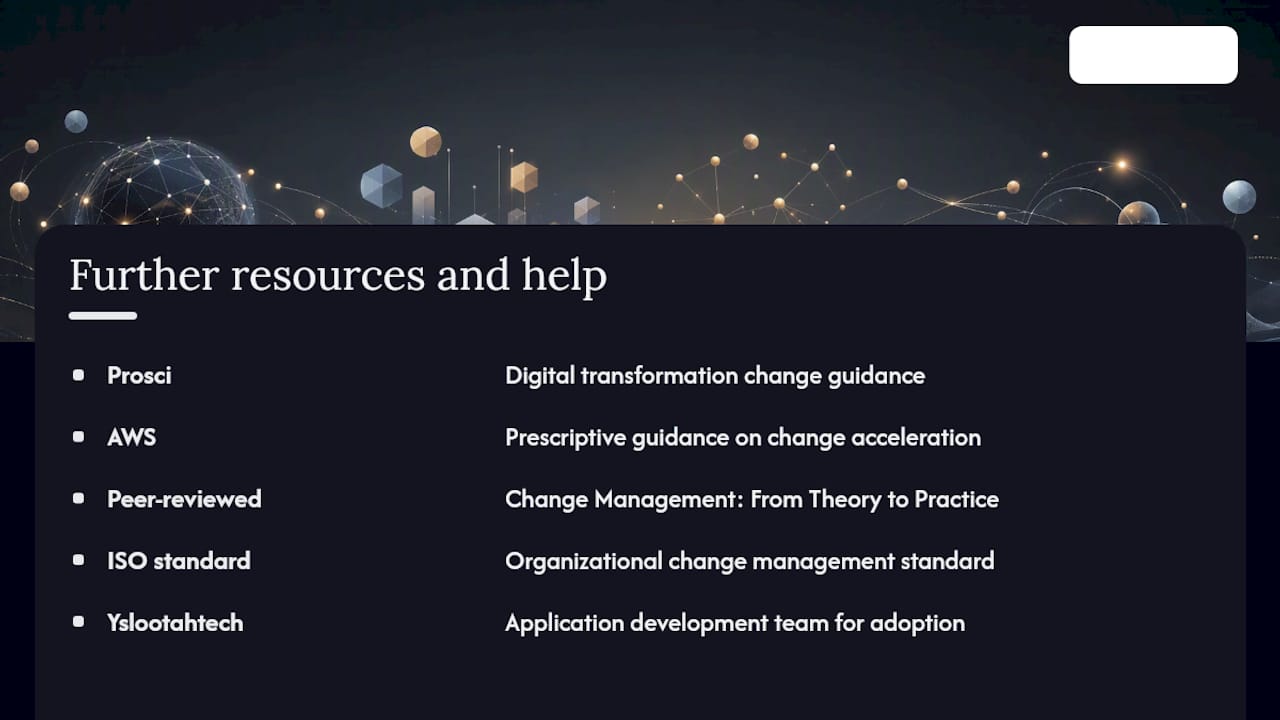
If your change initiative involves new user-facing workflows or custom tooling to reduce execution friction, Yslootahtech's application development team builds the systems that make adoption easier rather than harder.
Sources
- AWS prescriptive guidance: Change acceleration and organizational change management
- Change Management: From Theory to Practice — PMC
- ISO standard for organizational change management (OCM)
FAQ
What Are Change Management Frameworks?
They're structured methods for preparing, equipping, and sustaining people through organizational change, ranging from individual-focused models like ADKAR to organization-wide processes like Kotter's 8-Step Model or AWS Change Acceleration.
What Are the 7 C's of Managing Change?
Definitions of the "C's" vary across sources and aren't part of a single recognized framework like ADKAR or Kotter, so treat any list you find as a mnemonic rather than an established standard.
What Are the 5 Phases of Change Management?
Most frameworks compress into five practical phases: assess readiness, prepare the approach, manage the transition, reinforce adoption, and sustain the outcome, closely mirroring Prosci's 3-Phase Process.
What Is the McKinsey Framework for Change Management?
McKinsey's influence model identifies four levers leaders use to shift behavior: role modeling the change, fostering genuine understanding and conviction, developing talent and skills, and reinforcing change through formal structures and incentives.