Unlock the role of advanced analytics for business success

TL;DR:
- Advanced analytics provides forward-looking insights that drive proactive decision-making.
- Successful adoption depends on strong data foundations, skilled talent, and clear strategic goals.
- Human judgment remains essential to interpret models and make high-stakes decisions effectively.
Most organizations believe they are data-driven. They have dashboards, weekly reports, and spreadsheets full of numbers. Yet a striking number of these same companies still react to problems after they happen, miss market shifts, and struggle to justify technology investments. The gap is not a lack of data. It is a lack of advanced analytics. Basic reporting tells you what happened. Advanced analytics tells you what will happen and, more importantly, what you should do about it. For business leaders who want to move from reactive to proactive decision-making, understanding this distinction is not optional. It is the foundation of every meaningful digital transformation effort.
Table of Contents
- What is advanced analytics?
- Why advanced analytics matters for business leaders
- Key challenges and risks in implementation
- Applying advanced analytics: Steps to implementation
- The uncomfortable truth: Analytics isn't a silver bullet
- Ready to drive business transformation with advanced analytics?
- Frequently asked questions
Key Takeaways
| Point | Details |
|---|---|
| Advanced analytics defined | It enables predictive and prescriptive insights using sophisticated data methods for greater business value. |
| Strategic advantage | Organizations that prioritize analytics maturity gain efficiency and competitive edge. |
| Overcoming barriers | Success relies on data quality, talent, and balancing technology with human judgment. |
| Practical implementation | Start with strong data foundations, pilot use cases, and measure ROI by decision impact. |
What is advanced analytics?
Most people use the term "analytics" to mean charts, pivot tables, and monthly performance summaries. That is descriptive analytics, and while it has value, it only looks backward. Advanced analytics is a fundamentally different discipline. It uses statistical algorithms, machine learning, and computational methods to generate forward-looking insights that drive action.
Advanced analytics encompasses predictive modeling, machine learning, prescriptive analytics, data mining, sentiment analysis, regression analysis, clustering, and real-time processing to enable predictive and prescriptive insights beyond descriptive reporting. Gartner's definition reinforces this, framing it as the autonomous or semi-autonomous examination of data to discover deeper insights, make predictions, and generate recommendations.
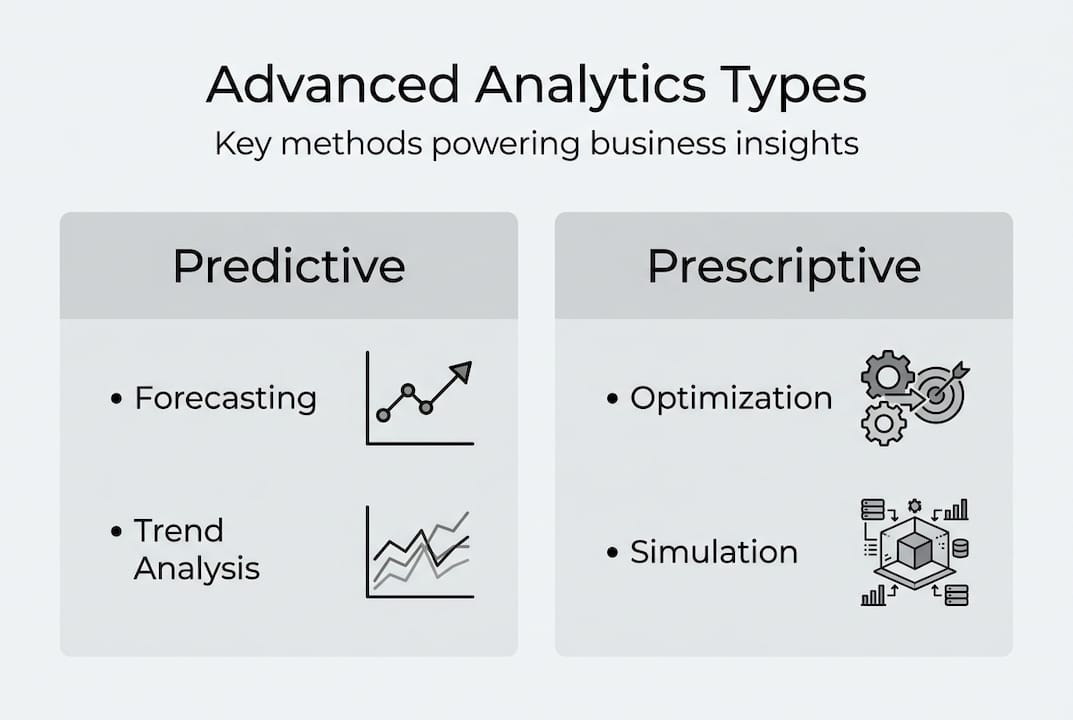
Here is a quick breakdown of the core techniques and where they apply:
| Technique | What it does | Business use case |
|---|---|---|
| Predictive modeling | Forecasts future outcomes based on historical patterns | Demand forecasting, churn prediction |
| Machine learning | Identifies patterns without explicit programming | Fraud detection, personalization |
| Prescriptive analytics | Recommends optimal actions | Supply chain optimization, pricing |
| Sentiment analysis | Interprets human language and emotion | Brand monitoring, customer feedback |
| Real-time processing | Analyzes data as it is generated | Operational alerts, live risk scoring |
| Data mining | Discovers hidden patterns in large datasets | Market segmentation, product bundling |
What separates advanced analytics from standard reporting is not just the technology. It is the intent. Standard reporting answers "What happened?" Advanced analytics answers "What will happen?" and "What should we do?" That shift in question changes everything about how leaders make decisions.
For organizations exploring the big data analytics advantages that come with scaling these capabilities, the entry point is always the same: clarity on which techniques match which business problems.
- Predictive analytics is best when you need to anticipate customer behavior or market demand
- Prescriptive analytics is most powerful when you need to optimize complex operational decisions
- Machine learning excels when patterns are too complex for rule-based systems to capture
- Real-time processing is essential when delays in insight mean direct financial or operational loss
Choosing the right technique for the right problem is a strategic decision, not a technical one.
Why advanced analytics matters for business leaders
Once you understand what advanced analytics is, you will want to see the advantages it brings to modern organizations. The business case is not theoretical. Leaders who have moved beyond descriptive reporting consistently report measurable gains in efficiency, risk management, and revenue growth.
Organizations that prioritize analytics maturity from descriptive to prescriptive and AI-enabled stages see sustainable efficiency gains and stronger ROI when they measure decision impact rather than raw data accuracy. That last point is critical. ROI in analytics is not about how much data you collect. It is about how much better your decisions become.
Here are the top business outcomes leaders can expect:
- Predictive customer insights. Know which customers are likely to churn, upgrade, or buy before they act. This transforms marketing from reactive campaigns to proactive engagement.
- Process automation. Machine learning models can automate repetitive decisions at scale, freeing your teams for higher-value work.
- Risk management. Real-time anomaly detection and predictive risk scoring reduce exposure before incidents escalate.
- New product innovation. Data mining and clustering reveal unmet customer needs that traditional market research often misses.
- Competitive intelligence. Sentiment analysis and external data feeds give you a live read on market dynamics and competitor positioning.
The business impact with analytics is most visible when leaders connect analytics outputs directly to operational decisions, not just executive dashboards. And for organizations building broader innovative tech strategies, advanced analytics is often the engine that makes those strategies executable.
Pro Tip: Stop measuring your analytics program by the number of dashboards produced. Measure it by the number of decisions that changed because of an insight. That shift in measurement will immediately reveal which analytics investments are actually delivering value.
Key challenges and risks in implementation
The upsides are clear, but leaders must also be aware of practical risks and pitfalls. Advanced analytics is not plug-and-play. Organizations that rush into complex models without addressing foundational issues consistently underperform or fail outright.
The most common challenges include:
- Data quality. Garbage in, garbage out. Models trained on incomplete or inconsistent data produce unreliable outputs.
- Data silos. When customer, operational, and financial data live in separate systems, building unified models is extremely difficult.
- Legacy systems. Older infrastructure often cannot support the data pipelines that advanced analytics requires.
- Skills gaps. Most organizations lack the data scientists, ML engineers, and analytics translators needed to execute effectively.
- Model bias. Algorithms trained on biased historical data will replicate and amplify those biases in their predictions.
- Interpretability. Many powerful models are black boxes. Leaders cannot explain their outputs, which creates trust and compliance issues.
Models fail on distribution shifts and adversarial inputs, require human oversight for high-stakes decisions, and face challenges including data quality, silos, skills gaps, bias amplification, and interpretability. Meanwhile, poor data quality and legacy systems limit the effectiveness of even the most sophisticated analytics and AI implementations.
"The most dangerous analytics failure is not a model that crashes. It is a model that confidently produces wrong answers, and no one in the organization has the context to question it."
This is why the AI role in transformation must always be paired with human judgment. Technology sets the direction. People validate it.
Pro Tip: Before you invest in any advanced model or analytics platform, run a data quality audit. Identify where your data is incomplete, duplicated, or inconsistent. Fixing these issues first will multiply the value of every analytics investment you make afterward.
Applying advanced analytics: Steps to implementation
With challenges mapped out, here is how to approach implementation strategically. The goal is not to boil the ocean. It is to build momentum through structured, measurable progress.
- Conduct a data audit. Map every data source in your organization. Identify gaps, quality issues, and integration barriers before touching any analytics tool.
- Build data foundations. Invest in data governance, a unified data platform, and clean pipelines. This step is non-negotiable.
- Upskill your talent. Train existing staff and hire strategically. Analytics translators who bridge technical and business thinking are especially valuable.
- Pilot focused use cases. Choose two or three high-impact, well-scoped problems where advanced analytics can deliver measurable results within 90 days.
- Measure decision impact. Track how insights change actual decisions, not just how many reports are generated.
- Scale what works. Use pilot results to build internal credibility and expand to enterprise-wide deployment.
Prioritizing analytics maturity progression from descriptive to prescriptive and AI-enabled stages, with data foundations first, is the proven path to sustainable ROI.

Here is how maturity stages compare:
| Maturity stage | Focus | Typical output | Time to value |
|---|---|---|---|
| Descriptive | What happened | Reports, dashboards | Immediate |
| Predictive | What will happen | Forecasts, risk scores | 3 to 6 months |
| Prescriptive | What should we do | Optimization recommendations | 6 to 12 months |
| AI-enabled | Autonomous decisions | Self-optimizing systems | 12 plus months |
For leaders building the operational backbone to support these stages, enterprise app transformation and staying current with technology trends for leaders are both essential inputs to the roadmap.
The uncomfortable truth: Analytics isn't a silver bullet
Here is what most analytics guides will not tell you: the technology is rarely the hard part. We have worked with organizations that had best-in-class analytics platforms sitting largely unused because leadership had not aligned on what decisions the tools were meant to support. Culture, change management, and strategic clarity are the real bottlenecks.
Most leaders underestimate how much ongoing learning and contextual judgment analytics requires. A model is only as good as the business questions it is built to answer. When those questions are vague, the outputs are useless regardless of how sophisticated the algorithm is.
The best ROI we have seen consistently comes when analytics empowers expert judgment rather than trying to replace it. AI augments but doesn't replace human judgment in novel or complex scenarios. That is not a limitation. It is the design. Leaders who treat analytics as a decision-support tool rather than a decision-making machine get dramatically better results.
If you are exploring digital solutions for growth, the strategic question is not "How do we get more data?" It is "How do we make better decisions with the data we already have?"
Ready to drive business transformation with advanced analytics?
Turning analytics insight into operational results requires more than software. It requires a technology partner who understands your industry, your data environment, and your strategic goals.
At YS Lootah Tech, we help business leaders design and deploy analytics solutions that are built around real decisions, not just dashboards. Our AI and machine learning services are tailored to your specific operational context, and our application development expertise ensures that insights are embedded directly into the tools your teams use every day. Whether you are starting with a data audit or scaling to enterprise-wide AI, we are ready to support every stage. Explore our solutions and take the first step toward analytics that actually moves the needle.
Frequently asked questions
How does advanced analytics differ from standard reporting?
Advanced analytics uses predictive, prescriptive, and machine learning methods to generate forward-looking insights, while standard reporting focuses primarily on summarizing historical data.
What is the most important first step for organizations adopting advanced analytics?
Investing in data foundations before implementing complex models or tools is the single most critical step for achieving sustainable efficiency gains and reliable results.
What are the main risks of using advanced analytics in business?
Key risks include data quality issues, skills gaps, system silos, model bias, and the ongoing need for human oversight in high-stakes or novel business decisions.
Does advanced analytics eliminate the need for human decision-making?
No. AI augments but doesn't replace human judgment, particularly in complex, novel, or high-stakes business scenarios where context and experience are irreplaceable.