Why ongoing IT support powers efficient transformation

TL;DR:
- Relying solely on reactive break-fix support leads to higher costs, longer recovery times, and operational instability.
- Switching to proactive, ongoing IT support reduces downtime, accelerates incident resolution, and enhances strategic growth.
Every minute your systems are down, the meter is running. Average downtime costs around $5,600 per minute, and that number climbs steeply when you factor in reputational damage, lost customer trust, and delayed projects. For business leaders and IT managers steering digital transformation initiatives, the choice between reactive troubleshooting and a disciplined ongoing support model is not an operational preference. It is a financial and strategic decision that shapes how fast, how safely, and how confidently your organization can grow.
Table of Contents
- Moving from break-fix to proactive IT support
- Why enforceable SLAs and SLOs matter
- Scaling capability and bridging skills gaps
- Enabling digital transformation and operational stability
- Coverage models: 24/7, monitoring, and continual improvement
- Editorial perspective: What most miss about ongoing IT support investments
- Transform IT operations with the right support partner
- Frequently asked questions
Key Takeaways
| Point | Details |
|---|---|
| Downtime risk is severe | Unplanned IT outages can cost hundreds of thousands per hour, making prevention essential. |
| SLAs turn promises into performance | Clear service agreements define accountability and measurable outcomes for continuous support. |
| Skills gaps are closed fast | Ongoing IT partners bring critical expertise that scales faster than hiring internally. |
| Transformation needs stable support | Continuous IT support ensures your digital change projects stay smooth, safe, and resilient. |
| Coverage and improvement matter | 24/7 monitoring and a culture of continual improvement prevent drifting back to reactive firefighting. |
Moving from break-fix to proactive IT support
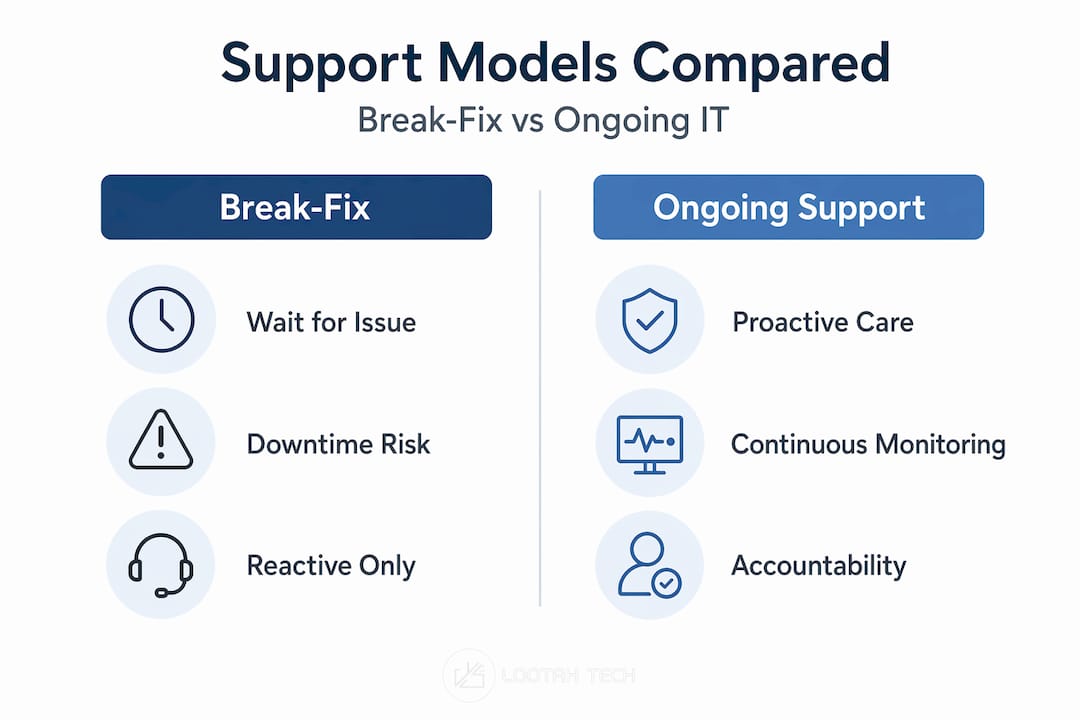
The break-fix model is intuitive but expensive. Something breaks, you call someone, they fix it, you pay, and you hope it doesn't happen again. The problem is that hope is not a strategy. Organizations still operating this way tend to experience longer recovery windows, higher per-incident costs, and a culture where IT feels like a liability rather than a growth engine.
Proactive, ongoing IT support flips this dynamic entirely. Instead of waiting for failure, your support partner is continuously monitoring, patching, optimizing, and stress-testing your environment. As proactive management reduces downtime and accelerates recovery, its financial impact becomes clear very quickly. Organizations that have made this shift report not just fewer incidents but faster containment when issues do occur, because the support team already has deep familiarity with the environment.
| Support model | Average recovery time | Incident cost | Predictability |
|---|---|---|---|
| Break-fix (reactive) | Hours to days | High and variable | Low |
| Ongoing (proactive) | Minutes to hours | Controlled and budgeted | High |
| Hybrid (mixed) | Moderate | Moderate | Medium |
The table above reflects a pattern we see consistently. Proactive models do not eliminate incidents, but they dramatically change the cost profile and the speed of response. Exploring a structured IT support services guide helps frame where your organization sits today and where you need to be.
"Downtime is not just an IT inconvenience. It is a measurable, boardroom-level financial risk."
Pro Tip: Before signing any support agreement, ask your prospective provider to walk you through a documented incident prevention workflow, not just a reactive escalation path. If they cannot show you how they prevent issues, they are still a break-fix provider wearing a managed services label.
One additional benefit that often gets overlooked is how proactive support enables custom software development benefits to materialize faster. When your underlying IT environment is stable and well-monitored, your development teams can release new features with far more confidence.
Why enforceable SLAs and SLOs matter
A proactive mindset only delivers if backed by clear accountability, and that accountability lives inside your service agreements. Many organizations sign contracts with vague language like "best effort response" or "reasonable uptime," and then discover what those phrases mean when something goes wrong. They usually mean very little.
An effective service level agreement (SLA) defines specific response and resolution timeframes, uptime targets, maintenance windows, and escalation paths. Strong SLAs should include measurable targets, and the best providers go further by layering on service level objectives (SLOs) that exceed SLA minimums. Think of the SLA as the legal floor and the SLO as the operational ambition. You want both.
| Feature | Weak SLA/SLO | Strong SLA/SLO |
|---|---|---|
| Response time | "As soon as possible" | Defined in minutes by severity tier |
| Resolution time | "Best effort" | Specific hours by incident category |
| Uptime commitment | "High availability" | 99.9% or higher with penalties |
| Reporting | Quarterly summary | Monthly detailed metrics and trends |
| Scope clarity | General IT support | Named systems, services, and exclusions |
| Escalation path | Single contact | Tiered with executive escalation triggers |
The risks of a weak agreement show up in two very damaging ways. First, cost creep. When scope is vague, your provider can bill for out-of-scope work on items you assumed were covered. Second, out-of-scope surprises during incidents. If a critical system goes down and your SLA does not name it explicitly, your provider may treat it as optional. Both outcomes are preventable with careful contract design. ROI value in IT contracts depends entirely on how precisely the agreement is written.
Essential metrics to demand in your ongoing IT support contract:
- Response time guarantees broken down by severity level (P1, P2, P3)
- Mean time to resolution (MTTR) for each incident category
- System uptime percentage with defined measurement methodology
- Scheduled maintenance windows with advance notification requirements
- Monthly reporting cadence including trend analysis and action items
- Clear scope definitions listing every system, application, and service covered
- Escalation paths with named contacts and response commitments at each tier
- Penalty or credit clauses activated when commitments are missed
Reviewing a detailed managed IT services guide can help you benchmark what good looks like before you enter contract negotiations.
"A contract without measurable commitments is not an agreement. It is a declaration of good intentions."
Scaling capability and bridging skills gaps
Beyond contracts, support partners become essential when it's time to scale and innovate quickly. Technology demands shift fast. AI integration, cloud architecture, cybersecurity hardening, compliance frameworks, and DevOps pipelines all require deep specialist knowledge that is genuinely difficult to hire, retain, and keep current in-house. Ongoing support fills specialist-skills gaps and scales capability far faster than internal-only models can.
The practical impact is significant. Instead of a months-long hiring process to find a cloud security engineer, your support partner already has that expertise on the bench and can deploy it immediately. This means your transformation projects move faster, your team handles fewer unfamiliar problems under pressure, and your organization stays competitive in areas where the technology landscape shifts quarterly.
Top business areas where ongoing support partners create measurable acceleration:
- Cloud migration and optimization: Architecture decisions, cost management, and right-sizing require deep and current expertise your internal team may not have.
- Cybersecurity posture management: Threat landscapes change weekly. Ongoing support partners monitor, patch, and test continuously rather than reactively.
- Digital product development: Stable operations infrastructure gives development teams the confidence to iterate faster and release more frequently.
- Compliance and audit readiness: Regulatory requirements in finance, healthcare, and public sector demand specialist knowledge that changes across regions and industries.
- Enterprise integration: Connecting legacy systems with modern platforms requires both deep system knowledge and strategic architecture experience.
The IT consulting advantages become most visible precisely in these high-complexity areas. Your internal team can maintain focus on your core business while your support partner handles the specialist work that would otherwise slow you down.
Pro Tip: Before engaging a new IT support partner, run an internal skills audit. List every technical capability you need in the next 12 months and compare it honestly to what your team has today. The gap is your partnership brief, and it should drive your provider selection criteria.
Enabling digital transformation and operational stability
A robust support partner enables innovation without sacrificing reliability, especially during major technology shifts. This is where many digital transformation efforts quietly fail. The ambition is strong, the roadmap looks good, but the execution collapses under operational instability. Systems that are not properly supported during a transition create cascading failures that erode stakeholder confidence and burn project budgets.

Operational stability during transformation requires more than keeping the lights on. It requires a support model that integrates across every phase of change. Upgrades and migrations introduce operational risk, and ongoing support must integrate incident and change management with continual improvement to manage that risk effectively.
Critical elements of integrated IT support during digital transformation:
- Incident management: Clear procedures for detecting, logging, categorizing, and resolving service disruptions without disrupting project momentum.
- Change management: Structured review and approval processes for all system changes, ensuring nothing gets deployed without proper impact assessment.
- Real-time monitoring: Continuous visibility into system health across all environments, with automated alerts before issues become outages.
- Problem management: Root cause analysis that goes beyond fixing symptoms to prevent recurrence, especially during high-change periods.
- Continual improvement: Regular reviews of support performance against objectives, with documented action plans rather than verbal commitments.
- Knowledge management: Maintaining current documentation of your environment so that any engineer on the support team can operate effectively from day one.
Understanding digital transformation failure risks is important context here. Most transformations do not fail because of bad technology choices. They fail because the operational foundation was not solid enough to support the change. Building your digital transformation roadmap on a reliable support infrastructure changes that risk profile significantly.
Availability in IT operations is not a luxury feature for large enterprises. It is a baseline requirement for any organization running business-critical digital systems.
"The organizations that transform most successfully are not the ones with the boldest plans. They are the ones with the most stable operational foundations beneath those plans."
Coverage models: 24/7, monitoring, and continual improvement
Coverage is not just about hours. It is the foundation of IT agility and business trust. A support partner that only operates during business hours creates a gap that adversaries, system failures, and customers do not respect. Modern digital operations run continuously, and your support model needs to match that reality.
Verify your coverage model, specifically whether it is 24/7 or business hours only, what monitoring depth is included, and whether incident and change management are built into the agreement rather than billed as add-ons. These details separate a genuine ongoing support partner from a helpdesk with a retainer.
Continual improvement is the area most often reduced to a checkbox. A provider that lists it in their service catalog but never shows you documented evidence of its execution is not actually delivering it. Continual improvement should be an execution capability, not just a process document sitting in a folder. In practice, this means regular reviews with measurable outcomes, monthly reporting on trends, and action items that get tracked to completion.
Questions to ask before signing an ongoing IT support contract:
- What is your exact coverage window? 24/7/365, business hours, or hybrid with on-call?
- What monitoring tools do you use, and will we have visibility into dashboards?
- How is incident management handled at 2 a.m. on a Saturday?
- What is included in change management, and who approves changes to production systems?
- How do you deliver continual improvement, and can you show examples from existing clients?
- What is your escalation path, and who is the named executive contact for major incidents?
- How is scope managed when requests fall outside the original agreement?
Well-structured enterprise applications require exactly this kind of layered support coverage to remain stable and performant as your organization scales.
Pro Tip: Request that monthly improvement reports be a contractual deliverable, not a courtesy. If your provider resists making this a formal commitment, that resistance tells you something important about how seriously they take improvement as a practice.
Editorial perspective: What most miss about ongoing IT support investments
Here is the uncomfortable truth that most evaluations of ongoing IT support skip entirely. Signing a managed services agreement does not automatically make you more resilient. It makes you potentially more resilient, depending on how rigorously you manage the relationship.
Some organizations experience cost creep or out-of-scope friction precisely because they treat the contract signing as the finish line rather than the starting point. Scope boundaries blur, governance gets informal, and monthly check-ins turn into social calls with no action items. The remedy is disciplined SLA and SLO specification combined with consistent monthly reporting with real accountability built in.
We have seen organizations invest heavily in ongoing support agreements and still struggle through major incidents because nobody had enforced the continual improvement provisions of their contract for 18 months. The provider was technically compliant, meetings happened, reports were issued, but nothing changed. That is not a support partnership. That is a recurring fee with paperwork.
The mindset shift that actually makes ongoing IT support valuable is treating it as a disciplined operational relationship. Your support partner should feel accountable to your outcomes, not just your ticket queue. That accountability starts with clear scope, enforced SLOs, transparent monthly reporting, and leadership engagement from both sides. A well-governed managed IT service relationship looks less like vendor management and more like a strategic operating function.
The organizations that get real value from ongoing support are the ones that invest time in governing it, not just procuring it.
Transform IT operations with the right support partner
Understanding the value of ongoing IT support is one thing. Finding a partner that actually delivers it, with enforceable commitments, deep technical expertise, and genuine strategic alignment, is another.
At YS Lootah Tech, we build technology relationships that go beyond ticket resolution. Our application development solutions and website development expertise are backed by ongoing operational support designed to keep your digital products stable, secure, and continuously improving. For organizations ready to move further into intelligent automation, our AI and machine learning support capabilities bring specialist depth to the technologies that are reshaping industry. Reach out to discuss how a structured support partnership can strengthen your IT strategy and accelerate your transformation outcomes.
Frequently asked questions
What is the main advantage of ongoing IT support over the 'break-fix' model?
Ongoing IT support proactively reduces downtime and accelerates recovery, lowering financial and business risk compared to reacting only when issues arise. This means fewer incidents, faster resolution, and a more predictable cost structure.
What should be included in an effective ongoing IT support contract?
An effective contract covers SLAs and SLOs for response, resolution, uptime, maintenance, clear reporting, and scope boundaries. Every system and service covered should be named explicitly, not described in general terms.
How does ongoing IT support assist with digital transformation?
Ongoing support integrates with change management, incident handling, and continuous improvement to make upgrades more stable and safe. Without this integration, transformation projects carry significantly higher operational risk.
Can ongoing IT support help bridge skills gaps for my team?
Yes. Strategic IT partners provide specialist skills that scale capability faster than internal-only solutions, particularly in cloud, security, AI integration, and compliance-heavy domains.
What is the risk of not having ongoing IT support for business-critical systems?
Lack of ongoing support increases your risk of prolonged outages and lost revenue, given that downtime costs $5,600 per minute on average, and those costs compound during digital change projects when environments are at their most vulnerable.