What Is IT Consultation for Business Decision-Makers

TL;DR:
- IT consultation is a strategic advisory service guiding organizations on technology decisions aligned with business goals, unlike operational IT support. It involves structured phases such as assessment, roadmap development, and vendor evaluation to enable informed decision-making. The core value lies in connecting technology investments to measurable business outcomes, emphasizing objective, decision-focused support over hands-on implementation.
Most business leaders assume IT consultation is just another term for IT support. It isn't. While IT support keeps your systems running, what is IT consultation really about? It's about advising your organization on which systems to build, change, or retire based on where your business is headed. Understanding this distinction changes how you budget, how you hire, and how much value you actually extract from your technology investments. This guide breaks down IT consulting explained from the ground up, so you walk away knowing exactly what to expect, what to demand, and how to make it work.
Table of Contents
- Key takeaways
- What IT consultation actually means
- The IT consultation process from assessment to strategy
- Aligning IT investments with real business outcomes
- Choosing the right IT consultation service
- Consultation versus engagement: a distinction that matters
- My take on what businesses consistently get wrong
- How Yslootahtech can support your IT consultation needs
- FAQ
Key takeaways
| Point | Details |
|---|---|
| IT consultation is advisory | IT consultants guide technology decisions tied to business goals, not day-to-day system maintenance. |
| Consultation follows a defined process | Engagements typically include assessment, strategy development, solution design, and implementation support. |
| Alignment drives ROI | The core value of IT consulting is connecting technology investments to measurable business outcomes. |
| Consulting differs from IT services | Confusing advisory consulting with operational IT services leads to mismatched expectations and wasted spend. |
| Choosing the right consultant matters | Define scope, evaluate industry fit, and ask about decision frameworks before hiring any IT consultant. |
What IT consultation actually means
An IT consultant is a technology professional who advises and supports clients in designing, developing, and executing technology projects tied to business goals. That last part matters most. The advisory role is inseparable from the business outcome. An IT consultant is not a helpdesk technician, nor a software developer assigned to a ticket queue. They are a decision partner.
IT consultation services typically cover a wide spectrum of strategic work. Here is what that looks like in practice:
- Technology assessment: Analyzing your current infrastructure, applications, data flows, cybersecurity posture, and performance gaps.
- Roadmap development: Translating business goals into a prioritized sequence of technology changes over a defined timeline.
- Solution design and architecture: Recommending specific platforms, vendors, or custom builds based on requirements analysis.
- Vendor evaluation: Providing comparison frameworks so procurement decisions are grounded in objective criteria.
- Implementation support: Guiding execution teams through change management and deployment without taking over operations.
The importance of IT consultation becomes clear when you compare it to what it is not. IT consulting is strategic and higher-level, distinct from IT professional services which are operational and hands-on. A professional services team builds the solution. A consulting team tells you which solution to build and why.
Pro Tip: If the person you hired to consult is also the one writing all the code or managing your servers, you may have hired a contractor, not a consultant. The two roles can overlap, but the distinction matters for scope, accountability, and budget.
The IT consultation process from assessment to strategy
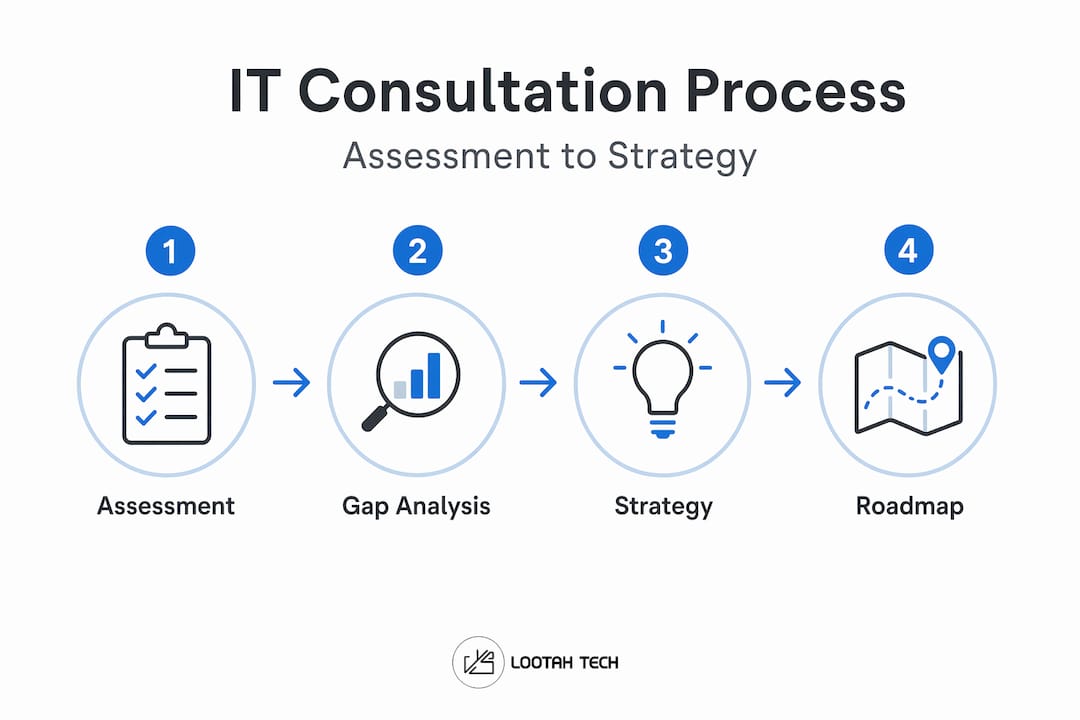
Understanding what does IT consulting involve requires seeing the engagement as a sequence of structured phases, not a single conversation. Most reputable IT consultation services include assessment, roadmap development, solution design, vendor selection, and implementation support as the core deliverables.
Here is how a typical engagement unfolds:
- Current-state assessment: The consultant maps your existing technology environment, including applications, integrations, ownership, risks, and cost drivers. This is not a purely technical audit. Effective IT consultations involve decision-focused current-state inventories that analyze applications, integrations, ownership, risks, and cost drivers to surface business-relevant insights.
- Gap analysis and business alignment: The consultant cross-references your technology state against your business objectives. Where are the gaps? What capabilities are missing? Which systems create risk?
- IT strategy and roadmap: You receive a prioritized plan that sequences technology initiatives based on business value, cost, and readiness. This roadmap becomes your decision-making guide for the next one to three years.
- Solution architecture and vendor evaluation: For each major initiative, the consultant defines the requirements and evaluates options. Vendor selection readiness is often underestimated. Consultants should provide evaluation criteria and comparison frameworks to enable swift procurement post-approval.
- Implementation support: Once execution begins, the consultant supports change management, monitors alignment with the original strategy, and flags deviations before they become expensive.
The table below shows the difference between what you get at each phase and who owns the work:
| Phase | Consultant's role | Client's role |
|---|---|---|
| Current-state assessment | Analysis and documentation | Provide access and context |
| Roadmap development | Strategy and prioritization | Validate against business goals |
| Vendor evaluation | Criteria and comparison framework | Make final procurement decision |
| Implementation support | Advisory oversight | Lead execution with internal or partner teams |
A structured process like this produces a paper trail of decisions, assumptions, and trade-offs. That documentation protects you when priorities shift and new stakeholders ask why certain choices were made.
Aligning IT investments with real business outcomes
The benefits of IT consulting are most visible when technology decisions get tied directly to financial and operational outcomes. Consultants provide expert advice to improve efficiency, reduce risks, and support digital transformation projects. But the mechanism matters. How does that actually happen?

The answer is alignment. Consulting decisions are framed around aligning IT capabilities with business objectives to optimize investments and enable innovation. In concrete terms, this means a consultant will ask questions like: "What does this technology investment need to make possible for your business in the next 24 months?" before recommending anything.
Here is where IT consultation for businesses creates the clearest financial value:
- Cost prioritization: Consultants identify which legacy systems are consuming disproportionate resources relative to the value they deliver, which frees up budget for higher-impact initiatives.
- Risk reduction: A technology assessment surfaces cybersecurity vulnerabilities, compliance gaps, and single points of failure before they become incidents.
- Innovation enablement: By aligning your technology roadmap with product or market strategy, consultants help you build the capabilities needed for new revenue streams before competitors do.
Confusing IT consulting with operational IT services is a common pitfall, and it leads to mismatched expectations and poor outcomes. If you engage a consultant to execute rather than advise, you lose the independence and objectivity that makes consulting valuable in the first place.
"IT consultation is most powerful when the client views it as decision support, not a technical fix. The goal is to know exactly what to build, change, or stop funding before a single contract is signed."
Pro Tip: Before any consulting engagement, write down the three technology decisions you need to make in the next six months. Hand that list to your consultant on day one. It tells them where to focus and gives you a clear benchmark for measuring their value.
Choosing the right IT consultation service
With the market full of consulting firms, independent consultants, and professional services providers all using similar language, knowing how to choose IT consultation for your specific situation is its own skill. Here is a practical framework.
Start by defining the scope before you talk to anyone. Are you looking for a technology assessment only? A full roadmap? Vendor selection support? Each requires different expertise and a different engagement model. Bringing in a large consulting firm for a scoped assessment can be overkill. Hiring an independent consultant for an enterprise transformation can leave you under-resourced.
When evaluating candidates, ask these questions:
- What business outcomes have your past clients achieved from similar engagements?
- How do you separate your advisory work from implementation to protect objectivity?
- What does your current-state assessment methodology look like, and what decisions does it inform?
- How do you handle scope creep and changing business priorities mid-engagement?
- Can you provide references from businesses in our industry or of similar size?
Also consider whether you want a technology consulting partner who can align a full digital strategy with your existing capabilities, or a narrow specialist focused on one technology domain. Both have value, but they serve different moments in your organization's growth.
For companies still in the early stages of digital maturity, a partner with broad experience across cloud, software development, and cybersecurity will typically deliver more usable guidance than a deep specialist in one area. The goal at that stage is a coherent technology direction, not perfection in any single domain.
Consultation versus engagement: a distinction that matters
One area where business leaders often encounter confusion is the difference between consultation, engagement, and communication, particularly in regulated industries or when working with government clients.
Formal consultation involves a public process to gather views on specific proposals at a stage where input can influence outcomes, governed by legal principles. This is fundamentally different from what most businesses mean by IT consultation, but the distinction matters for compliance and governance.
Here is a simple reference table:
| Term | Definition | IT context |
|---|---|---|
| Communication | One-way information sharing | Status updates, announcements |
| Engagement | Two-way dialogue without formal obligations | Stakeholder workshops, feedback sessions |
| Consultation | Structured process with documented input and legal responsiveness | Formal IT governance decisions, regulated procurement |
Formal consultation processes require documented governance and responsiveness to input, differing significantly from general engagement. For most private-sector IT projects, you will operate at the engagement level. But in public sector work, healthcare, or financial services, knowing where consultation starts can protect you from compliance risk.
My take on what businesses consistently get wrong
I've worked alongside enough technology initiatives to see one pattern repeat itself: companies bring in IT consultants and then immediately try to turn them into project managers or developers. I understand the impulse. You've paid for the engagement, the consultant is smart, and execution feels urgent. But the moment you shift a consultant into delivery mode, you lose the thing you actually paid for: objective, business-aligned judgment.
In my experience, the most valuable consulting relationships are the ones where the client treats the consultant as a strategic IT advisor rather than a technical resource. That means the consultant sits closer to the decision table than the development team. It means they challenge assumptions, not just confirm them.
What I've also learned is that the deliverable from a good IT consultation engagement is rarely the document. It's the quality of the decisions the document enables. A roadmap that sits in a shared drive and never gets acted on represents a failed engagement, regardless of how thorough it looks. The measure of a good consultant is whether your next ten technology decisions were better because they were involved.
My recommendation: before you sign any consulting agreement, define what a successful outcome looks like in terms of decisions made, not reports produced.
— YS
How Yslootahtech can support your IT consultation needs
At Yslootahtech, we work with organizations across industries to turn technology questions into clear, executable strategies. Whether you're assessing your current IT environment, building a digital roadmap, or moving from strategy into execution, our team brings the technical depth and business context to make those engagements count. If your consultation has surfaced the need for custom software or new digital products, our application development practice is built to take you from recommendation to delivery without losing the strategic intent. And if you want to understand how ongoing IT support fits alongside consultation, we can show you how both work together. Contact Yslootahtech to start with a conversation, not a commitment.
FAQ
What is IT consultation in simple terms?
IT consultation is a professional advisory service where technology experts help businesses decide which technology investments, changes, or strategies best support their business goals. It is strategic guidance, not technical support.
How does IT consultation differ from IT support?
IT support manages and maintains your existing systems on an operational basis. IT consultation advises on what systems, strategies, or investments your business should pursue to achieve specific outcomes.
What does an IT consultation engagement typically include?
A standard IT consultation engagement includes a current-state technology assessment, gap analysis, IT strategy and roadmap development, solution design, vendor evaluation, and implementation oversight support.
How do I know if my business needs IT consultation?
If your organization is facing a significant technology decision, experiencing repeated inefficiencies tied to outdated systems, planning a digital transformation, or struggling to align IT spending with business outcomes, an IT consultation engagement is likely the right next step.
What is the difference between consultation and engagement in IT governance?
Consultation involves a structured process with documented input that must be formally considered, while engagement is a two-way dialogue without legal obligations. In regulated industries, the distinction has compliance implications and should be understood before starting any formal governance process.