Cybersecurity Risk Assessment Guide for SMB Leaders

TL;DR:
- Most SMBs are breached not because attackers are more sophisticated, but because they fail to map out what is truly at risk. A structured cybersecurity risk assessment provides a practical framework to identify vulnerabilities, prioritize threats, and implement effective controls aligned with business impacts. Continuous monitoring and clear communication with leadership are essential to maintaining an up-to-date security posture that addresses evolving threats and operational risks.
Most small and medium-sized businesses don't get breached because attackers are sophisticated. They get breached because no one mapped out what was actually at risk. A structured cybersecurity risk assessment guide gives you the framework to identify your vulnerabilities before someone else does. This guide walks you through every phase of the process, from preparation through continuous monitoring, using proven methodologies aligned to real business priorities. Whether you're an IT professional or an executive responsible for protecting your organization, you'll leave with a working process, not just theory.
Table of Contents
- Key takeaways
- Your cybersecurity risk assessment guide starts here
- How to conduct the cybersecurity risk assessment process
- Risk treatment and remediation planning
- Verification and continuous monitoring
- My honest take on what most SMBs get wrong
- How Yslootahtech can strengthen your cybersecurity posture
- FAQ
Key takeaways
| Point | Details |
|---|---|
| Start with asset inventory | Know exactly what data and systems you're protecting before you assess any threats. |
| Use a recognized framework | Aligning to NIST or ISO 27005 keeps your process consistent and defensible to auditors and leadership. |
| Rank risks by business impact | Not every vulnerability is equal. Focus remediation on threats that could disrupt core operations or finances. |
| Assign owners and deadlines | Every risk treatment item needs a named owner and a deadline to actually get resolved. |
| Move beyond point-in-time assessments | Continuous monitoring tools keep your risk picture current as threats evolve rapidly. |
Your cybersecurity risk assessment guide starts here
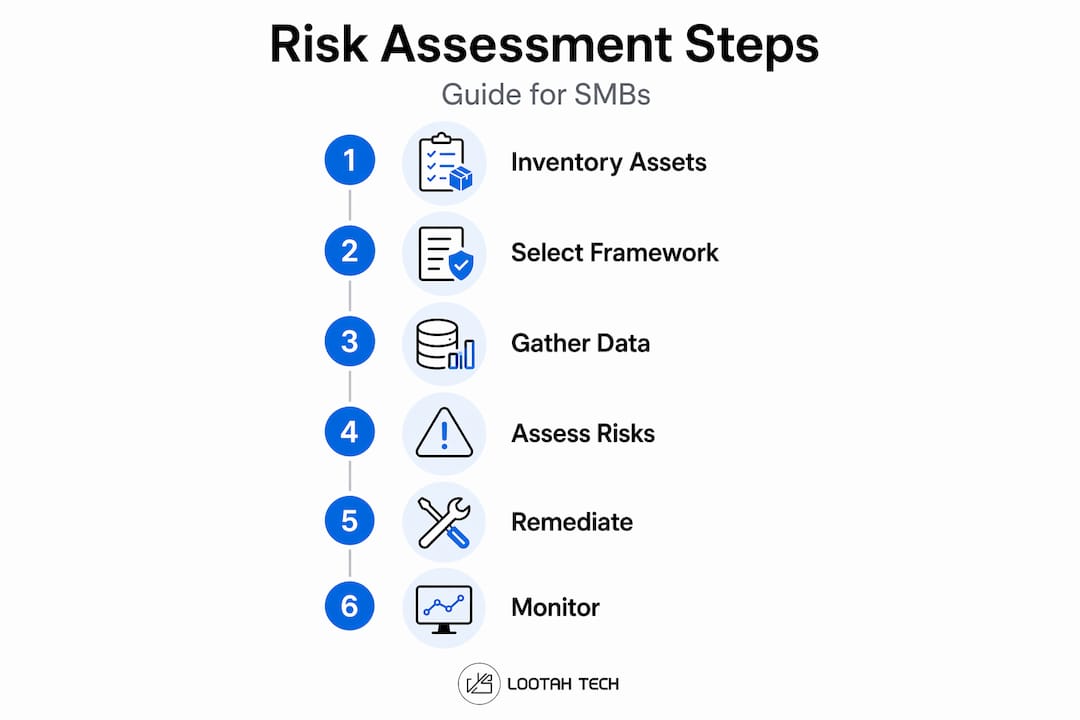
Before you open a spreadsheet or download a framework template, you need to know what you're protecting and why it matters to the business. This preparation phase is where most assessments quietly fail. Teams jump into scanning tools and vulnerability lists without first answering the foundational question: which systems, if compromised, would do the most damage?
Build your asset and data inventory
Start by cataloging every asset that touches sensitive data or supports a critical business process. This includes servers, endpoints, cloud workloads, third-party integrations, and the data those systems store or transmit. Group them by criticality. Your customer payment database is not in the same risk category as your marketing content server. These high-value targets are often called "crown jewels," and they should anchor your entire risk assessment framework.
Alongside the asset list, gather supporting documentation: network architecture diagrams, existing security policies, access control records, and any previous audit reports. The quality of your assessment depends directly on the quality of this input.
Choose your framework
Multiple risk management frameworks exist, but two dominate enterprise practice: NIST RMF and ISO 27005. NIST is especially well suited to US-regulated industries, while ISO 27005 maps cleanly onto ISO 27001 certification requirements. The FAIR model is a strong option if you want to quantify risk in financial terms, which tends to resonate with CFOs and boards.
Your choice should reflect your industry, your compliance obligations, and how mature your current security program is. Don't pick the most rigorous framework your team can't actually execute.

Tools you'll need
| Tool category | Purpose | Examples |
|---|---|---|
| SIEM/EDR platforms | Log collection and threat detection | Splunk, Microsoft Sentinel |
| Vulnerability scanners | Identify known weaknesses in systems | Tenable Nessus, Qualys |
| Risk register templates | Document and rank identified risks | Excel, dedicated GRC tools |
| Architecture diagramming | Visualize data flows and attack surfaces | Lucidchart, draw.io |
Define your team roles before you start. Assign a risk assessment owner, technical contributors, and executive sponsors. Without clear accountability at this stage, findings tend to sit in a document nobody reads.
Pro Tip: Collect 30 to 90 days of logs from your SIEM, EDR, and cloud providers before beginning. This baseline data is what allows you to score the likelihood of threats realistically, rather than guessing.
How to conduct the cybersecurity risk assessment process
A sound assessment methodology runs 5 to 7 structured steps, moving from scope definition through a documented risk treatment plan with owners and deadlines. Here is how each step works in practice.
-
Define scope and objectives. Decide whether this assessment covers the entire organization or a specific business unit, system, or compliance requirement. Narrow scope produces deeper, more useful results than trying to assess everything at once.
-
Identify and prioritize assets. Return to your asset inventory from the preparation phase. Rank assets by their value to the business and the sensitivity of the data they hold. Your ERP system and customer database almost always sit at the top.
-
Map credible threat scenarios. Effective cyber risk assessments focus on a manageable set of realistic threat scenarios relevant to your sector, rather than cataloging every theoretical attack. For most SMBs, the list includes ransomware, phishing attacks targeting credentials, misconfigured cloud storage, and insider threats from departing employees.
-
Assess likelihood and impact. Use a risk matrix to score each threat scenario. Likelihood scores typically reflect historical data, threat intelligence, and your log baseline. Impact scores reflect the financial, operational, and reputational damage a successful attack would cause. Multiply them to get a risk score.
-
Build your risk register. Document every identified risk with its score, the affected asset, the threat scenario, existing controls, and a residual risk rating. Sort the register by score. This ranked list becomes your prioritization tool.
-
Create a visual heat map. A ranked risk register with a heat map communicates priorities to non-technical executives far more clearly than a spreadsheet of numbers. Red quadrant items need immediate attention. Yellow items need a plan. Green items can be monitored.
-
Assign risk owners and deadlines. Each item in the register needs a named individual responsible for the treatment decision and a target date. Without this, assessments produce findings that never become action.
Pro Tip: When scoring business impact, ask yourself: "If this system were down for 72 hours, or this data were stolen and published, what would actually happen?" Tying technical risk to business continuity exposure makes it far easier to justify budget requests to leadership.
Risk treatment and remediation planning
An assessment without a treatment plan is just documentation. The point of your information security risk guide is to change something. Once your risk register is ranked, each item needs a treatment decision.
The four standard options are:
- Mitigate. Implement a control to reduce the likelihood or impact. This is the most common choice for high-scoring risks. Examples include deploying MFA, patching vulnerable systems, or segmenting your network.
- Accept. Formally document that the residual risk falls within the organization's tolerance. This is appropriate for low-scoring risks where the cost of mitigation exceeds the expected loss.
- Transfer. Shift the financial exposure through cyber insurance or by contractually assigning risk to a vendor. This does not eliminate the risk. It changes who bears the cost.
- Avoid. Discontinue the activity or system that creates the risk. Rarely practical for core operations, but relevant when a legacy system with no business use case carries significant exposure.
Once treatment decisions are made, build three remediation scenarios: short term (0 to 90 days), medium term (3 to 12 months), and long term (beyond 12 months). Assign each item a cost estimate. This gives leadership a concrete picture of what security improvement actually costs and when they'll see results.
Using a RACI model to assign ownership for each treatment item dramatically improves follow-through. Someone is Responsible. Someone is Accountable. Others are Consulted or Informed. Without this structure, remediation stalls because everyone assumes someone else owns it.
When you report findings to leadership, frame everything in business terms. Contextualize every risk through operational continuity, regulatory exposure, and potential financial loss rather than technical metrics alone. Your executive summary should fit on two pages. Your detailed technical annex can be as long as it needs to be. For a practical starting point on the controls side, the enterprise cybersecurity checklist from Yslootahtech covers 18 specific controls directly relevant to remediation planning.
Pro Tip: The most common mistake in remediation planning is treating all findings as equal urgency. Risk-based prioritization is what lets you justify investments to leadership and focus limited resources where they actually reduce exposure.
Verification and continuous monitoring
A point-in-time assessment is better than nothing. It is not good enough on its own. The industry is moving decisively from static annual assessments to continuous automated monitoring because the threat environment changes faster than any annual cycle can track.
What continuous monitoring actually looks like in practice:
- Real-time dashboards. Connect your SIEM to a dashboard that surfaces active alerts, login anomalies, and configuration drift without requiring someone to pull a manual report.
- Automated vulnerability scanning. Schedule regular scans against your asset inventory so new vulnerabilities get flagged before they're exploited, not after.
- Risk register updates. Treat your risk register as a living document. Any significant system change, new vendor, or threat intelligence update should trigger a review of affected register items.
- Defined re-assessment cycles. Major assessments should occur at least annually, with lighter reviews triggered by material events: a new product launch, a merger, a significant cloud migration, or a security incident.
- Leadership reporting cadence. Bring your risk posture metrics to leadership on a regular schedule. Monthly or quarterly dashboards showing risk trend lines, open treatment items, and upcoming deadlines keep cybersecurity visible at the executive level.
"Cybersecurity risk management is about prioritizing risks that impact core operations, not eliminating all risk. Continuous monitoring keeps that prioritization current."
The goal is not to create more meetings. The goal is to make sure that when the threat environment shifts, your organization knows about it and responds before damage occurs. Pair your monitoring practice with a review of evolving cybersecurity trends so you're calibrating to what attackers are actually doing in 2026.
My honest take on what most SMBs get wrong
I've seen organizations spend weeks building detailed risk registers and then present them to the board in a format so technical that no one approves the budget. The assessment was solid. The communication failed entirely.
The most persistent problem in cybersecurity risk management isn't technical. It's translation. IT teams speak in CVE scores and patch counts. Executives need to hear that an unpatched authentication flaw on the ERP system means a credential theft attack could halt invoicing for three days and expose the company to regulatory fines. Same fact, completely different framing. The business version gets funded.
Zero risk is mathematically impossible, and organizations that chase it waste resources on diminishing returns. The ones that do this well pick a risk tolerance, document it formally, and focus their energy on the threats that could genuinely derail operations. That clarity also takes enormous pressure off the security team.
There's also a skills dimension worth acknowledging. Demand for risk management certifications like ISACA CRISC is rising because organizations are finally recognizing they need people who can bridge technical security and business governance, not just one or the other. If your team lacks that bridge role, that gap is itself a risk worth addressing in your register.
Treat your risk assessment as an ongoing business process, not a compliance checkbox. The companies that build this into their quarterly governance rhythm are the ones that catch problems early and spend security budgets efficiently.
— YS
How Yslootahtech can strengthen your cybersecurity posture
Running a thorough cybersecurity risk assessment takes the right methodology, the right tools, and people who understand both the technical environment and the business at stake. That's where Yslootahtech helps SMBs across the region close the gap.

Yslootahtech brings deep expertise in cybersecurity risk management for businesses that need a structured process without building an entire security practice from scratch. From scoping and framework selection through risk register development and remediation planning, the team works alongside your IT professionals and leadership to produce results that are defensible, business-aligned, and actionable. Continuous monitoring setup and governance support are part of the service. If you're ready to build a security program your leadership can actually use, explore Yslootahtech's solutions to see where the work can begin.
FAQ
What is a cybersecurity risk assessment?
A cybersecurity risk assessment is a structured process for identifying, analyzing, and prioritizing threats to an organization's information systems and data. It produces a ranked risk register and treatment plan to guide security investments.
How often should SMBs conduct a risk assessment?
A full assessment should occur at least once a year, with lighter reviews triggered by major system changes, new vendor relationships, or security incidents. Continuous automated monitoring supplements the annual cycle to keep the risk picture current between formal reviews.
Which risk assessment framework is best for SMBs?
NIST RMF and ISO 27005 are the two most widely adopted frameworks for structured risk mapping. Your best choice depends on your industry, compliance obligations, and current security maturity. Selecting the right framework aligned to your business objectives also makes compliance audits more straightforward.
What is a risk register and why does it matter?
A risk register is a documented list of identified risks ranked by their likelihood and business impact scores. It serves as the central tool for tracking treatment decisions, assigning ownership, and reporting progress to leadership.
How do you communicate cybersecurity risks to non-technical executives?
Translate technical findings into business outcomes: financial exposure, operational downtime, and regulatory penalties. A visual heat map paired with a concise executive summary is far more effective than a technical report. Frame every risk in terms of what it would cost the business if it materialized.