Why mobile app development is essential for business growth

TL;DR:
- The global mobile app market is projected to reach $777.4 billion by 2032, emphasizing apps' strategic importance for business success. Developing user-centered, scalable apps with thoughtful platform and cost considerations can boost engagement, productivity, and revenue growth. Strategic planning and modernization are essential to avoid costly failures and sustain long-term competitive advantage.
The global mobile app market was valued at $208.5 billion in 2022 and is projected to reach $777.4 billion by 2032. That number should reframe how you think about why mobile app development belongs on your strategic agenda, not just your IT roadmap. Apps are no longer a digital nicety for consumer brands. They are how businesses collect data, retain customers, and give employees tools that actually work in the field. The question is no longer whether to build one. It's whether you can afford to keep waiting.
Table of Contents
- The rising influence of mobile apps on business performance
- Strategic and technical decisions shaping mobile app success
- Understanding the total cost of ownership of mobile app development
- User expectations and engagement challenges in 2026
- Applying mobile app development insights to your business strategy
- The overlooked truths in mobile app development strategies
- How YS Lootah Tech can support your mobile app development journey
- Frequently asked questions
Key Takeaways
| Point | Details |
|---|---|
| Mobile app market growth | The global mobile app market is expanding rapidly, highlighting the importance of mobile presence for businesses. |
| Key project decisions | Early choices about platform and architecture heavily influence app success and costs. |
| Total cost commitment | Budget for mobile apps must include multi-year maintenance and modernization, not just initial build. |
| User experience criticality | Fast, personalized apps significantly improve engagement and reduce high uninstall rates. |
| Strategic AI use | AI features work best when solving real user problems, not just adding novelty functions. |
The rising influence of mobile apps on business performance
The scale of mobile adoption makes the business case almost self-evident, but the operational specifics are where most decision-makers underestimate the opportunity. Annual app downloads are projected to surpass 300 billion by 2026, and 84% of organizations report significant employee productivity gains after deploying enterprise mobile apps. That is not a marginal improvement. That is a category-level shift in how work gets done.
The importance of mobile apps becomes even clearer when you look at sales performance. Sales reps using mobile CRM see 14% productivity gains compared to desktop-only counterparts. For a mid-size sales team, that delta compounds into millions in additional revenue annually without adding headcount.
Here is what the data collectively signals for business leaders:
- Customer engagement improves when your service is one tap away, not buried in a browser session
- Field workforce efficiency rises when mobile tools eliminate paperwork and approval delays
- Data collection becomes real-time instead of retrospective, sharpening decision-making
- Brand visibility increases because a well-placed app icon is daily passive marketing
- Retention rates outperform web-only competitors, especially in enterprise mobile app types that embed into daily workflows
The benefits of app development are not hypothetical. They show up in sales metrics, support ticket volumes, and customer lifetime value when the app is built for the right reasons and the right users.
Strategic and technical decisions shaping mobile app success
Most projects that fail do not fail in development. They fail in the first two weeks of planning. Early platform and backend decisions disproportionately impact total project success, and the native versus cross-platform choice sits at the center of that.
| Factor | Native apps | Cross-platform apps |
|---|---|---|
| Performance | Superior hardware access | Good, minor overhead |
| Development cost | Higher (two codebases) | Lower (shared codebase) |
| Time to market | Slower | Faster |
| UI consistency | Platform-specific, natural feel | Near-native with modern frameworks |
| Best for | High-performance, complex apps | Broad reach, faster launches |
Cross-platform frameworks like React Native and Flutter have matured significantly. For most B2B and mid-market applications, they deliver sufficient performance at meaningfully lower cost. Native development still wins for apps requiring deep hardware integration, such as augmented reality, real-time sensor processing, or complex graphics.
Beyond platform choice, these decisions shape your outcome before a single line of code is written:
- Backend architecture: Cloud-native backends built for scale prevent expensive rewrites at the 18-month mark
- API design: REST versus GraphQL choices affect how quickly you can add features later without breaking existing functionality
- UI/UX investment upfront: Design iterations during wireframing cost a fraction of post-launch redesigns; understanding the benefits of custom software helps frame why tailored architecture pays off
- Security protocols: Authentication, data encryption, and compliance requirements for your industry should be baked in from day one, not retrofitted
Pro Tip: Resist the urge to launch on both iOS and Android simultaneously if budget is constrained. Launching on one platform first with a polished experience beats a mediocre dual-platform release. User feedback from the first platform almost always reshapes the second.
A disciplined software development workflow that front-loads decisions saves you from the most expensive mistake in app development: building the wrong thing very efficiently.
Understanding the total cost of ownership of mobile app development
The build cost is the number everyone asks about. The total cost of ownership is the number that determines whether the investment makes sense. US mid-market enterprises spend an average of $840,000 over three years on a mobile app, with Year 2 costs running 60 to 75% of Year 1.
Here is how that typically breaks down:
| Phase | Cost component | Approximate share |
|---|---|---|
| Year 1 | Design, development, QA, launch | 45-50% of 3-year total |
| Year 2 | Maintenance, feature updates, server costs | 27-33% of 3-year total |
| Year 3 | Modernization or continued maintenance | 20-25% of 3-year total |
The hidden landmines in mobile app budgeting are almost always in the operational years, not the build year. Common pitfalls include:
- Underestimating QA overhead: Testing across device types, OS versions, and network conditions consumes 20 to 30% of development time in mature teams.
- Ignoring third-party API costs: Payment gateways, mapping services, and push notification platforms all carry per-use fees that scale with your user base.
- Skipping a modernization fund: Apps built on frameworks from even three years ago may require significant rework to stay compatible with new OS releases.
- Treating maintenance as optional: Apps that go six months without updates lose visibility in app store rankings and user trust simultaneously.
- Not budgeting for user acquisition: Building the app is only half the investment; getting users to download and retain it requires dedicated spend.
Pro Tip: AI-assisted development tools are reducing build costs by 15 to 25% for teams that use them effectively. If your development partner is not incorporating AI into their workflow, ask why. It is a reasonable question in 2026.
Understanding the true cost picture across enterprise app development steps lets you budget with accuracy rather than optimism, which is the difference between a successful launch and a stalled project.

User expectations and engagement challenges in 2026
Building the app is the starting line. Keeping users engaged is the actual race. Users spend over 4 hours daily on mobile, yet apps face a 70 to 80% uninstall rate. That gap is where most mobile strategies fall apart.
The reasons users abandon apps are predictable and preventable:
- Load time over 2 seconds triggers abandonment in a majority of users, regardless of how useful the app is
- Confusing onboarding creates friction before users experience any value
- Generic content and interfaces that do not reflect the user's role, history, or preferences feel impersonal
- Poorly designed search and form flows cause task failure, which is the single biggest driver of uninstalls among task-oriented apps
- Push notification overload trains users to ignore your communications until they mute them entirely
"The apps winning in 2026 are not the ones with the most features. They are the ones that make a handful of tasks feel effortless." This distinction is lost on most product roadmaps.
What works is often simpler than teams expect. Fixing broken user journeys delivers more measurable retention lift than adding AI features, which see only 0.4% usage among monthly active users when bolted on without a clear user need.
Personalization, done well, changes this equation. When an app surfaces relevant content, adapts to usage patterns, and reduces steps to common tasks, session length and return visit rates increase measurably. You can find more on building this kind of user engagement by examining apps that treat retention as a design problem, not a marketing problem.
A solid digital transformation roadmap accounts for user experience from the start, not as an afterthought once download numbers disappoint. Look also at enterprise app examples that have solved engagement well; the patterns are instructive.
Pro Tip: Run a task-completion audit before your next feature sprint. Identify the three most common tasks your users attempt and measure how many steps each requires. Reducing one step from each journey often outperforms a full feature release in retention metrics.
Applying mobile app development insights to your business strategy
Knowing why develop mobile applications is one thing. Translating that into budget allocation, vendor selection, and roadmap priorities is where most leadership teams stall. Here is a practical framework for moving from insight to action.
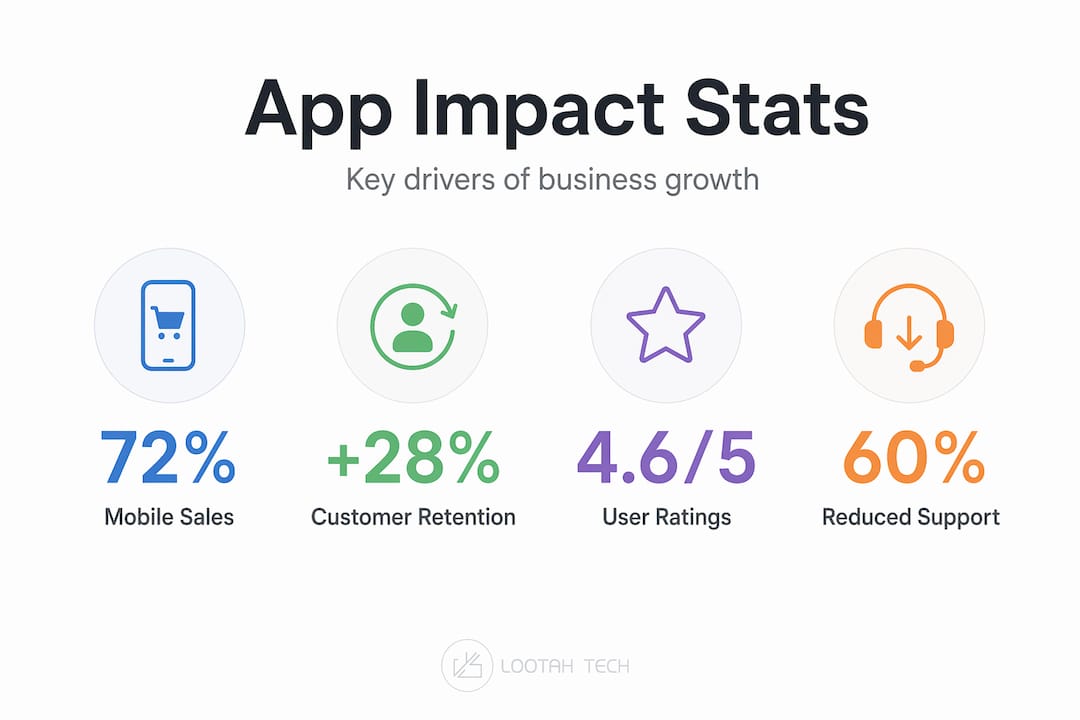
Start with owned channel economics. Mobile apps reduce acquisition costs and boost retention by 30% for high lifetime-value customers. If your current growth model is heavily reliant on paid social or search advertising, an app is a way to reduce that dependency over time, not just serve existing users better.
Follow this prioritization sequence when building your mobile app strategy:
- Define the one job your app must do well before designing any secondary functionality
- Choose your platform based on your user base's device distribution, not assumptions
- Budget for three years, not just launch, using the TCO framework outlined above
- Invest in UX research before wireframes, because validated user journeys are cheaper than rebuilt ones
- Integrate AI where it solves a documented user problem, not where it sounds impressive in a pitch deck
- Plan your retention mechanics from day one: push notifications, personalization triggers, and loyalty loops
Additional considerations for mobile apps for business growth include:
- M-commerce readiness: If you sell products or services, a frictionless in-app purchase flow delivers conversion rates that mobile browsers cannot match
- Employee-facing apps: Internal apps for field teams, logistics, or operations often deliver faster ROI than customer-facing apps because adoption is controllable
- Data ownership: An app gives you first-party behavioral data that platform-dependent channels cannot provide
Understanding the advantages of enterprise applications and staying current on technology trends shaping 2026 will help you align your app investment with where your industry is heading, not where it has been.
The overlooked truths in mobile app development strategies
Here is the perspective that most development vendors will not tell you directly: most mobile apps fail not because of bad ideas but because of misaligned timing, technology, or user experience strategy. That is a strategic failure, not a technical one.
The most common mistake we see from business leaders is treating the app as a product launch rather than a program. A product launches once. A program evolves continuously based on user behavior, market shifts, and technology changes. Organizations that budget for Year 1 and assume low costs thereafter are consistently surprised when Year 2 arrives with maintenance demands they did not plan for.
There is also a troubling tendency to chase features rather than fix fundamentals. A business adds a chatbot, an AI recommendation engine, and a loyalty tier system to an app where the basic search function still returns irrelevant results. Users do not care about the chatbot. They care that they cannot find what they came for. The insights from custom software development consistently reinforce the same lesson: doing fewer things exceptionally well beats doing many things adequately.
Finally, the decision to modernize versus patch is one of the most consequential and most deferred choices in enterprise technology. Every quarter you spend patching an aging architecture is a quarter where your team's energy goes toward keeping the lights on instead of building competitive advantage. The modernization cost feels large until you calculate the compounding cost of not modernizing.
Strategic clarity beats trend-chasing. The best mobile app investments we have seen share one trait: the leadership team knew exactly what problem they were solving and refused to let scope creep blur that focus.
How YS Lootah Tech can support your mobile app development journey
Turning the insights from this article into a working, revenue-generating app requires more than a development team. It requires a partner who understands your business context, your user base, and the technical decisions that compound over time.
At YS Lootah Tech, our application development services are built around exactly the framework this article describes: clear problem definition, platform-appropriate architecture, UX-first design, and realistic multi-year planning. We also bring deep expertise in AI and machine learning integration for businesses that want personalization and intelligent features grounded in actual user needs, not just trend-following. Whether you need a customer-facing app, an internal operations tool, or a full web and mobile presence, our team supports you from strategy through launch and beyond.
Frequently asked questions
Why is mobile app development crucial for business growth?
Mobile apps enable businesses to engage customers directly, reduce reliance on paid acquisition channels, and improve employee productivity. 84% of organizations report significant productivity gains after deploying enterprise mobile apps, making them a proven driver of both operational and revenue performance.
What are the biggest cost factors in mobile app development?
The main costs are the initial build, ongoing maintenance, feature updates, and periodic modernization to prevent technical debt from accumulating. US mid-market enterprises spend an average of $840,000 over three years, with Year 2 maintenance running 60 to 75% of Year 1 costs.
Should I choose native or cross-platform development?
Cross-platform frameworks reduce cost and speed up rollout, while native apps deliver stronger hardware access and peak performance. Early platform decisions disproportionately shape long-term project success, so this choice should reflect your performance requirements and budget, not defaults.
How does AI integration affect mobile app success?
AI improves retention and engagement when it directly addresses a documented user need, but adding AI without that alignment rarely moves the needle. AI-driven personalization can increase retention by up to 40%, while generic AI features see only 0.4% monthly usage among active users.
What user experience factors are essential for mobile apps today?
Speed, simplicity, and personalization are non-negotiable. Apps that load over 2 seconds or fail to personalize the interface face uninstall rates of 70 to 80%, making core user journey quality the single most important retention factor.