Why digital health matters: Evidence, impact, and best practices

TL;DR:
- Technology spending alone cannot improve healthcare workflows without foundational data infrastructure.
- Effective digital health in the Middle East requires reliable data sharing, interoperability, and governance to realize measurable outcomes.
Healthcare leaders across the Middle East know that technology spending alone does not fix broken workflows. A hospital can deploy the most sophisticated AI diagnostic tool available and still see no measurable improvement in patient outcomes if the underlying data infrastructure is fragmented. Reducing redundant tests alone could cut at least 20% of operational costs across GCC systems, yet many organizations skip the foundational work and jump straight to advanced platforms. This article works through the evidence, the proven outcomes, and the practical steps that actually move the needle for administrators evaluating digital health in the region.
Table of Contents
- What digital health really means for Middle East healthcare
- Proven outcomes: Mortality, costs, and efficiency gains
- How foundational technologies unlock real digital transformation
- Risks, roadblocks, and how to build resilience
- Nuances and next steps for decision-makers
- Why rushing digital health adoption misses the real opportunity
- Next steps: Partner with experts to drive digital health impact
- Frequently asked questions
Key Takeaways
| Point | Details |
|---|---|
| Foundations first | Prioritize interoperability, unified systems, and basic cybersecurity to set the stage for advanced digital health initiatives. |
| Proven health impact | Evidence shows digital health reduces mortality and costs, delivering measurable value for patients and organizations. |
| Real risks remain | Fragmented data, cyberattacks, and poor training can derail digital projects and erode patient trust. |
| ROI depends on execution | Actual gains require careful integration, outcome measurement, and staff engagement, not just new tools. |
| Leadership drives success | Sustained results in digital health come from strong governance, strategic partnerships, and continuous learning. |
What digital health really means for Middle East healthcare
The term "digital health" gets attached to everything from patient portals to robotic surgery suites, which creates dangerous ambiguity for decision-makers trying to allocate budgets responsibly. In the Middle East context, the working definition needs to be more grounded: digital health is the reliable capture, organization, and sharing of clinical and operational data across every point of care. That is where the value lives.
Understanding digital strategy importance starts with recognizing what problems regional health systems actually face. Across GCC countries, the dominant operational challenges are:
- Siloed patient records that force clinicians to repeat diagnostic tests because a lab result from another facility is inaccessible
- Fragmented insurer-provider communication, creating billing delays and prior authorization bottlenecks
- Inconsistent chronic care management, where patients with diabetes or cardiovascular disease fall through the gaps between primary and secondary care
- Administrative overload from manual processes that duplicate data entry across systems that do not talk to each other
When digital innovation addresses these specific pain points, the results are measurable rather than theoretical. Data unification alone reduces redundant testing and imaging, streamlines referral pathways, and gives insurers the structured claims data they need to process reimbursements faster.
Key stat: Digital health data unification can eliminate at least 20% of healthcare costs tied to redundant testing and duplicated administrative effort across GCC systems.
The critical point here is sequencing. You cannot layer predictive AI analytics on top of disorganized, incomplete data and expect accurate outputs. The algorithm will simply amplify whatever noise exists in the underlying system. Building the data foundation first is not a delay in digital transformation. It is the transformation itself.
Proven outcomes: Mortality, costs, and efficiency gains
Skeptics of digital health investment often ask a fair question: where is the evidence that this actually works? The answer is now more robust than ever, particularly following research published in 2025 and 2026.
A study published in Nature Digital Medicine tracked outcomes in coronary artery disease patients treated through digital-first care pathways. The results should stop any fence-sitter in their tracks:
| Outcome metric | Digital health impact | Hazard ratio |
|---|---|---|
| All-cause mortality | 42% reduction | HR 0.58 |
| MACCE (major adverse cardiac events) | 33% reduction | HR 0.67 |
| Hospital readmissions | 24% reduction | HR 0.76 |
| Primary care cost reduction | 22.7% average savings | N/A |
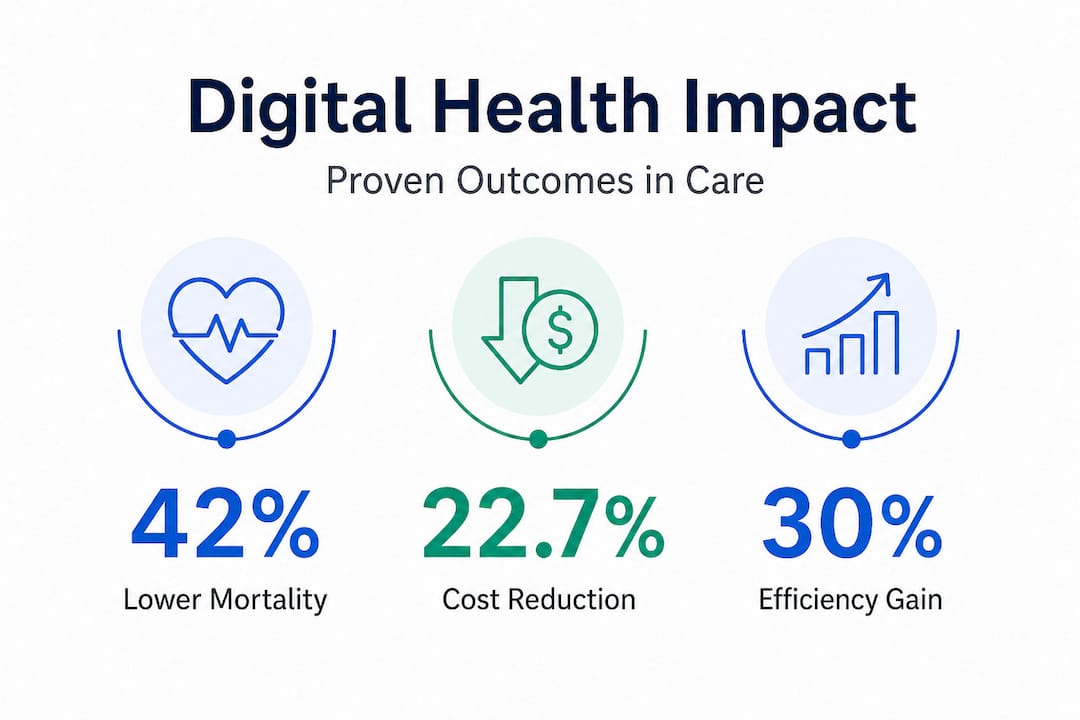
These are not projections. They are measured outcomes from real patient populations in digitally enabled care environments. A 42% reduction in all-cause mortality is a number that should be placed directly in front of every healthcare board considering whether to prioritize digital health spend.
The 22.7% primary care cost reduction is equally significant because it frames digital health not as an expense but as a financial lever. For health systems operating under budget pressure and growing patient volumes, that kind of efficiency gain creates room to reinvest in clinical capacity.
These transformative digital health solutions work because they close the information gaps that cause preventable harm. When a physician has immediate access to a patient's medication history, recent lab values, and specialist notes, they make better decisions faster. That is not a technology story. That is a data story.
Pro Tip: When building your internal business case for digital health investment, connect clinical KPIs (mortality rates, readmission rates, adverse events) directly to operational and financial KPIs (cost per episode, length of stay, staff utilization). This dual framing makes the case for digital growth far more compelling to both clinical and financial stakeholders in the same boardroom.
How foundational technologies unlock real digital transformation
Understanding the value of digital health is one thing. Building the infrastructure that delivers it is where most organizations struggle. The difference between a successful digital health program and an expensive failed pilot usually comes down to whether the foundational layer was built first.
The core building blocks for Middle East health systems specifically include:
- Interoperability standards: FHIR (Fast Healthcare Interoperability Resources), ICD-10 coding, and SNOMED CT provide the common language that allows different systems to exchange data accurately.
- National health information exchanges (HIEs): Regional platforms including Malaffi in Abu Dhabi, NABIDH in Dubai, and Riayati in Saudi Arabia are the connective tissue of digital health ecosystems. Connecting your organization to these platforms is not optional for long-term competitiveness.
- Data transformation layers: Integration middleware that maps data from legacy systems into standardized formats so that historical records become usable rather than archived.
- Governance frameworks: Defined ownership, access controls, audit trails, and data quality standards that make the data trustworthy enough to act on.
The digital healthcare transformation methodologies documented across the region consistently show that organizations connecting to HIEs with standardized data achieve AI deployments that actually scale, while those skipping this step see their AI pilots stall after the proof-of-concept stage.

| Approach | Foundation-first | AI-first |
|---|---|---|
| Data quality at launch | High | Variable |
| AI pilot success rate | High | Low |
| Cost of rework | Minimal | Significant |
| Staff adoption rate | Higher | Lower |
| Time to measurable ROI | 12 to 18 months | Often unclear |
| Risk of compliance issues | Low | Elevated |
The pattern is consistent. Organizations that implement digital health by starting with interoperability and data governance get better results from every subsequent technology they add, including AI, telehealth, and predictive analytics.
Pro Tip: Before signing any AI vendor contract, audit your current data infrastructure. Ask specifically: How many of our patient records are standardized in FHIR format? Which regional HIEs are we connected to? What is our current data error rate? If you cannot answer these questions confidently, invest there first.
Risks, roadblocks, and how to build resilience
No honest conversation about digital health in the Middle East can skip the risks. The same connectivity that enables data sharing also creates attack surfaces, and healthcare organizations are high-value targets.
Healthcare data breaches cost an average of $10.93 million per incident globally, the highest of any sector. In the GCC, where health systems are undergoing rapid digitization, cyber resilience is not a technical concern sitting in the IT department. It is a clinical imperative because a ransomware attack that locks electronic medical records creates immediate patient safety risks.
Beyond cybersecurity, the operational risks worth preparing for include:
- EMR fragmentation: Disconnected electronic medical record systems create disjointed care transitions where critical information about a patient's recent hospitalization does not follow them to their next appointment
- Workforce training gaps: Only 20.8% of healthcare staff report feeling adequately prepared to use digital health tools, meaning even excellent technology fails when people lack the skills to use it
- Algorithm quality concerns: 53.4% of healthcare stakeholders surveyed express concern about algorithm reliability and data privacy in digital health applications
- Regulatory complexity: Consent frameworks, cross-border data handling rules, and evolving compliance requirements vary by emirate and country across the region
"Digital technology is not a shortcut for systemic failures. Without governance, even the best tools reproduce existing inequities and inefficiencies." This is the caution embedded in the PLOS One research on digital trust in the Middle East, and it is worth taking seriously.
Practical resilience strategies that forward-thinking organizations are deploying include:
- Establishing cross-functional digital governance committees that include clinical, operational, IT, legal, and patient advocacy representation
- Implementing network observability tools that provide real-time visibility into data flows and anomalies before they become incidents
- Building cyber resilience frameworks that treat security as a continuous process, not a one-time implementation
- Conducting regular staff training and simulation exercises, not just onboarding sessions
The organizations managing digital health risks effectively share one trait: they treat resilience planning as a pre-launch requirement rather than a post-incident response.
Nuances and next steps for decision-makers
The conversation in regional healthcare leadership has shifted meaningfully in the past two years. The question is no longer "should we digitize?" Most systems have started. The real question now is "how do we measure whether it is working and how do we scale what succeeds?"
Expert guidance from the KLAS digital healthcare analysis points to a clear evolution in organizational priorities:
- Shift from implementation metrics to ROI metrics. Tracking the number of systems deployed is a lagging indicator. Leading indicators include clinician time saved per shift, diagnostic error rates, patient wait times, and cost per episode.
- Treat clinician experience as a primary outcome. If physicians and nurses find a system difficult to use or trust, adoption collapses regardless of technical capability. Clinician satisfaction surveys tied specifically to digital tools should be a standard quarterly metric.
- Recognize that workforce shortages are accelerating AI investment. When a hospital is operating with 15% nursing vacancies, AI-assisted triage and documentation tools become capacity solutions, not just efficiency tools.
- Network observability and real-time integration are non-negotiable. The ability to see data flowing across systems in real time is what allows administrators to catch errors, identify bottlenecks, and prove ROI.
Actionable next steps for Middle East healthcare administrators in 2026:
- Conduct a data maturity assessment across all facilities, mapping current HIE connections, data standardization rates, and integration gaps
- Establish a digital health governance committee with explicit accountability for ROI measurement, not just implementation oversight
- Identify two or three clinical use cases where data integration can demonstrably reduce cost or improve a measurable outcome, and build pilots around those
- Invest in structured workforce training programs before expanding the technology footprint
- Map your organization's current cybersecurity posture against healthcare-specific threat frameworks and close the highest-priority gaps
- Review your analytics adoption roadmap and align it with regional HIE connectivity timelines
Building internal champions at the department level, people who use the tools daily and can translate technical capability into clinical benefit, is one of the highest-leverage investments an organization can make in digital adoption.
Why rushing digital health adoption misses the real opportunity
Here is the uncomfortable truth about digital health investment in the Middle East right now: the organizations moving fastest are not necessarily the ones positioned to win. Speed without structure creates expensive technical debt that takes years to unwind.
We see this pattern repeatedly. A large health system procures an AI-powered diagnostics platform with board-level enthusiasm, runs a six-month pilot in one department, and generates promising preliminary numbers. Then the rollout to other departments stalls because the data formats are incompatible, the staff training budget was not planned, and the IT team is already stretched managing existing systems.
The organizations that have generated the most durable strategic advantage from big data almost always have one thing in common: they invested in boring, unglamorous data infrastructure work before deploying the exciting tools. Clean data pipelines. Standardized coding. Staff who understand what the outputs mean and trust them enough to act on them.
The hardest thing to communicate to a board eager for transformation is that intentional pacing is a competitive strategy, not a failure of ambition. A 14-month implementation that delivers stable, measurable ROI and high clinician adoption will outperform a 6-month rush deployment followed by two years of firefighting and low utilization.
Success in digital health is not about having the most advanced technology. It is about having technology that your clinical teams actually use, your data systems actually support, and your governance frameworks can actually sustain. That combination requires patience, cross-team alignment, and a willingness to build the foundation before designing the penthouse.
Next steps: Partner with experts to drive digital health impact
The evidence is clear and the roadmap exists. What most healthcare organizations need is an experienced partner who can translate the technical requirements of digital transformation into real-world implementations that work within regional regulatory environments and existing infrastructure constraints.
YS Lootah Tech works with healthcare organizations across the Middle East to design and build the digital health infrastructure that makes transformation sustainable. From connecting to national HIEs and implementing FHIR-compliant data layers, to deploying AI and machine learning tools on top of verified data foundations, our team brings both the technical depth and regional context that complex health system projects demand. Our custom application development practice builds security-first, interoperable solutions designed for the specific compliance and operational realities of GCC healthcare. If you are ready to move from assessment to action, a discovery conversation with our digital health team is the right next step.
Frequently asked questions
What are the biggest barriers to effective digital health in the Middle East?
The biggest barriers are siloed data systems, cybersecurity vulnerabilities, regulatory inconsistencies across jurisdictions, and workforce training gaps, with challenges like the digital divide adding additional complexity for smaller or rural facilities.
How does digital health improve patient outcomes?
Digital health improves outcomes by unifying medical records and enabling data-driven clinical decisions, with research showing 42% mortality reduction and 24% fewer readmissions in digitally enabled cardiac care populations.
What foundational steps should healthcare leaders prioritize?
Leaders should prioritize interoperability and HIE connectivity before investing heavily in AI, paired with structured workforce training programs to ensure adoption actually follows implementation.
How much do cyber incidents cost Middle East health systems?
Healthcare data breaches cost an average of $10.93 million per incident globally, with service disruption and patient safety risks amplifying the real-world impact far beyond the financial figure alone.