Why Data Privacy Matters: Protecting Trust and Compliance

TL;DR:
- AI models can unintentionally memorize and expose personal data, creating new privacy risks.
- Data privacy focuses on access and use, distinct from technical data security measures.
- Building a privacy-first culture and compliance strategy enhances trust, reputation, and market opportunities.
Most business leaders assume their biggest privacy risk is a hacker breaking through the firewall. The real danger is often quieter: an AI model trained on customer records that quietly memorizes and can regurgitate personal data, a third-party supplier with loose access controls, or a data flow nobody audited in years. Foundation AI models carry unique privacy risks, including the memorization of personally identifiable information that directly conflicts with regulations like GDPR. This guide walks business leaders and IT managers through what data privacy actually means, which regulations demand your attention right now, what a real breach costs, and how to build a culture where privacy is a competitive advantage.
Table of Contents
- What is data privacy and why does it matter?
- Regulations and compliance: The expanding global landscape
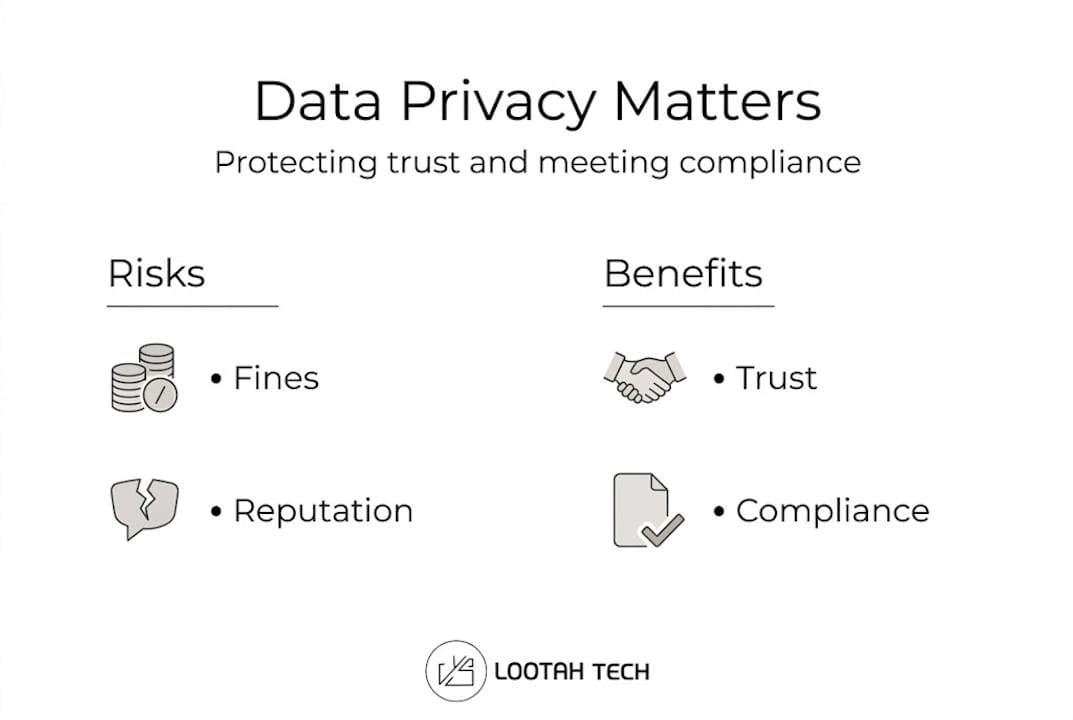
- Risks, threats, and the true cost of a privacy breach
- Building a privacy-first culture: Practical steps for organizations
- A fresh perspective: The overlooked ROI of data privacy
- Enhance data privacy with expert technology partners
- Frequently asked questions
Key Takeaways
| Point | Details |
|---|---|
| Privacy safeguards reputation | Strong privacy policies protect businesses from both reputational damage and regulatory penalties. |
| AI risks require new diligence | Emerging AI models increase the risk of unintended data exposure, demanding proactive review and controls. |
| Global laws impact every sector | Compliance with global privacy regulations is now critical for finance, energy, and more, not just technology. |
| Culture drives privacy success | Embedding privacy into company culture ensures long-term trust and reduces risk across all operations. |
| Investment in privacy pays off | Organizations committed to privacy gain an edge with customers, partners, and future business resilience. |
What is data privacy and why does it matter?
Data privacy and data security are often used interchangeably, but they are not the same thing. Data security refers to the technical measures that protect data from unauthorized access, such as encryption, firewalls, and access controls. Data privacy, on the other hand, governs who is permitted to access data, for what purpose, and under what conditions. You can have strong security and still have serious privacy failures if data is being used in ways people never consented to.
For organizations, data privacy covers every piece of sensitive information you collect: customer names, financial records, health data, behavioral tracking, and employee files. The core principle is that individuals have a right to control how their personal information is used. Your responsibility as a business is to honor that right, not just technically, but operationally.
Why does this matter beyond legal compliance? Consider what happens when privacy trust breaks down:
- Customers abandon brands that mishandle their data, often permanently
- Regulatory fines can reach tens of millions of dollars under frameworks like GDPR
- Reputational damage spreads faster than any press release can contain
- Strategic partnerships and enterprise deals stall when due diligence reveals weak privacy posture
- Employees lose confidence in leadership when sensitive HR data is exposed
One of the most underappreciated risks today comes from AI systems. Foundation AI models risk exposing PII and create compliance challenges that traditional data governance frameworks were never designed to handle. A model trained on customer support transcripts can inadvertently learn to reproduce names, addresses, and account details verbatim. That is not a hypothetical. It is a documented pattern that the importance of business data security has become inseparable from.
"Privacy is not a feature you bolt on at the end of a project. It is a decision you make at the beginning, or you pay for it later."
Pro Tip: Conduct a data flow audit at least once per quarter. Map every system where personal data enters, is processed, or exits your organization. You will almost always find data sitting where it should not be.
Regulations and compliance: The expanding global landscape
Regulations governing data privacy have moved well beyond tech companies in Silicon Valley. They now apply to virtually every industry that touches personal data, which in practice means nearly every organization.
Here is a quick reference for the frameworks most relevant to business leaders operating globally or regionally:
| Regulation | Jurisdiction | Scope | Max Penalty |
|---|---|---|---|
| GDPR | European Union | Any organization handling EU resident data | €20M or 4% of global revenue |
| CCPA/CPRA | California, USA | Businesses meeting revenue/data thresholds | $7,500 per intentional violation |
| PDPL | Saudi Arabia | All data controllers in Saudi Arabia | SAR 5M per violation |
| DIFC/ADGM DP Law | UAE (Free Zones) | Entities registered in DIFC or ADGM | Varies by regulator |
The critical shift happening right now is cross-sector enforcement. GDPR enforcement is spreading to industries like finance and energy, not just technology companies. A manufacturing firm in Germany, an insurance broker in the Netherlands, or an energy utility in France can now face fines that would have seemed unimaginable five years ago.
For organizations operating across borders, the challenge is harmonizing multiple overlapping frameworks. Some practical priorities:
- Shift toward first-party data collection: data you collect directly with clear consent, rather than purchased or scraped sources
- Implement server-side tracking to reduce dependence on third-party cookies and meet browser-level privacy restrictions
- Document every data processing activity with a clear legal basis
- Appoint a Data Protection Officer or equivalent where legally required
The organizations that are managing this complexity best are those building global data protection strategies rather than reacting regulation by regulation. If you operate in the Middle East, our Middle East compliance guide is a useful starting point for understanding regional requirements alongside global ones.
Risks, threats, and the true cost of a privacy breach
Regulation is just one dimension of risk. The practical consequences of a privacy failure extend well beyond the fine you might receive.
| Cost Category | Example Impact |
|---|---|
| Financial | Regulatory fines, legal fees, breach response costs |
| Reputational | Customer churn, negative press, reduced brand equity |
| Legal | Class action suits, director liability, contract penalties |
| Operational | System downtime, data recovery, process disruption |
| Strategic | Lost partnerships, failed audits, delayed product launches |
Some of the most damaging threats come from inside the organization. Privilege misuse, where employees access data beyond what their role requires, accounts for a significant share of privacy incidents. Supplier breaches are equally dangerous: your vendor's weak controls become your legal liability.

AI-specific risks deserve their own attention. Foundation AI models can memorize and regurgitate sensitive personal data, creating regulatory exposure that organizations often do not discover until after a model is deployed. This is especially relevant for businesses building or buying AI model privacy challenges solutions that process customer interactions, financial records, or health information. Understanding ethical big data use is no longer optional for AI-forward organizations.
If a privacy incident occurs, your response speed matters enormously. Here is a structured first-response plan:
- Contain the breach immediately by revoking compromised access credentials
- Assess the scope: what data was involved, how many individuals are affected
- Notify your legal and compliance team within hours, not days
- Report to regulators within required timeframes (72 hours under GDPR)
- Communicate transparently with affected individuals
- Document every action taken for regulatory and legal defense purposes
Pro Tip: Due diligence on AI data training sets is non-negotiable. Before deploying or purchasing any AI system, require documentation on what data was used to train it, whether that data was properly anonymized, and whether consent was obtained.
Building a privacy-first culture: Practical steps for organizations
Tools and policies alone do not create privacy-first organizations. Culture does. And culture is built through repeated decisions, not one-time announcements.
Here are the five pillars that drive sustainable privacy leadership:
- Leadership commitment: Privacy must be championed at the executive level. When the CISO and CEO treat privacy as a business priority, teams follow.
- Ongoing training: Employees need practical, scenario-based training, not annual checkbox modules. Focus on real mistakes: forwarding data to personal email, over-sharing in support tickets, clicking phishing links.
- Technical controls: Role-based access, data minimization, encryption at rest and in transit, and automated data retention policies are non-negotiable foundations.
- Incident response readiness: A plan on paper is not enough. Run tabletop exercises so your team knows exactly what to do when something goes wrong.
- Continuous review: Privacy impact assessments (PIAs) should be triggered by every new project, vendor onboarding, or significant change to data processing.
Watch for these common employee mistakes that create silent privacy risks:
- Sharing customer data over unencrypted channels like personal email or messaging apps
- Retaining data longer than necessary because "it might be useful later"
- Granting broad system access as a shortcut instead of configuring precise permissions
- Using customer data in test environments without proper anonymization
GDPR and CCPA compliance can be simplified with harmonized strategies that rely on first-party data and server-side approaches. Organizations that make this shift find compliance less burdensome and customer relationships significantly stronger.
"Trust is the currency of the digital economy. Privacy is how you earn it."
Apply a privacy lens to every new AI or machine learning project before it launches. Consult your privacy-first security steps checklist and align with digital privacy leadership principles from the start. Integrating privacy by design services into your development lifecycle prevents the far more expensive option: retrofitting compliance after the fact.
A fresh perspective: The overlooked ROI of data privacy
Most organizations treat privacy as a cost center: a compliance burden that consumes budget and slows down product teams. We think that framing is outdated and, frankly, leaving real money on the table.
Privacy leadership is increasingly a market differentiator. Enterprise buyers now run privacy due diligence as a standard procurement step. Healthcare and financial sector clients will not sign contracts with vendors that cannot demonstrate robust data governance. That means your privacy posture directly affects your ability to close deals and enter new markets.
The strategic angle goes deeper for AI-driven businesses. Balancing AI innovation and privacy is not purely a technical challenge. It is a cultural and strategic advantage. Organizations that build privacy-respecting AI from the ground up avoid costly regulatory intervention and earn the right to scale faster, because regulators and partners trust them.
Investing in privacy is also investing in brand resilience. Companies that handle crises transparently and demonstrate genuine respect for personal data consistently recover faster and retain more customer loyalty than those that treat privacy as an afterthought. Explore how innovative tech strategies are increasingly inseparable from privacy-centered design.
Enhance data privacy with expert technology partners
Privacy best practices only create value when they are embedded into the systems your organization actually runs on. That means your applications, your data pipelines, and your cloud infrastructure all need to be built with privacy as a core requirement, not an add-on.
At YS Lootah Tech, we help organizations across the Middle East and beyond design and build technology that is compliant by design. From audit-ready data privacy solutions to privacy-integrated secure application development, our team brings both technical depth and regulatory expertise to every engagement. If your organization is ready to treat privacy as a competitive advantage rather than a legal obligation, we are ready to help you get there.
Frequently asked questions
What is the main difference between data privacy and data security?
Data privacy governs who has access to data and how it is used, while data security focuses on the technical measures that protect data from threats. Foundation AI models risk both privacy breaches and security incidents, illustrating why organizations need to address both disciplines separately.
Why should non-tech companies care about GDPR or CCPA?
Global enforcement now targets finance, energy, and other sectors, not just technology firms, raising risk for all businesses handling personal data. GDPR enforcement has expanded well beyond tech into sectors that many leaders assumed were outside its scope.
How do AI systems pose new privacy risks?
Advanced AI models may memorize and reproduce personal data, creating hidden privacy and compliance challenges that standard anonymization cannot always prevent. AI foundation models can unintentionally memorize and leak PII in ways that are difficult to detect before deployment.
What's the first action for organizations to improve privacy?
Map every point where personal data enters, moves through, or leaves your systems, then prioritize reducing unnecessary access and storage. First-party data and server-side tracking help organizations take meaningful control of their compliance posture from day one.
Recommended
- Why data security is vital for protecting business assets
- Data Protection | YS Lootah Tech
- Data security guide: 7 steps for Middle East businesses
- What is IT security? Protecting business data explained
- Fransk DPA Bötfäller Free Mobile med 27 Miljoner Euro: En Viktig Lektion i GDPR-Efterlevnad och Cybersäkerhetsrisk - TrustView