What Is Smart Technology? A 2026 Explainer

TL;DR:
- Smart technology encompasses interconnected systems using sensors, AI, and data analytics across various sectors, not just gadgets. It operates through the sense-transmit-process-act loop, enabling autonomous functions like energy saving and productivity enhancement. Interoperability, driven by protocols like Matter, and advancements like edge AI, are key drivers of smart technology’s expanding integration into daily life and business.
Most people assume smart technology means a flashy gadget with a touchscreen or a voice assistant you talk to in your kitchen. That assumption misses about 90% of the picture. Smart technology is already embedded in the factory floor, your doctor's office, your car, and the building you work in. Understanding what is smart technology, how it actually functions, and why it matters for your daily life and business decisions gives you a real advantage in a world where this stuff is no longer optional.
Table of Contents
- Key Takeaways
- What is smart technology, defined
- How smart technology works in practice
- Benefits of smart technology for people and businesses
- Trends shaping smart technology right now
- My perspective on smart technology adoption
- Ready to put smart technology to work?
- FAQ
Key Takeaways
| Point | Details |
|---|---|
| Smart tech is not just gadgets | It covers interconnected systems using sensors, AI, and data analytics across homes, industries, and healthcare. |
| SMART has a specific origin | The acronym stands for Self-Monitoring, Analysis, and Reporting Technology, first applied to hard drives in the 1990s. |
| Energy savings are measurable | Smart thermostats alone can cut residential energy bills by around 10% annually. |
| Interoperability is now solved | The Matter protocol lets devices from different brands communicate on a single network without brand-specific hubs. |
| AI is a general-purpose shift | AI integrated into smart devices does not just automate tasks; it has the potential to reshape productivity at an economic scale. |
What is smart technology, defined
The definition of smart technology starts with one word: connectivity. Smart devices combine sensors, processing power, and internet connectivity to collect data and take autonomous action. That is the operational core.
The word "smart" in this context traces back to a very specific origin. The SMART acronym originated in the 1990s as Self-Monitoring, Analysis, and Reporting Technology, applied first to hard drives that could predict their own mechanical failure before it happened. That early concept, a device that watches itself and reports what it finds, is the DNA of everything from your smartwatch to a turbine sensor on an oil rig.
Over the following decades, the concept expanded well beyond storage hardware. What started as self-monitoring evolved into fully networked, AI-enhanced systems that do not just report data but act on it.
"Smart is not just about sensors but requires an immersive, centralized data platform that connects various touchpoints to ensure operational efficiency." This framing matters for businesses managing multiple locations, departments, or physical venues.
The core components that make any device "smart" include:
- Sensors that capture real-world data (temperature, motion, sound, pressure, biometrics)
- Processing power that interprets the data locally or sends it to the cloud
- AI and data analytics that find patterns and generate decisions or recommendations
- Network connectivity that links the device to other systems, platforms, or users
When all four work together, you get a device that learns, adapts, and acts without you having to intervene every time.
How smart technology works in practice
Understanding how smart technology works becomes much clearer through specific examples rather than abstract principles. The operational loop is always the same: sense, transmit, process, act.
Here is how that loop plays out across common use cases:
- Smart thermostats detect room temperature and occupancy, send that data to a processing layer (either cloud or local), compare it against your scheduled preferences, and adjust heating or cooling automatically. No button press required.
- Wearables like fitness trackers collect heart rate, movement, and sleep data continuously. Algorithms detect anomalies and either alert you or sync with a health platform for analysis.
- Industrial sensors monitor equipment vibration, heat, and pressure in real time. When readings drift outside set parameters, the system flags a maintenance need before anything breaks down.
- AI-powered refrigerators now go far beyond keeping food cold. Samsung's Bespoke AI refrigerators use Optical Character Recognition and natural language processing to identify packaged goods, track expiration dates, and suggest recipes based on what is actually inside.
The data processing side is worth understanding because it splits into two distinct approaches. Cloud processing sends data to remote servers for heavy computation, which offers more power but introduces slight delays and raises privacy considerations. Edge AI processes data directly on the device itself. Edge AI achieves up to 10x faster response times compared to cloud processing, and keeps sensitive information local rather than sending it off-device.
Pro Tip: If you are setting up smart technology for a home or office, you do not need to replace every appliance. Universal hubs like SwitchBot can convert existing non-smart devices into voice and automation-controlled appliances using infrared signals, which means you can start without buying everything new.
Here is a quick comparison of the two main processing approaches:
| Processing Type | Speed | Privacy | Best For |
|---|---|---|---|
| Cloud AI | Moderate | Lower (data sent off-device) | Complex analysis, large datasets |
| Edge AI | Very fast | Higher (data stays local) | Real-time responses, sensitive environments |
Benefits of smart technology for people and businesses
The benefits of smart technology are not theoretical. They are documented and measurable, and they show up at both the personal and organizational level.

At home, the most talked-about gain is energy efficiency. Smart thermostats reduce energy bills by approximately 10% annually, which adds up meaningfully over a decade of use. Smart lighting systems go further, detecting occupancy and adjusting automatically so you never pay for an empty lit room.
For professionals and business leaders, the productivity case is even more compelling. When AI and IoT devices handle data collection, monitoring, and routine decisions automatically, your teams focus on higher-value work. This is not a marginal improvement. It changes what your workforce can actually accomplish in a day.
The economic picture is bigger still:
- AI is now recognized as a general-purpose technology with the potential to reshape productivity and living standards across entire economies, comparable historically to electricity or the internet.
- Companies adopting smart solutions for efficiency consistently report gains in decision speed, resource allocation, and error reduction.
- In healthcare, AI-integrated devices are accelerating diagnostics and patient monitoring in ways that were cost-prohibitive just five years ago.
"AI could transform productivity and living standards significantly," according to economists at the Bank of Canada, who classify AI as a general-purpose technology likely to trigger broad structural economic changes.
The uses of smart technology extend across every major sector: retail, logistics, manufacturing, healthcare, construction, and financial services. The common thread is always the same. Replace manual data collection and reactive decision-making with automated, continuous intelligence.
Trends shaping smart technology right now
Smart technology in 2026 looks different from what it did even three years ago. Two changes stand out as genuinely significant.
The first is the shift from rigid, command-based assistants to context-aware AI. Early smart speakers responded to exact voice commands. Today's AI systems understand intent, remember context across a conversation, and adjust responses based on your history and preferences. That gap between "turn on the lights" and "set the mood for a dinner party" represents a fundamental change in how humans and devices interact.
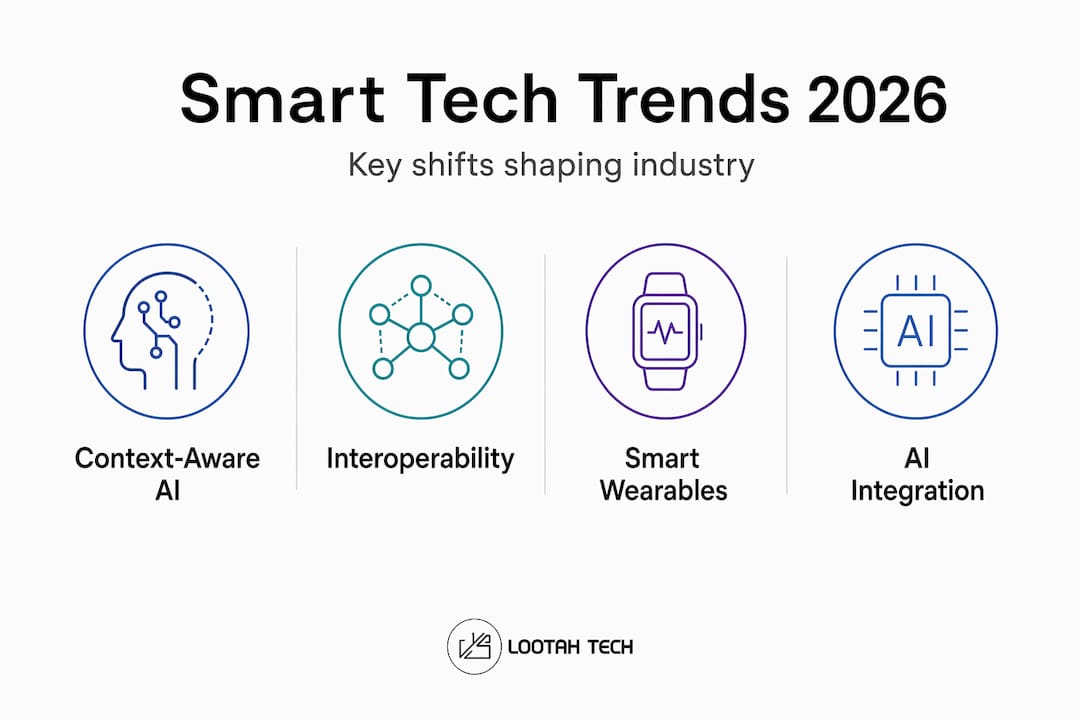
The second major shift is interoperability. For years, smart home technology suffered from a fragmentation problem. Your Philips lights did not talk to your Samsung thermostat, and your Google speaker could not control your Apple TV without workarounds. The Matter protocol resolves this by standardizing communication across devices from different manufacturers, so everything works on the same network without brand-specific hubs cluttering your setup.
Pro Tip: When evaluating smart devices for home or office use, check for Matter certification before purchasing. It future-proofs your investment by guaranteeing cross-brand compatibility as your setup grows.
On the wearables front, the trajectory is moving from wrist-based fitness tracking toward multifunctional smart glasses. Smart glasses integrating AR and AI are designed to deliver hands-free digital experiences, reducing dependence on smartphones for navigation, communication, and information lookup. For professionals in fields like construction, surgery, or field service management, this shift has real operational implications.
You can also look at top technology trends for 2026 to understand how AI, IoT, and smart workplace integration are reshaping competitive positioning across industries.
My perspective on smart technology adoption
I have worked alongside organizations at very different stages of technology adoption, and the pattern I see most often is not that the technology fails. It is that the integration does.
Companies bring in smart devices without connecting them to a centralized data platform. Homeowners install five different smart gadgets that require five separate apps and do not actually talk to each other. The technology is capable; the setup is fragmented. That gap is where the frustration lives.
What I have come to believe is that the most effective smart technology implementations start small, with one clearly understood problem, and build outward. A logistics company that starts with smart inventory sensors before touching AI-driven demand forecasting will get more value than one that tries to deploy every AI-driven business strategy simultaneously.
The Matter protocol and edge AI are genuinely significant developments because they remove two of the biggest adoption barriers: incompatibility and privacy concerns. But the human side still needs attention. People need to understand what the system is doing, trust the data it produces, and know how to act on what it tells them.
My honest advice: treat smart technology as infrastructure, not a feature. The businesses and individuals getting the most out of it are not chasing novelty. They are solving specific operational problems with reliable, connected systems, and then expanding from there.
— YS
Ready to put smart technology to work?
If this article has clarified what is smart technology and made you think about how it applies to your own operations, the logical next step is figuring out where AI and machine learning specifically fit into your business.
Yslootahtech specializes in helping organizations across the Middle East and beyond build AI-driven systems that do real work, not just impressive demos. From custom machine learning models to full IoT integration and digital transformation consulting, the team brings both technical depth and industry context. Whether you are starting from scratch or looking to connect existing systems into a smarter architecture, explore AI and machine learning services at Yslootahtech to see how the right implementation can change what your business is capable of.
FAQ
What is the definition of smart technology?
Smart technology refers to interconnected, network-enabled devices that use sensors, AI, and data analytics to operate autonomously or adapt to user behavior. The term traces back to the 1990s SMART acronym: Self-Monitoring, Analysis, and Reporting Technology.
What are examples of smart devices?
Examples of smart devices include smart thermostats, fitness wearables, AI-powered refrigerators, industrial IoT sensors, and smart speakers. Each combines sensors, connectivity, and processing to collect and act on data without constant manual input.
How does smart technology work?
Smart technology follows a sense-transmit-process-act loop. Sensors gather data, which is sent to a processing layer (cloud or edge), analyzed by AI or algorithms, and then used to trigger an automatic response or alert the user.
What are the main benefits of smart technology?
The benefits of smart technology include energy savings (smart thermostats cut bills by roughly 10% annually), productivity gains through automation, faster business decision-making, and the broader economic potential of AI as a general-purpose technology.
What is the Matter protocol and why does it matter?
Matter is a communication standard that allows smart devices from different manufacturers to work together on the same network. It solves the historic fragmentation problem in smart home technology by removing the need for brand-specific hubs.