What is data privacy? A compliance guide for businesses

TL;DR:
- Data privacy involves controlling how personal information is legally collected, used, stored, and shared, distinct from data security. Many organizations mistakenly equate security with compliance, risking penalties for improper data handling despite having strong security measures. With 20 US states enacting privacy laws in 2026, businesses must adopt comprehensive governance, operationalize consumer rights, and treat privacy as a strategic function to ensure lawful data processing.
Most business owners assume that locking down their systems is enough. If the data is protected, the thinking goes, then the business is compliant. That assumption is expensive. What is data privacy, really? It is not just a firewall or an encrypted database. Data privacy governs how personal information is collected, used, stored, and shared, and whether all of that happens lawfully. Security is one layer. Privacy is the entire framework. And in 2026, with 20 US states enforcing their own privacy laws, the gap between "secure" and "compliant" can cost your business more than a breach ever would.
Table of Contents
- What is data privacy and how does it differ from data security?
- Current data privacy regulations affecting US businesses in 2026
- Core data privacy principles guiding lawful data handling
- Practical steps and best practices to ensure data privacy compliance
- The overlooked truth about data privacy compliance in 2026
- How YS Lootah Tech supports your data privacy compliance journey
- Frequently asked questions
What is data privacy and how does it differ from data security?
The data privacy definition that matters for compliance is this: privacy is the right of individuals to control how their personal information is handled, and the obligation of businesses to honor that control. Data privacy concerns the proper handling of sensitive and personal data to meet regulatory requirements, distinct from data security which protects data from external and internal threats.
Data security answers the question: is this data protected? Data privacy answers a harder question: do we have the right to hold and use this data in the first place?
Here is where most organizations go wrong. Businesses frequently confuse the two terms and mistakenly believe that keeping personal and sensitive data secure means compliance with data privacy laws. It does not. A company can have zero breaches and still face regulatory penalties for collecting data without proper consent, using it beyond its stated purpose, or failing to honor a consumer's deletion request.
Understanding data security vs data privacy as separate disciplines helps clarify your compliance obligations. The importance of data security is real, but security alone does not fulfill privacy law requirements.
Key distinctions at a glance:
- Data security protects data from unauthorized access, theft, and breaches through technical controls
- Data privacy ensures data is collected lawfully, used only for disclosed purposes, and shared only with appropriate consent
- Privacy compliance requires documented policies, consumer rights workflows, and regulatory alignment
- Security without privacy can still result in enforcement actions, fines, and reputational damage
"Privacy is about lawful and ethical data use. Security is the mechanism that supports it. You need both, but they are not interchangeable."
Current data privacy regulations affecting US businesses in 2026
If you operate in the United States, the regulatory picture is more complicated than most businesses realize. As of Q1 2026, 20 US states have comprehensive privacy laws with consumer rights such as data access, deletion, correction, and opt-out, applying to businesses based on consumer data volume or data sales revenue. There is no single federal law governing all of it yet.
Here is a snapshot of how several state laws compare on key compliance thresholds:
| State | Consumers threshold | Sensitive data opt-in required | Universal opt-out honored |
|---|---|---|---|
| California (CPRA) | 100,000 consumers | Yes | Yes (Global Privacy Control) |
| Texas (TDPSA) | No volume threshold | Yes | Yes |
| Indiana | 100,000 consumers | Yes | No requirement |
| Rhode Island | 35,000 consumers | Yes | Yes |
| Kentucky | 100,000 consumers | Yes | No requirement |
The federal landscape may shift soon. The SECURE Data Act, proposed in April 2026, would create a federal privacy framework with opt-in consent requirements for sensitive data, potentially preempting state laws and applying to businesses processing data of at least 200,000 consumers annually with $25 million in revenue.
What this means for your compliance planning right now:
- Multi-state businesses must track thresholds and rights requirements across all 20 states
- Sensitive personal information categories vary by state and trigger stricter consent rules
- Universal opt-out signals like Global Privacy Control must be honored by several states already
- A comprehensive privacy laws overview can help map current exposure before the federal framework arrives
- Understanding the connection between privacy laws and cybersecurity is critical for building integrated compliance programs
The practical takeaway: assume you are subject to more laws than you think, especially if your customer base crosses state lines.
Core data privacy principles guiding lawful data handling
Principles matter because they give your compliance program a foundation that survives regulatory changes. The two most referenced frameworks globally are the GDPR's seven core principles and the NIST Privacy Framework.
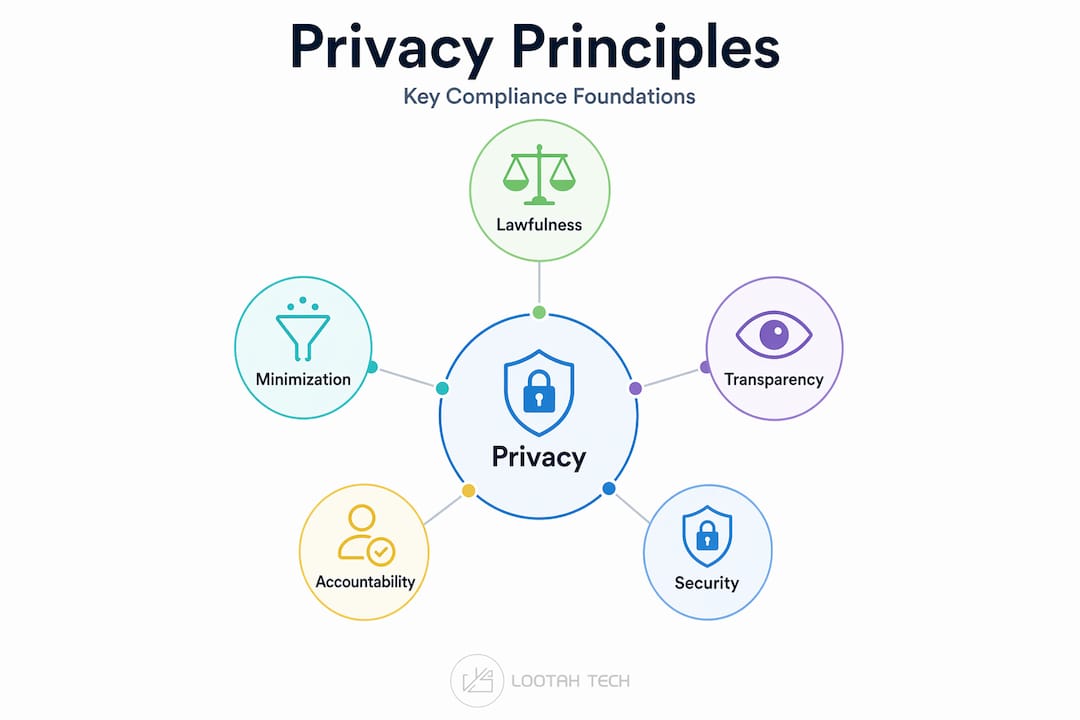
GDPR's seven key principles require lawful, fair, and transparent processing, data minimization, purpose limitation, accuracy, storage limitation, integrity and confidentiality, and accountability. Even if your business is US-based, these principles align with virtually every state privacy law and serve as a practical compliance checklist.
The NIST Privacy Framework 1.1, updated in April 2025, describes five core functions: Identify, Govern, Control, Communicate, and Protect, to manage privacy risks systematically. It is designed to work alongside the NIST Cybersecurity Framework, which reinforces the point that security and privacy are related disciplines, not the same one.
Here is how the core data protection principles translate into business obligations:
| Principle | What it means in practice |
|---|---|
| Lawful basis | You must have a legal reason to process each type of personal data |
| Data minimization | Collect only what you actually need for a defined purpose |
| Purpose limitation | Do not use data for anything beyond what you told users at collection |
| Accuracy | Keep personal data current and correct it when users request |
| Storage limitation | Do not keep data longer than necessary; set retention schedules |
| Accountability | Document your compliance decisions so you can prove them |
The NIST Privacy Framework overview provides a useful starting point for operationalizing these principles. Data minimization best practices are especially relevant for businesses modernizing their IT infrastructure, where legacy systems often over-collect without anyone realizing it.
Pro Tip: Assign a named owner to each data category in your systems. When that person can explain why each field is collected and where the retention schedule lives, you have moved from policy to accountability.
Practical steps and best practices to ensure data privacy compliance
Knowing the principles is one thing. Operationalizing them is where most programs break down. Here is a sequence that actually works.
-
Conduct a Privacy Impact Assessment (PIA) before launching new systems. PIAs can identify 30 to 50 percent more vulnerabilities than standard audits, making them a front-loaded risk management tool rather than a reactive one.
-
Map your data flows with state thresholds in mind. Know exactly which data you collect, where it goes, who can access it, and which state laws apply based on your consumer population.
-
Implement privacy by design, not privacy by patch. Granular, revocable consent and automated data subject rights fulfillment can prevent up to 80 percent of common violations. Build consent management into your applications from the start rather than retrofitting it later.
-
Schedule routine privacy tune-ups. Regular privacy checkups including app permission reviews, disabling unnecessary location access, and clearing session data reduce unexpected exposure. This applies to both consumer-facing products and internal business tools.
-
Automate consumer rights fulfillment. Data access, deletion, and correction requests have legally mandated response windows. Manual processes fail at scale. Automate them.
-
Review vendor and third-party contracts. Every third party that touches personal data is your compliance risk. Data processing agreements must reflect current regulatory requirements.
"Privacy by design means building the fence before the horse bolts. Retrofitting compliance into a live system costs three to five times more than building it in from day one."
Privacy compliance best practices require ongoing attention, not a one-time audit. Similarly, privacy impact assessments should be a standing part of your product development process, not an afterthought.
Pro Tip: Set calendar reminders every quarter to review third-party data access. Vendors change their practices and ownership. A tool that was compliant when you onboarded it may not be compliant today.

The overlooked truth about data privacy compliance in 2026
Here is the uncomfortable reality most compliance guides skip: having a privacy policy does not mean you are compliant. Having a consent banner does not mean it works. And the businesses most likely to face enforcement are not the ones with no policies. They are the ones whose policies exist on paper but have never been tested in practice.
Strong data security does not automatically mean privacy compliance. Privacy requires documented lawful use, transparency, and operationalizing consumer rights. That means when a consumer submits a deletion request, something actually happens within the required timeframe. That workflow needs to be tested, not assumed.
The threshold miscalculation is another real problem. States like Rhode Island with a 35,000-consumer threshold can trigger enforcement actions that surprise businesses which assumed they were too small to matter. If you have not checked every state where your consumers live against their applicable thresholds, you have blind spots.
The businesses that handle this well share one trait: they treat privacy as a governance function, not a legal formality. That means documented decisions, tested workflows, and assigned accountability. It means reviewing data privacy operational challenges as a standing agenda item, not a one-time project.
What is personal data security without privacy governance? It is a locked room with an open ceiling. The technical protection is there, but the legal and ethical framework that tells you who should be in the room is missing. That gap is where enforcement happens.
How YS Lootah Tech supports your data privacy compliance journey
Navigating 20 state privacy laws while keeping your systems functional and your users' trust intact is not a problem you should solve with spreadsheets and guesswork.
YS Lootah Tech builds applications with privacy by design baked in from the architecture stage, not retrofitted after launch. Their data protection services align with current US state laws and global frameworks including GDPR, so your compliance posture covers both domestic and international exposure. For businesses using or building intelligent systems, their AI and machine learning solutions incorporate data minimization and lawful processing standards from the ground up. The result is a technology environment where compliance is operational, not theoretical, and where consumer rights workflows are automated rather than manual and error-prone.
Frequently asked questions
What is the difference between data privacy and data security?
Data privacy governs how personal data is collected, used, and shared lawfully, while data security protects data from unauthorized access and breaches. Data security protects data from compromise, whereas data privacy governs data collection, sharing, and use.
Which US states have comprehensive data privacy laws in 2026?
Twenty US states have comprehensive privacy laws effective in 2026, including Indiana, Kentucky, and Rhode Island, each granting consumers rights like access, deletion, and opt-out.
What are the key principles of GDPR that businesses should follow?
Key GDPR principles include lawful and transparent processing, data minimization, purpose limitation, accuracy, storage limitation, security, and accountability. GDPR's seven core principles apply to any organization handling the personal data of EU residents, regardless of where the business is located.
How can businesses prepare for multi-state privacy compliance?
Businesses should map their data flows by state thresholds, honor universal opt-out signals like Global Privacy Control, and automate consumer rights workflows to ensure compliance. Mapping data flows per state thresholds and honoring Global Privacy Control is essential for multi-state US compliance in 2026.
What is the SECURE Data Act and how does it affect businesses?
The SECURE Data Act is a proposed federal privacy law that would apply to US businesses processing personal data of at least 200,000 consumers annually with $25 million in revenue, requiring opt-in consent for sensitive data. The SECURE Data Act would potentially preempt existing state laws, simplifying multi-state compliance but raising the national baseline for consent requirements.