Unlock the business value of digital sustainability

TL;DR:
- Digital sustainability uses technology to measure and reduce emissions across the entire value chain.
- Organizations must adopt frameworks like Web Sustainability Guidelines and lifecycle assessment for effective impact.
- Digital efficiency gains can lead to increased consumption due to rebound effects, requiring demand management.
The digital world appears efficient, but data centers alone account for roughly 1.5% of global greenhouse gas emissions. That number is growing, and it sits awkwardly alongside the assumption that going digital automatically means going green. For business leaders navigating efficiency demands, investor scrutiny, and tightening regulations, digital sustainability is no longer optional. This guide walks you through what the concept actually means, the structural frameworks that support it, the hidden paradoxes that trip organizations up, and the practical steps you can take to make digital sustainability a genuine business advantage rather than a marketing checkbox.
Table of Contents
- What is digital sustainability and why does it matter?
- Key pillars and frameworks for digital sustainability
- Digitalization paradoxes: Efficiency gains, rebound effects, and hidden impacts
- Actionable strategies for integrating digital sustainability
- A new mindset: Moving beyond greenwashing to real digital impact
- Transform your business with digital sustainability expertise
- Frequently asked questions
Key Takeaways
| Point | Details |
|---|---|
| Digital sustainability defined | It means embedding carbon tracking and reduction in business strategy using digital tools. |
| Frameworks guide action | Use standards like the Web Sustainability Guidelines to structure your approach. |
| Beware hidden impacts | Efficiency gains can be canceled out by increased digital demand and overlooked emissions. |
| Strategic integration pays off | Prioritizing sustainability in digital strategy delivers measurable performance and innovation gains. |
What is digital sustainability and why does it matter?
Before you can act, you need a working definition. Digital sustainability uses digital technologies and data to measure, track, and reduce carbon emissions across operations, products, and ecosystems. Notice that the definition is not about reducing your tech footprint in isolation. It is about using technology as a lever to drive sustainability across your entire value chain, from procurement through delivery to end-of-life product management.
This distinction matters enormously for business strategy. When leaders treat digital sustainability as an IT compliance issue, they miss the broader opportunity. When they treat it as a strategic capability, it opens doors to better customer relationships, lower operating costs, and new revenue streams from innovation.
"Digital sustainability is not a constraint on business growth. It is a new foundation for competitive advantage."
Why this topic is urgent now
Four distinct forces are driving digital sustainability from the boardroom agenda onto the operations plan.
First, regulation is accelerating. The European Union's Corporate Sustainability Reporting Directive and the UAE's net-zero by 2050 agenda are pushing organizations toward mandatory emissions disclosures. Penalties for non-compliance are real, and they grow heavier each reporting cycle.
Second, stakeholders are watching. Institutional investors, corporate clients, and even end consumers are factoring sustainability credentials into their decisions. A weak digital sustainability posture can cost you contracts before the pitch meeting even ends.
Third, costs are rising. Energy is a growing line item for any technology-intensive business. Organizations that optimize their digital infrastructure for efficiency reduce that cost directly. Those that don't are essentially subsidizing waste.
Fourth, innovation advantages are real. Sustainability-focused organizations are building new capabilities in data management, AI-driven optimization, and circular economy modeling that have direct commercial value beyond the environmental benefit.
The numbers that make the case
| Digital activity | Estimated environmental impact |
|---|---|
| Global data centers | ~1.5% of global GHG emissions |
| Internet infrastructure overall | ~3.7% of global carbon emissions |
| Streaming video annually | ~300 million tons of CO2 equivalent |
| Cryptocurrency mining (Bitcoin) | Comparable to some medium-sized nations |
| Enterprise IT hardware lifecycle | Significant embodied carbon, often untracked |
These figures are not intended to alarm you into avoiding technology. They are a prompt to use technology more deliberately.
Risks of ignoring digital sustainability include:
- Reputational damage when supply chain emissions are disclosed publicly
- Regulatory fines and reporting failures as disclosure rules tighten
- Rising energy and infrastructure costs with no mitigation strategy
- Loss of enterprise clients who require sustainability audits from vendors
- Talent attrition, as purpose-driven employees increasingly choose employers with credible environmental commitments
Understanding sustainability in tech at an enterprise level is the first step toward turning awareness into action.

Key pillars and frameworks for digital sustainability
With a solid definition in place, the next question is structural. What proven principles and frameworks should you actually work within?
The most relevant global standard for digital products is the Web Sustainability Guidelines, or WSG. The WSG principles provide a set of principles including clean, efficient, open, honest, regenerative, and resilient design, along with detailed success criteria for building sustainable web products and services. Think of the WSG as the sustainability equivalent of web accessibility guidelines. They give your development and design teams something concrete to measure against.
Beyond the WSG, two other frameworks deserve space in your planning conversations.
Lifecycle assessment (LCA) is a methodology for tracking the total environmental impact of a product or service from raw material extraction through manufacturing, use, and disposal. For technology companies, this means accounting not just for the electricity your servers consume today, but for the emissions embedded in the hardware itself when it was manufactured. This is a discipline that most organizations skip because it is uncomfortable and complex. But it is essential for honest reporting.
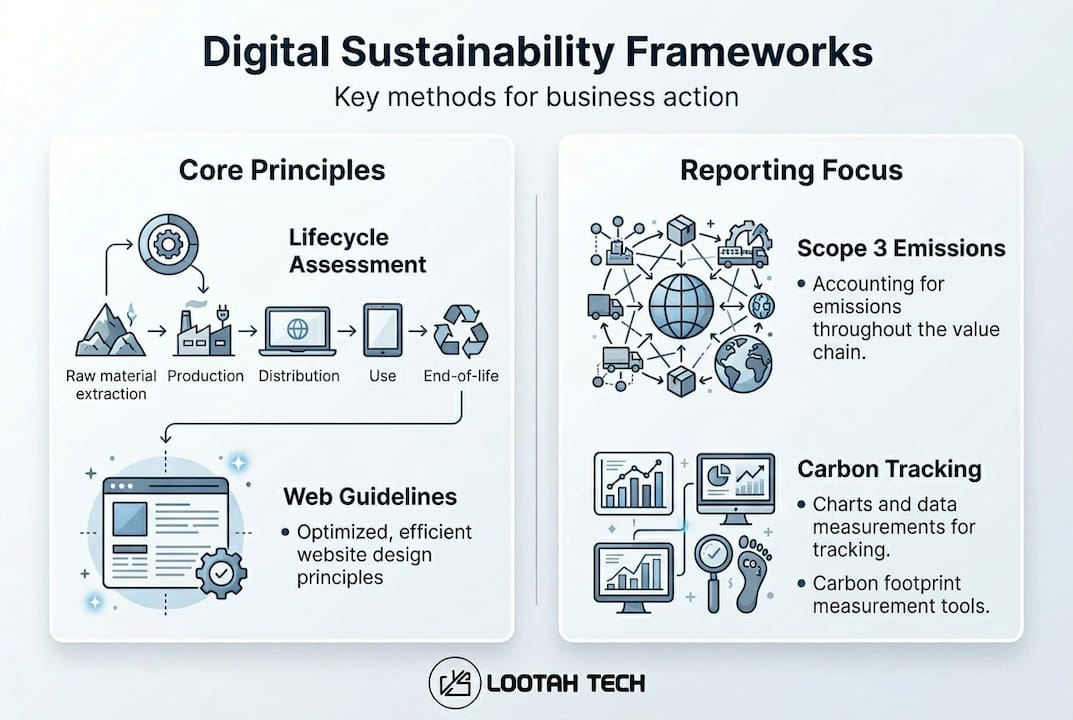
Scope 3 carbon accounting extends your emissions inventory beyond what you directly control. Scope 1 covers direct emissions from your own operations. Scope 2 covers purchased energy. Scope 3 covers everything in your value chain, including the energy your software consumes on customers' devices and the manufacturing footprint of hardware your suppliers produce.
Frameworks at a glance
| Framework | Primary focus | Best for |
|---|---|---|
| Web Sustainability Guidelines (WSG) | Digital products and services | Development and design teams |
| Lifecycle assessment (LCA) | End-to-end environmental impact | Product strategists and procurement |
| Scope 3 accounting | Supply chain emissions | CFOs and sustainability officers |
| PPP (Planet, People, Prosperity) | Balanced value creation | Executive strategy and governance |
Steps to align your organization with a framework
- Audit your current state. Map your digital infrastructure and identify your biggest energy consumers, from data centers to employee devices to customer-facing applications.
- Select one primary framework. Attempting to implement all frameworks simultaneously leads to analysis paralysis. Choose the one that aligns with your stakeholder demands and build from there.
- Set measurable targets. Vague commitments are easy to make and easy to miss. Define specific percentage reductions with deadlines tied to your reporting calendar.
- Assign accountability. Sustainability targets without clear ownership do not get executed. Assign cross-functional responsibility that includes operations, IT, legal, and finance.
- Report transparently. Publish your progress, including setbacks. Credibility with stakeholders requires honesty, not just good news.
Pro Tip: Avoid fixating solely on Power Usage Effectiveness, or PUE, as your single sustainability metric. PUE measures data center energy efficiency but tells you nothing about the embodied carbon in your hardware, the sustainability of your energy source, or the lifecycle impact of your software. Use it as one signal, not the whole story.
Staying aligned with top technology trends and grounding your approach in a well-designed digital strategy will help you implement these frameworks with much greater precision and consistency.
Digitalization paradoxes: Efficiency gains, rebound effects, and hidden impacts
Here is a reality that most sustainability reports avoid: digitalization does not automatically reduce environmental impact. In many cases, it amplifies it. Understanding these paradoxes is what separates business leaders who manage sustainability strategically from those who manage it cosmetically.
The most important concept here is the rebound effect. When digital efficiency improvements make a process cheaper or faster, they often generate greater overall demand for that process. Streaming a movie at home uses less energy than driving to a theater, but the efficiency of home streaming has enabled people to consume far more video content than they ever did before. Net result: energy consumption goes up, not down.
The same logic applies in industrial settings. When IoT sensors make a manufacturing line 20% more efficient, the business often responds by running the line longer or expanding capacity. The efficiency gain does not translate to a 20% reduction in energy use. It frequently results in higher total output and higher total energy consumption.
"Efficiency without demand management is not sustainability. It is just faster consumption."
The AI energy paradox
AI efficiency gains grew roughly 2.5x between 2020 and 2025, but compute demand grew approximately 10x over the same period. The hardware required to train and run large AI models consumes enormous amounts of energy, and edge computing devices add embodied carbon that rarely appears in sustainability reporting.
This is not an argument against AI. It is an argument for being intentional about which AI investments you prioritize and how you account for their true environmental cost.
Research on digitalization's decarbonization impact shows a U-shaped relationship in advanced economies, where early digital adoption reduces emissions but later-stage saturation can increase them. In emerging markets, the curve is inverted, meaning early digital expansion often raises emissions before they come down. This regional nuance matters if your operations span multiple geographies.
Top overlooked pitfalls for leaders:
- Counting renewable energy certificates as equivalent to actual on-site renewable generation
- Ignoring the embodied carbon in hardware procurement when calculating your digital footprint
- Treating software efficiency improvements as permanent without accounting for demand growth
- Reporting Scope 1 and 2 emissions while leaving Scope 3 entirely unexamined
- Assuming cloud migration automatically reduces your environmental impact without auditing your cloud provider's energy sourcing
Exploring practical efficiency boost strategies in your specific context will help you design digital investments that create genuine sustainability gains rather than technical efficiencies that are quickly consumed by expanded demand.
Actionable strategies for integrating digital sustainability
Understanding the paradoxes does not mean accepting paralysis. It means designing your digital sustainability program with open eyes. Here is how to move from strategy to real organizational change.
Build measurement before you build targets
You cannot reduce what you cannot see. Start by deploying digital measurement capabilities that give you accurate, real-time visibility into energy consumption, hardware utilization, software efficiency, and supply chain emissions. AI-powered energy management tools, IoT sensor networks, and digital twin modeling are all proven instruments for this work.
A practical implementation roadmap:
- Establish your baseline. Document your current energy consumption, hardware inventory, software portfolio, and known Scope 3 exposure. This is your starting point for every future comparison.
- Implement monitoring infrastructure. Deploy energy meters, cloud cost monitoring, and application performance tracking. You need data at granular levels, not just aggregate figures.
- Identify your highest-impact reduction opportunities. In most organizations, a small number of systems account for a disproportionate share of energy use. Find those systems first.
- Redesign for efficiency by default. Build sustainability requirements into your software development lifecycle, procurement criteria, and infrastructure architecture decisions. It is far cheaper to design sustainably than to retrofit.
- Integrate into governance. Embed sustainability KPIs into quarterly business reviews and executive dashboards. Make them as visible and urgent as revenue and margin metrics.
- Iterate and report. Sustainability is not a project with an end date. Build cycles of continuous measurement, adjustment, and transparent reporting into your operating rhythm.
Benefits that leading organizations are already realizing:
- Reduced energy and infrastructure costs through right-sizing and workload optimization
- Faster regulatory compliance with lower legal and audit costs
- Stronger brand positioning with enterprise clients who require sustainability credentials
- Higher employee engagement from purpose-driven organizational identity
- Revenue from innovation, with top-quartile sustainability performers seeing 53% more revenue from innovation, 22% higher circularity, and 13% better customer experience scores
Pro Tip: Establish a digital waste governance policy that requires regular audits of unused software licenses, idle cloud resources, and redundant data storage. In most organizations, digital waste accounts for 20 to 30% of IT spend. Eliminating it reduces costs and emissions simultaneously, making the business case for sustainability practically self-funding.
Following a proven digital transformation roadmap and drawing on innovative tech strategies will give you the structural and operational foundation to embed these practices sustainably across your organization.
A new mindset: Moving beyond greenwashing to real digital impact
We see a consistent pattern with organizations that are serious about digital sustainability versus those that are performing it. The performers buy carbon offsets, publish sustainability reports, and migrate workloads to cloud providers with green energy claims. The serious ones do something harder. They ask whether they needed that workload in the first place.
Carbon offsets are not irrelevant, but they are frequently a substitute for the harder work of demand reduction. Purchasing offsets to neutralize the emissions from a bloated software system is not sustainability. It is accounting. Real progress requires organizations to build humility into their technology decisions, accepting that more digital is not always better, and that the cheapest path to lower emissions is often using less, not using greener.
Lifecycle assessment is another underdeveloped capability. Most organizations have no idea what the true environmental cost of their hardware fleet is when you account for manufacturing. That ignorance is increasingly expensive as disclosure requirements expand.
The leaders who will win on digital sustainability over the next decade are those who pair genuine reduction ambitions with transparent, lifecycle-aware reporting. A strong tech strategy blueprint is essential for turning that ambition into operational reality.
Transform your business with digital sustainability expertise
Translating digital sustainability strategy into operational results requires more than frameworks and good intentions. It requires technology partners who build efficiency, transparency, and sustainability into every layer of your digital infrastructure.
At YS Lootah Tech, our custom application development services are designed to help you build software that performs efficiently and meets modern sustainability standards from day one. Our website development solutions incorporate clean architecture and optimized performance that reduce your digital carbon footprint without sacrificing user experience. Whether you are mapping your digital emissions baseline or building the measurement systems to track progress, our team is ready to work alongside you as a committed long-term partner in your sustainability journey.
Frequently asked questions
What are the main benefits of digital sustainability for my business?
Digital sustainability enhances operational efficiency, improves customer experience scores, and unlocks innovation-driven revenue. Companies prioritizing sustainability consistently outperform peers on both financial and environmental performance metrics.
How do I start measuring my company's digital carbon footprint?
Start with a digital infrastructure audit and deploy monitoring tools to capture energy use, hardware utilization, and software performance data. Digital sustainability practice centers on using technology to measure and track emissions before you can meaningfully reduce them.
Are there standards for digital product sustainability?
Yes, the Web Sustainability Guidelines provide a structured set of principles and measurable success criteria your development and design teams can use directly to build sustainable web products.
Is digital always more sustainable than analog?
Not automatically. AI and digital demand growth frequently outpaces efficiency gains, and rebound effects mean that digital efficiency improvements often drive higher total consumption rather than lower emissions overall.