How Innovation in Tech Drives Efficiency and Competitive Edge

TL;DR:
- Digital innovation creates measurable operational efficiency and competitive advantage through purposeful technology application.
- AI tools significantly boost developer productivity, reducing onboarding time and narrowing skill gaps.
- Successful innovation requires ongoing organizational commitment, governance, and integration, not just tool adoption.
Many established enterprises still treat digital innovation as a luxury reserved for startups, when the evidence tells a completely different story. AI tools boost developer productivity significantly across organizations of all sizes, and the measurable gains are hard to dismiss. This article breaks down exactly how technology innovation creates operational efficiency, where the real risks hide, and what frameworks business leaders can use to turn innovation from a buzzword into a competitive weapon. If you lead teams in a complex, fast-moving industry, this is the roadmap you need.
Table of Contents
- Understanding innovation's place in technology leadership
- Benchmarking the impact: How innovation transforms outcomes
- Where innovation goes wrong: Limits, risks, and lessons
- Making innovation stick: Operationalizing tech for competitive edge
- The real innovation advantage: What most leaders miss
- Drive innovation with proven tech partners
- Frequently asked questions
Key Takeaways
| Point | Details |
|---|---|
| Innovation delivers hard ROI | Embracing tech innovation produces measurable productivity gains and positions businesses ahead of the competition. |
| Risks require governance | Strategic innovation demands robust oversight to prevent automation errors or bias from emerging technologies. |
| Execution outweighs tools | Disciplined process and leadership buy-in matter more than adopting the latest technology alone. |
| Systematic approach wins | A structured, measured innovation roadmap sustains long-term advantage through ongoing improvements. |
Understanding innovation's place in technology leadership
After outlining the promise of innovation, it's critical to clarify what the term actually means to business technology leaders today. Innovation is frequently misunderstood. It is not about chasing every new tool or building something the market has never seen. In a business technology context, innovation means the purposeful application of emerging capabilities to create scalable, measurable value for your organization and its customers.
Think about it this way: purchasing a cloud platform is not innovation. Redesigning your entire service delivery model around that platform, eliminating three manual approval steps, and reducing customer wait time by 40% — that is innovation. The distinction matters because it determines where you invest, what you measure, and how you define success.
Understanding digital innovation basics is the starting point for every leader who wants to move from technology spending to technology leverage. Once you shift the definition from "new tools" to "purposeful transformation," the roadmap becomes much clearer.
What technologies actually qualify as drivers of this kind of transformation? The list is not as exotic as it sounds:
- Artificial intelligence and machine learning for predictive analytics, process automation, and decision support
- Advanced connectivity including 5G networks and edge computing that bring real-time data processing closer to operations
- Cloud-native architectures that allow organizations to scale services without proportional cost increases
- Cybersecurity platforms that protect the value created by all the above
- Robotics and automation for manufacturing, logistics, and repetitive back-office functions
"Government investments in frontier technologies highlight innovation's role in economic growth and resilience, creating sector-specific advancements that reshape entire industries from the ground up."
This is not just theory. National governments are backing frontier technology investment with significant public funds precisely because the economic multiplier effect is documented and real. When you translate that same logic to an enterprise context, the message is clear: strategic investment in innovation shifts competitive landscapes, and the organizations that act early capture the most value.
For leaders responsible for technology strategy, this means that digital transformation for CIOs is no longer an IT initiative. It is a core business strategy with direct implications for revenue, talent retention, and market position.
Benchmarking the impact: How innovation transforms outcomes
With the concept of innovation clarified, it's time to examine how its real-world application moves the performance needle for tech teams and entire organizations.
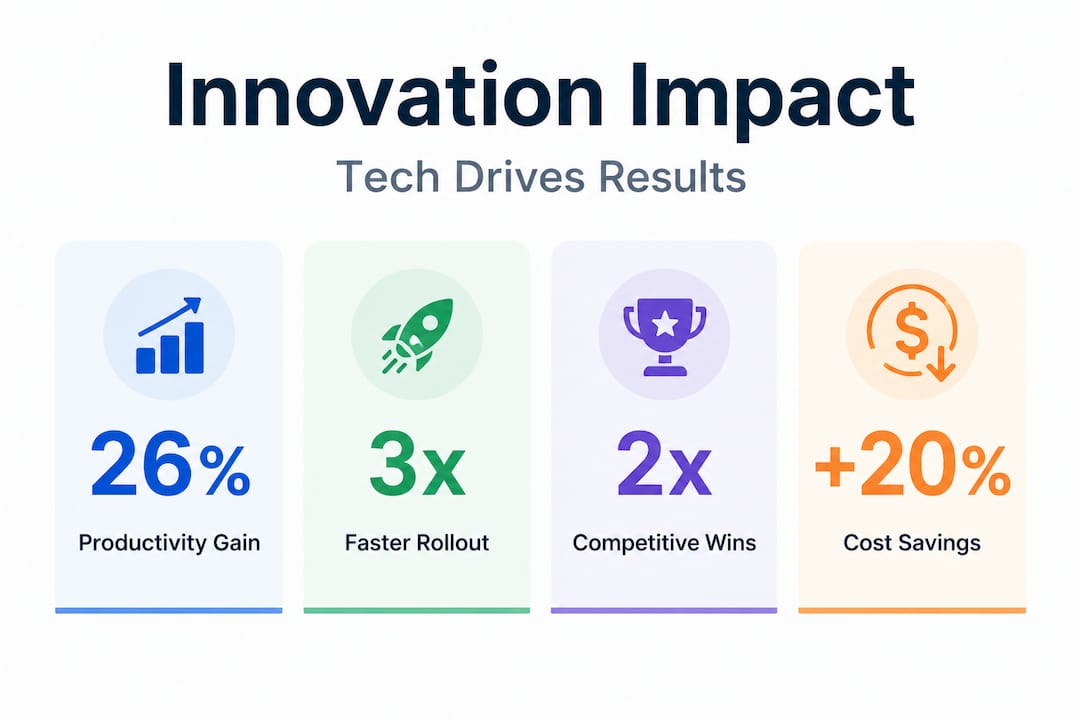
Leaders often struggle to get board-level buy-in for innovation investments because the business case relies on projections rather than hard data. That problem is now largely solved. A rigorous MIT study examined developers using GitHub Copilot, an AI-powered coding assistant, and the results were striking. Developers using AI tools saw 26% more completed tasks and a 13.55% increase in code commits compared to those working without assistance.
These are not marginal improvements. A 26% productivity increase in a development team of 20 engineers is effectively the same as adding five full-time contributors without increasing headcount.
| Metric | Without AI tools | With AI tools | Improvement |
|---|---|---|---|
| Tasks completed per sprint | Baseline | +26% above baseline | 26% gain |
| Code commits per developer | Baseline | +13.55% above baseline | 13.55% gain |
| Junior vs. senior gap | Wide | Noticeably reduced | Leveling effect |
| Onboarding time (estimated) | Longer | Accelerated | Faster ramp-up |
The data reveals something even more strategically important: junior developers benefited disproportionately from AI assistance. The performance gap between new team members and experienced engineers narrowed substantially. For organizations struggling with talent shortages or high turnover in technical roles, this finding is enormous. It means innovation tools do not just make your best people better — they raise the floor for your entire team.
Stat to remember: A 26% task completion increase translates directly to faster time-to-market, which is one of the most important competitive variables in technology-driven industries.
This data creates a clear obligation for leaders. When you are justifying a technology investment to a CFO or board, you now have benchmarks. You are not guessing. You can model the ROI of an AI development toolset against your current team size, average salary, and project backlog, and produce a number that makes sense on a spreadsheet.
Boosting efficiency with strategy requires exactly this kind of evidence-led thinking. Decisions made on real benchmarks — not vendor promises or industry hype — are far more likely to deliver on their projections.
Pro Tip: Before your next technology investment, run a controlled 30-day pilot with one team. Measure output before and after with the same KPIs used in the MIT study: tasks completed and commits per developer. You will have internal data that is far more persuasive to stakeholders than any third-party case study.
Where innovation goes wrong: Limits, risks, and lessons
While the promise is real, business leaders also need to understand where and why innovation efforts can backfire if not managed wisely.
The most dangerous moment in any innovation initiative is not the planning phase. It is right after an early win, when the team assumes the technology can handle everything and human oversight gets quietly reduced. That is when problems compound quickly.
Consider generative AI. The productivity data is genuinely compelling, but a critical finding from operations research cautions against full automation: frontier LLMs show strategic biases, underperform humans in high-uncertainty scenarios, and require Human-in-the-Loop (HITL) governance for reliable business outcomes. In other words, today's most capable AI models can make systematically poor decisions in edge cases — and they often do so with high confidence, which makes the errors harder to catch.
Common failure patterns observed across organizations include:
- Over-exploitation of the core business — AI systems optimized for current conditions may resist or deprioritize exploration of new opportunities, creating strategic blind spots
- Poor governance structures — No clear owner for AI outputs means errors propagate unchecked
- Lack of transparency — When teams do not understand how a tool makes recommendations, they cannot effectively challenge bad outputs
- Rushing implementation — Skipping the pilot phase to meet a launch deadline is one of the most reliably expensive shortcuts in technology leadership
- Absence of a rollback plan — If a new system underperforms, what is your path back? Organizations that do not plan for this get trapped
"The question is not whether AI can outperform humans on average tasks — often it can. The question is whether your governance model is robust enough to catch the cases where it fails badly."
This is why choosing digital solutions requires a structured evaluation of both capability and risk. Selecting a vendor or technology because it is popular, or because a competitor just adopted it, is not a strategy. It is a gamble.
The HITL principle deserves more attention than it typically gets in enterprise AI discussions. Human-in-the-loop means that for any high-stakes decision — financial transactions, customer communications, compliance-related outputs — a human reviewer remains part of the approval chain. The AI accelerates the work and surfaces options, but a trained person validates the final call.
Pro Tip: For any AI system making decisions that affect customers, revenue, or compliance, define in advance which outputs require human review. Build that checkpoint into your workflow before deployment, not after a problem occurs.
The governance lesson extends beyond AI. Cybersecurity gaps, rushed software releases, and poorly integrated cloud migrations have all caused significant business disruption for organizations that moved faster than their oversight structures could support. Innovation is not inherently risky. Unmanaged innovation is.
Making innovation stick: Operationalizing tech for competitive edge
Once risks are managed, the next move for leaders is to systematize innovation for sustainable advantage.

The difference between organizations that keep winning through innovation and those that plateau after one successful project comes down to one thing: they treat innovation as a repeating operational process, not a one-time initiative. Here is a practical framework for making that shift.
Phased innovation roadmap:
- Assess your current baseline — Measure existing process efficiency, output volume, and quality benchmarks before any technology is introduced. You cannot demonstrate improvement without a starting point.
- Identify the highest-leverage opportunities — Prioritize areas where productivity gains or risk reduction have the largest financial impact. Do not start with the hardest problem or the most exciting technology. Start where the ROI is clearest.
- Run a contained pilot — Test the technology with one team, one process, or one customer segment. Collect data over 30 to 90 days.
- Measure, adapt, and decide — Review pilot results against your baseline. Decide whether to scale, modify, or abandon based on the numbers.
- Scale with governance built in — When you expand the initiative, bring your oversight structures, training protocols, and rollback plans along with the technology.
- Establish a continuous review cycle — Schedule quarterly reviews of your innovation portfolio. Technologies evolve, and what was optimal 12 months ago may need replacing or updating.
A well-built digital transformation roadmap follows exactly this logic, moving from assessment through pilot to enterprise-wide adoption with governance intact at every stage.
One of the most useful decisions any leadership team makes is determining which innovation efforts to build internally versus which to source through strategic partners. Here is a simple decision matrix:
| Factor | Build in-house | Partner externally |
|---|---|---|
| Core competitive IP | Strong preference | Low preference |
| Speed to market | Slower | Faster |
| Specialized expertise needed | Difficult to hire | Available immediately |
| Ongoing maintenance burden | Fully yours | Shared or managed |
| Cost for non-core functions | Often higher | Often lower |
| Flexibility to scale or pivot | Moderate | High with right partner |
The lesson from frontier technology investment at a national level applies here: even governments with enormous internal resources choose to partner with industry, universities, and technology firms because specialization accelerates outcomes. The same principle works for enterprises.
AI in digital transformation across sectors like healthcare shows that the organizations achieving the most consistent results are not necessarily those with the largest internal technology teams. They are the ones with the clearest strategy and the right external partners executing against it.
The KPIs worth tracking across any innovation initiative include: output increase per team member, process cycle time reduction, time-to-market for new features or products, customer satisfaction scores tied to improved digital experiences, and competitive market share growth over a 12 to 24 month window.
The real innovation advantage: What most leaders miss
As this guide wraps up, it is worth zeroing in on what actually sets enduring innovation leaders apart from the rest.
Here is the uncomfortable truth most technology strategy articles skip: the majority of innovation failures have almost nothing to do with the technology itself. The AI worked. The platform was solid. The developer tools were exactly as advertised. What failed was the organization around them.
We have seen this pattern repeatedly. A leadership team authorizes a significant technology investment, the procurement goes smoothly, the implementation vendor delivers on scope, and then — nothing changes. The tools sit underused. The team defaults back to old workflows. Six months later, the initiative is quietly shelved. The technology was not the problem. The absence of genuine process integration and leadership buy-in was.
Shiny new tools without cultural alignment are just expensive software licenses. Leaders who treat innovation as a project to be completed rather than a capability to be developed will keep cycling through the same disappointing outcomes. The organizations that win over a five-year horizon are the ones that build innovation into their operating rhythm: regular retrospectives on technology performance, budget cycles that account for iteration, and leadership teams that model the behavior they want to see.
Cutting digital transformation failure starts with this mindset shift. When leadership owns the outcome rather than delegating it entirely to an IT function, the success rate improves dramatically.
The contrarian point worth making loudly: being an innovation leader does not mean being first. It means being smart and consistent. The organizations that repeatedly outperform do not bet everything on a single emerging technology. They build the organizational muscle to evaluate, pilot, measure, and scale innovation systematically. That muscle, once built, is a competitive advantage that is extremely difficult for competitors to replicate.
Drive innovation with proven tech partners
To bring innovation from strategy to reality, working with the right technology partner can make all the difference.
At YS Lootah Tech, we work with business leaders across industries to turn innovation strategy into real, measurable outcomes. Whether you need end-to-end custom application development that integrates AI capabilities directly into your operations, or modern UX/UI solutions that translate your digital experience goals into products your customers actually want to use, we bring the technical depth and industry experience to get it done right. Our team supports you through every stage: from initial assessment and pilot design through to full-scale deployment and ongoing optimization. If you are ready to move from planning to execution, we would like to help you build it.
Frequently asked questions
How does tech innovation improve operational efficiency?
By automating tasks, optimizing workflows, and enabling smarter decisions, tech innovation directly boosts efficiency and measurable outcomes. Empirical benchmarks confirm that AI tools alone can increase completed developer tasks by 26% without adding headcount.
What is the biggest risk when adopting new technology?
Common risks include poor governance, lack of integration, and over-relying on automation without human oversight in critical workflows. Research shows gen AI requires HITL governance to prevent systematic errors in high-stakes decisions.
Why should leaders prioritize innovation now?
Innovation delivers measurable gains in productivity, competitive positioning, and long-term organizational resilience when managed strategically and consistently. Frontier tech investments at the national level demonstrate the economic growth multiplier that applies equally to enterprise contexts.
How is AI specifically transforming business results?
AI adoption increases team output, speed, and quality, delivering up to 26% more completed technical tasks and measurably narrowing the performance gap between junior and senior team members.
What KPIs can measure successful innovation?
Output increase per team member, process cycle time reduction, time-to-market for new products, and competitive market share growth over 12 to 24 months are the leading indicators of successful innovation impact in enterprise environments.