How to scale enterprise applications for maximum efficiency

TL;DR:
- Incorrect scaling of enterprise applications can lead to costly failures and delays in digital transformation.
- A structured, data-driven approach starting with readiness assessment ensures effective and resilient scaling strategies.
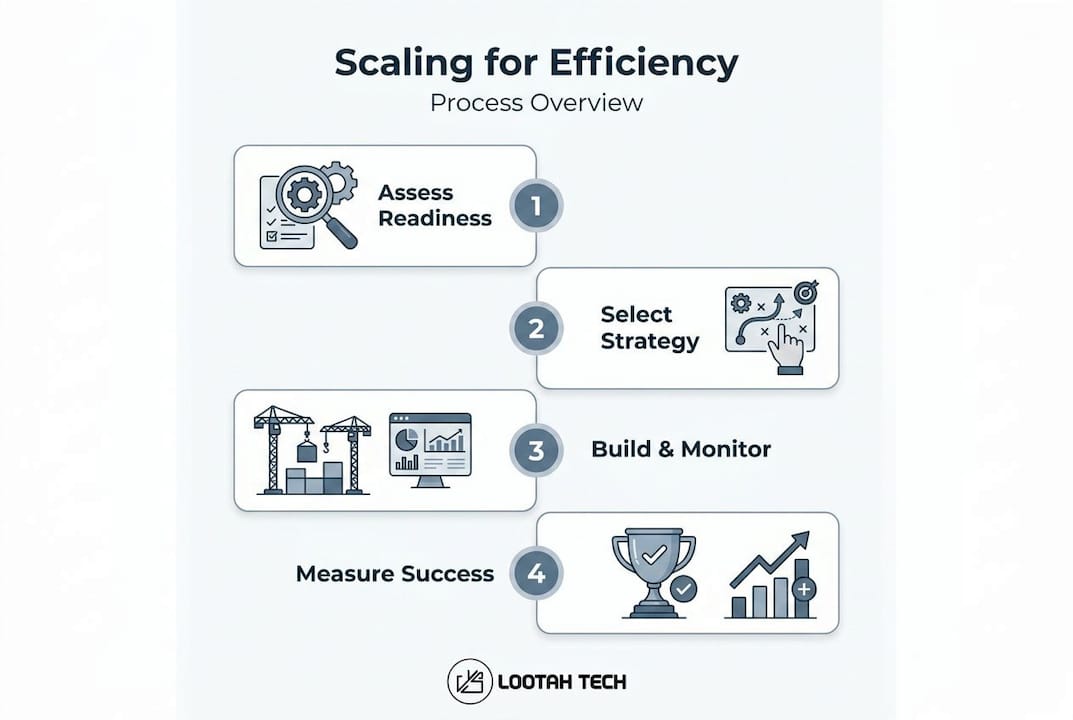
Scaling an enterprise application incorrectly is one of the most expensive mistakes an IT organization can make. A rushed migration to microservices, an under-resourced cloud lift-and-shift, or simply ignoring performance signals until a system collapses under load can stall digital transformation for months and cost millions in remediation. The good news is that scaling done right is a repeatable, data-driven process. This guide walks IT leaders through every phase of that process, from readiness assessment and strategy selection to execution, monitoring, and measuring outcomes.
Table of Contents
- Assessing readiness: prerequisites and planning for scale
- Choosing the right scaling strategy: vertical, horizontal, or diagonal?
- Step-by-step execution: building resilient and scalable architecture
- Operational resilience: monitoring, automation, and cost controls
- Measuring success: KPIs and verification after scaling
- Expert perspective: Why one-size-fits-all scaling doesn't work
- How YS Lootah Tech can accelerate your application scaling journey
- Frequently asked questions
Key Takeaways
| Point | Details |
|---|---|
| Start with readiness | Evaluate your current environment and align scaling with clear business goals before starting. |
| Pick strategy by context | Choose vertical, horizontal, or hybrid scaling based on user base, complexity, and operational requirements. |
| Focus on resilient execution | Build in observability, automation, and architectural adjustments to support real growth and resilience. |
| Measure and iterate | Use data-driven KPIs to verify outcomes and keep optimizing post-deployment. |
Assessing readiness: prerequisites and planning for scale
Having set the stage for why scaling matters, the next step is a structured evaluation of your existing application environment and readiness. Jumping straight into architecture changes without this baseline is like renovating a building without checking the foundation. You need to know what you have before you can plan what to build.
Start with a portfolio health check. Catalog every enterprise application, document dependencies, and capture baseline performance metrics including response times, error rates, throughput, and resource utilization under peak load. If you lack visibility into these metrics today, that gap itself is a blocker. Understanding enterprise application basics helps ensure your team shares a common language before engaging vendors or cloud providers.
Once you have your data, align your scaling strategy to concrete business objectives. Are you preparing for geographic expansion? A 5x increase in transaction volume? New integrations with third-party partners? Each scenario demands a different scaling posture.
Key prerequisites to confirm before any scaling work begins:
- Centralized monitoring and alerting in place
- Documented SLA targets per application tier
- CI/CD pipelines capable of rapid rollback
- Clear service ownership and on-call responsibilities
- Automation coverage for infrastructure provisioning
The Azure Well-Architected Framework advises starting with a portfolio health check and a modular monolith before scaling horizontally with containers or cloud, and only doing so when bottlenecks are proven via monitoring data. This is a critical distinction. Many teams prematurely invest in complex distributed systems before their monitoring even confirms a scaling problem exists. Use your deployment guide for IT leaders as a reference when structuring your readiness checklist.
| Readiness dimension | Minimum viable state | Target state |
|---|---|---|
| Monitoring coverage | Key app metrics captured | Full-stack observability with tracing |
| Deployment automation | Manual with scripts | Full CI/CD with automated testing |
| Architecture documentation | High-level diagrams | Dependency maps with SLA annotations |
| Team scaling knowledge | Basic cloud exposure | Hands-on container and IaC experience |
Pro Tip: Do not rush into microservices or complex distributed patterns until your monitoring data clearly identifies where bottlenecks are. Premature complexity is the number one driver of failed scaling projects.
Choosing the right scaling strategy: vertical, horizontal, or diagonal?
Once you've assessed readiness, the crucial next step is to pick a scaling strategy fit for your context. Three primary approaches exist, and the right one depends on your application's architecture, expected user growth, team capabilities, and budget.
Vertical scaling means adding more resources to existing servers, more CPU, more RAM, more storage. It is simple to implement, requires no code changes, and works well for tightly coupled applications. The tradeoff is that hardware has hard limits, and a single server represents a single point of failure. Research on load test scenarios confirms that vertical scaling is most effective for applications serving fewer than 100,000 concurrent users.
Horizontal scaling distributes load across multiple instances, typically behind a load balancer. It removes single points of failure and theoretically offers unlimited scale. It demands stateless application design, session management changes, and more operational overhead. The same ICWS 2024 research shows horizontal scaling is best suited for applications expecting more than 1 million users.
Diagonal scaling, also called hybrid scaling, combines both. You scale up individual nodes for memory-intensive workloads while adding more nodes to handle concurrent traffic. According to software scalability research, hybrid and diagonal approaches often deliver the best efficiency for complex enterprise systems because they let you optimize at the workload level rather than applying a single rule to everything.
How to choose:
- Map each application to its expected peak load and growth trajectory
- Identify stateful vs. stateless components
- Calculate the cost of hardware upgrades vs. horizontal fleet expansion
- Assess your team's operational maturity for managing distributed systems
- Review whether hybrid cloud scaling options reduce the operational burden
- Use AI-powered scaling strategies to automate decision-making at scale
| Strategy | Best for | Main risk | Cost profile |
|---|---|---|---|
| Vertical | Under 100K users, legacy apps | Hard resource ceiling | Lower upfront, higher ceiling cost |
| Horizontal | Over 1M users, stateless services | Operational complexity | Scales linearly with demand |
| Diagonal | Complex, mixed-workload apps | Coordination overhead | Optimized when tuned correctly |
Pro Tip: Use real growth projections from your business unit, not theoretical benchmarks. An application growing 15% per year does not need the same scaling investment as one expected to handle a 10x load spike during peak season.
Step-by-step execution: building resilient and scalable architecture
Choosing an approach is only half the battle. Execution with the right architectural focus is where true scalability is realized. Many organizations select the right strategy on paper but stumble during implementation because they skip foundational steps.
Here is a reliable sequence for building scalable enterprise architecture:
- Modularize your application. Break large codebases into well-defined modules with clear interfaces. This does not require a full microservices migration. A well-structured modular monolith is often the right intermediate step, and it makes future decomposition far safer.
- Containerize workloads. Package services in containers using Docker and orchestrate them with Kubernetes. Containers make scaling individual components independent and repeatable across environments.
- Implement API gateways. A properly replicated API gateway prevents a single chokepoint from undermining your entire scaling effort. Without replication, the gateway itself becomes your bottleneck.
- Apply Domain-Driven Design (DDD) for service boundaries. DDD helps you identify where services naturally separate. Only decompose where boundaries are clear and where teams can own those services independently.
- Build for observability from day one. Distributed tracing, structured logging, and real-time dashboards are not optional extras in scaled environments. They are prerequisites for diagnosing failures quickly.
- Automate deployment with Infrastructure as Code (IaC). Tools like Terraform or Pulumi let you provision, version, and replicate environments reliably. Manual provisioning introduces variance that compounds at scale.
"The architecture pattern you choose today must be validated against real-world load data tomorrow. Commit to iteration, not perfection at launch."
One of the most important lessons from the field: monolithic architectures are not inherently bad. Some organizations that migrated back to a monolith from over-engineered microservices reported a 400% performance gain and a 72% cost reduction by eliminating the overhead of unnecessary service coordination. Microservices, on the other hand, deliver major benefits at true scale when teams are sized appropriately and service boundaries are well-defined. Context is everything.

Review proven enterprise app development steps when structuring your build phases to ensure nothing critical falls through the cracks.
Pro Tip: Avoid treating DDD and microservices as synonymous. Use DDD to find your bounded contexts, and then decide independently whether each context warrants its own service. Many do not, at least not yet.
Operational resilience: monitoring, automation, and cost controls
With execution underway, maintaining operational resilience and optimizing costs become long-term imperatives for IT leaders. A scaled architecture that is not monitored and governed will drift into instability and waste within months.
Real-time monitoring is the foundation. Every scaled system needs end-to-end distributed tracing, anomaly detection, and root-cause analysis tooling. When latency spikes in a distributed environment, you need to pinpoint the offending service within seconds, not hours. Platforms like Datadog, Grafana, and OpenTelemetry have become standard for enterprises at scale.
Auto-scaling is equally critical. Configuring dynamic scaling policies based on CPU, memory, or custom application metrics means your system can absorb traffic spikes without human intervention. This is not just a reliability feature. According to Aerospike's research on application scale, auto-scaling handles traffic spikes effectively, asynchronous processing reduces latency significantly, and caching combined with database optimizations can cut operational costs by 25 to 70 percent.
Key tactics for cost control and resilience in scaled environments:
- Implement caching layers (Redis, Memcached) to reduce database read pressure and latency
- Use database partitioning and read replicas to distribute query load
- Apply asynchronous messaging (Kafka, RabbitMQ) to decouple services and flatten load spikes
- Set cost budgets and alerts at the cloud account level to catch runaway scaling costs early
- Schedule non-critical batch workloads during off-peak hours to reduce peak resource demands
- Review enterprise app efficiency tips to identify quick wins before committing to infrastructure changes
25 to 70% cost reduction is achievable through caching and database optimization alone, without any architectural overhaul.
Infrastructure as Code also plays a role in cost control. When environments are defined in code, teams can spin up and tear down test environments on demand, eliminating the persistent idle infrastructure that quietly burns budget in many enterprises.
Measuring success: KPIs and verification after scaling
After operationalizing your newly scaled environment, measuring impact and iterating are key for long-term value. Without clear KPIs, you cannot tell whether your scaling investment is delivering returns or just increasing complexity.
The Azure Well-Architected Framework is clear: empirical data, not theoretical models, should drive scaling decisions, and ongoing monitoring informs where to iterate next.
| KPI | What it measures | Target benchmark |
|---|---|---|
| P99 response time | User experience under peak load | Under 500ms for web-facing apps |
| Uptime / availability | System reliability | 99.9% or higher per SLA |
| Resource utilization | Infrastructure efficiency | 60 to 80% average utilization |
| Deployment frequency | Engineering velocity | Weekly or more frequent releases |
| Cost per user | Economic efficiency of scale | Trending downward over time |
| Error rate | Application stability | Below 0.1% for critical paths |
Establishing these benchmarks before scaling begins is essential. Without a pre-scaling baseline, you cannot demonstrate improvement or justify future investment to stakeholders.
Effective measurement practices include:
- Set automated alerts when KPIs breach thresholds, not just after incidents occur
- Run quarterly capacity planning reviews using trend data, not point-in-time snapshots
- Share enterprise app success stories internally to align teams on what good outcomes look like
- Build a continuous feedback loop with business stakeholders so scaling priorities reflect revenue and customer experience goals, not just technical metrics
The goal is a living system of measurement that evolves alongside your application portfolio. Scaling is not a one-time project. It is an ongoing practice.
Expert perspective: Why one-size-fits-all scaling doesn't work
After working across diverse enterprise environments, we have seen a consistent pattern: the organizations that struggle most with scaling are not the ones with the hardest technical problems. They are the ones that followed a trend without validating it against their specific context.
The microservices movement is a perfect example. Heavily promoted from 2018 onward, it led hundreds of mid-market IT organizations to decompose perfectly functional monoliths into dozens of services before their teams had the operational maturity to manage them. The result was increased complexity, slower deployment cycles, and, ironically, worse performance. Contradictory evidence confirms this pattern consistently: monolithic architectures win for tightly coupled services or small teams, while microservices and hybrid architectures bring significant benefits only when the use case and data justify them.
The uncomfortable truth is that architecture decisions driven by conference talks and vendor marketing routinely cost more than the problems they were supposed to solve. Successful IT leaders we have observed share one trait: they insist on monitoring data before committing to architectural change. They run load tests. They measure. They pilot before they migrate.
We also believe the industry undervalues the organizational dimension of scaling. An architecture that your team cannot operate confidently is worse than a simpler one they understand deeply. Scaling capability lives in people and processes as much as it lives in code. Explore innovative tech strategies that treat architecture, people, and process as an integrated system rather than isolated technical decisions.
The bottom line: stay skeptical of universal prescriptions. Scale what the data tells you to scale, using the simplest architecture your team can operate reliably. That principle beats any trend.
How YS Lootah Tech can accelerate your application scaling journey
For IT leaders ready to take the next step, expert help can accelerate and de-risk your scaling journey significantly.

At YS Lootah Tech, we work with enterprises across the Middle East and beyond to design, build, and scale applications that perform under real-world demand. Whether you need guidance on your first cloud migration, a full enterprise application development engagement, or support integrating AI and machine learning services to automate scaling decisions, our team brings hands-on experience with the exact challenges this article describes. We do not sell cookie-cutter architectures. We start with your data, your team's capabilities, and your business objectives, and we build from there. Reach out for a consultation and let's define a scaling roadmap built around what your organization actually needs.
Frequently asked questions
When should we choose microservices over a monolith?
Choose microservices when your scaling requirements demand full service replication and you have clearly defined domain boundaries. Stick with a monolith when replication needs are low, the team is small, or services are tightly coupled, since microservices need full replication to justify their complexity cost.
What is diagonal scaling, and when is it optimal?
Diagonal scaling combines vertical and horizontal techniques to provide flexibility across mixed workloads. According to software scalability research, this hybrid approach often delivers optimal efficiency for complex enterprise systems where different components have different scaling profiles.
Which KPIs should we use to track application scalability?
The most important KPIs are P99 response time, uptime, resource utilization, deployment frequency, error rate, and cost per user. As the Azure Well-Architected Framework emphasizes, empirical data and continuous monitoring should drive all optimization decisions.
How does auto-scaling cut costs in enterprise applications?
Auto-scaling eliminates idle capacity by dynamically matching resources to actual demand, and combined with caching and database optimization, cost savings of 25 to 70% are achievable in production enterprise environments.
What's the biggest risk IT leaders face when scaling enterprise apps?
The biggest risk is over-engineering before monitoring justifies the complexity. Organizations that migrated back from microservices to simpler architectures have reported dramatic performance gains and cost reductions, proving that premature complexity is a real and costly threat.