Future of mobile app development: The business leader's guide

TL;DR:
- The future of mobile app development centers on agentic AI that observes context, makes decisions, and acts autonomously.
- Implementing such AI requires architectural changes focusing on security, performance, privacy, and scalable deployment.
Mobile apps stopped being static tools years ago. Today, the future of mobile app development points toward something more fundamental: apps that observe your context, make decisions, and act without being asked. For business leaders and IT decision-makers, this shift is not a trend to monitor from a distance. It is an architectural change that directly affects your competitive position, your operational costs, and how your customers experience your brand. This guide cuts through the noise and gives you the intelligence you need to act.
Table of Contents
- The rise of agentic AI in mobile apps
- API security and governance shaping mobile app backends
- Performance, AI integration, and the evolving user experience
- Navigating privacy and measurement challenges in mobile apps
- Applying future trends: A strategic framework for business leaders
- Why the future of mobile app development demands architectural rethinking
- How YS Lootah Tech helps you lead in mobile app innovation
- Frequently asked questions
Key Takeaways
| Point | Details |
|---|---|
| Agentic AI transformation | Mobile apps are evolving into proactive agents that act for users, requiring architectural shifts tied to business outcomes. |
| API security priority | Risk-based security during API development and runtime is essential to protect mobile app backends. |
| Performance as a feature | Fast, AI-enhanced user experiences impact retention and are mandatory for competitive apps. |
| Privacy regulation impact | Growing user consent for tracking changes personalization and data measurement strategies. |
| Strategic adoption framework | Start with focused AI use cases, incremental security, and human oversight for successful app innovation. |
The rise of agentic AI in mobile apps
The term "agentic AI" is gaining real traction, and for good reason. Unlike the AI features many apps bolted on between 2022 and 2024, agentic AI does not simply respond to input. It observes context, sets sub-goals, and completes tasks on behalf of users with minimal human prompting. Think of it less as a smarter chatbot and more as a capable digital colleague embedded in your app.
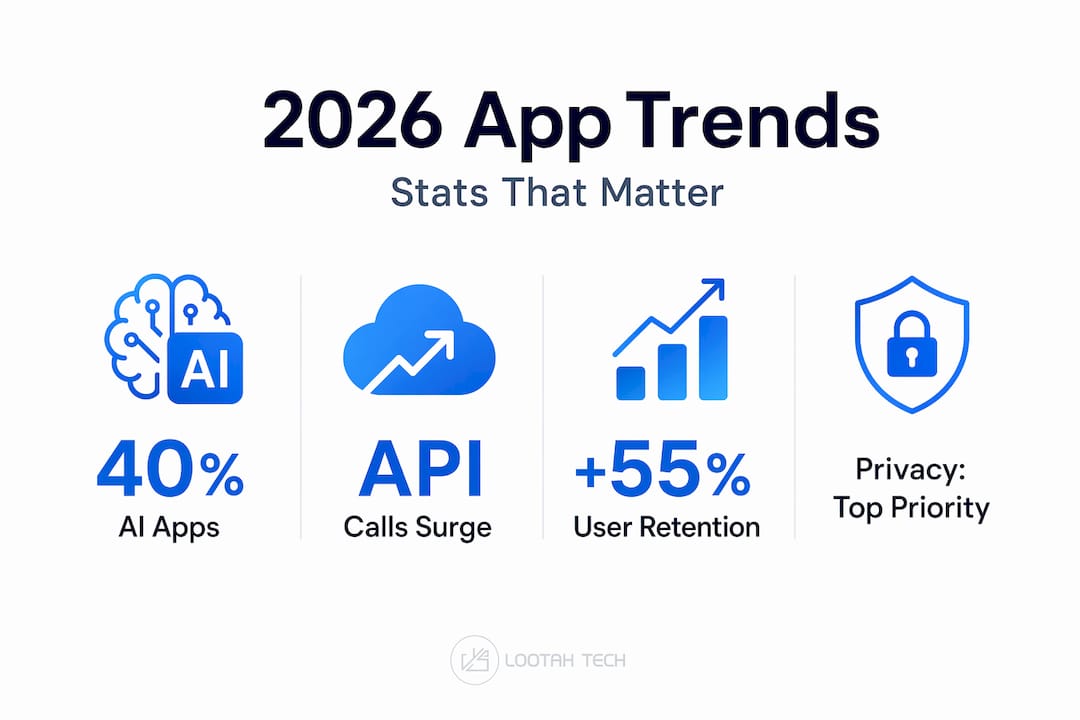
This distinction matters enormously for enterprise mobile app types built for operational workflows. Gartner predicts 40% of enterprise apps will feature task-specific AI agents by end of 2026. That is not a forecast about experimentation. That is a forecast about production deployment at scale.
Organizations seeing real returns are the ones linking AI to specific, measurable business outcomes. AI productivity gains are tangible when teams define success criteria before building, not after. The companies struggling are those chasing novelty without governance.
The practical warning here is what the industry calls "agent washing." Many product teams rebrand their existing chatbot flows as AI agents to capture budget or marketing attention. The result is technical debt, user disappointment, and failed ROI cases. Spotting the difference requires asking a pointed question: can this system initiate actions across multiple systems autonomously, or does it only respond to a single user input?
Key traits that separate genuine agentic AI from repackaged chatbots:
- It can call external APIs or services without a new user prompt
- It maintains memory of prior context across sessions
- It can interrupt a workflow if it detects an error or anomaly
- It generates sub-tasks from a single high-level instruction
- It escalates to a human when confidence is below a defined threshold
"The architectural shift from reactive to agentic is not a feature update. It is a redesign of how the app makes decisions, stores context, and connects to services." This distinction is what separates apps that deliver real efficiency from apps that merely look intelligent.
API security and governance shaping mobile app backends
Agentic AI apps call more APIs than their predecessors. A single user session in a well-designed agent app may trigger dozens of backend calls: data retrieval, authentication checks, third-party integrations, model inference. Each call is a potential entry point for a bad actor. This is why API security is not just an IT concern in 2026. It is a business continuity issue.

NIST recommends risk-based security controls during API pre-runtime and runtime phases, which is critical for mobile app backends operating in cloud-native environments. The practical implication is a two-layer protection model: hardening your API design before deployment, and monitoring it actively while it runs in production.
A phased approach that maps to your development cycles works best:
- Threat model at design time. Before writing the first line of API code, map the data flows and identify what an attacker would target first.
- Apply authentication and authorization controls. OAuth 2.0 and fine-grained scopes are not optional for consumer-facing mobile apps in 2026.
- Enforce rate limiting and input validation. These are low-effort, high-impact controls that block the most common attack vectors.
- Run automated security scanning in your CI/CD pipeline. Catching issues before deployment is ten times cheaper than patching a live breach.
- Monitor runtime traffic for anomalies. Behavioral baselines let you detect credential stuffing, scraping, and injection attempts before they escalate.
- Conduct quarterly API inventory audits. Shadow APIs and deprecated endpoints are among the most exploited vulnerabilities in mobile app backends.
Pro Tip: Treat your API catalog the same way you treat your software bill of materials. Every undocumented endpoint is a liability. A monthly audit of what is exposed and to whom costs a few hours and can prevent a costly breach.
Performance, AI integration, and the evolving user experience
Performance has become a feature. Not a technical checkbox, but something users notice, rate, and abandon over. Research consistently shows that load time and responsiveness drive retention more reliably than most design decisions. When your app stalls, users leave and they rarely return.
The arrival of powerful mobile hardware has changed what is possible at the device level. Modern flagship chipsets process AI inference tasks locally, which means on-device AI reduces latency and costs while meeting user demand for personalized experiences. This is the core logic behind hybrid AI architectures, where lightweight models run on the device for speed and privacy-sensitive tasks, while heavier computation routes to the cloud when needed.
| Capability | On-device AI | Cloud AI |
|---|---|---|
| Response latency | Very low (milliseconds) | Medium to high (depends on network) |
| Privacy protection | High (data stays on device) | Moderate (data leaves device) |
| Processing power | Limited by hardware | Nearly unlimited |
| Cost per inference | Near zero at scale | Accumulates with usage |
| Offline functionality | Yes | No |
The trends reshaping how users experience next-gen app development today include:
- Predictive UI that pre-loads content before the user requests it
- Voice and multimodal input replacing typed queries in service apps
- Proactive push notifications driven by behavioral prediction, not batch schedules
- Adaptive interfaces that restructure themselves based on usage patterns
Pro Tip: Set a performance budget in your product requirements document before UI design begins. Agree on maximum acceptable load times, frame rates, and memory usage. Teams that establish these constraints early avoid the expensive performance retrofitting that happens when optimization is left to the final sprint.
Navigating privacy and measurement challenges in mobile apps
Privacy is no longer just a legal requirement. It has become a user experience expectation. Your users increasingly know that their data has value. They expect transparency, control, and a clear reason to share.
iOS App Tracking Transparency opt-in rates are rising in early 2026, which creates an interesting tension for mobile teams. More users consenting to tracking sounds positive, but it also raises the stakes when that consent is violated or poorly managed. The margin for error is shrinking.
For decision-makers, the practical consequences span several business functions:
- Marketing attribution becomes less deterministic. Probabilistic modeling and first-party data strategies replace the pixel-based tracking that dominated the previous decade.
- Product analytics require different architectures. Aggregated event reporting and privacy-preserving measurement tools are now standard requirements, not advanced features.
- Personalization depends on voluntary data sharing. Users who understand the value exchange are more likely to consent. Transparency is now a growth strategy, not just a compliance checkbox.
- Regulatory exposure accumulates with complexity. Apps operating across the UAE, EU, and US markets must satisfy overlapping privacy frameworks simultaneously.
- First-party data becomes your most defensible asset. Companies investing in direct user relationships and CRM depth are far better positioned for a world where third-party data degrades.
Analytics driving ROI in 2026 rely on consent-based, first-party data pipelines. Organizations building these infrastructures now are creating durable competitive advantages, not just checking compliance boxes. For IT leaders, the investment in clean data architecture pays dividends far beyond privacy management.
The smart move here connects directly to innovative tech strategies that treat privacy as a product feature rather than a legal constraint. Users reward it with trust. Trust compounds into retention.
Applying future trends: A strategic framework for business leaders
Knowing the trends is necessary but not sufficient. The real challenge is sequencing your response so you capture value without accumulating risk. Here is a practical framework that maps to real development cycles.
Phase your AI adoption deliberately:
- Select one AI use case tied to a measurable business outcome. Customer service automation, predictive inventory alerts, or anomaly detection in operational data all work well as starting points.
- Define the governance model before launch. Who reviews AI decisions? What happens when the model is wrong? Establish escalation paths.
- Deploy in shadow mode first. Let the AI run in parallel with your existing process and compare outputs before replacing human decisions.
- Instrument everything. Log model inputs, outputs, and user reactions from day one.
- Set a 90-day review cadence to assess whether the defined outcome is being achieved.
Organizations that start with a single high-value AI use case tied to ROI and governance consistently achieve better adoption than teams that launch broad AI initiatives without clear success criteria.
| Investment area | Short-term priority | Long-term payoff |
|---|---|---|
| Agentic AI | Single use case with governance | Autonomous workflow automation |
| API security | Pre-runtime threat modeling | Zero-trust backend architecture |
| On-device AI | Performance budget and hybrid routing | Reduced cloud costs and better UX |
| Privacy infrastructure | Consent management platform | First-party data advantage |
Beyond the table above, consider the structural requirements for enterprise app development in the UAE and wider GCC markets. Regional data residency requirements and sector-specific regulations in fintech and healthcare add constraints that require deliberate planning from the architecture phase, not patched in at deployment.
Pro Tip: Implement a human-in-the-loop checkpoint for any AI action that has financial, legal, or safety consequences. This is not a limitation of your AI ambition. It is the design pattern that lets you scale AI responsibly without catastrophic failure modes halting your entire program.
Why the future of mobile app development demands architectural rethinking
Here is a view most articles will not share: the biggest risk facing mobile app strategies in 2026 is not competitors with better features. It is leaders who treat AI as a layer to add on top of an existing architecture that was never designed for it.
Treating AI as a feature rather than architecture creates strategic debt and raises the risk of project failure significantly. We have seen this pattern repeatedly: a team integrates an LLM API, wraps it in a chat interface, ships it as an AI feature, and then struggles with latency, cost overruns, and inconsistent outputs because the data layer, security model, and state management were never designed for agentic interactions.
The same logic applies to security. Organizations that bolt API governance onto apps that were not designed with it in mind spend more, move slower, and carry more risk than those that embed it from the start. There is no shortcut here.
What does genuine architectural readiness actually look like? It means your AI and machine learning services are first-class considerations in your system design documents, not line items in a feature sprint. It means your data model is structured to support personalization, privacy compliance, and model training simultaneously. It means your security posture is designed for an API surface that will grow as you add AI capabilities.
The businesses that will lead in this next phase are the ones treating mobile app strategy as infrastructure strategy. Not in the boring, maintenance-budget sense. In the competitive-moat sense. Get this right, and every AI feature you deploy builds on a foundation that works. Get it wrong, and every new capability you add makes the system harder to trust, harder to maintain, and harder to change.
How YS Lootah Tech helps you lead in mobile app innovation
The trends covered in this article require more than a roadmap. They require a development partner who builds AI, security, and performance into the architecture from day one, not as afterthoughts.
At YS Lootah Tech, our application development services are built specifically for organizations navigating this shift. We design and build custom mobile apps that incorporate agentic AI, hybrid on-device architectures, and API governance frameworks aligned with your actual business outcomes, not generic best practices. Our AI and machine learning services help you identify the right use case, build the governance model, and deploy with measurable ROI from the first phase. And our UX UI design services ensure that technical excellence translates into experiences users trust and return to. If you are ready to move from strategy to execution, we are the team to do it with.
Frequently asked questions
What is agentic AI and how does it impact mobile apps?
Agentic AI enables mobile apps to autonomously observe context and perform tasks on behalf of users, transforming them from passive tools into proactive systems. Gartner predicts 40% of enterprise apps will include task-specific AI agents by end of 2026, making this a near-term operational priority, not a distant experiment.
How important is API security for mobile app development?
API security is critical for protecting the backend systems that power modern mobile apps, particularly as agentic AI expands the number of API calls per session. NIST recommends risk-based security controls during both pre-runtime and runtime phases to reduce vulnerability exposure and maintain operational trust.
How are privacy regulations affecting mobile app personalization?
Rising user opt-in rates create both opportunity and accountability, forcing app teams to build personalization on consent-based, first-party data rather than passive tracking. iOS App Tracking Transparency opt-in rates are shifting the measurement and personalization landscape in early 2026, requiring new data architectures and transparent user value exchanges.
What practical steps can businesses take to adopt future mobile app trends?
Start with one AI use case tied to clear ROI, define governance before launch, and deploy in shadow mode before replacing existing processes. Organizations that begin with a single high-value AI initiative under proper governance consistently achieve stronger adoption and better business outcomes than those attempting broad AI transformation simultaneously.