Streamline Enterprise Cybersecurity Workflow: 6 Steps

TL;DR:
- Fragmented workflows and governance gaps lead to major security breaches and high costs.
- Building a repeatable cybersecurity workflow based on NIST CSF 2.0 and CISA CPGs enhances risk management.
- Strong leadership, clear roles, and continuous testing are essential for effective enterprise security.
Enterprise security failures rarely come from a single missed patch or a lone attacker slipping through the firewall. They come from fragmented workflows, siloed teams, and governance gaps that turn a minor incident into a multi-million dollar breach. The IBM Cost of a Data Breach Report consistently places average breach costs well above $4 million for large organizations, and regulatory fines from GDPR and similar frameworks can stack on top of that. If your organization still relies on manual, disjointed processes, you are carrying unnecessary risk. This guide walks IT decision-makers through building a unified, repeatable enterprise cybersecurity workflow anchored in NIST CSF 2.0 and CISA CPGs 2.0, from initial preparation to continuous improvement.
Table of Contents
- Understanding the enterprise cybersecurity workflow
- Preparing your organization: Frameworks, roles, and prerequisites
- Step-by-step execution: Building a robust cybersecurity workflow
- Verification and continuous improvement
- The overlooked power of workflow governance
- Next steps: Level up your enterprise security
- Frequently asked questions
Key Takeaways
| Point | Details |
|---|---|
| Unified frameworks | Combining NIST CSF 2.0 and CISA CPGs 2.0 strengthens and streamlines your cybersecurity workflow. |
| Governance is crucial | Elevating governance drives accountability, improvement, and true resilience in security operations. |
| Stepwise execution | Mapping step-by-step actions to each function ensures clarity and rapid response for your team. |
| Continuous verification | Ongoing measurement and lessons learned optimize workflows and maintain risk alignment. |
Understanding the enterprise cybersecurity workflow
An enterprise cybersecurity workflow is a structured, repeatable sequence of actions, roles, and decisions that govern how your organization identifies, manages, and recovers from cyber risk. The keyword here is repeatable. Ad hoc responses to threats cost more time, more money, and more credibility than organizations can afford. Without a defined workflow, security teams operate reactively, and that is exactly the environment attackers exploit.
The gold standard structure comes from the NIST CSF 2.0, which defines six core functions that map directly to your workflow stages: Govern, Identify, Protect, Detect, Respond, and Recover. The addition of Govern in version 2.0 is significant because it embeds cybersecurity directly into enterprise risk management, not as a technical afterthought, but as a boardroom priority.
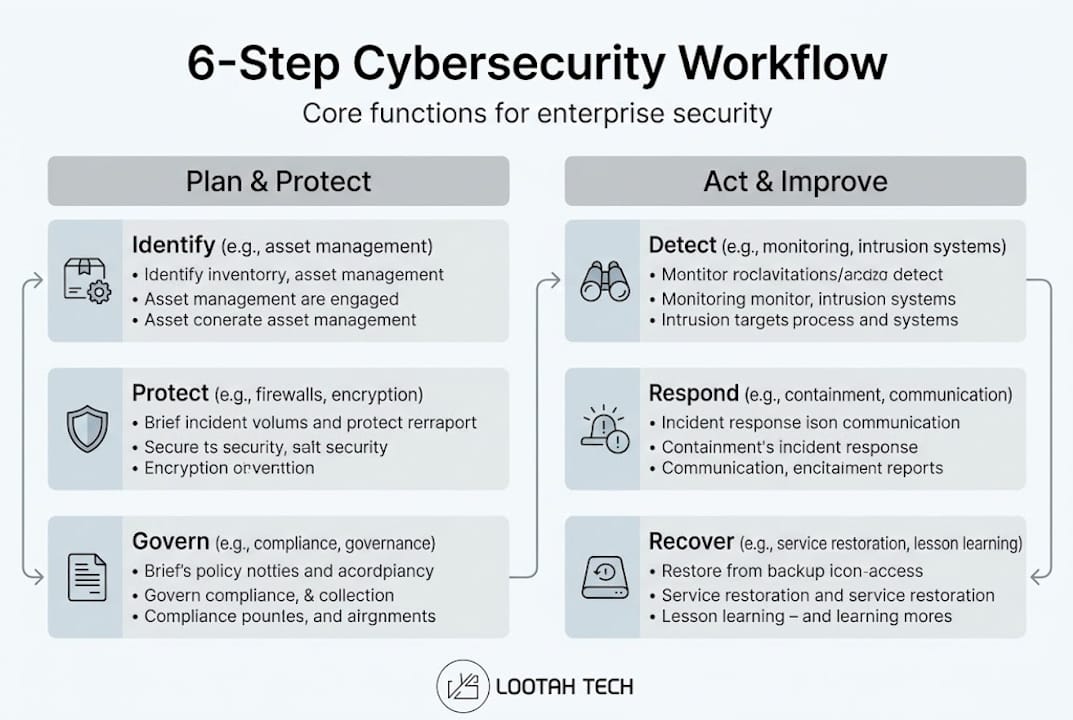
Layered on top of CSF 2.0, the CISA CPGs 2.0 add prioritized, outcome-driven practices aligned to each CSF function. Think of CPGs as the tactical playbook that translates the strategic CSF into concrete actions your SOC and IT teams can execute today.
| CSF 2.0 Function | CPG 2.0 Alignment | Workflow Stage |
|---|---|---|
| Govern | Policy, risk strategy, accountability | Foundation and oversight |
| Identify | Asset management, risk assessment | Discovery and baselining |
| Protect | Access control, data security, training | Hardening and prevention |
| Detect | Anomaly detection, continuous monitoring | Real-time visibility |
| Respond | Incident response, communications | Active threat management |
| Recover | Recovery planning, post-incident review | Restoration and learning |
Building your workflow around these functions delivers measurable benefits:
- Reduced risk exposure through consistent control application
- Faster regulatory compliance with frameworks like NIS2, HIPAA, and local UAE cybersecurity mandates
- Shorter incident response cycles because every role knows their lane
- Clearer audit trails that satisfy board-level and regulatory scrutiny
- Improved budget justification by connecting controls to business outcomes
For a deeper look at how these steps connect in practice, explore these cybersecurity workflow steps and consider reviewing an overview of security frameworks and risks to see how framework selection shapes your risk posture.
Preparing your organization: Frameworks, roles, and prerequisites
No framework executes itself. Before you touch a single control, three prerequisites must be in place: leadership buy-in, policy alignment, and a committed security budget. Skipping any of these turns even the most well-designed workflow into a document that nobody follows.

NIST CSF 2.0 integrates cybersecurity into enterprise risk management precisely because security decisions should not live in a vacuum below the CISO. They should be visible to the C-suite and board.
Chooosing the right framework is equally critical. Here is how the major options compare:
| Framework | Primary Focus | Best Use Case |
|---|---|---|
| NIST CSF 2.0 | Strategic risk management across all sectors | Enterprise-wide governance and program structure |
| CISA CPGs 2.0 | Prioritized, practical controls for IT and OT | Operationalizing CSF and closing high-risk gaps fast |
| CIS Controls v8 | Technical control implementation | Specific hardening tasks and asset-level security |
Once the framework is selected, assign clear ownership. Your workflow needs a CISO to own strategy and governance, a SOC team for detection and monitoring, an Incident Response lead for Respond and Recover functions, and business unit representatives who translate security requirements into operational reality.
Here are the preparation steps to follow in order:
- Assess your current maturity using a structured gap analysis against your chosen framework.
- Select and formally adopt the framework at the executive level.
- Assign named owners for each CSF function.
- Baseline your existing controls and document gaps.
- Build a communication plan so every stakeholder knows their role during normal operations and during incidents.
Pro Tip: Use CPGs 2.0 as your first gap assessment tool. The goals are ranked by priority and cross-referenced to CSF functions, so you can show visible, reportable progress to leadership within weeks rather than quarters.
For enterprise-specific guidance, review enterprise cybersecurity best practices and strengthen your team's foundation with cybersecurity fundamentals.
Step-by-step execution: Building a robust cybersecurity workflow
Preparation sets the table. Execution is where workflows actually protect your business. Below is a practical, numbered sequence that maps each action to its corresponding NIST CSF 2.0 function and CISA CPG priority.
- Govern: Establish and document your cybersecurity policy, risk tolerance, and accountability structure. Assign ownership at the board and executive level. Without this step, every downstream decision lacks authority.
- Identify: Build and maintain a complete asset inventory covering hardware, software, data, users, and third-party connections. You cannot protect what you cannot see.
- Protect: Enforce least-privilege access controls, implement multi-factor authentication, deploy endpoint protection, and run regular security awareness training. These are the CPG-prioritized controls that close the most common attack vectors first.
- Detect: Deploy continuous monitoring tools including SIEM (Security Information and Event Management) and EDR (Endpoint Detection and Response). Set defined thresholds for alerting and establish who reviews alerts and when.
- Respond: Activate your documented incident response plan the moment a confirmed threat is detected. Assign IR lead authority, initiate communications protocols, and preserve forensic evidence.
- Recover: Execute recovery playbooks, restore operations from clean backups, and conduct a structured post-incident review to capture lessons learned.
NIST SP 800-61r3 updates the incident response lifecycle to map directly across CSF 2.0 functions, reinforcing that incident response is not a separate discipline but an integrated part of your enterprise workflow.
Pro Tip: Automate the handoff between your Detect and Respond functions wherever possible. SOAR (Security Orchestration, Automation, and Response) platforms can trigger initial containment actions in seconds, cutting your mean time to respond significantly before a human analyst even opens a ticket.
For practical ways to reduce breach exposure, explore guidance on cutting breach risk and apply structured data protection steps to your Protect function.
Verification and continuous improvement
Deploying a workflow is not the finish line. Workflows drift. Threats evolve. Teams change. Continuous verification is what separates organizations that respond well from those that scramble.
Use these methods to validate your workflow regularly:
- Tabletop exercises: Simulate realistic attack scenarios with your IR lead, CISO, and business unit reps to test decision-making under pressure.
- Red and purple team engagements: Offensive testing reveals control gaps that internal reviews miss. Purple teaming adds a collaborative feedback loop between attackers and defenders.
- Compliance audits: Map your controls to regulatory requirements and framework benchmarks on a scheduled basis.
- KPI tracking: Measure what matters consistently.
NIST SP 800-61r3 integrates incident response into ongoing risk management, reinforcing that post-incident reviews are not optional post-mortems but required inputs for workflow refinement.
| KPI | Target Benchmark | Recommended Tool |
|---|---|---|
| Mean time to detect (MTTD) | Under 24 hours | SIEM platform |
| Mean time to respond (MTTR) | Under 4 hours | SOAR platform |
| Compliance score | 90%+ against CSF/CPG goals | GRC platform |
| Phishing click rate | Below 5% | Security awareness platform |
| Patch compliance rate | 95%+ within SLA | Vulnerability management tool |
Establish a formal feedback loop where every incident, near-miss, and audit finding feeds back into your workflow documentation. Update controls, adjust thresholds, and re-assign roles as your organization changes. Keep alignment with evolving standards by monitoring cybersecurity trends and reinforce the connection between workflow health and business cyber resilience.
The overlooked power of workflow governance
Here is an uncomfortable truth most cybersecurity guides skip: technology is rarely the reason enterprise security programs fail. Governance is. Organizations invest heavily in SIEM platforms, next-gen firewalls, and zero-trust architecture, and then wonder why breaches still happen. The answer is almost always a governance gap.
CSF 2.0 added Govern as its own function precisely because leadership accountability and strategic oversight are not implied by the other five functions. They require explicit ownership. What we see repeatedly is that organizations treat governance as a checkbox. They produce a policy document, file it, and return to technical work. When a real incident hits and budgets are being cut or a regulator is asking hard questions, there is no clear owner and no process for making decisions under pressure.
Strategic cyber protection starts at the top. If your CISO cannot walk your board through the current risk posture in plain language, your governance layer is missing. Prioritize stakeholder engagement and leadership accountability at every workflow stage, not just at the policy level. That is what makes workflows survive budget cycles, leadership changes, and real crises.
Next steps: Level up your enterprise security
Building a structured cybersecurity workflow is a major step forward. The next step is ensuring the technology and expertise behind that workflow match its ambition.

At YS Lootah Tech, we help enterprises translate framework-aligned workflows into real, deployed security capability. Our enterprise application development services build secure, custom platforms that fit your operational environment, while our AI and machine learning solutions accelerate detection and response automation. Whether you are starting your governance layer or hardening an existing program, our team provides the strategic and technical depth to move faster with confidence. Let's build security that actually holds.
Frequently asked questions
What is the difference between NIST CSF 2.0 and CISA CPGs 2.0?
NIST CSF 2.0 provides a high-level framework for strategic enterprise cybersecurity, while CISA CPGs 2.0 offer prioritized, practical steps to implement that strategy for both IT and OT environments.
How does the incident response process fit into the enterprise cybersecurity workflow?
Incident response spans multiple workflow functions, including preparation, detection, response, recovery, and ongoing improvement, as defined by NIST SP 800-61r3 mapped across CSF 2.0 functions.
Why is governance so important in modern cybersecurity workflows?
CSF 2.0 adds Govern as a core function because leadership accountability and ongoing evaluation are what keep workflows aligned with enterprise goals when conditions change.
What are common mistakes when implementing enterprise cybersecurity workflows?
The most frequent failures include neglecting executive involvement, leaving roles undefined, over-relying on tools without process backing, and entering incidents without a rehearsed response plan.
How do you measure if your workflow is effective?
Effective workflows show reduced mean time to detect and respond, higher compliance scores against selected frameworks, and consistently improving results from red team exercises and internal audits.