Digital platforms: driving efficiency and engagement

TL;DR:
- A digital platform is a dynamic business model that enables interactions among multiple participant groups, creating value through their connections. It requires active ecosystem management, governance, and trust-building, rather than just deploying technology, to ensure sustained success and competitive advantage. Effective platform strategies involve balancing technological development with relationship management, regulatory compliance, and continuous ecosystem engagement.
Most business leaders assume a digital platform is just a fancier version of their existing website or enterprise app. That assumption is expensive. A digital platform is not a tool you deploy and forget. It is a living business model that reshapes how value is created, distributed, and captured across entire ecosystems. Understanding the real difference between a platform and a piece of software is the first step toward building a competitive advantage that compounds over time. This article breaks down what digital platforms are, why they matter, how they create value, and what leaders need to know before investing in one.
Table of Contents
- What are digital platforms and why do they matter?
- Key types of digital platforms in business
- How digital platforms create value and drive efficiency
- Risks, regulations, and strategic considerations
- How business leaders can leverage digital platforms
- Why most organizations misunderstand digital platforms (and what to do instead)
- Ready to harness digital platforms? YS Lootah Tech can help
- Frequently asked questions
Key Takeaways
| Point | Details |
|---|---|
| Multi-actor value creation | Digital platforms deliver value by enabling interactions and exchanges among multiple participant groups. |
| Types fit different needs | Innovation, transaction, and content platforms serve distinct business strategies, with many firms blending several. |
| Efficiency and scale | Platforms support rapid efficiency gains and scalable growth when used strategically. |
| Regulatory awareness needed | Successful platform leaders address emerging digital regulations and governance challenges early. |
| Leadership is critical | Strategic adoption and platform success hinge on proactive business leadership, not just technology investments. |
What are digital platforms and why do they matter?
The confusion starts with language. Most organizations use the word "platform" to mean any piece of software with a dashboard. That is not what we are talking about here. A digital platform is a fundamentally different business construct.
As Harvard Business School faculty research describes it:
"A digital platform is a business model and technology infrastructure that enables interactions among multiple participant groups (often across external ecosystems), where value is created through those interactions."
That phrase "multiple participant groups" is where everything changes. Traditional IT systems are designed for one organization, executing one set of workflows. A digital platform is designed to host interactions between suppliers, customers, partners, developers, and even competitors, all at once. Value does not come from the platform itself but from the connections it makes possible.
Why does this matter to you as a business leader? Three reasons stand out. First, network effects mean that every new participant you add makes the platform more valuable for everyone already on it. Second, platforms can scale without the same proportional increase in operating costs that traditional businesses face. Third, platforms generate external value creation, meaning partners and third parties build on your infrastructure, expanding your reach without you paying for it directly.
Consider what a traditional ERP system does. It automates internal processes. Now consider what a platform like a B2B procurement marketplace does. It connects your procurement team with hundreds of verified suppliers, enables real-time bidding, and generates data insights that improve purchasing decisions month over month. The digital transformation impact on operational efficiency and revenue potential is categorically different.
Key reasons every business leader should understand digital platforms:
- Network effects accelerate growth as participant count increases
- Scalable architecture allows revenue to grow faster than costs
- Ecosystem expansion opens new revenue streams through third-party contributions
- Data generation creates proprietary insights unavailable in traditional models
- Customer lock-in builds through switching costs created by community and integrations
Key types of digital platforms in business
Not all platforms are built the same way or serve the same purpose. HBS research identifies four common platform types: innovation platforms, transaction/exchange platforms, content platforms, and standards. Each enables a different kind of multi-party value creation, and each requires a different strategic approach.
| Platform type | Main purpose | How value is created | Real-world example |
|---|---|---|---|
| Innovation platform | Enable external developers to build products on a core technology | Third-party apps and integrations expand the core offering | Apple iOS ecosystem |
| Transaction/exchange | Facilitate buying, selling, or matching between parties | Revenue from completed exchanges or subscriptions | Amazon Marketplace |
| Content platform | Aggregate and distribute content from multiple creators | Advertising, subscriptions, or creator revenue sharing | YouTube, LinkedIn |
| Standards platform | Define interoperability rules others must follow | Adoption drives licensing fees or ecosystem control | USB-C standard, SWIFT network |
Innovation platforms are most relevant to technology-forward organizations. If you build a core software product and allow external developers to create integrations, plugins, or companion apps, you are running an innovation platform. The more developers build on your foundation, the harder it becomes for customers to leave. This is the same logic behind cloud services for digital platforms, where cloud infrastructure becomes the foundation on which entire product ecosystems are constructed.
Transaction platforms are the most immediately recognizable. They earn by facilitating exchanges. A B2B marketplace connecting industrial equipment buyers with certified sellers is a transaction platform. So is a logistics platform matching freight companies with shippers. The key metric here is gross merchandise value, which represents the total transaction volume flowing through the platform.

Content platforms win by aggregating creators and audiences. LinkedIn is an instructive example. It combines content (professional articles and updates) with transactions (job postings, recruiting) and community (network connections). This blending of platform types is common among the most successful digital businesses.
Pro Tip: Most organizations benefit more from blending platform types than from committing to a single category. A fintech company, for example, might run a transaction platform for payments while also operating a content platform for financial education and an innovation platform for third-party API integrations. Each layer deepens customer engagement and multiplies switching costs.
How digital platforms create value and drive efficiency
Understanding platform types is useful. Understanding how they generate value is what separates strategic leaders from technology followers.
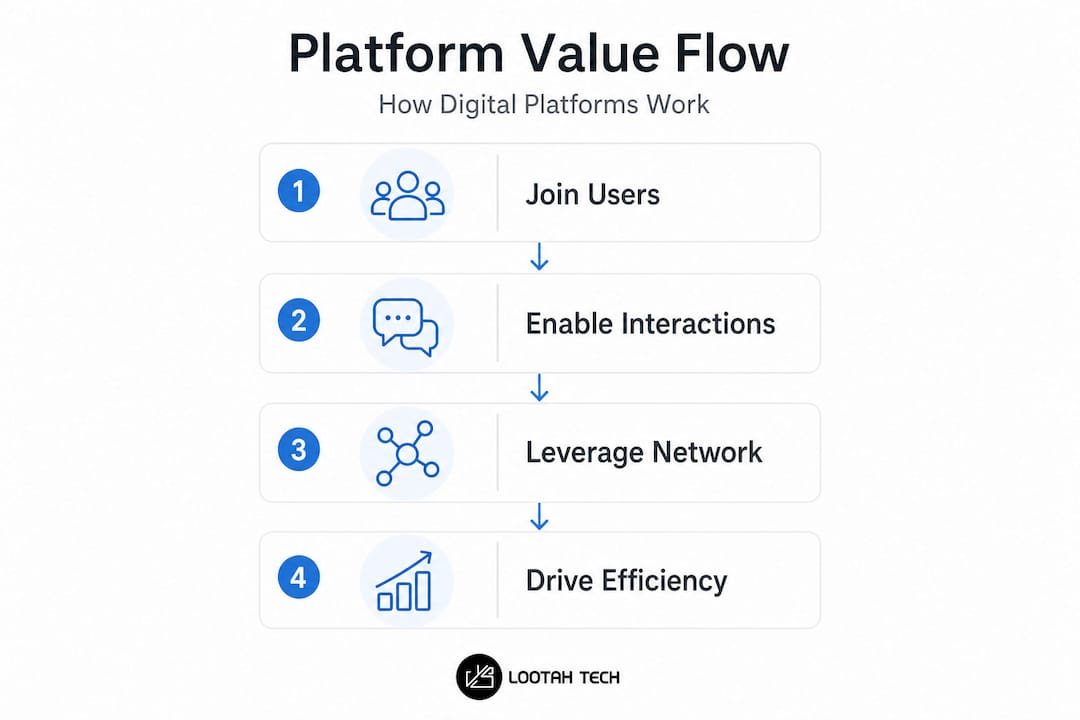
The core mechanism is the network effect. Every additional user, supplier, or developer increases the platform's value for existing participants. But here is the caveat most strategy consultants skip: network effects alone do not guarantee sustained success. Platform performance ultimately depends on how the platform manages multiple embedded network dynamics, including real threats like disintermediation and multi-homing.
Disintermediation happens when participants on your platform build direct relationships and bypass you entirely. A freelance marketplace, for instance, risks buyers and sellers moving their transactions off-platform once they establish trust. Multi-homing occurs when participants join multiple competing platforms simultaneously, reducing the exclusivity that drives network effects. Both threats can erode value faster than growth creates it.
| Value source | Description | Example |
|---|---|---|
| User-generated content | Participants create value for other participants | Reviews, ratings, tutorials |
| Partner ecosystem contributions | Third parties build features or supply inventory | App stores, supplier catalogs |
| AI-driven personalization | Platform learns from behavior to surface better matches | Netflix recommendations, B2B lead scoring |
| Aggregated data insights | Transaction data reveals market trends | Supply chain analytics, demand forecasting |
| Community and trust signals | Reputation systems lower transaction friction | Verified seller badges, credit ratings |
How to boost efficiency with digital strategy through a platform approach:
- Audit your current value chain. Identify which steps involve manual coordination between multiple parties, as those are prime candidates for platform automation.
- Define your participant groups. Clarity on who will interact on the platform, and what each group wants from it, is non-negotiable before you write a single line of code.
- Design for both sides simultaneously. A platform with suppliers but no buyers has zero value. Build incentives to attract both sides in parallel.
- Instrument everything. Measure interaction rates, match quality, and transaction completion rates. These metrics reveal friction faster than user complaints do.
- Govern actively. Establish rules for who can participate, what behaviors are allowed, and how disputes are resolved. Passive governance destroys trust.
When you drive growth with digital tools by restructuring a linear value chain into a value network, you stop being a single link in a chain and become the connective tissue for an entire ecosystem. That is a structural competitive advantage.
Risks, regulations, and strategic considerations
Efficiency and scale attract scrutiny. Any leader building or scaling a digital platform needs to understand the regulatory environment before it becomes a liability.
The most significant regulatory development for global platforms is the EU Digital Services Act, which applies to online marketplaces, social media networks, app stores, and online travel and accommodation platforms. The DSA requires platforms to increase transparency, remove illegal content faster, and give users more control over algorithmic recommendations. Non-compliance carries fines up to 6% of global annual revenue.
Even if your organization is headquartered outside the EU, the DSA applies if your platform serves EU users. This is a critical point for organizations operating in the Gulf region or Southeast Asia with European customers. Regulatory exposure is global, even when your physical presence is not.
Additional risks leaders must address:
- Data sovereignty violations: Storing user data in non-compliant jurisdictions creates legal exposure under GDPR and regional equivalents
- Antitrust liability: Dominant platforms face increasing scrutiny for self-preferencing, where a platform favors its own products over third-party competitors
- Trust and safety failures: Failure to moderate harmful content or fraudulent listings can destroy user trust rapidly, reducing network participation
- Governance gaps: Poorly defined rules for participant behavior create conflict, increase churn, and attract regulatory attention
- Cybersecurity vulnerabilities: Multi-party platforms create larger attack surfaces; a breach affecting one participant can cascade across the ecosystem
Referencing B2B digital strategy frameworks that explicitly include compliance checkpoints is one of the most effective ways to prevent these pitfalls before they materialize. Businesses that integrate digital solutions systematically, rather than reactively, build more resilient platform ecosystems.
Pro Tip: Involve your legal, compliance, and strategy leads during platform design, not after launch. Retrofitting compliance into a live platform is significantly more expensive and disruptive than building it in from the start. A two-week compliance review at the design stage can save months of remediation work later.
How business leaders can leverage digital platforms
Strategy without action stays on whiteboards. Here is a structured approach to moving from understanding to execution.
Steps to start leveraging digital platforms:
- Conduct a platform readiness audit. Assess your existing technology stack, participant relationships, and data assets. Identify where a platform model could replace manual coordination or linear workflows.
- Define your platform hypothesis. What two or more participant groups would benefit from interacting through your platform? What value does each group bring, and what does each group need in return?
- Start with a minimum viable platform. Resist the urge to build everything at once. Launch with the smallest set of features that creates a real interaction between participant groups, then measure.
- Track network effect indicators early. Monitor cohort retention rates, the ratio of organic referrals to paid acquisition, and interaction depth per user. These signals reveal whether your platform is generating genuine network effects or just paid traffic.
- Invest in ecosystem relationships. Identify three to five anchor partners or participants whose early adoption will signal credibility to others. In B2B markets, a single lighthouse customer often unlocks a wave of followers.
Questions to assess your platform readiness:
- Do you have access to two or more distinct participant groups that would benefit from interacting with each other?
- Can you create rules and governance structures that protect participant trust?
- Does your organization have the data infrastructure to instrument and learn from platform interactions?
- Are you prepared to invest in both sides of the platform simultaneously during the early growth phase?
A compelling example comes from digital health platform examples, where providers connect patients, physicians, diagnostic labs, and insurance companies on a single infrastructure. The platform does not just digitize existing workflows. It creates new interactions, such as real-time insurance pre-authorization or AI-driven care recommendations, that were structurally impossible in the fragmented, linear healthcare system.
Leadership plays a decisive role here. Platform transformation is not an IT project. It requires executives who understand ecosystem dynamics, can champion cross-functional governance structures, and are willing to invest in both sides of the market before either side fully commits. Organizations that delegate platform strategy entirely to their technology teams routinely underestimate the organizational change required to make it succeed.
Why most organizations misunderstand digital platforms (and what to do instead)
After working across industries in digital transformation, one pattern repeats itself: organizations invest heavily in platform technology and then wonder why adoption stalls. The technology rarely fails. The organizational model does.
Most platform failures trace back to underestimating multi-sided complexity. Leaders treat a platform launch the same way they treat a software rollout. They deploy, they announce, they wait for adoption. But platforms require active ecosystem management that starts before launch and never fully stops. You are not just shipping a product. You are designing an economy with its own incentive structures, governance rules, and trust mechanisms.
The most counter-intuitive lesson we have seen play out repeatedly is this: technology is the easy part. Governance, trust-building, and the slow work of building ecosystem relationships are the actual competitive moats. The organizations that win with platforms are the ones that invest as heavily in community management, partner enablement, and policy design as they do in software development.
The conventional wisdom is to chase the most advanced technology available, whether that is AI-powered matching, blockchain-based smart contracts, or real-time analytics. Our view is different. Prioritize ecosystem relationships and governance clarity first. A well-governed platform running on relatively simple technology will consistently outperform a technologically sophisticated platform with weak governance and low participant trust.
Reviewing B2B tech success factors consistently points to the same conclusion: organizations that treat platforms as relationship infrastructure rather than software infrastructure build more durable competitive positions. Network effects, when they finally activate, are powerful. But they only activate when participants trust the platform enough to commit to it exclusively, and trust is a governance achievement, not a technology feature.
Ready to harness digital platforms? YS Lootah Tech can help
Translating platform strategy into working technology requires a partner who understands both the business model and the engineering complexity behind multi-sided architectures.
YS Lootah Tech specializes in building the digital infrastructure that makes platform strategies executable. From custom application development that handles multi-party interactions at scale, to AI and machine learning capabilities that power personalization and matching algorithms, to website development solutions that serve as the customer-facing layer of your platform ecosystem, YS Lootah Tech brings end-to-end capability to your transformation. If your organization is ready to move from strategy to execution, our team is built to support that transition at every stage.
Frequently asked questions
How are digital platforms different from traditional software?
Digital platforms enable interaction among multiple participant groups, creating value through those interactions, while traditional software typically serves one organization or workflow without enabling multi-party exchanges.
What is an example of a successful digital platform?
Amazon is a classic transaction platform that connects buyers and sellers at scale. Common platform types include innovation, transaction, content, and standards platforms, each creating value differently.
Do digital platforms need to comply with international regulations?
Yes. Platforms serving EU users must comply with the EU Digital Services Act, which applies to marketplaces, social networks, app stores, and similar services regardless of where the platform is headquartered.
What risks should leaders consider when adopting digital platforms?
Leaders must address regulatory compliance, data governance, and the structural risks of disintermediation and multi-homing, which can erode network effects and undermine long-term platform performance.