Cybersecurity Planning Guide for Business Leaders

TL;DR:
- Most organizations remain unaware of their incomplete cybersecurity posture until they experience a breach.
- A structured cybersecurity plan, aligned with business goals and continuously verified, is essential for protecting data, systems, and reputation.
Most organizations don't realize their cybersecurity posture is dangerously incomplete until after a breach. Global cybercrime losses reached $16.6 billion in 2024, a 33% jump from the prior year, and that number will only climb. A structured cybersecurity planning guide isn't a luxury reserved for large enterprises. It's the operational foundation that keeps your data, systems, and reputation intact. This article walks business leaders and IT professionals through every stage of building an effective plan, from initial preparation through ongoing verification, with specifics you can act on immediately.
Table of Contents
- Key takeaways
- Your cybersecurity planning guide starts here
- Building your cybersecurity plan step by step
- Maintaining and verifying your plan
- Common pitfalls and best practices
- My perspective on what actually makes this work
- Strengthen your plan with the right technical foundation
- FAQ
Key takeaways
| Point | Details |
|---|---|
| Start with asset and risk inventory | You cannot protect what you haven't cataloged; map every device, application, and data type before drafting policy. |
| Align security goals to business objectives | A cybersecurity plan disconnected from business priorities creates gaps and wastes budget on the wrong controls. |
| Build in incident response from the start | Incident response and recovery planning must be part of the initial plan, not an afterthought added after a crisis. |
| Schedule continuous verification cycles | Quarterly vulnerability reviews and regular testing prevent your plan from becoming a static document that erodes over time. |
| Leadership buy-in is non-negotiable | Executive involvement drives resource allocation, cultural adoption, and the sustained commitment security programs require. |
Your cybersecurity planning guide starts here
Before you write a single policy or purchase a single security tool, you need a clear picture of what you're protecting, who's involved, and where you currently stand. Most organizations skip this groundwork and pay for it later. Organizations that bolt on security tools without comprehensive evaluation create blind spots and waste significant budget on misaligned solutions.
Conduct a full asset inventory
Your asset inventory is the foundation of every decision that follows. That means cataloging hardware (laptops, servers, mobile devices, IoT endpoints), software (licensed applications, SaaS platforms, open-source dependencies), and the data that lives across all of it. Don't stop at the obvious assets. Shadow IT, personal devices used for work, and unmanaged cloud storage accounts are where real exposure hides.
Identify where sensitive data is stored, who can access it, and how it moves between systems. This mapping exercise often reveals that critical data is far more accessible than anyone assumed.
Identify your stakeholders early
A cybersecurity plan that only involves the IT department is already compromised. You need input from business leadership, legal, compliance, HR, and department heads who understand which processes are operationally critical. End users matter too. The people who actually touch your systems daily will either be your first line of defense or your biggest liability, depending on how well they're engaged.
Pro Tip: Assign a named executive sponsor to your cybersecurity planning process from day one. When security decisions need budget or policy authority, having that sponsor already invested removes weeks of delay.
Assess your current security posture
Baseline your existing defenses before writing any forward-looking strategy. This means running a maturity assessment to understand where your controls actually sit today, not where you assume they are. Maturity assessments should project target states three to five years ahead to set strategic objectives that have real directional clarity. Pair that with a cybersecurity risk assessment that maps your most likely threat vectors to your most valuable assets. Phishing, ransomware, and credential compromise are typically the top findings for mid-market and enterprise organizations alike.

Building your cybersecurity plan step by step
With your foundation in place, you're ready to formulate the actual plan. This is where many organizations produce a document that looks thorough but lacks the structural integrity to survive contact with reality. The following steps are ordered deliberately. Skipping ahead creates cascading gaps.
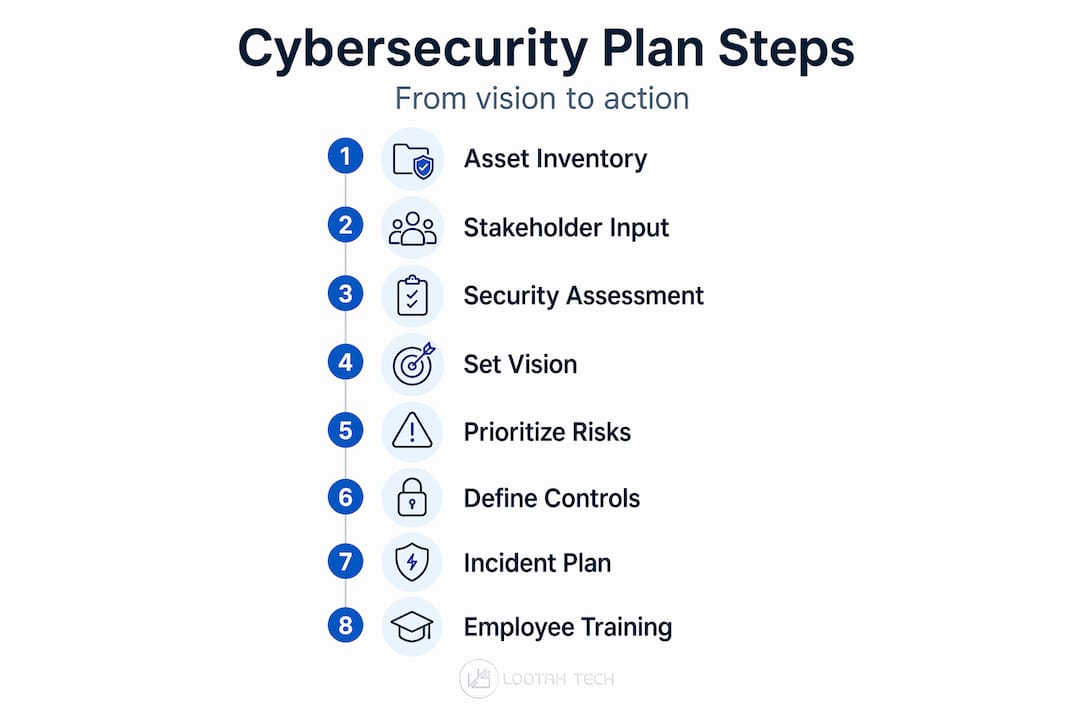
Step 1: Set a strategic vision
Your cybersecurity goals must connect directly to your business objectives. If your organization is expanding into new markets, the plan needs to address the data sovereignty and regulatory requirements that come with that growth. If you're migrating workloads to the cloud, the strategy must account for shared responsibility models and identity management. A cybersecurity strategy disconnected from specific business risks leads to implementation gaps and resources spent on controls that don't address your actual exposure.
Write a security mission statement that your leadership team and board can understand without a technical background. Jargon-heavy vision statements get ignored. Plain language gets funded.
Step 2: Prioritize risks by business impact
Not every risk deserves equal attention or equal budget. Use your risk assessment findings to rank threats by two dimensions: likelihood and business impact. A ransomware attack that could shut down operations for 72 hours ranks higher than a theoretical denial-of-service scenario that slows a secondary website.
This is where your cybersecurity risk assessment translates into spending decisions. Create a risk register that captures each identified threat, its likelihood rating, its potential impact on revenue or operations, and the current control gap. Review this document with your executive sponsor before finalizing any budget requests.
Step 3: Define controls, policies, and access management
This step is where your plan becomes operational. Work through the following control categories:
- Access control and identity management. Implement least-privilege access across all systems. Multi-factor authentication reduces account compromise risk by over 99%, making it one of the highest-return controls available. MFA deployment should be treated as non-negotiable, not optional.
- Data protection policies. Define classification levels (confidential, internal, public), encryption standards for data at rest and in transit, and retention and disposal procedures.
- Network segmentation. Divide your network so that a compromise in one segment cannot spread laterally to critical systems.
- Endpoint security. Deploy endpoint detection and response tools on all managed devices and define clear policies for unmanaged devices that access corporate resources.
- Vendor and third-party risk. Assess each vendor's security posture before granting access to your environment. Include security requirements in contracts.
Pro Tip: When documenting policies, write them at the level of the person who must follow them. A data classification policy written for a security engineer will be ignored by a marketing manager.
Step 4: Develop your incident response plan
Incident response is where how to plan cybersecurity shifts from prevention to resilience. Your incident response plan must define roles, escalation paths, communication protocols, and recovery procedures before an incident happens, not during one. Assign an incident commander role and document who has authority to take systems offline, notify regulators, and communicate externally.
| Incident response component | What it must include |
|---|---|
| Detection and identification | Monitoring tools, alert thresholds, triage process |
| Containment | Isolation procedures, decision authority, system backup status |
| Eradication | Root cause analysis, patch or remediation steps |
| Recovery | Restore sequence, validation testing, business continuity steps |
| Post-incident review | Lessons learned, plan updates, reporting to leadership |
Test your incident response plan at least twice a year through tabletop exercises. Ransomware appeared in 88% of breaches at small and medium businesses last year, so test ransomware scenarios specifically. The organizations that recover fastest are the ones who have practiced the response.
Step 5: Integrate employee training and awareness
Human error is still the primary attack vector for most breaches. Regular phishing simulations, security awareness training, and clear reporting procedures transform employees from vulnerabilities into assets. For guidance on how cybersecurity fundamentals in the enterprise support this kind of cultural security program, the principles translate directly to awareness design.
Maintaining and verifying your plan
A cybersecurity plan that doesn't evolve is a liability dressed as a strategy. Cybersecurity strategy must be dynamic and aligned with shifting business priorities, not a static document filed away after initial approval. Maintaining your plan requires a governance structure, a testing schedule, and metrics that actually tell you something useful.
Governance and review cycles
Vulnerability and risk reviews should be scheduled quarterly or biannually, with executive involvement at each cycle. This is not just a technical task. When leadership sees the metrics, they make better resource decisions. Regular reporting to executives improves buy-in and resource allocation over time. Make your security reporting visual and outcome-focused, not a wall of technical findings.
Structure your governance calendar around these activities:
- Quarterly vulnerability scans with prioritized remediation tracking
- Biannual risk assessment updates to capture new threats and changed business context
- Annual full plan review involving all stakeholders
- Post-incident reviews conducted within two weeks of any security event
- Continuous monitoring dashboards reviewed weekly by the security team
Pro Tip: Tie your cybersecurity metrics to business outcomes where possible. "Mean time to detect" and "percentage of critical vulnerabilities patched within SLA" communicate security performance in terms that resonate with non-technical executives.
Testing your defenses
Governance reviews tell you whether your plan is current. Penetration testing and red team exercises tell you whether your controls actually work. Vulnerability assessments should be conducted regularly, not just annually, because the threat environment changes faster than any annual cycle can track. For a detailed look at how cybersecurity in 2026 shapes testing priorities, the evolving attack surface demands that assessment scope expand beyond traditional network perimeters.
Common pitfalls and best practices
Even well-resourced organizations fall into predictable traps when developing a cybersecurity plan. Awareness of these failure patterns is part of any honest best practices for cybersecurity discussion.
The most common pitfalls:
- Insufficient leadership buy-in. Security programs without executive champions consistently lose budget battles and fail to achieve the policy enforcement they require.
- Neglecting the fundamentals. Advanced controls are insufficient if basics like phishing-resistant authentication are neglected. Organizations that skip MFA and basic access hygiene in pursuit of advanced threat detection are building on sand.
- Treating the plan as a one-time deliverable. A cybersecurity plan reviewed once and shelved provides no defense after month six. Threats evolve. Your plan must too.
- Ignoring third-party risk. Supply chain compromises are now among the most damaging breach vectors. Every vendor with access to your environment is part of your attack surface.
The CISA Cybersecurity Performance Goals offer a prioritized, achievable set of security practices specifically designed to help critical infrastructure entities and SMBs get the fundamentals right without overcomplicating early-stage programs. Pair that with the NIST Cybersecurity Framework for a structured approach to identifying, protecting, detecting, responding, and recovering.
"Embedding cybersecurity goals into organizational culture and workflows is as important as the technological controls themselves for sustained defense."
For organizations building or refining their approach to developing a cybersecurity plan at the executive level, framing security as a business enabler rather than a cost center changes how leadership engages with the program over the long term.
My perspective on what actually makes this work
I've seen a lot of cybersecurity plans. Most of them are well-structured, technically credible, and functionally useless eighteen months after they're written. The reason is almost never the controls. It's the culture.
In my experience, organizations that sustain strong security postures share one trait: security is embedded in how decisions get made, not bolted onto the end of projects as a checklist. When a development team treats security in custom software as a design constraint from day one rather than a deployment review step, vulnerabilities drop dramatically. When procurement teams include security requirements in vendor contracts automatically, third-party risk shrinks without a separate program to manage it.
What I've learned is that the best cybersecurity strategy guide you can write is one that your organization will actually follow next year. That means involving the people who will live under the policies in the process of creating them. It means making security reporting something executives look forward to because it tells them something useful about business risk, not just patch counts.
The other thing I've come to believe is that leadership alignment is not a soft skill concern. It's a hard security outcome. Teams whose leadership visibly prioritizes security respond to incidents faster, report suspicious activity more reliably, and adopt new controls with less resistance. If you are a business leader reading this, your behavior sets the tone more than any policy document ever will.
— YS
Strengthen your plan with the right technical foundation
If your cybersecurity planning process has revealed gaps in how your applications and digital infrastructure are built, those gaps compound over time. Yslootahtech works with organizations across industries to build digital solutions that integrate security requirements at the architecture level, not as an afterthought.

From secure application development that aligns with your strategic security goals to resilient web environments designed to support your overall cybersecurity posture, Yslootahtech brings technical depth and strategic alignment to every engagement. If you're developing or overhauling your cybersecurity plan and need a technology partner who understands the full picture, reach out to the Yslootahtech team to explore what a tailored approach looks like for your organization.
FAQ
What is a cybersecurity planning guide?
A cybersecurity planning guide is a structured framework that helps organizations identify risks, define security controls, and build incident response and recovery capabilities. It connects security objectives directly to business goals and provides a repeatable process for ongoing improvement.
How do I start developing a cybersecurity plan?
Start with a full asset inventory and a cybersecurity risk assessment to understand what you're protecting and where your current gaps are. From there, set strategic goals aligned to business priorities before selecting any controls or tools.
How often should a cybersecurity plan be reviewed?
Vulnerability and risk assessments should be reviewed at minimum quarterly, with a full plan review annually and post-incident reviews conducted within two weeks of any security event. Continuous monitoring should run between those formal cycles.
What frameworks support best practices for cybersecurity planning?
The NIST Cybersecurity Framework and the CISA Cybersecurity Performance Goals are the most widely used references for structuring plans, particularly for organizations in critical infrastructure or SMB contexts seeking a prioritized starting point.
Why do so many cybersecurity plans fail in practice?
Most plans fail because they lack leadership buy-in, are treated as one-time documents, or focus on advanced controls while neglecting fundamentals like MFA and access management. A plan that isn't tested, updated, and embedded into daily workflows degrades quickly regardless of its initial quality.