Cloud Security Basics for Business Owners and IT Pros

TL;DR:
- Most organizations mistakenly believe their cloud provider handles all security, leading to frequent breaches caused by misconfigurations. Cloud security relies on understanding shared responsibilities, enforcing least privilege and Zero Trust principles, and continuously monitoring configurations to prevent common risks like exposed storage and permissive access policies. Building a strong security foundation through frameworks like CIS Controls IG1 and aligning with regulatory standards ensures organizations maintain effective protection beyond mere compliance.
Most businesses assume that moving to the cloud means their provider handles security. That assumption is responsible for more breaches than any sophisticated hacker technique. Cloud security basics are not about picking a vendor with the right certifications. They are about understanding exactly what you own, what your provider owns, and what happens to your data when those lines blur. This guide walks you through the foundational principles, real risks, and practical frameworks so you can build a cloud security strategy that actually holds up under pressure.
Table of Contents
- Key takeaways
- Cloud security basics: core concepts defined
- The shared responsibility model explained
- Common cloud risks and misconfiguration breaches
- Practical frameworks for building cloud security
- Cloud security and regulatory compliance
- My take on getting cloud security right
- How Yslootahtech can support your cloud security goals
- FAQ
Key takeaways
| Point | Details |
|---|---|
| You own more than you think | The shared responsibility model puts data, identity, and access management squarely on your organization, regardless of service model. |
| Misconfiguration is the top threat | Overly permissive IAM policies and exposed storage buckets cause more breaches than external attacks. |
| Zero Trust is non-negotiable | Every access request must be verified continuously. Trust nothing by default, inside or outside your network. |
| Start with CIS IG1 safeguards | Fifty-six foundational safeguards give any team a measurable, accessible security baseline before advancing to complex controls. |
| Compliance does not equal security | A provider's certifications cover their infrastructure. Your applications, data configurations, and user access are still your responsibility. |
Cloud security basics: core concepts defined
Before you can protect anything, you need a clear picture of what cloud security actually covers. It is not a single tool or a checkbox. Cloud security is the combination of policies, controls, technologies, and services that protect cloud-based data, applications, and infrastructure from threats.
Cloud environments run across three service models, and each one changes your exposure differently.
- IaaS (Infrastructure as a Service): You manage the operating system, applications, and data. Providers like AWS, Azure, and Google Cloud handle physical hardware and networking.
- PaaS (Platform as a Service): The provider adds runtime, middleware, and the operating system to what they manage. You focus on your application and data.
- SaaS (Software as a Service): The provider manages almost everything. You configure the application, manage users, and control your data settings.
Understanding cloud service model differences matters because your security obligations shift with each layer. Many IT teams treat SaaS the same way they treat IaaS and end up either over-engineering controls or missing critical gaps entirely.
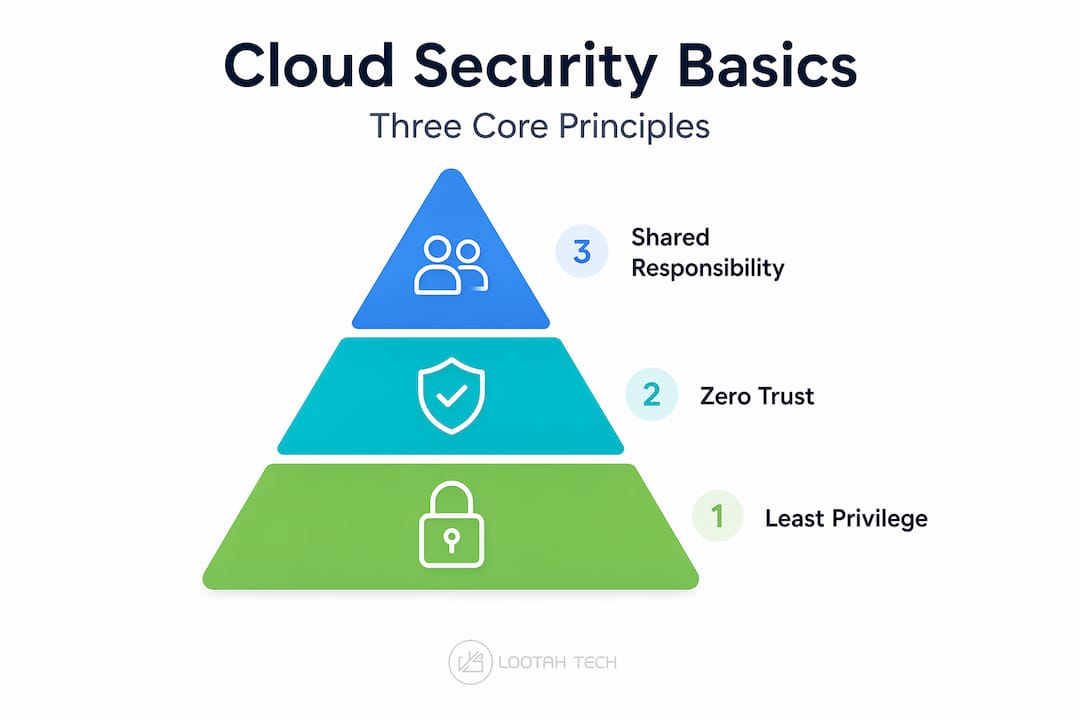
Three principles anchor any introduction to cloud security worth its weight.
Least privilege means every user and system gets only the minimum access required for their function. Nothing more. Zero Trust takes that further by assuming no user, device, or system is inherently trustworthy. Human errors cause roughly 80% of data breaches, which is why Zero Trust mandates continuous verification for every access request rather than trusting a session once it starts. Continuous verification pairs with Zero Trust to detect behavioral anomalies in real time rather than waiting for quarterly audits to catch problems.
Pro Tip: If you are new to understanding cloud security, start by mapping every cloud asset your organization uses. Shadow IT (cloud services adopted without IT approval) is often the first place attackers find an unguarded door.
The shared responsibility model explained
This is where most organizations get into serious trouble. The shared responsibility model defines which security tasks belong to your cloud provider and which belong to you. Provider certifications like FedRAMP and ISO 27001 do not relieve your team of responsibility for data access, identity management, or application security.
Here is how responsibilities split across service models:
| Security area | IaaS | PaaS | SaaS |
|---|---|---|---|
| Physical infrastructure | Provider | Provider | Provider |
| Network controls | Shared | Provider | Provider |
| Operating system | Customer | Provider | Provider |
| Application security | Customer | Customer | Provider |
| Data classification | Customer | Customer | Customer |
| Identity and access management | Customer | Customer | Customer |
| Encryption configuration | Customer | Shared | Customer |
Notice that data classification and identity management stay with the customer across every model. That never changes. Many businesses sign SaaS agreements assuming their vendor handles everything, then discover after a breach that their misconfigured user permissions were entirely their own problem.
The shared responsibility model also extends into legal territory. Contracts, audit rights, and incident notification timelines are your responsibility to negotiate and enforce. A provider going offline does not automatically satisfy your regulatory reporting obligations.
Pro Tip: Request your cloud provider's responsibility matrix in writing before signing any contract. Most major providers publish these documents publicly. If yours does not, that is itself a red flag.
For a broader view of how these principles connect to organizational security governance, the enterprise security frameworks guide from Yslootahtech offers a practical starting point.
Common cloud risks and misconfiguration breaches
Speed kills in cloud security. The same agility that makes cloud infrastructure attractive creates the conditions for constant configuration drift. Misconfigurations are the most common cause of cloud breaches, driven by fast deployment cycles, permissions creep, and forgotten test environments that never get cleaned up.
The most common misconfiguration issues seen in real cloud environments include:
- Overly permissive IAM policies: Giving users or services administrator-level access because it is faster to set up. This is the number one entry point attackers exploit.
- Exposed storage buckets: S3 buckets and Azure Blob containers set to public by default, often left that way after a development phase.
- Disabled logging: CloudTrail, Azure Monitor, and similar tools turned off to cut costs, removing the visibility you need to detect attacks.
- Forgotten test environments: Dev and staging environments spun up quickly and never decommissioned, running with weaker security settings indefinitely.
- Lateral movement opportunities: Once inside a misconfigured environment, attackers escalate privileges and move across services because there are no internal boundaries.
Attackers specifically scan for these exposures. Automated tools probe for open storage buckets and IAM misconfigurations constantly. Your environment is not too small to be a target. Small and mid-sized businesses are frequently targeted precisely because attackers expect weaker controls.
Automated posture management tools like Terraform combined with Open Policy Agent address this by blocking insecure configurations before they ever reach production. Manual audits simply cannot keep pace with the rate of change in modern cloud environments. If you are still relying on quarterly reviews to catch misconfigurations, you are operating with a significant blind spot.

Practical frameworks for building cloud security
Understanding risks is only half the work. You also need a structured approach to address them. This is where cloud security fundamentals connect to real-world implementation.
CIS Controls v8 is one of the most practical frameworks available. It comprises 18 prioritized controls with 153 safeguards organized into three Implementation Groups. IG1 contains 56 foundational safeguards designed for every organization, regardless of technical maturity. IG2 and IG3 add more advanced controls for organizations with dedicated security staff and high-risk environments.
Here is a phased approach to getting started:
- Build your asset inventory. You cannot secure what you cannot see. Catalog every cloud resource, including compute instances, storage, databases, APIs, and third-party integrations.
- Enforce multi-factor authentication (MFA). MFA across all administrative and user accounts is one of the highest-impact, lowest-cost controls available. It belongs in IG1 for good reason.
- Apply secure configuration baselines. Use your provider's security benchmarks (AWS Foundations, CIS Benchmarks) to harden default settings before deployment, not after.
- Enable audit logging everywhere. Every access event, configuration change, and permission update should be logged and retained. This is your evidence trail for compliance and incident response.
- Automate continuous monitoring. Set up alerts for configuration drift, unusual access patterns, and policy violations. Starting with IG1 safeguards gives teams with limited security expertise a measurable baseline before moving to more advanced controls.
- Run regular access reviews. Remove unused accounts, revoke excess permissions, and audit service account privileges on a defined schedule, at minimum quarterly.
Pro Tip: Do not try to implement all 153 CIS safeguards at once. Teams that attempt a full rollout simultaneously rarely finish. Pick IG1, assign ownership for each safeguard, and get those 56 controls solid before moving forward.
For teams getting grounded in the broader discipline, Yslootahtech's cybersecurity fundamentals guide covers the foundational security concepts that sit underneath cloud-specific controls.
Cloud security and regulatory compliance
Cloud security fundamentals do not exist in a vacuum. For most businesses, they directly connect to regulatory requirements that carry real legal and financial consequences.
Three frameworks matter most in cloud-regulated environments:
- FedRAMP: Required for cloud services handling U.S. federal data. 80% of FedRAMP authorizations fall under Moderate impact, setting the practical benchmark for most cloud security programs serving government clients.
- NIST SP 800-53: The underlying framework for FedRAMP and a broadly adopted standard. It includes 1,007 controls across 20 families, organized into Low, Moderate, and High baselines to match different risk levels.
- ISO/IEC 27017: Extends ISO 27001 with seven cloud-specific controls covering tenant segregation, virtual machine hardening, and administrative access monitoring. It is not standalone and must be implemented as part of an ISO 27001 ISMS.
| Compliance area | What it requires from you | Common gap |
|---|---|---|
| Data classification | Categorize and label all cloud-stored data by sensitivity | Organizations store mixed data with no segmentation |
| Access control documentation | Document who has access to what and why | IAM policies exist but are not reviewed or documented |
| Incident response plan | Define detection, escalation, and notification timelines | Plans exist on paper but are never tested |
| Audit log retention | Retain logs for defined periods per regulation | Logs are enabled but not retained long enough |
Compliance is a floor, not a ceiling. Meeting a regulatory requirement does not mean your cloud environment is well-defended. It means you have documented controls that satisfy an auditor. The organizations that actually reduce risk go beyond compliance checkboxes and build security into their processes and culture. Internal training, tabletop exercises, and clear incident response ownership matter as much as any technical control.
My take on getting cloud security right
I have worked with enough organizations migrating to the cloud to see the same pattern repeat: they move fast, they assume their provider covers security, and they discover the gap after something goes wrong.
What changed how I advise clients was fully internalizing the shared responsibility model. Not as a slide in a vendor deck, but as an operational reality that reshapes how you configure, monitor, and govern every cloud resource you touch. When you really understand that your provider's ISO 27001 certification covers their data center and not your S3 bucket permissions, the entire security conversation shifts.
The most common pitfall I see is treating compliance as a destination. Organizations achieve a certification, declare victory, and stop monitoring. Configuration drift sets in within weeks. Automated posture management is not optional anymore. It is the difference between knowing your environment is secure right now versus hoping it stayed secure since your last audit.
My honest opinion on certifications: they build a foundation but do not substitute for security ownership. The organizations that handle incidents well are not always the ones with the most certifications. They are the ones with clear ownership, tested response plans, and continuous visibility into their environments. Build security bottom-up, starting with the basics, and the compliance layer becomes much easier to maintain.
— YS
How Yslootahtech can support your cloud security goals
Building secure cloud environments requires both technical depth and strategic planning. Yslootahtech works with businesses across industries to design and deliver digital solutions built with security at the architecture level, not as an afterthought.

Whether you need a secure custom application with access controls and audit logging built in from day one, or a complete cloud security review aligned with frameworks like CIS Controls and ISO 27017, Yslootahtech brings the expertise to get it right. The team has deep experience with cloud computing, cybersecurity, and enterprise application development across fintech, health tech, and industrial sectors. If your organization is ready to move from uncertainty to a structured, defensible cloud security posture, the Yslootahtech team is ready to help you get there.
FAQ
What is cloud security?
Cloud security is the set of policies, controls, and technologies that protect cloud-based data, applications, and infrastructure from threats. It applies across all cloud service models including IaaS, PaaS, and SaaS.
Who is responsible for cloud security?
Responsibility is shared between the cloud provider and the customer. Providers secure physical infrastructure and core services, while customers are always responsible for data, identity management, and access configuration regardless of service model.
What causes most cloud security breaches?
Misconfigurations are the leading cause, including overly permissive IAM policies, exposed storage, and disabled logging. These issues typically result from fast deployments and insufficient ongoing monitoring.
What is the best framework for cloud security basics?
CIS Controls v8 is widely recommended for organizations building foundational cloud security. Starting with Implementation Group 1 provides 56 fundamental safeguards accessible to any team, regardless of security maturity.
Does my provider's compliance certification protect my data?
No. Provider certifications cover the provider's infrastructure and operations. Your data configurations, user permissions, and application security remain your responsibility under every service model.