Boost your security: Understanding cybersecurity posture
TL;DR:
- Most organizations overestimate their cybersecurity resilience despite ongoing audits and investments. Cybersecurity posture reflects the true, measurable ability to prevent, detect, and respond to threats, requiring continuous assessment beyond technology tools. Improving posture involves systematic frameworks, accountability, targeted actions, and leadership commitment to adapt to evolving threats and organizational changes.
Most business executives believe their organization is more secure than it actually is. A telling pattern emerges across industries: leadership signs off on annual security audits, budgets increase for tools and software, yet real vulnerabilities persist because no one has taken an honest look at what "secure" actually means. Cybersecurity posture is the term that captures this reality. It describes your organization's true, measurable ability to prevent, detect, and respond to threats. Getting it right is not about buying more tools. It is about understanding where you actually stand.
Table of Contents
- Defining cybersecurity posture: What it is and why it matters
- Key frameworks for assessing and improving posture
- How to measure your cybersecurity posture
- Bridging the gap: Strategies to strengthen your cybersecurity posture
- Perspective: The real-world challenges and what most companies overlook
- How YS Lootah Tech can help you advance your cybersecurity posture
- Frequently asked questions
Key Takeaways
| Point | Details |
|---|---|
| Cybersecurity posture defined | It’s your organization’s real-time readiness to prevent, detect, and respond to cyber threats. |
| Frameworks offer structure | Industry-standard tools like NIST CSF and CISA CPGs help you benchmark and improve posture. |
| Assessment is ongoing | Regular, continuous evaluation closes gaps and reduces real risk. |
| Strategic improvements matter | Linking posture improvements to business outcomes amplifies value. |
Defining cybersecurity posture: What it is and why it matters
Cybersecurity posture is the overall security status of your digital environment at any given moment. Think of it less like a grade and more like a health checkup. It tells you how well your people, processes, and technology are working together to protect your organization against cyber threats. It also tells you where the gaps are.
For executives and IT managers, posture matters because it connects directly to business outcomes. Poor posture increases your exposure to costly breaches, regulatory fines, and the kind of reputational damage that clients remember for years. A strong posture, by contrast, builds trust with customers and partners, supports compliance with frameworks like ISO 27001 and local data protection laws, and reduces your overall risk surface.
Key methodologies for managing security posture involve frameworks like NIST Cybersecurity Framework (CSF) 2.0, which organizes security across six functions: Govern, Identify, Protect, Detect, Respond, and Recover. Alongside that, the CISA Cross-Sector Cybersecurity Performance Goals serve as prioritized baseline practices. Continuous assessments, including gap analysis between current and target profiles, are essential components of keeping posture accurate.
Several misconceptions make this harder than it needs to be:
- "We have a firewall and antivirus, so we're protected." Tools are one layer. Posture encompasses the entire stack, including user behavior, patching habits, and access controls.
- "We passed our last audit." An audit is a point-in-time snapshot. Posture is dynamic and changes as your environment evolves.
- "Security is an IT problem." Posture is a business problem. Decisions made by finance, HR, and operations directly affect your risk exposure.
- "We're too small to be targeted." Attackers frequently target organizations with weaker postures regardless of size, often using them as entry points into larger supply chains.
"The organizations that take the most damage are often those that believed they were adequately protected. The gap between perceived security and actual security is where breaches happen."
Understanding cybersecurity in 2026 means accepting that your posture is never static. Threats evolve. Your environment evolves. Your posture must be measured, monitored, and improved continuously.
Key frameworks for assessing and improving posture
Now that you know why posture matters, let's examine how frameworks help measure, benchmark, and improve it.
Frameworks give your security posture assessment a shared language and a repeatable structure. Without them, assessments tend to be inconsistent, incomplete, and impossible to benchmark year over year. Two frameworks stand out for most organizations.
NIST CSF 2.0 is the most widely adopted global standard for cybersecurity risk management. Its six functions provide a complete lifecycle for security:
| Function | What it covers | Business relevance |
|---|---|---|
| Govern | Policies, roles, risk management strategy | Sets accountability at the leadership level |
| Identify | Asset inventory, risk assessment | Knows what you have and what is at risk |
| Protect | Access control, training, data security | Reduces likelihood of an incident |
| Detect | Monitoring, anomaly detection | Catches threats before they escalate |
| Respond | Incident response plans, communication | Limits damage when a breach occurs |
| Recover | Recovery planning, improvements | Restores operations and applies lessons learned |
CISA Cross-Sector Cybersecurity Performance Goals (CPGs) offer a complementary approach. While NIST CSF provides a broad, strategic view, CISA CPGs prioritize baseline practices that apply across critical infrastructure sectors. They are especially useful for organizations that need a prioritized, action-oriented checklist rather than a full strategic overhaul.
For organizations newer to formal security governance, cybersecurity essentials provide the foundational knowledge needed to apply these frameworks meaningfully. For larger or more complex environments, enterprise security frameworks offer deeper guidance tailored to scale.
How do you choose the right framework? Consider two factors: your organization's size and your regulatory environment. A mid-sized financial services firm operating under strict compliance requirements will get more value from a structured NIST CSF implementation. A smaller company just beginning to formalize its security practices may find the prioritized simplicity of CISA CPGs a better starting point.
Pro Tip: Do not try to adopt multiple frameworks simultaneously. Start with one, build maturity, then layer in additional benchmarks as your program evolves. Complexity early on leads to inconsistency and team fatigue.
How to measure your cybersecurity posture
Understanding frameworks is only useful if you know how to apply them. Here is how to assess your own posture effectively.

Measurement turns posture from an abstract concept into a manageable program. The goal is to create a current state picture, compare it against a target state, and define a roadmap to close the gaps. Continuous assessments and gap analysis between current and target profiles are not optional extras. They are what separates organizations that improve from those that just document.
Here is a step-by-step process to get started:
- Inventory all digital assets. You cannot protect what you do not know you have. Document every endpoint, application, cloud service, and data store. Pay special attention to shadow IT assets that users may have introduced outside formal procurement.
- Categorize assets by business criticality. Not every asset carries equal risk. Rank systems and data by the business impact of their compromise. Crown jewels, such as customer data, financial systems, and intellectual property, get priority.
- Map threats to assets. For each critical asset, identify realistic threats. This is where your threat intelligence inputs matter. What are attackers targeting in your industry right now?
- Perform a gap analysis. Compare your current controls against your chosen framework's target profile. Where are you meeting the standard? Where are you falling short? Be honest. Inflated scores here create false confidence downstream.
- Implement tracking and metrics. Assign ownership of each gap, set remediation timelines, and define the metrics that will confirm improvement.
- Schedule reassessments. Build your calendar. Posture degrades as your environment changes, so measurement must be ongoing.
The data you track should tell a clear story over time. Here are key metrics worth monitoring:
| Metric | What it measures | Target direction |
|---|---|---|
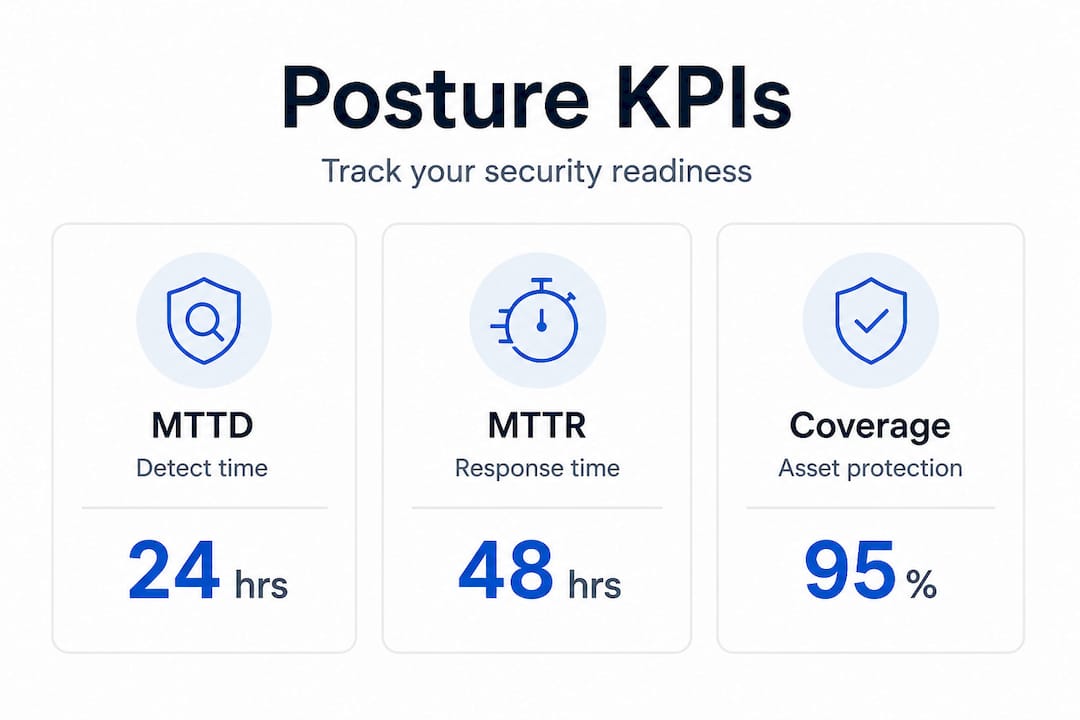
| Mean time to detect (MTTD) | How quickly threats are identified | Decreasing |
| Mean time to respond (MTTR) | How fast incidents are contained | Decreasing |
| Vulnerability remediation rate | Percentage of known vulnerabilities patched | Increasing |
| Phishing simulation failure rate | Percentage of employees clicking phishing tests | Decreasing |
| Compliance coverage percentage | Controls meeting framework requirements | Increasing |
| Security training completion rate | Staff completing required training | Near 100% |
Reviewing cybersecurity best practices can help you set realistic baselines for each metric based on industry norms. Tracking these figures monthly gives leadership a genuine picture of posture movement, not just a point-in-time audit result. Looking at cybersecurity trends 2026 also helps you anticipate which threat categories deserve more measurement focus in the near term.
Pro Tip: Present posture metrics in business language, not technical jargon, when reporting to senior leadership. Translate "MTTD is 48 hours" into "We currently take two days to detect a threat after it enters our environment, which increases breach costs significantly." That framing drives budget and urgency.
Bridging the gap: Strategies to strengthen your cybersecurity posture
Once you have identified vulnerabilities and opportunities, let's turn to how you can drive measurable improvements.
Knowing your gaps is only the first step. The real challenge is closing them systematically while keeping the business running and securing executive support for sustained investment. Gap analysis findings and CISA CPG priorities should guide which actions you take first, not urgency alone.
The most effective strategies for improving posture include:
- Security awareness training. Human error is involved in the majority of breaches. Regular, role-specific training that goes beyond annual checkbox compliance builds a workforce that recognizes and resists social engineering, phishing, and policy violations.
- Access control and least privilege. Review who has access to what. Limit permissions to what each role actually needs. This single action dramatically reduces your attack surface, especially in cloud environments where over-permissioned accounts are common.
- Patch and vulnerability management. Establish a formal patching cycle with defined response times for critical vulnerabilities. Many breaches exploit known vulnerabilities that were not patched in time.
- Incident response readiness. A documented incident response plan that is tested regularly means your team reacts faster and more effectively when something actually happens. Untested plans fail under pressure.
- Governance and ownership. Assign a senior owner for cybersecurity posture, ideally at the CISO or equivalent level. Executive ownership drives accountability, budget, and cross-functional cooperation.
Linking posture improvements to business outcomes is what earns sustained leadership support. When you frame a proposed training program as "this reduces breach risk by improving detection of phishing, which accounts for 60% of all incidents in our industry," the business case becomes compelling rather than technical.
Strong security governance strategies are the backbone of a resilient posture. Governance determines how decisions get made, who owns risk, and how accountability flows across the organization. Without it, even the best technical controls degrade over time because no one is actively maintaining them.
"A security culture is not built through compliance checklists. It is built through visible leadership commitment, honest conversations about risk, and systems that make secure behavior easy and rewarded."
For executives looking to translate posture improvements into an actionable workflow, reviewing an executive cybersecurity workflow provides a structured, practical approach to embedding security decisions into the daily rhythm of business operations.
Continuous improvement loops matter here. After every incident, near-miss, or failed assessment control, run a structured retrospective. What failed? Why? What process change will prevent recurrence? That feedback loop, applied consistently, is what transforms a reactive security posture into a proactive one.
Perspective: The real-world challenges and what most companies overlook
Here is something that gets overlooked in almost every posture assessment we see: the hardest problems are not technical.
Most assessments find plenty of technical issues. Missing patches, misconfigured cloud permissions, overprivileged accounts. These are real, important, and fixable. But the reasons they persist year after year almost always come down to people and process failures, not technology failures. Someone did not own the process. Leadership did not prioritize the budget request. The team was too stretched to follow the procedure that already existed on paper.
Organizations that invest heavily in tools but under-invest in governance and culture tend to score higher on their assessments than their actual readiness deserves. They have the technology, but not the discipline or accountability to run it properly. This is the gap that creates real exposure.
We have seen organizations with sophisticated security stacks get breached because a contractor bypassed standard onboarding, or because a key employee left and no one audited their access. These are not technology failures. They are organizational ones.
The most important question you can ask in a posture review is not "what tools are we missing?" It is "where does accountability break down in our current security process?" That question leads you to the real vulnerabilities.
Honest data security steps require leaders to acknowledge that security posture is a shared responsibility across every department, not just IT. When the CFO approves shadow IT tools to save time, or when HR skips security onboarding for contractors due to urgency, posture degrades. Executive teams that model secure behavior and hold every function accountable close far more gaps than those that delegate security entirely to the technical team.
True differentiators are not the organizations with the most sophisticated tools. They are the ones where security is normalized as a business discipline, discussed openly, and owned at the leadership level.
How YS Lootah Tech can help you advance your cybersecurity posture
Knowing where your organization stands is one thing. Building a systematic path from assessment to resilience requires experienced partners who understand both the technical and business dimensions of security.

At YS Lootah Tech, we work with business leaders and IT teams across industries to design and implement cybersecurity strategies that are grounded in real risk, not theoretical frameworks. Our approach starts with honest assessment and ends with measurable improvement. Whether you need secure app development practices embedded from the ground up or AI security solutions that improve threat detection across your environment, our team brings the depth and regional expertise to move your posture forward. We do not believe in one-size-fits-all security. We build solutions that fit your organization's actual risk profile and business objectives.
Frequently asked questions
How is cybersecurity posture different from cybersecurity strategy?
Posture measures your current security status and readiness across people, processes, and technology, while strategy is your overall plan and vision for defending against cyber risks over time.
Which frameworks are most widely used for posture assessment?
NIST CSF 2.0 and CISA CPGs are the most commonly applied frameworks for comprehensive security posture evaluation across industries and organization sizes.
How often should we assess our cybersecurity posture?
Continuous assessments with gap analysis are the gold standard, but at minimum, organizations should conduct a formal posture review annually to stay ahead of evolving threats.
What are examples of metrics used to evaluate cybersecurity posture?
Common metrics include mean time to detect and respond to incidents, vulnerability remediation rates, phishing simulation failure rates, and compliance coverage percentages against your chosen framework.
Recommended
- Executive cybersecurity workflow: reduce risk in 5 steps
- Cybersecurity Fundamentals Explained: Guide for Dubai Leaders
- Cybersecurity best practices: Enterprise guide to safer ops
- What is cybersecurity? Essential guide for business resilience
- 6 Reasons You Should Back Up WordPress | WP Tango
- Essential security tips for safe DLL downloads on Windows – FixDlls Blog