Benefits of Digital Optimization for Business Leaders

TL;DR:
- Digital optimization offers extensive benefits beyond software updates, including cost reduction, productivity gains, and competitive advantage. Effective measurement relies on establishing baseline costs, sector-specific frameworks, and organizational capabilities like talent and governance to activate true savings. Success depends on integrating technology with organizational development, cross-functional collaboration, and ongoing performance assessment.
Digital optimization often gets reduced to a conversation about software upgrades or faster websites. That framing misses most of the value. The real benefits of digital optimization span cost reduction, productivity gains, governance improvements, and competitive differentiation that compounds over time. This article cuts through the noise with data-backed frameworks, sector-specific evidence, and practical examples so you can make informed decisions about where to invest, how to measure returns, and what organizational conditions actually make those returns materialize.
Table of Contents
- Key takeaways
- Benefits of digital optimization: how to measure what you actually gain
- Sector-specific impacts: where digital gains are strongest
- Logistics and supply chain: where efficiency gains get concrete
- Innovation, governance, and talent: the multipliers that activate real gains
- My perspective on what most organizations get wrong
- How Yslootahtech can help you unlock measurable results
- FAQ
Key takeaways
| Point | Details |
|---|---|
| Start with baseline costs | Quantifying benefits requires mapping current cost-per-transaction before modeling any savings. |
| Manufacturing gains are clearest | A 1-unit digitization increase lifts manufacturing productivity by roughly 8.45%, while services require tailored approaches. |
| Logistics cost cuts are measurable | IoT and AI integration can reduce logistics costs by up to 23%, but only with strong organizational alignment. |
| Technology alone is not enough | Innovation capacity, skilled talent, and governance are what translate digital tools into sustained cost reductions. |
| Sector context shapes strategy | A framework effective in one industry may produce misleading results in another without customization. |
Benefits of digital optimization: how to measure what you actually gain
Most business leaders instinctively believe digital optimization will save money and time. Far fewer know how to prove it before committing the budget, which is exactly where most programs stall.
The starting point is defining what categories of benefit you are actually targeting. The UK Government Digital Service's Digital and Data Benefits framework organizes digital benefits into four distinct categories worth adopting regardless of your industry:
- Productivity gains: Time saved on tasks that employees or users previously completed manually
- Cost reduction: Lower cost-per-transaction driven by channel shift from high-cost to low-cost service delivery
- User experience improvement: Reduced failure demand, meaning fewer repeat contacts caused by an incomplete first interaction
- Channel shift economics: The financial delta between what it costs to serve someone digitally versus through a call center or in-person interaction
The practical power of this framework lies in forcing a baseline assessment. You cannot model savings without knowing your current cost per transaction. Once you have that number, you can estimate the "size of the prize" for each category and prioritize accordingly.
Pro Tip: Before launching any digital optimization initiative, run a 30-day audit of your highest-volume service interactions. Track the channel used, time taken, and resolution rate. That data becomes your baseline for every ROI conversation you will have later.
The UK GDS framework modeled these categories across more than 7,000 government services using Monte Carlo simulation. The projected savings from full digitization reached £1.5 billion through channel shift and failure demand reduction alone. For private sector leaders, the methodology is more instructive than the figure. Running scenario-based modeling against your own cost data gives you a defensible investment case that generic ROI calculators cannot provide.
Separately, analysis of AI adoption in the UK public sector found £6.3 billion in annual savings potential, combining £1.1 billion in direct cost reductions with 5.2 million productivity hours gained. The method behind that figure, mapping task augmentation potential across 200,000 job descriptions, translates directly to how private organizations should audit their own workforce for automation opportunity.
Sector-specific impacts: where digital gains are strongest
The advantages of digital optimization are not evenly distributed across industries, and that distinction matters when you are allocating capital.
Research analyzing over 3,000 firms found that each unit increase in digitization lifts manufacturing total factor productivity by approximately 8.45%. The logic is structural. Manufacturing outputs are standardizable. Processes follow predictable sequences. Digital tools can encode those sequences, detect deviations, and correct them at a speed no human supervisor can match.
Services industries present a different picture. Productivity gains exist, but they are harder to isolate and measure because service quality depends on human judgment, relationship dynamics, and context that digital systems struggle to capture cleanly. The measurement complexity in services means that sector-specific measurement approaches are not optional. Applying a manufacturing-derived digitization index to a professional services firm will give you directionally misleading results.
What does differ by sector is which organizational capabilities matter most:
- Manufacturing: AI, automation, and big data deliver the largest productivity lifts when paired with process standardization and quality management systems
- Financial services: Digital tools generate the clearest gains in compliance monitoring, fraud detection, and customer onboarding efficiency
- Healthcare: Digital optimization benefits concentrate in scheduling, diagnostics support, and supply chain management rather than direct patient care
- Retail and e-commerce: The impact of digital optimization shows most clearly in inventory accuracy, fulfillment speed, and personalized customer interaction
The firms that extract the most value share a common profile. They have invested in innovation capacity, recruited or developed technically skilled talent, and built governance structures that can absorb and act on data. Without those organizational capabilities, the technology investment underperforms regardless of sector.
Logistics and supply chain: where efficiency gains get concrete
If you want a case study in quantifiable digital transformation benefits, logistics is where the numbers are clearest and the methodology most replicable.

Research analyzing 346 logistics managers and financial performance data found that IoT and AI-enabled optimization can reduce logistics costs by up to 23%. That figure comes with an important qualifier. Organizations that showed the strongest gains had also invested in organizational integration, meaning digital systems were connected across functions rather than operating as isolated tools.
Here is how that plays out in practice, step by step:
- Digitize data capture. Replace manual shipment logging with IoT sensors and real-time tracking. This eliminates data latency and creates a live operational picture.
- Integrate systems horizontally. Connect warehouse management, transport management, and demand planning into a shared data environment. Siloed systems are the primary reason IoT investments underperform.
- Apply optimization algorithms. Use AI-driven route planning and load optimization to convert your data into cost-saving decisions at a speed no planning team can manually match.
- Train for adoption. Build cross-functional training programs so planners, drivers, and warehouse staff understand how to interpret and act on digital outputs.
- Measure cycle time alongside cost. Cost reduction is one metric. Decision cycle time is equally important because faster planning creates compounding efficiency gains.
Toyota's outbound logistics program offers a concrete illustration of this sequence. Mathematical optimization applied to their logistics network cut transportation costs by 10% while reducing planning time from several hours down to 20 minutes. The planning time reduction is arguably more strategically valuable than the cost figure. Near real-time plan updates mean Toyota can respond to supply disruptions, demand spikes, and routing changes without the lag that turns operational problems into customer-facing failures.
Pro Tip: When evaluating digital optimization vendors for logistics, ask specifically about decision cycle time reduction alongside cost metrics. A system that makes better decisions slowly will not give you the competitive response speed that justifies the investment.
Innovation, governance, and talent: the multipliers that activate real gains
Here is what most technology investment conversations miss. Digital tools do not reduce costs directly. They create the conditions under which cost reductions become possible, but those conditions only activate when three complementary factors are present.
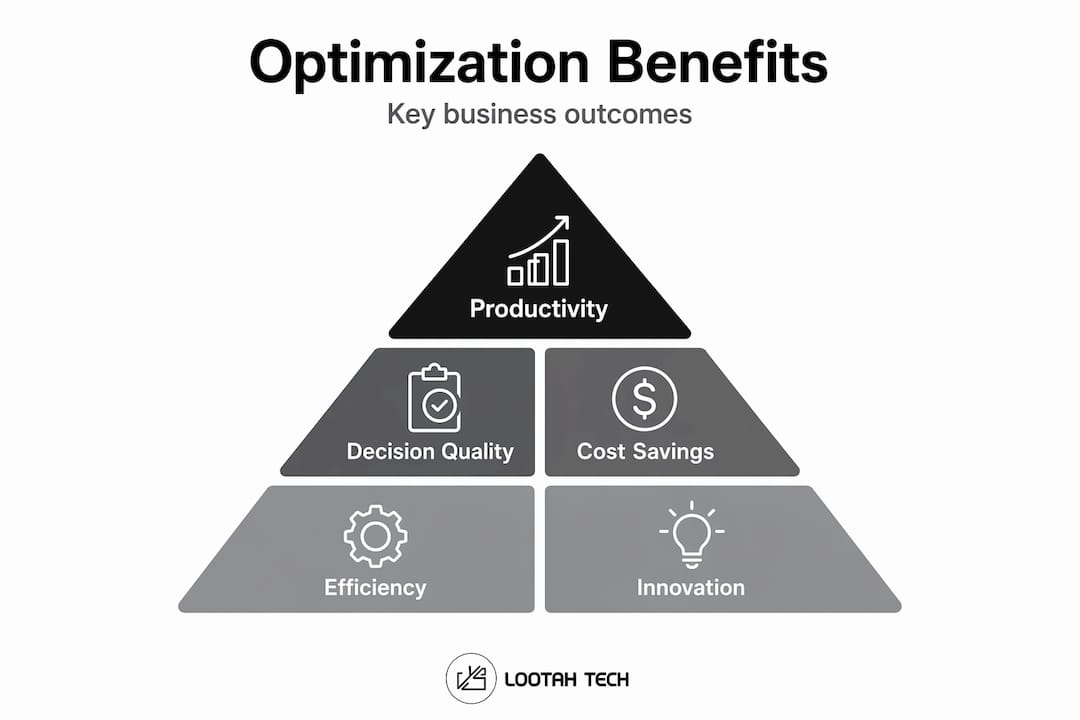
An empirical study of Chinese A-share listed firms found that digital transformation reduces operating costs through three mediation pathways: innovation activity, talent quality, and governance effectiveness. Strip away any one of those three and the cost reduction effect diminishes significantly. That finding has direct implications for how you structure a digital optimization program.
Innovation capacity means your organization actively uses digital tools to generate new approaches to old problems, not just automate existing processes. When teams have permission and tools to experiment, they find cost-reduction opportunities that top-down planning misses.
Talent quality is the most uncomfortable mediator for leaders to acknowledge. Technology investments routinely underperform because the people using the tools lack the skills to interpret outputs and act decisively. Skilled talent mediates the relationship between technology adoption and cost savings more reliably than the technology itself.
Governance effectiveness refers to decision-making quality and accountability structures. Digital tools generate more data than most organizations can process meaningfully. Without governance frameworks that define who is responsible for acting on which data, the insights accumulate without translating into operational changes.
Organizations that treat digital optimization as a technology procurement exercise will consistently underperform those that treat it as an organizational development program that happens to involve technology.
The practical implication: budget for capability building alongside every technology deployment. The digital capability building evidence from the UK GDS framework shows that workforce development investments reduce contractor dependency, lower failure rates, and improve overall program effectiveness. That is not a soft benefit. It is a measurable cost reduction with a clear mechanism.
You can read more about how innovation drives competitive edge and why the organizational context around technology adoption matters as much as the tools themselves.
My perspective on what most organizations get wrong
I have worked closely enough with digital optimization programs to see a pattern that rarely makes it into the conference room conversation. Most organizations measure the wrong things at the start, then justify the whole program based on those metrics. They track deployment completion rates, user account activations, and feature adoption percentages. None of those figures tell you whether the business is actually running more efficiently.
What I have found actually works is starting the measurement conversation before the technology selection conversation. When you know exactly which baseline costs you are trying to move, you can evaluate vendors against that specific outcome rather than against feature lists. The organizations I have seen extract the most value from digital optimization are those that appointed someone specifically accountable for measuring business outcomes, not technology delivery. That distinction changes the entire dynamic of how a program is managed.
My view on sector-specific challenges is direct: services businesses should be skeptical of productivity benchmarks derived from manufacturing contexts. The dynamics are genuinely different, and importing the wrong measurement model leads to either false confidence or unfair skepticism about what digital tools can do. Invest in measurement design before you invest in technology. That sequence feels counterintuitive, but it consistently produces better outcomes.
The role of cross-functional collaboration is also underestimated. The strongest programs I have encountered treat digital optimization as a shared operational responsibility rather than an IT project. When finance, operations, and technology sit in the same room defining what success looks like, the resulting program is harder to stall and easier to scale.
— YS
How Yslootahtech can help you unlock measurable results
At Yslootahtech, we work with business leaders who are past the theoretical stage. You understand that improving business efficiency through digital means requires more than deploying new software. You need solutions designed around your specific operational constraints and measured against outcomes that matter to your business.
Our team in Dubai builds tailored digital solutions across UX/UI design, application development, and website development with a direct focus on the operational metrics your leadership team tracks. We do not hand over a finished product and walk away. We bring the measurement frameworks, technical expertise, and ongoing support to ensure your digital optimization investment produces the cost reductions and productivity gains you modeled at the start. If you are ready to move from intention to a quantified plan, our team is the right starting point.
FAQ
What are the main benefits of digital optimization?
The core benefits of digital optimization include reduced operating costs, improved productivity, better decision-making through real-time data, and stronger competitive positioning. Research shows logistics enterprises alone can achieve up to 23% cost reduction through IoT and AI integration.
How do you measure the impact of digital optimization?
Start by establishing baseline cost-per-transaction data, then model savings across benefit categories like channel shift, failure demand reduction, and productivity gains. The UK GDS Digital and Data Benefits framework provides a structured methodology applicable beyond government contexts.
Does digital optimization work differently across industries?
Yes. Manufacturing enterprises see the clearest productivity gains, with each digitization unit lifting total factor productivity by roughly 8.45%. Service industries benefit as well but require sector-specific measurement frameworks to capture results accurately.
Why do some digital optimization programs fail to deliver?
Programs fail most often when technology is deployed without investing in the organizational capabilities that activate its value. Innovation capacity, talent quality, and governance effectiveness are the three factors that mediate whether technology investment actually reduces costs.
How long does it take to see the benefits of digital optimization?
Early wins in areas like logistics routing and process automation can appear within months. Larger benefits tied to organizational capability development and sustained productivity gains typically materialize over 12 to 24 months of consistent implementation and measurement.