B2B technology: tools, trends, and 2026 success factors

Most digital transformation programs don't fail because companies lack the right software. They fail because 70% of programs collapse under cultural misalignment and poor process design. That's a strategic problem, not a technology shortage. B2B technology, when applied correctly, is one of the most powerful levers for operational efficiency and sustained growth. This article breaks down what B2B technology actually means, which components matter most, how it drives measurable results, and what separates the leaders who succeed from the majority who stall.
Table of Contents
- What is B2B technology?
- Core components of B2B technology stacks
- How B2B technology drives operational efficiency
- B2B technology and digital transformation: Success factors and hurdles
- Key trends and the future of B2B technology
- Get expert help with your B2B technology journey
- Frequently asked questions
Key Takeaways
| Point | Details |
|---|---|
| Define B2B technology | B2B technology is a set of integrated tools and platforms designed specifically for business-to-business use, prioritizing efficiency and ROI. |
| Optimize for efficiency | Leveraging B2B tech cuts costs, automates processes, and can triple team productivity when implemented strategically. |
| Avoid transformation pitfalls | Digital initiatives fail when cultural alignment or process redesign are ignored—focus on end-to-end integration for success. |
| Monitor tech trends | The future favors vertical SaaS, AI-powered services, and solutions that blend integration with deep industry expertise. |
What is B2B technology?
B2B technology is not simply enterprise software. It's a connected ecosystem of digital tools, platforms, and services built specifically for how businesses operate with other businesses. The goals are different from consumer apps: scalability across large user bases, deep integration with existing systems, and a clear return on operational investment.
B2B technology refers to digital tools, platforms, and services designed for enterprises, with a focus on integration and ROI. That's a fundamentally different design philosophy than B2C (business to consumer) tools, which prioritize individual user experience and ease of onboarding.
Here's what separates B2B technology from consumer solutions:
- Scalability: Built to support hundreds or thousands of users, not individuals.
- Integration depth: Designed to connect with CRMs, ERPs, data warehouses, and third-party APIs.
- Compliance and security: Enterprise-grade controls that consumer apps rarely offer.
- Operational ROI focus: Measured by cost reduction, throughput, and process efficiency, not engagement metrics.
"B2B technology is not a product category. It's an interconnected ecosystem where each tool must earn its place by improving how the business operates end to end."
Examples include CRM platforms like Salesforce, ERP systems like SAP, cybersecurity infrastructure, and advanced analytics platforms. These are not interchangeable with consumer software. They require configuration, integration planning, and ongoing governance to deliver value.
Core components of B2B technology stacks
A B2B technology stack is the layered combination of tools and platforms that power an organization's operations. Understanding the layers helps you make smarter investment decisions and avoid costly redundancy.
The core layers include:
- SaaS (Software as a Service): Cloud-delivered applications like CRMs, HR platforms, and marketing automation tools.
- PaaS and IaaS: Infrastructure and platform layers that support custom development and cloud hosting.
- ERP systems: Centralized platforms that unify finance, supply chain, HR, and operations.
- Automation tools: Workflow engines and RPA (robotic process automation) that eliminate manual steps.
- Analytics and BI: Platforms that turn operational data into actionable decisions.
SaaS, PaaS/IaaS, ERPs, and automation tools are critical B2B components. SaaS pricing typically ranges from $10 to $200 per user per month, while on-premise deployments often start at $50,000 or more upfront. That cost difference shapes how organizations build their stacks.
| Factor | SaaS | On-premise |
|---|---|---|
| Upfront cost | Low ($10-$200/user/mo) | High ($50k+ upfront) |
| Scalability | Instant, elastic | Requires hardware investment |
| Maintenance | Vendor-managed | Internal IT team |
| Customization | Limited to moderate | High |
| Integration complexity | API-first, easier | Often requires middleware |
| Security control | Shared responsibility | Full internal control |
For most mid-to-large enterprises, a hybrid approach works best: SaaS for standard functions, on-premise or private cloud for sensitive or highly customized workloads. You can explore enterprise app examples to see how leading organizations structure these decisions.
The right cloud computing services layer is often the foundation that makes everything else work. Without it, integration becomes a bottleneck. With it, your stack becomes a competitive asset.
Pro Tip: Before adding any new tool, map it against your existing stack. If it doesn't integrate cleanly with at least two core systems, the long-term maintenance cost will outweigh the short-term benefit. Prioritize compatibility over features.
Strategic IT consulting can help you audit your current stack and identify where integration gaps are costing you the most.
How B2B technology drives operational efficiency
Operational efficiency is where B2B technology delivers its clearest, most measurable value. The gains aren't theoretical. They show up in cost structures, team output, and error rates.

B2B partnerships and AI automation reduce costs by 20 to 40%, cut manual operations by up to 80%, and can increase team throughput by up to 3x. Those numbers reflect what happens when technology is applied to the right processes, not just deployed broadly.
Here's how automation typically scales inside an enterprise:
- Trigger-based workflows: Simple rules that automate repetitive tasks like invoice routing or lead assignment.
- Cross-app orchestration: Connecting multiple platforms so data flows automatically between CRM, ERP, and support systems.
- AI-assisted decision support: Predictive models that surface recommendations, flag anomalies, or prioritize queues.
- Full process automation: End-to-end workflows where human intervention is only required for exceptions.
| Efficiency metric | Before B2B tech | After B2B tech |
|---|---|---|
| Cost per transaction | High, variable | Reduced 20-40% |
| Manual processing time | Hours per task | Minutes or automated |
| Data access speed | Siloed, delayed | Real-time, unified |
| Team throughput | Baseline | Up to 3x increase |
| Error rate | High (manual input) | Near-zero (automated) |
Top-performing SaaS companies report 113% net revenue retention, which reflects how deeply embedded their technology becomes in client operations. When a platform drives that level of stickiness, it's because it's genuinely improving how work gets done.
A solid digital transformation roadmap ensures these efficiency gains are sequenced correctly, so you're not automating broken processes. The goal is to redesign first, then automate. Your digital strategy should connect every technology investment back to a specific operational outcome.
B2B technology and digital transformation: Success factors and hurdles
Most organizations understand that digital transformation requires technology. Fewer understand that technology is the easy part. The hard part is everything around it.
70% of digital transformation attempts fail, and the leaders who succeed consistently point to process focus and cultural alignment as the differentiators. Not the software vendor. Not the budget.
Common failure points include:
- Data silos: Departments running disconnected systems that prevent unified reporting or workflow automation.
- Over-customization: Building so many custom features that upgrades become impossible and maintenance costs spiral.
- Poor user adoption: Deploying tools without training, change management, or clear incentives for adoption.
- Feature-first thinking: Selecting technology based on capabilities rather than process fit.
Success factors look different:
- Leadership alignment across all departments before rollout begins.
- Incremental deployment with clear milestones and feedback loops.
- Ongoing training tied to actual job functions, not generic onboarding.
- A dedicated change management process that addresses resistance early.
"Technology doesn't transform organizations. People do. The most successful digital transformations treat cultural readiness as a technical requirement, not an afterthought."
Pro Tip: Before selecting any platform, run a process audit. Document the current state of each workflow you plan to digitize. If the process is broken manually, automating it will only make it break faster.
If you're navigating these challenges in the UAE market, the digital transformation guide for UAE enterprises covers region-specific considerations. And if you're evaluating whether technology investment is worth the risk, digital solutions for growth provides a clear framework for making that case internally.
Key trends and the future of B2B technology
The B2B technology landscape is shifting fast. The tools that defined enterprise stacks five years ago are being replaced, commoditized, or absorbed into larger platforms. Decision-makers who understand these shifts will allocate budgets more effectively.
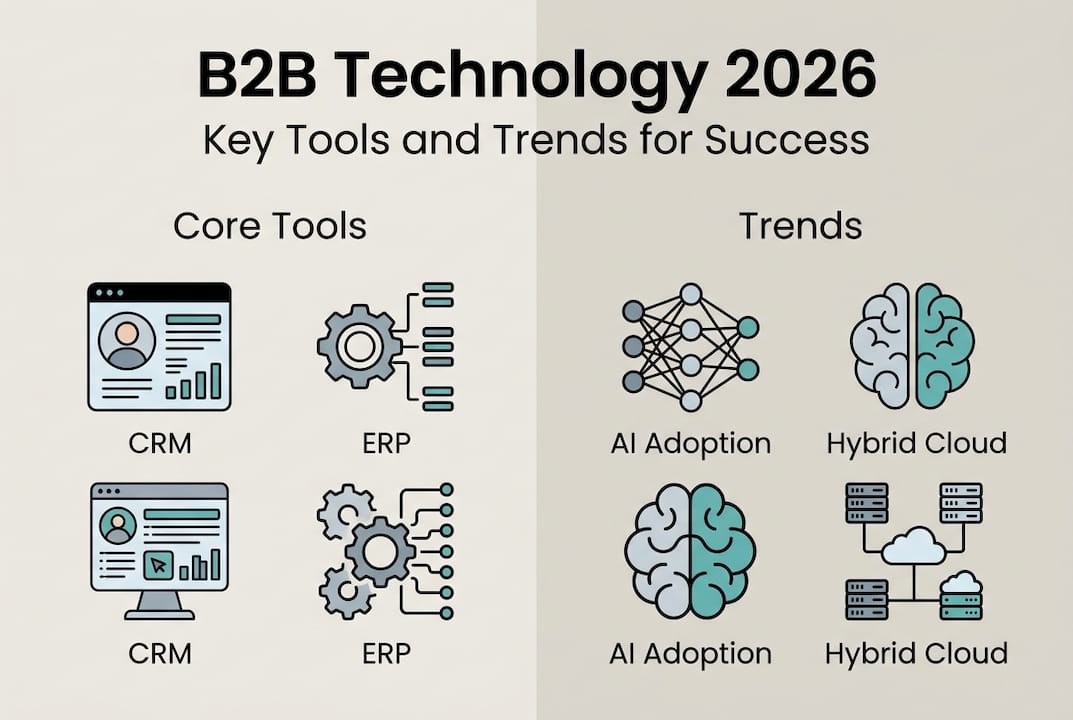
The B2B e-commerce market sits at $18.7 trillion with an 18.2% compound annual growth rate. That scale signals where investment is flowing and which capabilities are becoming table stakes.
Key trends reshaping B2B technology in 2026:
- Vertical SaaS growth: Domain-specific platforms built for healthcare, logistics, fintech, or manufacturing are outperforming generic tools. They offer compliance, workflow logic, and integrations that horizontal platforms can't match.
- AI commoditization: Basic AI features like summarization, classification, and prediction are now standard. The competitive advantage shifts to organizations that apply AI to proprietary data and domain-specific processes.
- Integration platforms as infrastructure: iPaaS (integration platform as a service) tools are becoming as critical as the applications they connect.
- Compliance-driven procurement: Especially in regulated industries, certainty and auditability are now more important than speed of deployment.
"Enterprise buyers are no longer impressed by AI features. They want to know: does this integrate with what we already have, and can we trust it with sensitive data?"
The SaaS moat debate is real: generic software advantages are eroding, but vertical and integrated solutions are gaining ground. Organizations that invest in domain-specific stacks now will have a structural advantage as AI continues to flatten generic feature sets.
For leaders building forward-looking strategies, innovative tech strategies for business leaders outlines how to position your organization ahead of these shifts rather than reacting to them.
Get expert help with your B2B technology journey
Understanding B2B technology is one thing. Designing, deploying, and optimizing a stack that actually delivers operational efficiency and supports digital transformation is another challenge entirely. The gap between knowing and doing is where most organizations lose time and budget.
At YS Lootah Tech, we work with technology-focused organizations to build B2B technology stacks that are integrated, scalable, and aligned with real business outcomes. Whether you need enterprise application development tailored to your workflows, AI and machine learning services that go beyond generic features, or IT consulting experts who can audit your current environment and identify the highest-impact improvements, our team brings the technical depth and industry experience to move fast without cutting corners. Let's build something that works.
Frequently asked questions
What makes B2B technology different from B2C tools?
B2B technology is built for enterprise integration and ROI, with scalability and compliance requirements that consumer tools don't address. B2C tools prioritize individual user experience and ease of use over operational depth.
How does B2B technology impact cost savings?
Strategic B2B tech use cuts costs 20 to 40% and can reduce manual operations by up to 80%, freeing teams to focus on higher-value work.
What are the main risks of implementing B2B technology?
The biggest risks are poor process redesign, cultural resistance to change, and fragmented data systems that prevent integration. 70% of transformations fail because these factors are underestimated.
Is vertical SaaS better than generic B2B solutions?
Vertical SaaS wins in specialized environments where domain-specific workflows, compliance, and integrations matter. Generic tools may still suit organizations with broad, standardized needs across multiple functions.