B2B ecommerce explained: Digital growth for Dubai

TL;DR:
- Modern B2B ecommerce integrates procurement, ERP, and workflows for seamless buying experiences.
- Buyers prefer digital self-service and research, making integration and agility crucial for success.
- Effective B2B ecommerce in Dubai leverages local logistics, compliance, and technological advancements for competitive advantage.
Most decision-makers assume B2B ecommerce means putting a product catalog online and calling it digital transformation. That assumption is costing Dubai businesses real revenue. The reality is that modern B2B ecommerce is a fully integrated commerce channel connecting procurement systems, enterprise resource planning (ERP) tools, customer data, and automated workflows into one seamless buying experience. This guide breaks down what B2B ecommerce actually is, how it differs from consumer models, and what Dubai's business leaders need to do right now to build a platform that creates lasting competitive advantage.
Table of Contents
- Defining B2B ecommerce: More than an online store
- Key differences: B2B vs. B2C ecommerce
- Why B2B ecommerce is booming: Buyer behavior and digital acceleration
- Building a B2B ecommerce strategy: Technology and integration essentials
- Success factors for B2B ecommerce in Dubai: Benefits, barriers, and local opportunities
- What most leaders overlook about B2B ecommerce transformation
- How YS Lootah Tech empowers digital B2B commerce in Dubai
- Frequently asked questions
Key Takeaways
| Point | Details |
|---|---|
| B2B ecommerce redefined | It's more than a digital storefront—it's an integrated, enterprise-grade ordering channel. |
| Digital-first buyer shift | Most B2B buyers now prefer digital and self-service procurement experiences. |
| Local opportunity in Dubai | Dubai businesses can thrive by integrating commerce platforms with local strengths and compliance. |
| Technology and integration matter | Choosing adaptable platforms and aligning with business systems is key for success. |
| Expert guidance pays off | Partnering with specialists accelerates digital growth and avoids common pitfalls. |
Defining B2B ecommerce: More than an online store
With the expectations for digital experience set, it's key to explore exactly what sets B2B ecommerce apart from conventional consumer models.
B2B ecommerce refers to online transactions conducted between businesses rather than between a business and an individual consumer. That sounds straightforward, but the practical reality is far more layered. Think of a manufacturing company in Dubai ordering raw materials from a regional distributor, a healthcare provider reordering medical supplies from a wholesale partner, or a construction firm managing vendor contracts digitally. These are not simple shopping cart interactions. They involve contract pricing, purchase order workflows, credit terms, and multiple levels of internal approvals.
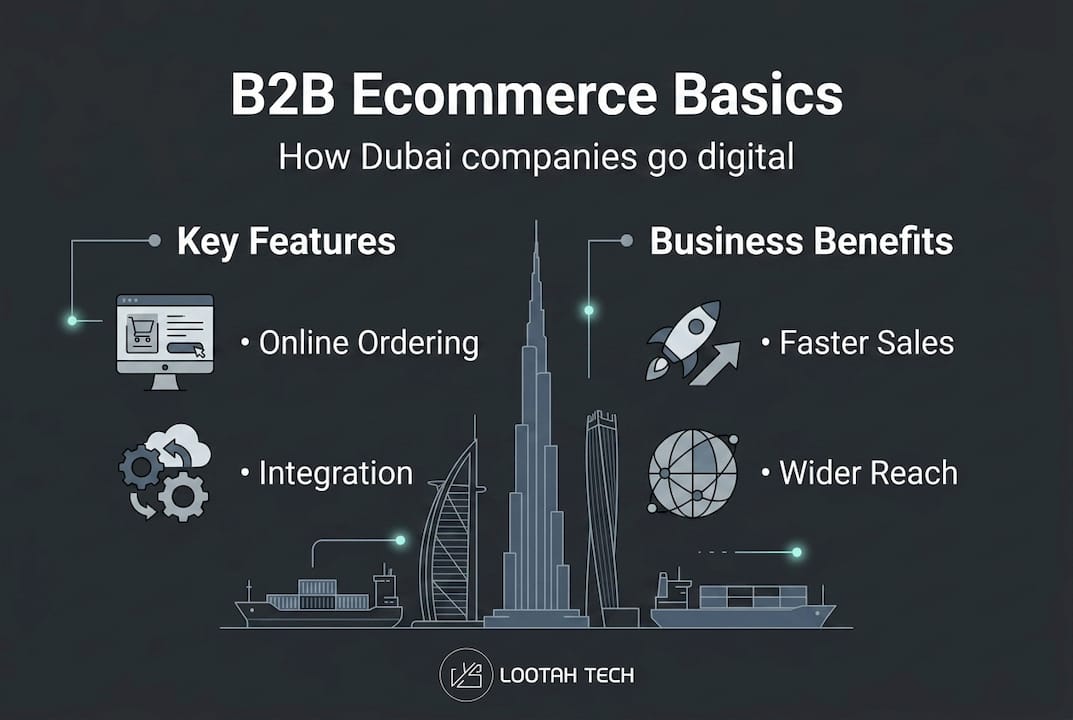
The most common misconception is that standing up an ecommerce website is sufficient. A website is the front door, not the house. The real value of B2B ecommerce comes when that digital channel is connected to your existing enterprise systems, including ERP platforms, CRM databases, inventory management tools, and accounting software. Without that integration, your team ends up re-entering data manually, your buyers get inaccurate product availability, and orders fall through the gaps.
Here is what a genuinely integrated B2B ecommerce channel looks like in practice:
- Real-time inventory and pricing pulled directly from your ERP
- Role-based access so different buyers within the same client organization see their specific pricing tiers
- Automated order confirmation and fulfillment triggers
- Digital invoice generation synced to accounts receivable
- Self-service reordering for approved items within negotiated contracts
- Multi-location shipping and split invoicing for enterprise accounts
"B2B buyers increasingly prefer digital and self-service experiences for purchasing and reordering."
That preference is not a trend anymore. It is the new baseline expectation. The companies staying relevant are those tracking B2B technology trends carefully and building infrastructure that matches what business buyers now expect as standard. If you are still operating a disconnected ordering portal, you are not competing on digital. You are just adding friction. For a deeper breakdown of platform choices specific to the region, the B2B ecommerce platforms UAE guide covers the full decision framework.
Key differences: B2B vs. B2C ecommerce
Distinguishing B2B from B2C helps clarify why technology and workflows matter when selecting and operating a platform.
Consumer ecommerce is designed for individuals making fast, low-friction purchases. B2B ecommerce is designed for organizations making deliberate, often high-value purchases across extended decision cycles. Those two goals require completely different technology architectures and user experiences.
Here is a structured comparison:
| Feature | B2B ecommerce | B2C ecommerce |
|---|---|---|
| Pricing model | Negotiated, customer-specific | Fixed, publicly listed |
| Order volume | High-volume, recurring | Typically one-time, lower volume |
| Decision-makers | Multiple stakeholders, formal approvals | Individual consumer |
| Payment terms | Net 30/60/90, purchase orders | Credit card, instant checkout |
| Account management | Dedicated account teams | Self-service |
| Product catalog | Restricted by contract and role | Open to all visitors |
| Platform complexity | High integration requirements | Moderate |
The implications for platform selection are significant. When you build or buy a B2B ecommerce platform, you need it to handle all of those complexity layers out of the box or through integration. A platform that works brilliantly for consumer retail will collapse under the weight of B2B procurement requirements. Here is how to approach the selection process systematically:
- Map every touchpoint in your current order-to-cash process before evaluating any platform.
- Identify which enterprise systems need to communicate with the ecommerce layer in real time.
- Evaluate platforms on their ability to support role-based pricing and user hierarchy management.
- Assess mobile usability, since many B2B buyers now complete orders on mobile devices between meetings.
- Check compliance readiness for UAE-specific tax, invoicing, and trade documentation requirements.
Pro Tip: Before finalizing any platform decision, run a pilot with a small group of your most demanding accounts. Their feedback will reveal integration gaps that internal reviews never catch.
Aligning your platform choice with a solid B2B digital strategy framework prevents costly rework later. And if your existing systems are limiting what off-the-shelf platforms can do, custom software for business is often the smarter long-term investment.
Why B2B ecommerce is booming: Buyer behavior and digital acceleration
Given the scale and rapid shift in buyer preference, Dubai decision-makers need actionable ways to capitalize on this momentum.
The numbers tell a clear story. B2B ecommerce growth is being tracked as a meaningful channel within the overall B2B economy, with the global market projected to reach $2.93 trillion in 2025 and continuing to grow at roughly 13% year over year. That growth is not driven by companies pushing buyers online. It is pulled by buyers who actively prefer digital channels.

| Buyer behavior | Statistic |
|---|---|
| Prefer website ordering over sales rep | 70% |
| Conduct online research before purchase | 94% |
| Want a seller-free buying experience | 33% |
Those figures represent a fundamental shift in how business purchasing decisions happen. 70% of B2B buyers find buying from a website more convenient than from a sales representative, 94% conduct online research before making a purchase decision, and 33% desire a completely seller-free sales experience. Your buyers are already doing their homework digitally before your sales team even gets a meeting.
What does this mean practically for Dubai businesses?
- Digital product content matters. Buyers researching online need accurate specifications, pricing transparency, and comparison tools. Thin or outdated content kills deals before they start.
- Self-service portals are not optional. Buyers who can reorder independently, check order status, and download invoices without calling your team are more loyal, not less.
- Speed wins deals. Response time expectations have collapsed. Buyers who can get an instant quote from a competitor's platform will not wait 48 hours for your sales team to call back.
- Mobile experience is a qualifier. A procurement manager approving an order from their phone needs the same complete functionality as a desktop user.
- Data from digital channels is strategic intelligence. Every search, click, and abandoned cart tells you something about buyer intent that your sales team cannot capture manually.
Firms exploring digital solutions for growth in this environment are not just building better websites. They are building buyer intelligence systems that compound over time. And companies investing in boosting digital efficiency across their ordering workflows are seeing measurable reductions in cost-per-order and measurable increases in account retention.
Building a B2B ecommerce strategy: Technology and integration essentials
With a strategy in hand, let's consider the major benefits and challenges unique to the Dubai market before putting B2B ecommerce plans into action.
A B2B ecommerce strategy is not a website project. It is an enterprise systems project that happens to have a customer-facing digital layer on top. Getting that framing right changes everything about how you resource, plan, and execute.
The core technology components you need to align before launch include:
- Platform selection: Choose between purpose-built B2B platforms, custom-developed solutions, or hybrid architectures depending on your volume, complexity, and growth trajectory.
- ERP and CRM integration: Your ecommerce channel must read from and write to your core systems in real time. One-way or delayed syncing creates data quality problems that erode buyer trust fast.
- User role management: Different buyers within the same client company need different permissions, catalogs, and pricing. Your platform must handle that hierarchy natively.
- Mobile experience: A responsive design is the minimum. A purpose-built mobile experience optimized for B2B workflows, including quick reorder, approval notifications, and digital PO submission, is the goal.
- Analytics and reporting: You need to track not just sales volume but buyer journey depth, search behavior, cart abandonment rates, and account engagement trends.
Digital Commerce 360 notes operational gaps and marketplace momentum shaping value in B2B ecommerce, which means companies that solve their integration problems gain a durable advantage over those still operating disconnected systems.
Pro Tip: Do not underestimate change management. The biggest B2B ecommerce failures in Dubai are not technology failures. They are adoption failures where internal teams or buyer accounts were not trained or incentivized to use the new system.
Here are the most common pitfalls Dubai firms encounter during B2B ecommerce rollouts:
- Unconnected platforms that force manual data entry between systems
- Ignoring local compliance requirements for VAT invoicing and trade documentation
- Skipping user acceptance testing with actual buyer accounts before launch
- Underestimating content requirements for product catalogs and technical documentation
- Neglecting post-launch optimization by treating launch as the finish line
Following proven innovative tech strategies prevents these traps. A structured transformation roadmap helps you sequence the work correctly, and understanding what smart solutions for business efficiency actually look like at the operational level keeps your implementation grounded.
Success factors for B2B ecommerce in Dubai: Benefits, barriers, and local opportunities
A well-informed perspective helps business leaders in Dubai make strategic decisions as B2B ecommerce evolves.
Dubai offers a genuinely unique environment for B2B ecommerce. The city's world-class logistics infrastructure, progressive government digital initiatives, and position as a regional trade hub create conditions that few global cities can match. Companies that align their digital commerce strategy with these local strengths gain advantages that are hard to replicate elsewhere.
Key advantages Dubai firms can leverage:
- Geographic positioning as a gateway between Asia, Europe, and Africa supports cross-border B2B trade at scale
- Advanced logistics networks including Jebel Ali Port and multiple free zones enable fast, reliable fulfillment
- Government digital initiatives under the UAE Vision 2031 framework actively support enterprise digitization
- High digital literacy among the business population reduces buyer adoption barriers
- Strong fintech ecosystem supporting flexible payment terms and digital invoicing for B2B transactions
The obstacles are real too. Legacy technology systems in established industries can make integration expensive and slow. Skills gaps in digital commerce operations mean many firms need external partners for both build and run phases. Market fragmentation across sectors means no single platform approach works universally.
"Digital acceleration alongside slower overall B2B sales growth highlights the need to find new value in digital channels."
That insight is especially relevant for Dubai firms in sectors like construction, healthcare, and industrial supply, where revenue growth has slowed but digital adoption remains an open competitive opportunity. Companies that invest now in robust digital infrastructure will be the default choice for buyers who have already decided they want to transact digitally.
Your final checklist for leveraging B2B ecommerce successfully in Dubai:
- Align your ecommerce roadmap with UAE regulatory requirements from day one
- Build buyer onboarding programs to accelerate adoption among your client accounts
- Invest in Arabic language support where your buyer base requires it
- Treat your platform as a living product, not a one-time project
- Use data from your digital channel to inform sales strategy and product development
A strong tech strategy planning approach gives Dubai businesses the blueprint to move from disconnected digital experiments to a coherent, scalable B2B commerce operation.
What most leaders overlook about B2B ecommerce transformation
Here is the uncomfortable truth we see repeatedly: leaders invest in the platform and forget the plumbing. They launch a polished ecommerce portal, celebrate the go-live, and then wonder why buyer adoption stalls at 20% six months later. The platform was never the problem. The integration was.
When a buyer logs in and sees yesterday's inventory, or receives a manual call to confirm an order they already placed online, the digital experience collapses. Trust collapses with it. True B2B ecommerce transformation happens at the intersection of technology, process, and behavior change, and behavior change is the hardest part.
We have seen Dubai businesses with genuinely excellent platforms underperform because internal sales teams were not incentivized to direct buyers to the digital channel. The sales team saw the platform as a threat rather than a tool. Fixing that required leadership alignment more than any technology upgrade.
The firms seeing real impact from B2B ecommerce are prioritizing user experience and data insights from day one. They are using buyer behavior data to improve their product content, their pricing tiers, and their reorder prompts. They are treating the platform as a revenue intelligence engine. If you want to understand what sustainable B2B ecommerce success factors actually look like beyond the launch, start there.
How YS Lootah Tech empowers digital B2B commerce in Dubai
Take your digital plans further with technology partners dedicated to Dubai's evolving business landscape.
YS Lootah Tech builds the digital infrastructure that makes B2B ecommerce work at an enterprise level. From custom application development tailored to complex procurement workflows, to professional website development that converts business buyers, the team brings deep expertise in building platforms that integrate seamlessly with ERP and CRM systems.

For Dubai businesses ready to go beyond a basic portal, YS Lootah Tech also delivers AI and machine learning capabilities that personalize buyer experiences, automate reordering, and surface demand forecasting insights. Whether you are launching your first B2B ecommerce channel or upgrading an existing one, connect with YS Lootah Tech for a consultation tailored to your industry and growth goals.
Frequently asked questions
What distinguishes B2B ecommerce from B2C ecommerce?
B2B ecommerce supports complex buying journeys, negotiated pricing, and integration with enterprise systems, unlike consumer-focused B2C platforms. B2B buyers increasingly prefer digital and self-service experiences specifically designed around their workflow needs.
Why is B2B ecommerce growing so quickly in 2026?
Growth is fueled by buyers' strong preference for digital research and transactions, with 70% finding online purchasing more convenient than traditional sales rep interactions and 94% conducting online research before any purchase decision.
What features are most important for a B2B ecommerce platform?
Key features include workflow integration, role-based access, flexible pricing, mobile usability, and strong analytics. Operational gaps in these areas are the primary reason B2B platforms underperform after launch.
How do B2B buyers in Dubai differ from global counterparts?
Dubai's B2B buyers value digital solutions that combine global best practices with local compliance requirements, Arabic language support where relevant, and logistics efficiency tied to the region's advanced fulfillment infrastructure.
Can AI and automation drive B2B ecommerce success?
Yes, AI and automation help streamline ordering, personalize customer experiences, and optimize supply chains by turning buyer behavior data into actionable recommendations that improve every stage of the purchasing cycle.