AI cybersecurity strategies that transform how IT leaders defend

TL;DR:
- AI enhances threat detection, reduces analyst fatigue, and speeds response times in cybersecurity.
- Effectively deploying AI involves understanding its methodologies, limitations, and implementing iterative frameworks.
- AI's primary advantage lies in defense, with human oversight crucial for complex and high-stakes decisions.
AI cybersecurity strategies that transform how IT leaders defend
Most cybersecurity leaders assume AI is primarily a weapon in the attacker's arsenal. That framing is understandable but wrong. AI excels at pattern recognition and systematic detection far more than it does at the creative deception attackers rely on. The real opportunity is on the defense side, where AI is fundamentally changing how organizations detect threats, reduce analyst fatigue, and respond faster than any human team could alone. This guide breaks down the methodologies, benchmarks, limitations, and implementation strategies IT leaders need to understand before making their next cybersecurity investment.
Table of Contents
- How AI is reshaping the threat detection and response landscape
- From penetration testing to zero-day mitigation: AI's practical uses
- AI's limitations and risks: What leadership must address
- Implementation frameworks: Building effective, trustworthy AI-driven security
- Perspective: Why defense, not deception, remains the winning bet for AI in cybersecurity
- Explore advanced AI cybersecurity solutions with YS Lootah Tech
- Frequently asked questions
Key Takeaways
| Point | Details |
|---|---|
| AI amplifies defense | AI's main cybersecurity value is improving real-time detection and rapid response capacity for organizations. |
| Routine automation, not total replacement | AI automates up to 60% of repetitive tasks, but expert human oversight remains vital for complex decisions. |
| Leadership focus: trustworthy implementation | Prioritize explainable AI, robust model training, and human-in-the-loop frameworks to maximize effectiveness and trust. |
| Beware overconfidence | High false positives and model limitations require strategic budget and team structure to avoid unexpected gaps. |
How AI is reshaping the threat detection and response landscape
To use AI effectively in cybersecurity, you need to know what kind of AI you're actually deploying. These are not interchangeable tools. Each methodology has a specific strength, and matching the right approach to the right problem is what separates a successful implementation from an expensive experiment.
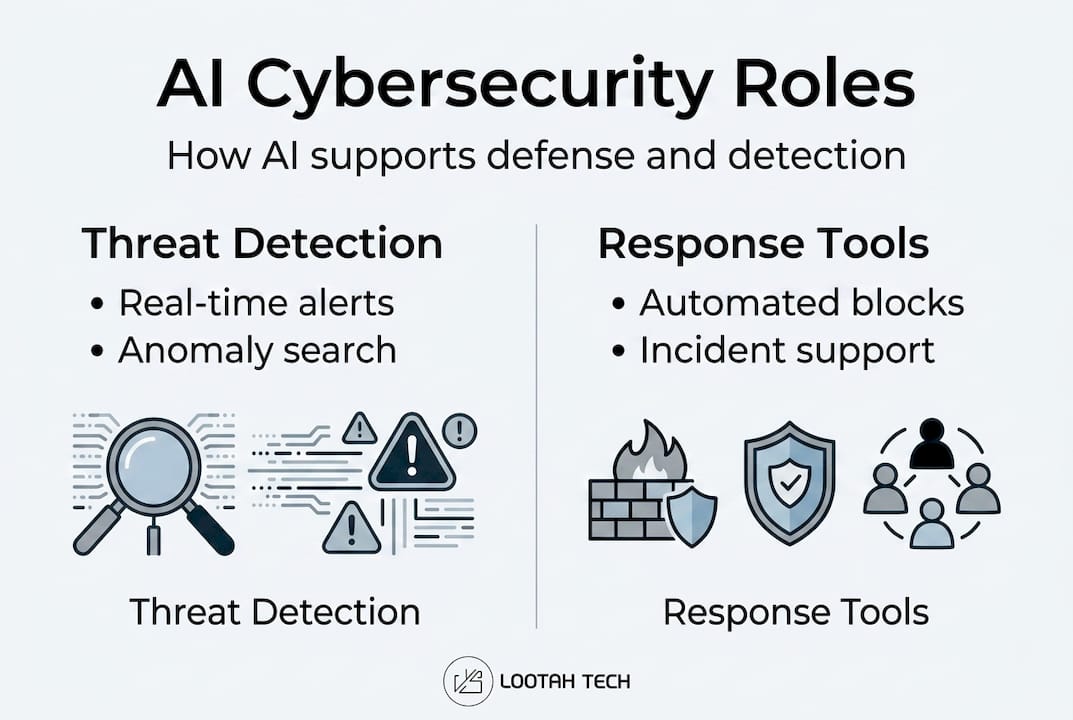
Core AI and ML methodologies in cybersecurity:
| Technique | Best used for | Practical example |
|---|---|---|
| Machine Learning (ML) | Classification, clustering, anomaly detection | Flagging unusual login behavior across user accounts |
| Deep Learning (DL) | Image/pattern recognition, complex traffic analysis | Detecting malware signatures in network packet payloads |
| Federated Learning (FL) | Collaborative learning without sharing raw data | Multiple hospitals sharing threat intelligence privately |
| Reinforcement Learning (RL) | Adaptive threat response, zero-day mitigation | Adjusting firewall rules in real time based on attack behavior |
As AI/ML methods in cybersecurity research confirms, reinforcement learning is particularly important because it overcomes the core limitation of static ML models: the inability to adapt to threats they've never seen before. Traditional signature-based detection fails completely against zero-day exploits. RL-based systems learn from interaction with their environment, meaning they can identify novel attack patterns by recognizing behavioral anomalies rather than known signatures.
Here's where AI genuinely changes the math for your security operations center:
- Scale: AI processes millions of log events per second, something no human team can match regardless of size
- Consistency: Unlike human analysts, AI doesn't experience fatigue, distraction, or alert blindness after hour six of a shift
- Speed: Automated threat classification reduces mean time to detect from hours to minutes in well-integrated environments
- Breadth: AI can simultaneously monitor endpoint telemetry, network traffic, cloud workloads, and user behavior without the siloed coverage gaps humans create
- Continuous learning: Modern ML models update their baselines as the environment changes, reducing false positives over time
The accelerative effect is significant. AI doesn't just speed up what humans already do. It enables capabilities that simply weren't practical before, particularly in cybersecurity fundamentals like perimeter monitoring and behavioral analysis at scale. When integrated into a risk reduction workflow, these capabilities translate directly into faster containment and lower breach costs. The practical upshot is that your analysts can focus on investigation and decision-making while AI handles the volume problem that was overwhelming them.
From penetration testing to zero-day mitigation: AI's practical uses
Benchmarks tell a more honest story than vendor marketing. When researchers actually tested AI agents against real-world vulnerability datasets, the results were revealing in both what AI can do and where it still falls short.
In the CyberGym benchmark using 1,507 real-world vulnerabilities, top AI agents achieved roughly 20 to 22 percent success rates in generating working proof-of-concept exploits, and the research process led to the discovery of 34 to 35 previously unknown zero-day vulnerabilities. That number might sound modest, but consider the scale and speed at which AI can run these tests compared to a human team.
The cost and efficiency comparison is even more striking. AI agents are 20x cheaper and faster than humans for low to medium complexity vulnerabilities in penetration testing, and they can replace 50 to 60 percent of routine security tasks. However, AI still lags behind senior pen-testers on multi-step reasoning, complex exploit chaining, and genuinely novel attack scenarios.

| Factor | AI agent | Senior human pen-tester |
|---|---|---|
| Cost per task | Very low | High |
| Speed (routine vulns) | 20x faster | Baseline |
| Routine task automation | 50 to 60% | N/A |
| Complex multi-step exploits | Weak | Strong |
| Novel/zero-day discovery | Improving | Best in class |
| False positive rate | Moderate to high | Low |
For enterprise security teams, the practical takeaway is clear. AI is an outstanding force multiplier for coverage and volume, not a replacement for experienced human judgment on complex cases. The security frameworks for enterprises that perform best are those that leverage AI to handle scale while reserving senior analyst time for the edge cases where human reasoning is irreplaceable.
High-impact cybersecurity tasks AI can automate right now:
- Continuous vulnerability scanning across large asset inventories
- Log correlation and threat classification at SIEM scale
- Phishing email detection and automated triage
- Network anomaly detection and baseline deviation alerting
- Patch prioritization based on risk scoring models
- Routine incident response playbook execution via SOAR integration
- Credential stuffing and brute force detection with automated blocking
Pro Tip: Pair junior analysts with AI-assisted investigation tools rather than deploying AI as a standalone system. Junior staff benefit from AI's pattern recognition to build contextual awareness faster, while their human judgment helps validate AI outputs and catch false positives before they escalate. This pairing model produces faster skill development and better coverage than either approach alone. For teams adopting enterprise cybersecurity best practices, this human-plus-AI model consistently outperforms both all-human and all-automated approaches.
AI's limitations and risks: What leadership must address
No technology earns unconditional trust, and AI in cybersecurity is no exception. Understanding where AI fails is just as important as knowing where it excels. Leaders who skip this step often discover the gaps during an actual incident, which is the worst possible time.
Critical AI cybersecurity risks your team needs to account for:
- Adversarial attacks: Attackers deliberately craft inputs to confuse or fool AI models, such as slightly modified malware that evades detection by exploiting model blind spots
- Data poisoning: If attackers compromise the training data your AI relies on, they can manipulate its behavior at a fundamental level without touching the model directly
- Bias in training data: Models trained on historically biased or incomplete datasets will produce skewed detection results, missing threat categories underrepresented in the training corpus
- High false positive rates: Overly sensitive models generate alert fatigue, which ironically recreates the exact human burnout problem AI was supposed to solve
- Poor generalization: Static models trained on known attack patterns often fail to recognize genuinely novel or complex zero-day scenarios
- Explainability gaps: Many deep learning models operate as black boxes, making it impossible to audit why a particular alert was triggered
- Hallucinations and overconfidence: AI agents sometimes present incorrect conclusions with high confidence, which is dangerous in a security context where decisions carry real consequences
As limitations of AI agents research documents, these failure modes aren't theoretical. Adversarial attacks, data quality issues, hallucinations, and sycophantic overconfidence are active concerns in production deployments.
"AI-generated security assessments may carry overconfident conclusions. Studies indicate that a meaningful proportion of AI security claims contain errors or unsupported assertions, creating risk when teams rely on automated outputs without human verification."
This is why strategic cybersecurity in 2026 planning must include explicit AI governance policies. Blind trust in model outputs is a vulnerability. The cybersecurity trends for 2026 that matter most are those addressing AI governance, not just AI capability.
Pro Tip: Build defense-in-depth principles into your AI deployment from day one. No AI system should be the sole decision-maker for high-stakes actions like blocking production traffic or escalating to incident response. Require human confirmation for consequential actions, log all AI decisions for audit, and establish a regular model review cycle to catch drift before it creates gaps in your coverage.
Implementation frameworks: Building effective, trustworthy AI-driven security
Knowing AI's capabilities and limitations is useful. Actually deploying it effectively requires a structured approach. The organizations that get the most out of AI cybersecurity investments tend to follow an iterative model rather than a single large deployment.
A proven 5-phase implementation model for AI cybersecurity projects looks like this:
- Assess needs: Audit your current security stack, identify the highest-volume pain points where AI could reduce toil, and define clear success criteria before selecting tools
- Design: Select AI methodologies that match your specific threat model, define data pipelines, establish governance requirements, and map integration points with existing SIEM and SOAR platforms
- Implement: Deploy in a controlled environment first, integrate human-in-the-loop validation at decision points, and document the baseline behavior your AI will learn from
- Evaluate: Measure performance against your pre-defined KPIs, run red team exercises to test adversarial robustness, and actively seek out false positive and false negative patterns
- Optimize: Use evaluation findings to retrain models, refine alert thresholds, improve explainability outputs, and expand scope incrementally as confidence in performance grows
The KPIs that matter most for measuring AI cybersecurity effectiveness include mean time to detect, mean time to respond, false positive rate, false negative rate, analyst alert handling capacity, and the percentage of routine tasks fully automated without human intervention.
| Leadership priority | Why it matters | Action step |
|---|---|---|
| Explainable AI (XAI) | Enables audit, builds trust, supports compliance | Require XAI capabilities in vendor evaluation criteria |
| Human-in-the-loop (HITL) | Prevents automated errors from causing real damage | Define which decisions require human confirmation |
| Continuous model retraining | Prevents model drift and keeps detection current | Schedule quarterly model reviews tied to threat intel updates |
For organizations building or expanding their AI and machine learning capabilities, this framework provides a repeatable path from pilot to production. Pairing it with innovation strategies for leaders ensures the governance layer keeps pace with capability growth.
Perspective: Why defense, not deception, remains the winning bet for AI in cybersecurity
There's a persistent narrative in cybersecurity circles that offensive AI is the real threat, and that organizations need to prioritize understanding attacker AI to stay safe. We think that framing misallocates both attention and budget.
Here's the honest strategic view: AI's detection and response capabilities are maturing far faster than its offensive capabilities. AI's defense advantage grows precisely because detection is a pattern recognition problem, which is exactly what AI is built to solve. Creative deception, the kind sophisticated attackers use to bypass defenses, still requires human ingenuity that AI cannot yet reliably replicate.
The leaders who win are not the ones chasing offensive AI research. They are the ones building what we call human-plus-AI teams, combining AI's tireless, scalable detection with deep human contextual reasoning. Your senior analysts should be doing less triage and more investigation. Your junior staff should be developing faster with AI-assisted tooling. Your budget should prioritize proactive detection infrastructure and rapid response capability, because those are the highest ROI areas in your entire security program.
If you're still allocating the majority of your security budget to perimeter defenses and manual processes, AI-assisted detection is the lever that will change your exposure profile fastest. That shift, from reactive to proactive, from overwhelmed to amplified, is where enterprise cybersecurity wisdom is pointing every mature security organization right now.
Explore advanced AI cybersecurity solutions with YS Lootah Tech
Understanding AI's role in cybersecurity is one thing. Implementing it safely, at scale, in your specific environment is another challenge entirely. YS Lootah Tech works directly with enterprise IT and security teams to design and deploy AI-driven security solutions tailored to your infrastructure, risk profile, and compliance requirements.
Whether you're evaluating your first AI-assisted detection platform or scaling an existing investment, our team brings practical experience across AI and machine learning services, application development, and website development. We help you move from strategy to implementation without the costly missteps that come from going it alone. Reach out to discuss your roadmap and get expert guidance on building a security program that grows with your organization.
Frequently asked questions
Can AI fully replace human cybersecurity analysts?
AI can automate routine tasks and accelerate threat detection, but human experts remain essential for complex, creative analysis and handling novel attack scenarios. AI replaces 50 to 60 percent of routine tasks but consistently lags on multi-step reasoning and novel exploits where senior analysts excel.
What are the biggest risks of using AI in cybersecurity?
Major risks include adversarial attacks, model poisoning, excessive false positives and negatives, and bias in training data, which can impact trust and effectiveness. Limitations of AI agents research specifically identifies hallucinations, overconfidence, and poor generalization as production-level concerns.
How does AI help detect zero-day attacks?
AI, especially reinforcement learning models, adapts to identify unfamiliar patterns and new threats that signature-based tools may miss, improving zero-day detection rates. RL overcomes static ML limitations by learning from behavioral interaction rather than fixed signatures.
Is AI more beneficial for attackers or defenders in cybersecurity?
AI currently gives more advantage to defenders by enhancing detection and response, although attackers use it for more sophisticated phishing and automation. AI's detection strengths outpace its deceptive capabilities, widening the defense advantage as stakes increase.