How to modernize IT infrastructure: Cut costs by 30%
Aging IT infrastructure is silently draining your enterprise's efficiency and competitiveness. Legacy systems create bottlenecks, security vulnerabilities, and mounting maintenance costs that divert resources from innovation. For IT executives and digital transformation leaders in medium to large enterprises, modernizing IT infrastructure is no longer optional. This comprehensive guide walks you through the proven preparation, execution, and verification steps to transform outdated systems into agile, secure, and cost-effective platforms that drive business success.
Table of Contents
- Key takeaways
- Understanding the need for IT infrastructure modernization
- Preparing for IT modernization: assessing and planning
- Executing the modernization: step-by-step implementation
- Verifying modernization success: monitoring and iteration
- How YS Lootah Tech can accelerate your IT modernization
- Frequently asked questions
Key Takeaways
| Point | Details |
|---|---|
| Strategic planning | Successful modernization requires understanding the current environment, setting measurable objectives, and executing changes in controlled phases. |
| Phased upgrades | Execute upgrades in controlled phases with secure migration to minimize risk and downtime while improving agility. |
| Stakeholder engagement | Early and ongoing engagement with stakeholders ensures alignment and sustained support throughout the modernization effort. |
| Continuous verification | Ongoing monitoring of performance and user feedback validates benefits and guides iterative improvements. |
| Ongoing journey | Treat modernization as an ongoing journey rather than a one time project to maintain competitiveness and adapt to change. |
Understanding the need for IT infrastructure modernization
Legacy IT systems create operational friction that compounds over time. Outdated hardware struggles to support modern workloads, causing slowdowns that frustrate users and customers alike. Security vulnerabilities multiply as vendors discontinue support for aging platforms, leaving your enterprise exposed to cyber threats. Maintenance costs escalate as specialized expertise becomes scarce and replacement parts harder to source. These challenges directly impact your bottom line and competitive position.
Modern IT infrastructure improves operational efficiency and resilience by replacing rigid legacy systems with flexible, scalable platforms. Cloud migration eliminates the need for costly on-premises hardware while providing instant scalability. Automation reduces manual intervention in routine tasks, freeing your IT team to focus on strategic initiatives. Modern applications integrate seamlessly across systems, enabling real-time data access and faster decision-making. The cumulative effect transforms IT from a cost center into a growth enabler.
Competitive pressure and digital transformation initiatives drive the urgency for modernization. Enterprises that delay infrastructure upgrades find themselves unable to support new digital services or respond quickly to market changes. Customer expectations for seamless digital experiences continue rising, making outdated systems a liability. Regulatory compliance requirements evolve constantly, demanding infrastructure that can adapt to new standards without extensive rework.
Key challenges from outdated infrastructure include:
- System downtime that disrupts operations and damages customer trust
- Integration failures that create data silos and prevent unified reporting
- Scalability limitations that restrict business growth and market expansion
- Compliance gaps that expose the organization to regulatory penalties
- Talent retention issues as skilled professionals prefer modern technology environments
Modernized IT infrastructure reduces operational costs by up to 30% while simultaneously improving system reliability and user satisfaction. The investment pays for itself through efficiency gains and reduced maintenance overhead.
The business case for modernization extends beyond cost savings. Enhanced agility allows you to launch new products faster and respond to competitive threats more effectively. Improved security posture protects valuable data assets and maintains customer confidence. Better performance metrics enable data-driven decision-making across the organization. These benefits compound over time, creating sustained competitive advantage.
Preparing for IT modernization: assessing and planning
Thorough preparation determines modernization success or failure. You need to understand exactly what you have before deciding what to change. A comprehensive audit examines hardware age and capacity, software licensing and support status, network architecture and bandwidth, security controls and vulnerabilities, and integration points between systems. This baseline assessment reveals hidden dependencies and potential risks that could derail your modernization efforts.
Thorough assessment and clear goals reduce modernization risks by providing a realistic foundation for planning. Set measurable objectives that align with business priorities rather than pursuing technology for its own sake. Define specific targets for cost reduction, performance improvement, security enhancement, and user satisfaction. Establish timelines that balance urgency with practical constraints. Document success criteria that stakeholders can evaluate objectively.

Stakeholder engagement starts during the planning phase, not after decisions are made. Involve business unit leaders who depend on IT systems to understand their pain points and priorities. Include end users who will work with modernized systems daily to gather practical insights. Engage security and compliance teams to ensure requirements are built in from the start. Secure executive sponsorship to provide resources and remove organizational barriers.
Audit checklist for infrastructure assessment:
- Inventory all hardware assets with age, specifications, and utilization metrics
- Document software applications with versions, dependencies, and user counts
- Map network topology including bandwidth, latency, and connection points
- Review security controls covering access management, encryption, and monitoring
- Identify integration interfaces and data flows between systems
- Evaluate backup and disaster recovery capabilities and test results
- Assess total cost of ownership including licenses, maintenance, and support
| Assessment Criteria | Legacy System Status | Modernization Target |
|---|---|---|
| System Availability | 95% uptime with frequent maintenance windows | 99.9% uptime with automated failover |
| Security Posture | Manual patching with 30-day lag | Automated updates with real-time threat detection |
| Scalability | Fixed capacity requiring hardware upgrades | Elastic scaling based on demand |
| Integration Capability | Point-to-point connections with custom code | API-driven architecture with standard protocols |
| Operational Cost | High maintenance with specialized expertise | Reduced overhead through automation and cloud services |
Pro Tip: Schedule one-on-one conversations with key decision-makers before formal planning sessions. These informal discussions reveal concerns and priorities that people hesitate to share in group settings, allowing you to address objections proactively and build consensus more effectively.
Your modernization roadmap should prioritize quick wins that demonstrate value while tackling complex transformations in parallel. Identify systems that deliver maximum business impact with minimum technical risk for early phases. Plan for temporary hybrid states where legacy and modern systems coexist during transitions. Build contingency plans that allow rollback if unexpected issues arise. Document dependencies and sequencing requirements to prevent cascade failures.
Executing the modernization: step-by-step implementation
Phased rollouts with secure migration ensure smoother IT transformations by reducing risk and maintaining business continuity. Start with non-critical systems to validate your approach and build team confidence. Establish clear success criteria for each phase before moving forward. Maintain detailed documentation of configurations, decisions, and lessons learned. Schedule regular checkpoints to assess progress and adjust plans based on real-world feedback.
Prioritize critical systems using a risk-based approach that considers business impact and technical complexity. High-impact, low-complexity systems make ideal early targets because they deliver visible value quickly. Reserve high-complexity migrations for later phases when your team has gained experience. Always maintain rollback capabilities until new systems prove stable under production loads. Test rollback procedures before you need them to ensure they work when pressure is highest.
Migration best practices:
- Establish parallel environments to test new systems without disrupting production
- Migrate data in stages with validation checkpoints to catch errors early
- Maintain dual operations temporarily to ensure seamless cutover
- Document every configuration change and decision rationale for future reference
- Train users before go-live to reduce support burden and resistance
Implementation steps for successful modernization:
- Set up development and testing environments that mirror production configurations
- Migrate non-production workloads first to identify issues in low-risk settings
- Conduct thorough testing including performance, security, and integration scenarios
- Execute production migration during planned maintenance windows with full team support
- Monitor systems intensively during the first 72 hours to catch emerging issues
- Gather user feedback systematically to identify usability problems and training gaps
- Optimize configurations based on real-world usage patterns and performance data
| Modernization Approach | Best For | Key Advantages | Primary Challenges |
|---|---|---|---|
| Lift and Shift | Quick cloud migration with minimal changes | Fastest time to value, lowest initial cost | Limited optimization, may not leverage cloud benefits fully |
| Replatforming | Moderate optimization during migration | Balance of speed and improvement | Requires careful planning to avoid scope creep |
| Refactoring | Maximum cloud-native benefits | Optimal performance and cost efficiency | Highest complexity and resource investment |
| Hybrid Approach | Large enterprises with diverse needs | Flexibility to match strategy to system requirements | Coordination complexity across multiple approaches |
Cloud platforms provide the foundation for modern infrastructure through elastic scalability and global reach. Choose providers based on your specific workload requirements rather than brand recognition alone. Evaluate pricing models carefully because cloud costs can spiral without proper governance. Implement automated monitoring and cost controls from day one to prevent budget overruns. Leverage managed services to reduce operational overhead and accelerate deployment.
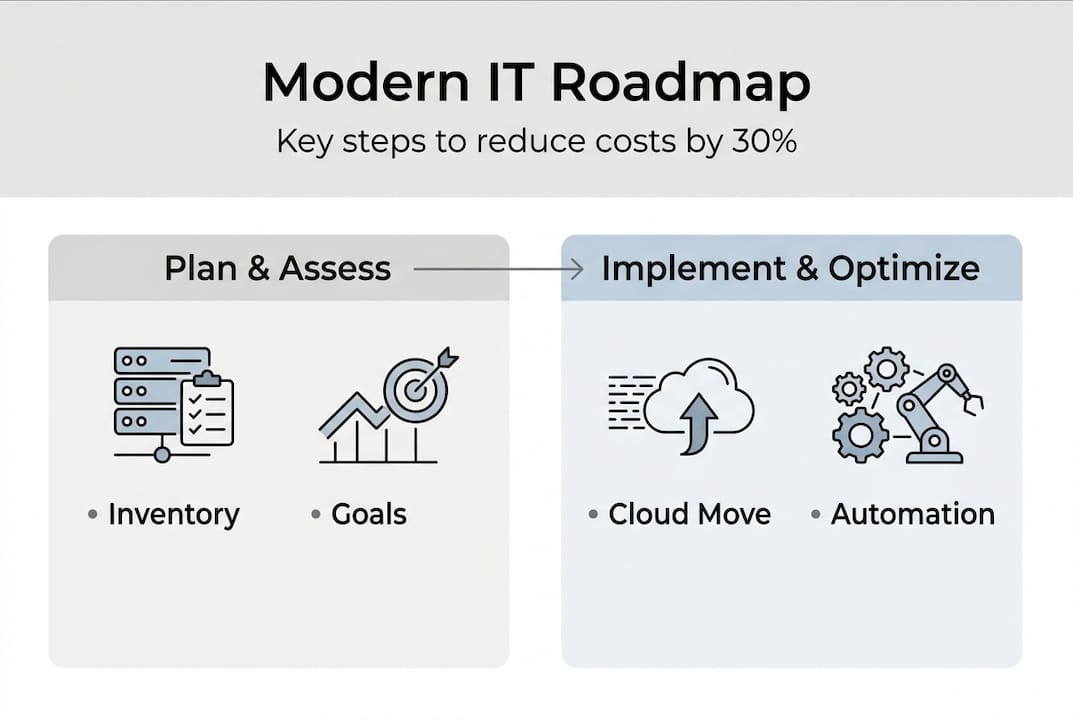
Automation transforms IT operations from reactive firefighting to proactive optimization. Start with repetitive tasks like provisioning, patching, and backup management. Expand automation to include monitoring, alerting, and initial incident response. Document automation scripts and maintain version control to enable collaboration and prevent errors. Test automated processes thoroughly in non-production environments before deploying to production systems.
Pro Tip: Create a dedicated war room during critical migration phases where technical teams, business stakeholders, and executives can collaborate in real time. This centralized coordination prevents communication gaps and enables rapid decision-making when unexpected issues arise, significantly reducing downtime and stress.
Verifying modernization success: monitoring and iteration
Continuous monitoring and feedback loops are critical for sustainable IT modernization because technology and business needs evolve constantly. Implement comprehensive monitoring that tracks system performance, security events, user satisfaction, and business outcomes. Use dashboards that provide real-time visibility into key metrics for both technical teams and business stakeholders. Set up automated alerts that notify appropriate teams before minor issues become major incidents.
Track system performance metrics including response times, throughput, error rates, and resource utilization. Compare these metrics against baseline measurements from legacy systems to quantify improvements. Monitor security incidents including attempted breaches, successful attacks, and vulnerability discoveries. Measure user satisfaction through surveys, support ticket volumes, and direct feedback sessions. Connect IT metrics to business outcomes like revenue growth, customer retention, and operational efficiency.
Key performance indicators for modernization success:
- System uptime percentage compared to legacy baseline and target SLA
- Average response time for critical business transactions
- Security incident frequency and time to resolution
- Infrastructure cost per user or per transaction
- User satisfaction scores from regular surveys
- Time to deploy new features or updates
- Data backup success rate and recovery time objectives
- Integration failure rates between systems
Feedback collection methods:
- Regular user surveys targeting specific system functions and overall satisfaction
- Support ticket analysis to identify recurring issues and pain points
- Focus groups with power users who can articulate detailed concerns
- Automated usage analytics showing how people actually interact with systems
- Executive briefings that connect IT metrics to business performance
Conduct quarterly reviews that assess progress against original objectives and adjust strategies based on lessons learned. Evaluate whether modernization delivered expected cost savings, performance improvements, and business benefits. Identify gaps between planned and actual outcomes to understand root causes. Update your roadmap to address emerging priorities and incorporate new technologies. Celebrate successes publicly to maintain momentum and organizational support.
Iteration transforms one-time modernization into continuous improvement. Allocate resources for ongoing optimization rather than declaring victory and moving on. Establish processes for evaluating new technologies and determining when to adopt them. Create feedback loops that capture user suggestions and technical team insights. Build organizational capabilities that enable rapid response to changing requirements.
Real-time insights require tools that aggregate data from multiple sources and present it in actionable formats. Implement centralized logging that captures events across all systems for correlation and analysis. Use application performance monitoring that traces transactions end to end to identify bottlenecks. Deploy security information and event management platforms that detect threats across the infrastructure. Ensure dashboards are accessible to stakeholders who need them without overwhelming users with irrelevant data.
Regular strategy adjustments keep modernization aligned with business evolution. Technology capabilities advance rapidly, creating new opportunities for optimization. Business priorities shift in response to market conditions and competitive pressures. Regulatory requirements change, demanding infrastructure adaptations. Your modernization approach must remain flexible enough to incorporate these changes without losing momentum or coherence.
How YS Lootah Tech can accelerate your IT modernization
Navigating IT infrastructure modernization requires specialized expertise and proven methodologies. YS Lootah Tech delivers comprehensive application development services that transform legacy systems into modern, cloud-native platforms. Our IT consulting services provide strategic guidance through every modernization phase, from initial assessment to ongoing optimization. We combine technical excellence with deep industry knowledge to ensure your modernization delivers measurable business value.
Our team specializes in minimizing disruption during complex migrations while maintaining security and compliance. We implement phased approaches that allow you to modernize incrementally without risking business continuity. Our website development solutions integrate seamlessly with modernized infrastructure to deliver exceptional digital experiences. Partner with us to reduce modernization risks and accelerate your digital transformation journey.
Frequently asked questions
What is the first step in IT infrastructure modernization?
The first step involves conducting a comprehensive assessment of your current IT assets, including hardware, software, network architecture, and security controls. This audit establishes a baseline that reveals dependencies, vulnerabilities, and opportunities. Simultaneously, define business-aligned modernization goals with measurable success criteria. Early stakeholder engagement during this phase ensures your roadmap addresses real business needs rather than pursuing technology for its own sake. Review our IT modernization guide for detailed assessment frameworks.
How can security be ensured during modernization?
Security must be integrated from the start to protect data and maintain compliance throughout the modernization process. Embed security controls in every migration phase rather than treating them as afterthoughts. Implement zero-trust architecture that verifies every access request regardless of source. Conduct regular security audits and penetration testing to identify vulnerabilities before attackers exploit them. Maintain detailed access logs and automated monitoring to detect suspicious activity in real time. Our IT support services guide provides comprehensive security frameworks for modernization projects.
What common mistakes should be avoided in IT modernization?
Failing to plan thoroughly and neglecting user adoption are top causes of modernization failure. Skipping comprehensive audits leads to unexpected dependencies that derail migrations. Insufficient stakeholder engagement creates resistance and misaligned priorities. Neglecting change management and user training results in low adoption rates despite technical success. Underestimating timeline and resource requirements causes rushed implementations and quality issues. Always plan for contingencies and maintain rollback capabilities. Learn from our digital transformation success guide to avoid these pitfalls.
What technologies are critical for IT modernization success?
Cloud computing, automation, and modern application development form the foundation of successful IT modernization. Cloud platforms provide elastic scalability and global reach without massive capital investment. Automation reduces manual intervention in routine tasks, improving consistency and freeing teams for strategic work. Agile development methodologies enable rapid iteration and continuous improvement. API-driven architectures facilitate integration and data sharing across systems. Containerization and orchestration tools simplify deployment and management of modern applications. Explore our cloud computing trends analysis for implementation strategies.