Why Outsource Software Development: A 2026 Guide

TL;DR:
- Outsourcing software development offers cost savings, faster delivery, and access to niche skills, especially with AI tools in 2026.
- A small, AI-augmented internal team paired with external specialists achieves the same output as larger in-house teams, optimizing resources.
Software development outsourcing is the practice of delegating software project tasks to external teams to gain cost savings, faster delivery, and access to niche skills. The decision to outsource software development has moved from a cost-cutting tactic to a core business strategy, especially as AI tools reshape how internal teams operate. With roughly 1.4 million unfilled computing jobs in the US alone, building an entirely in-house team is slow, expensive, and often unrealistic. The most effective model in 2026 pairs a small, AI-augmented core team with external specialists who cover the gaps.
Why outsource software development: the core business case

The financial argument for outsourcing software services is direct. In-house teams cost 2–3 times more than outsourced equivalents when you factor in recruiting, benefits, office space, and overhead. That gap translates to up to 40% cost savings and 50% faster time-to-market for companies that outsource effectively.
Speed is the second major driver. The average time to fill an internal technical developer role is 42 days. Outsourcing gives you access to pre-vetted developers almost immediately. For a product team racing to hit a launch window, that difference is decisive.
The third driver is talent access. No single city or country holds all the specialized skills a modern software product requires. Mobile development, AI/ML integration, DevOps, and cybersecurity each demand deep expertise. Outsourcing lets you pull from a global pool rather than limiting yourself to whoever is available locally.
The custom software development benefits extend beyond cost. Outsourcing frees your internal team to focus on the product decisions that actually differentiate your business. Commodity work gets handled externally. Core architecture and product vision stay in-house.
What are the main benefits of outsourcing software?
The advantages of software outsourcing fall into four clear categories: cost, speed, talent, and flexibility.
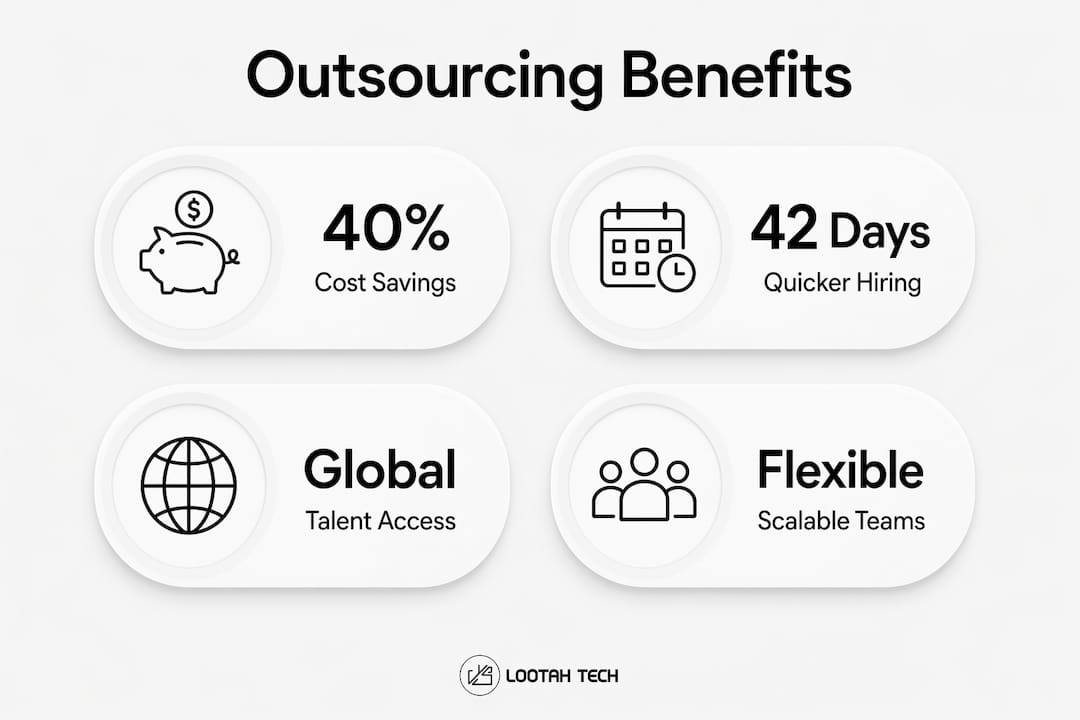
Cost reduction is the most cited reason, but the mechanism matters. You eliminate recruiting fees, benefits packages, equipment costs, and the productivity drag of onboarding. You pay for output, not headcount. That shift changes how you budget for development entirely.
Faster delivery comes from two sources. First, outsourced teams are already assembled and trained. Second, many external partners operate across time zones, which means work continues while your internal team sleeps. For well-defined projects, this can compress timelines significantly.
Access to specialized talent solves a problem that no amount of internal hiring budget fully addresses. Skills like machine learning engineering, blockchain development, and advanced UX research are scarce. External specialists bring those skills without the cost of a full-time hire.
Flexibility is the most underrated benefit. You can scale an outsourced team up for a product launch and scale it back down once the sprint ends. Internal headcount does not flex that way. For companies with variable development workloads, this alone justifies the model.
The advantages of software outsourcing also include reduced management overhead for non-core work. Your senior engineers stop spending time on admin dashboards and CI/CD pipeline maintenance. They focus on the problems only they can solve.
Pro Tip: When evaluating outsourcing partners, ask for examples of projects with similar technical complexity to yours. A vendor's track record in your specific domain matters more than their general portfolio size.
Which software development tasks are best suited for outsourcing?
Not every task belongs outside your walls. The best candidates for outsourcing share a common trait: they are well-defined, stable in requirements, and not central to your product's competitive edge.
- Admin dashboards and internal tools. These are necessary but not differentiating. External teams can build them efficiently from clear specs without needing deep product context.
- CI/CD pipelines and DevOps infrastructure. DevOps specialists can set up and maintain deployment pipelines faster than a generalist in-house team. The work is repeatable and well-documented.
- Mobile app development. Native iOS and Android development requires platform-specific expertise. Unless mobile is your core product, outsourcing this layer is cost-effective and practical.
- AI/ML modules. Integrating a recommendation engine or a computer vision feature into an existing product is a bounded, specialized task. External AI specialists handle it without disrupting your core team.
- QA and testing. Quality assurance is time-intensive and benefits from fresh eyes. Outsourced QA teams bring structured testing methodologies and reduce the bias that internal teams carry.
- Short-term projects and seasonal spikes. A product launch, a holiday-season feature push, or a one-time data migration all fit the outsourcing model cleanly.
Keep core product architecture, user research, and rapid-iteration features in-house. Rapid weekly iteration projects favor internal teams because communication overhead slows down the feedback loop. When requirements change every few days, the coordination cost of an external team erases the speed benefit.
Pro Tip: Write a one-page technical brief before engaging any outsourcing partner. Teams that can respond to a clear brief with a detailed proposal are the ones worth hiring.
What challenges should decision-makers watch for?
The reasons to outsource development are real, but the risks are equally concrete. Understanding them upfront prevents the most common failures.
- Unclear requirements cause most failures. Roughly 25% of outsourcing relationships fail within two years, and the primary cause is unclear client requirements, not vendor incompetence. The vendor builds what you describe. If your description is vague, the output will be wrong.
- Communication friction compounds over time. Time zone gaps, language differences, and slow feedback loops all add latency to a project. A question that takes two hours to answer in an open-plan office can take 24 hours across time zones.
- Onboarding takes longer than expected. Even pre-vetted external teams need context. Your product's history, technical decisions, and user behavior patterns are not obvious from a spec document. Budget two to four weeks for meaningful onboarding.
- Vendor dependency is a real risk. If a single external partner holds critical knowledge about your system, losing that partner creates a gap. Maintain internal documentation and ensure your team understands the architecture.
- Project success rates are not guaranteed by outsourcing alone. Only 29% of software projects succeed on time, on budget, and on scope regardless of whether the team is internal or external. Process quality and leadership matter more than team location.
The mitigation for most of these risks is the same: strong internal product leadership. You need someone on your side who owns the requirements, manages the relationship, and reviews the output. Outsourcing the work does not mean outsourcing the accountability.
How has AI changed the in-house vs. outsourced balance in 2026?
AI coding tools have shifted the math on team size. A small core team augmented by tools like GitHub Copilot and Cursor can now produce output that previously required a much larger group. This changes how companies think about outsourcing software services.
| Team model | Core team size | AI tools | Outsourced functions | Relative output |
|---|---|---|---|---|
| Traditional in-house | 15–20 engineers | Minimal | None | Baseline |
| AI-augmented hybrid | 5–10 engineers | Copilot, Cursor | Mobile, QA, DevOps, AI/ML | Equal or higher |
| Fully outsourced | 1–2 internal leads | Minimal | All development | Variable |
The AI-augmented hybrid model is the most effective approach in 2026. A 5–10 member in-house team using AI tools, paired with outsourced specialists for mobile, QA, and AI/ML work, matches the output of traditional teams twice the size. That is not a marginal efficiency gain. It is a structural change in how software gets built.
The implication for decision-makers is direct. You do not need to choose between a large internal team and full outsourcing. The hybrid development model gives you institutional knowledge retention, cost efficiency, and access to specialized skills simultaneously. AI handles the repetitive coding work internally. External specialists handle the deep domain work externally.
This also shifts what you look for in an outsourcing partner. You no longer need a vendor who can staff a 20-person team. You need one with deep expertise in a specific domain, the ability to integrate with your internal tools, and a track record of working alongside AI-augmented teams.
Key Takeaways
Outsourcing software development works best when a small, AI-augmented internal team owns core architecture while external specialists handle well-defined, non-differentiating tasks.
| Point | Details |
|---|---|
| Cost and speed gains are real | Outsourcing cuts costs by up to 40% and can deliver 50% faster time-to-market versus in-house teams. |
| Match tasks to the model | Outsource commoditized work like QA, DevOps, and mobile apps. Keep core product architecture in-house. |
| Clear requirements prevent failure | 25% of outsourcing relationships fail within two years due to vague client specs, not vendor issues. |
| AI changes the team equation | A 5–10 person AI-augmented team plus outsourced specialists now matches the output of traditional 20-person teams. |
| Internal leadership is non-negotiable | Outsourcing the work does not outsource accountability. Strong internal product ownership drives success. |
The uncomfortable truth about outsourcing relationships
Most outsourcing failures I have seen come from the same source: the client treated outsourcing as a way to avoid thinking about the problem. They handed over a vague brief, expected a finished product, and were surprised when the result did not match their mental image.
Outsourcing is not a delegation of thinking. It is a delegation of execution. The clearer your internal team is about what you are building and why, the better any external partner will perform. That clarity is hard work, and it belongs to you.
The companies that get the most from outsourcing treat it as a portfolio decision. They map every development task against two questions: does this require deep product context, and does it change frequently? Tasks that score high on both stay in-house. Tasks that score low on both go external. Everything in between gets evaluated on cost and timeline.
The AI shift makes this even more important. External partners with deep domain expertise in AI/ML, mobile, or security are genuinely valuable. But they need a counterpart on your side who understands the product well enough to direct them. Without that, even the best vendor produces work that does not fit.
My honest recommendation: before you engage any outsourcing partner, spend a week writing down exactly what you need, why you need it, and how you will measure success. That document will tell you more about your readiness to outsource than any vendor evaluation process.
— YS
How Yslootahtech supports your outsourcing needs
Yslootahtech works with business leaders who need external development capacity without sacrificing quality or control.
Whether you need a full website development build, a specialized application development engagement, or dedicated UX/UI design support, Yslootahtech brings the domain expertise and process discipline that hybrid teams require. The team works across fintech, e-commerce, industrial management, and digital health, which means your project benefits from cross-industry pattern recognition. Yslootahtech also provides ongoing consultation and technical planning, so your internal team stays informed and in control throughout the engagement.
FAQ
Why outsource software development instead of hiring in-house?
Outsourcing delivers immediate access to pre-vetted developers, costs 2–3 times less than in-house equivalents, and removes the 42-day average hiring delay. It is the faster, more cost-effective path for non-core development work.
What types of projects are best suited for outsourcing?
Well-defined, stable projects like mobile apps, QA, DevOps pipelines, and admin tools are the best fit. Core product architecture and rapid-iteration features perform better with internal teams.
Is outsourcing software worth it for small businesses?
Yes, particularly for small businesses without the budget for full-time specialists. Outsourcing gives access to skills like AI/ML integration, mobile development, and security testing that would otherwise require multiple senior hires.
What is the most common reason outsourcing relationships fail?
Unclear client requirements cause roughly 25% of outsourcing failures within two years. The fix is writing detailed, testable specs before any external engagement begins.
How do AI tools affect the decision to outsource software development?
AI coding tools like GitHub Copilot increase the productivity of small internal teams, reducing the need for large in-house headcount. This makes hybrid models, where a small AI-augmented core team works alongside outsourced specialists, the most cost-effective structure in 2026.