What Is IT Service Management? A 2026 Guide

TL;DR:
- IT service management is a structured practice that aligns IT services with business goals and treats each service as a product.
- Implementing core processes like incident, problem, and change management enhances service quality, reduces downtime, and improves business outcomes.
IT service management (ITSM) is defined as the structured practice of designing, delivering, managing, and improving IT services to align with business goals. Unlike raw IT operations, ITSM treats every service as a product with a lifecycle, an owner, and a measurable impact on the business. Frameworks like ITIL (Information Technology Infrastructure Library) and the ISO/IEC 20000 standard give organizations a proven structure for putting ITSM into practice. Organizations implement ITSM primarily to improve service quality (48%) and enhance customer experience (35%). Those two numbers explain why ITSM has moved from a back-office concern to a boardroom priority.
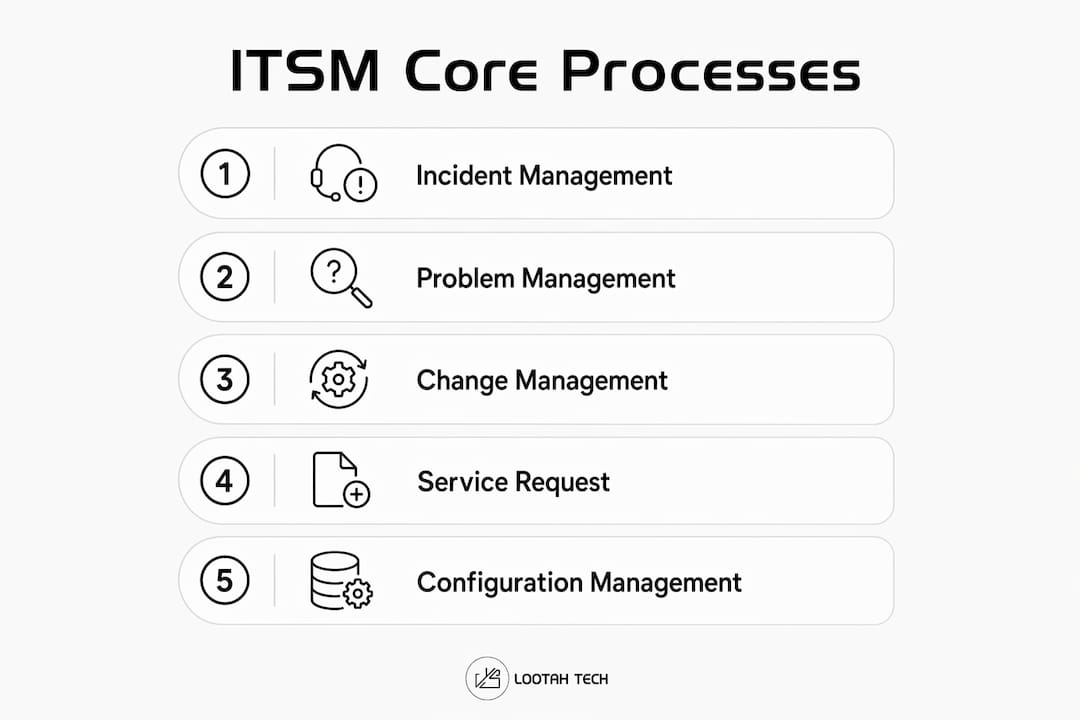
What are the core processes in IT service management?
ITSM is not a single process. It is a collection of interconnected practices that span the full IT service lifecycle: design, transition, operation, and continual improvement. Each stage depends on the others. A service designed without transition planning breaks during deployment. A service operated without continual improvement degrades over time.
The key ITSM process areas defined by 2026 industry standards include:
- Incident management: Restoring normal service as fast as possible after an unplanned disruption.
- Problem management: Finding and eliminating the root cause of recurring incidents so they stop happening.
- Change management: Controlling how changes to IT systems are planned, approved, and deployed to reduce risk.
- Service request fulfillment: Handling routine user requests, such as password resets or software installs, through a defined workflow.
- Asset and configuration management: Tracking every hardware and software component and how they relate to each other.
These five areas are where most organizations start. They create a baseline of consistency that makes everything else possible.
ITSM is also distinct from IT operations management (ITOM). ITOM focuses on keeping infrastructure running, monitoring servers, networks, and cloud environments. ITSM focuses on the services built on top of that infrastructure and how those services deliver value to the business. Both matter, but confusing them leads to gaps in accountability.

Pro Tip: Map each ITSM process to a specific business outcome before you build workflows. "Incident management reduces downtime" is more motivating for stakeholders than "incident management logs tickets."
How does ITSM deliver value and improve business outcomes?
Successful ITSM adoption correlates with reduced downtime, lower IT operational costs, increased employee productivity, higher return on IT investments, and lower IT staff turnover. That is a broad set of benefits, and it is worth unpacking why they cluster together.
Reduced downtime is the most visible benefit. When incident management follows a defined process, teams resolve issues faster because they are not improvising. Faster resolution means less lost productivity across the organization.
Lower operational costs follow from process discipline. Repetitive tasks handled through service request workflows cost less than ad hoc support. Automation of routine requests, such as account provisioning, removes manual labor entirely. Teams that integrate automation into their ITSM workflows consistently report fewer escalations and shorter resolution times.
Higher employee productivity is a downstream effect. When IT services work reliably and requests are fulfilled quickly, employees spend less time waiting and more time working. This is measurable through service-level agreements (SLAs), which set clear expectations for response and resolution times.
Key performance indicators (KPIs) that high-performing ITSM teams track include:
- Mean time to resolve (MTTR): How long it takes to fix an incident from detection to closure.
- First-contact resolution rate: The percentage of issues resolved without escalation.
- Change success rate: The percentage of changes deployed without causing incidents.
- SLA compliance rate: The percentage of requests and incidents resolved within agreed timeframes.
- Customer satisfaction score (CSAT): Direct feedback from the people using IT services.
These metrics connect IT performance to business outcomes in language that executives understand. An IT leader who can show a rising CSAT score and a falling MTTR has a much easier conversation with the CFO than one who reports ticket volumes.
What distinguishes ITSM from ITIL and related frameworks?
The most common confusion in this space is treating ITSM and ITIL as synonyms. They are not. ITSM is the practice of delivering IT services; ITIL is a best-practice framework that guides how to do it well. ITSM is the discipline. ITIL is one of several playbooks for executing that discipline.
Think of it this way: ITSM is the sport, and ITIL is the coaching manual. You can play the sport without the manual, but you will make more mistakes and develop bad habits. ISO/IEC 20000 is the international standard that certifies an organization's ITSM processes meet a defined quality threshold. ITIL and ISO/IEC 20000 work together, but they serve different purposes.
Within ITSM, the terms "service desk," "help desk," and "call center" are often used interchangeably. They are not the same thing. A call center handles inbound calls. A help desk handles technical support requests. A service desk, as defined by ITSM frameworks, is the single point of contact between IT and the business. It handles incidents, service requests, and communication about planned changes. The service desk is a strategic function, not just a support queue.
Enterprise Service Management (ESM) applies ITSM principles beyond IT to functions like HR, facilities, and finance. An HR team using a service catalog and SLAs for onboarding requests is practicing ESM. This expansion shows that ITSM principles are not IT-specific. They are organizational management principles that happen to have been developed and proven in IT first.
How can organizations implement ITSM successfully?
Phased, incremental ITSM adoption starting with core processes avoids the most common failure patterns. Attempting to implement every ITIL process at once overwhelms teams and produces bureaucratic overhead without business value. The better path is deliberate and sequential.
A practical implementation sequence looks like this:
- Start with incident management. This delivers immediate, visible value. Users notice faster resolution. IT teams build confidence in the process.
- Add problem management. Once incidents are tracked consistently, patterns emerge. Problem management addresses root causes and reduces incident volume over time.
- Introduce change management. With a stable incident and problem process, you can control how changes enter the environment without creating new incidents.
- Build out the service catalog. Define what IT offers, who can request it, and what the fulfillment process looks like. This is where ITSM starts to feel like a service business.
- Implement asset and configuration management. This is the most data-intensive step. It pays off when service mapping links infrastructure components to business services, enabling teams to see the impact of a server failure before users report it.
The technical steps are the easier part. The harder challenge is cultural. Shifting IT's identity from a cost center to a strategic business partner requires leadership commitment and consistent communication. IT leaders need to speak in business outcomes, not technical metrics. Teams need to understand why process discipline matters, not just how to follow it.
Pro Tip: Before your first ITSM tool goes live, run a tabletop exercise. Walk your team through a simulated major incident using the new process. Gaps in the workflow show up in a 90-minute exercise, not during a real outage at 2:00 AM.
Continual improvement is not a phase. It is a permanent operating mode. ITSM frameworks build this in through regular service reviews, post-incident analyses, and KPI tracking. Teams that treat improvement as a scheduled activity rather than a reaction to failure consistently outperform those that do not. For a broader view of how ongoing IT support drives this kind of maturity, the connection between support quality and business transformation is direct and well-documented.
Key Takeaways
Effective IT service management requires structured processes, measurable outcomes, and a cultural shift that positions IT as a business partner rather than a support function.
| Point | Details |
|---|---|
| ITSM definition | ITSM is the practice of designing, delivering, and improving IT services aligned with business goals. |
| Core processes first | Start with incident and problem management before expanding to change management and service catalogs. |
| ITSM vs. ITIL | ITSM is the discipline; ITIL is a best-practice framework for executing it. |
| Measure what matters | Track MTTR, SLA compliance, and CSAT to connect IT performance to business outcomes. |
| Culture is the hard part | Repositioning IT as a strategic partner takes longer than any technical implementation. |
Where ITSM is heading, and what most teams get wrong
The organizations I work with fall into two clear groups. The first group treats ITSM as a ticketing system with extra steps. They log incidents, close tickets, and call it done. The second group treats ITSM as an operating model. They use problem management to eliminate recurring issues, service mapping to anticipate failures, and KPIs to drive quarterly conversations with business leaders.
The gap between those two groups is not technology. Every organization has access to capable tools. The gap is intent. Reactive ITSM keeps the lights on. Proactive ITSM creates competitive advantage.
The ESM trend is the most significant development in this space right now. When HR uses the same service catalog and SLA discipline that IT uses, onboarding time drops and employee experience improves. The principles transfer because they are fundamentally about managing work as a service, not about managing servers. Organizations that recognize this early gain a structural advantage in operational efficiency.
My honest advice: resist the urge to implement everything at once. I have seen well-resourced teams collapse under the weight of a full ITIL rollout attempted in six months. The teams that succeed pick one process, do it well, measure it, and then expand. That patience feels slow. It is not. It is the fastest path to lasting results.
— YS
How Yslootahtech supports your ITSM goals
Yslootahtech works with organizations across the UAE and beyond to build the technical foundation that makes ITSM work at scale.
The AI and machine learning services from Yslootahtech help IT teams automate repetitive processes, from service request routing to anomaly detection, so staff can focus on higher-value work. For organizations that need custom tooling, the application development team builds purpose-built platforms that integrate with existing ITSM workflows rather than forcing teams to adapt to off-the-shelf limitations. If you want to understand where your IT function stands today, the IT consultation services at Yslootahtech are a practical starting point.
FAQ
What is the IT service management definition?
IT service management (ITSM) is the practice of designing, delivering, managing, and improving IT services to align with business objectives. It uses standardized processes and frameworks like ITIL and ISO/IEC 20000 to ensure consistent, measurable service quality.
What is incident management in ITSM?
Incident management is the ITSM process that restores normal service operation as quickly as possible after an unplanned disruption. It is typically the first process organizations implement because it delivers immediate, visible value to users and the business.
What is the difference between ITIL and ITSM?
ITSM is the discipline of managing IT services; ITIL is a best-practice framework that guides how to implement ITSM effectively. You practice ITSM and use ITIL as a reference model, not the other way around.
What are the main benefits of IT service management?
ITSM reduces downtime, lowers IT operational costs, increases employee productivity, and improves customer satisfaction. These benefits are measurable through KPIs like mean time to resolve (MTTR) and SLA compliance rates.
How does Enterprise Service Management differ from ITSM?
Enterprise Service Management (ESM) applies ITSM principles to non-IT functions like HR, facilities, and finance. It uses the same service catalog and SLA discipline developed in IT to improve workflows across the entire organization.