Industrial Automation Explained: A Practical Guide
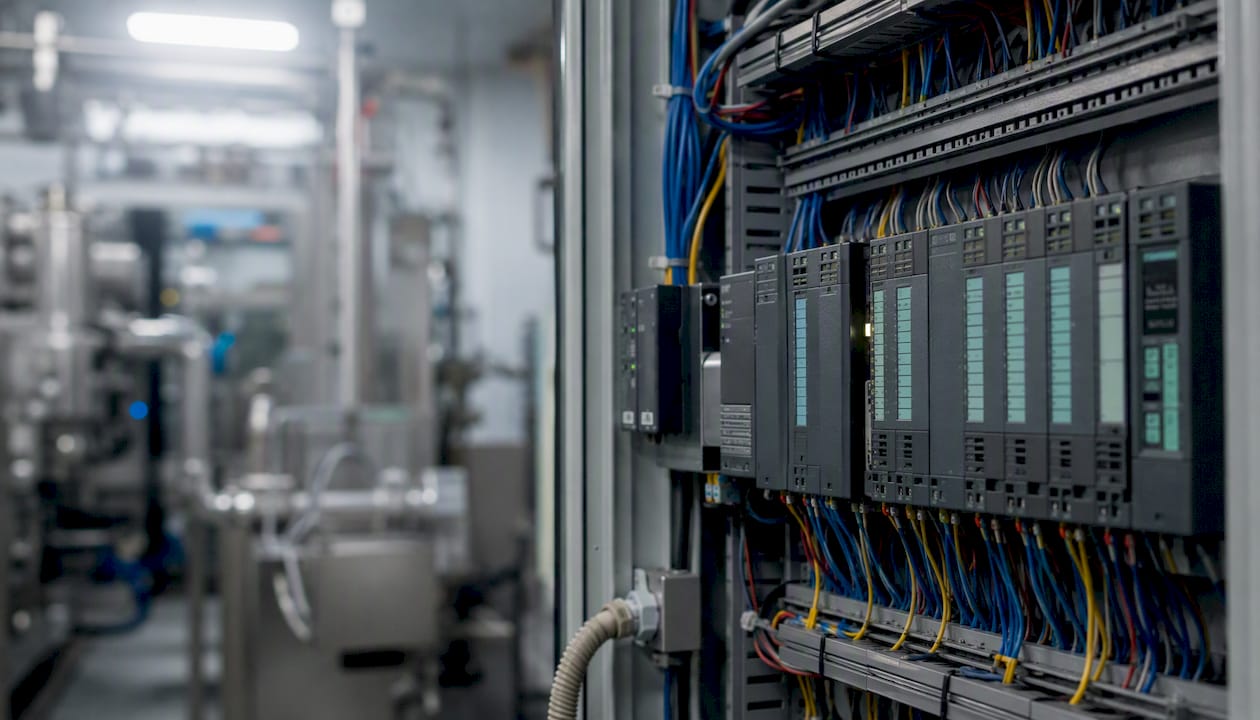
Industrial automation is the use of control systems, sensors, robots, PLCs, SCADA software, and IIoT devices to run industrial processes with minimal human intervention, as Arm's glossary defines it. The core business outcome is repeatable throughput at consistent quality, with real-time data feeding decisions that humans alone could never make fast enough. Standards bodies like the OPC Foundation and the Industry 4.0 framework have pushed this well beyond simple mechanization: today's systems connect field sensors to cloud analytics, letting a plant manager in one city spot a bearing failure before the machine on the floor even slows down.
Key Takeaways
Industrial automation combines PLCs, sensors, SCADA, robots, and IIoT to run industrial processes with minimal human intervention, delivering repeatable throughput, consistent quality, and real-time operational data.
| Point | Details |
|---|---|
| Three core automation types | Fixed, programmable, and flexible automation each suit different volume and variety trade-offs. |
| PLC is the control backbone | A PLC reads sensor inputs, runs logic, and drives actuators in millisecond scan cycles at the control level. |
| OPC UA enables interoperability | The OPC Foundation's OPC UA standard provides vendor-neutral, encrypted data exchange across multi-vendor systems. |
| Sensors can cut maintenance costs | A McKinsey estimate cited by the World Economic Forum suggests connected sensors can reduce maintenance costs by roughly 10–15%. |
| Start with a pilot, not a platform | Define ROI metrics first, run a proof-of-concept pilot, then scale — most project failures trace back to skipping this sequence. |
| Yslootahtech delivers end-to-end projects | From assessment and custom design to secure IIoT integration and AI-driven analytics, Yslootahtech covers the full automation stack. |
Table of Contents
- What Is Industrial Automation? Types and When to Choose Each
- What are the core components that make automation work?
- How are industrial automation systems structured?
- What does industrial automation look like in practice?
- Why do organizations invest? Benefits and the business case
- What challenges should you plan for before automating?
- What is a PLC and how does it work?
- Is industrial automation a good career? Roles, skills, and paths
- How does a company start an industrial automation project?
- How Yslootahtech approaches industrial automation projects
- Sources
What Is Industrial Automation? Types and When to Choose Each
Britannica classifies industrial automation into three foundational types, and the classification still holds because it maps directly to the production trade-off every operations team faces: volume versus variety.
-
Fixed automation runs one product or process at very high speed with no changeover. Think of a stamping line pressing the same bracket thousands of times per shift. The equipment is purpose-built, capital-intensive, and nearly impossible to retool. It wins on unit cost when demand is stable and volume is enormous.
-
Programmable automation uses reprogrammable controllers to switch between product variants. A batch pharmaceutical reactor or a CNC machining center that runs different part programs on different days fits here. Changeover takes time, but the same equipment serves multiple SKUs.
-
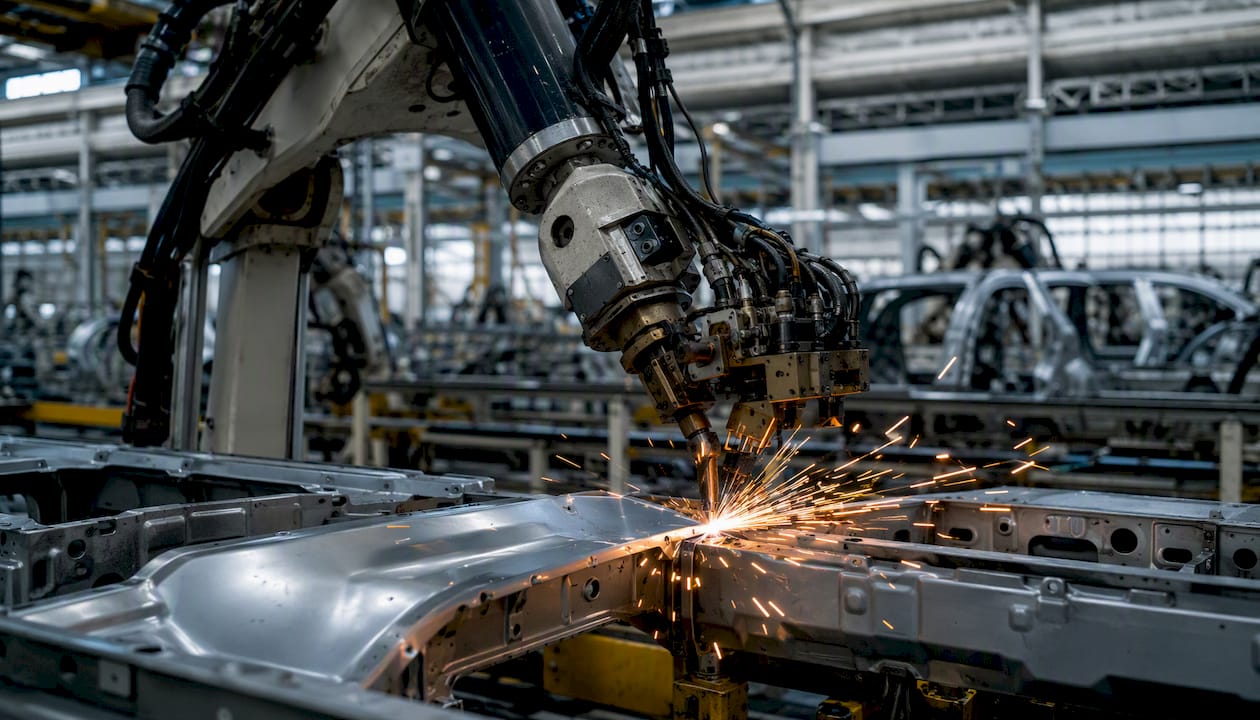
Flexible automation (sometimes called soft automation) handles high-mix production with near-instant changeover, typically through robotic cells that load different fixtures or grippers on command. A robotic welding cell that switches between three car-body variants in the same shift is the textbook example.
A fourth category, integrated automation, combines all three across a plant, linking them through a common data backbone. That is where most large manufacturers are heading.
Pro Tip: If your annual volume exceeds roughly 100,000 identical units and variety is low, fixed automation usually pays back fastest. If variety is high and batch sizes are moderate, programmable or flexible automation protects you against demand shifts without stranding capital.
What are the core components that make automation work?
The hardware and software stack behind any automated system follows a consistent pattern, even when the industry changes. Here is how the pieces map to their roles and where they sit in the system.
| Component | Role | Typical placement |
|---|---|---|
| PLC (Programmable Logic Controller) | Reads sensor inputs, executes control logic, drives actuators in real time | Control level |
| HMI (Human-Machine Interface) | Operator display and input panel for local monitoring and manual overrides | Control / supervisory level |
| SCADA | Supervisory data acquisition, alarming, trending, and remote control across multiple PLCs | Supervisory level |
| DCS (Distributed Control System) | Continuous process control across large plants (refining, chemicals) | Supervisory level |
| MES (Manufacturing Execution System) | Production scheduling, work orders, quality records, OEE tracking | Enterprise / supervisory level |
| Sensors | Detect temperature, pressure, position, flow, vision, and more | Field level |
| Actuators | Execute physical actions: valves, motors, cylinders, grippers | Field level |
| Variable Frequency Drives (VFDs) | Control motor speed and torque precisely | Field / control level |
| Industrial robots | Perform welding, assembly, pick-and-place, painting, inspection | Field level |
| IIoT devices / edge nodes | Collect and pre-process data at the machine; feed cloud analytics | Field / edge level |
Supporting these hardware layers are the software and connectivity technologies that turn raw data into decisions. MachineMetrics describes how modern stacks layer IIoT devices, edge computing, and cloud analytics with machine-learning models for predictive maintenance and operational optimization. The result is a system that does not just control a machine but learns from it.
Protocol interoperability is what holds multi-vendor systems together. OPC UA, defined by the OPC Foundation, provides vendor-neutral, encrypted data exchange between field devices, controllers, and enterprise software. Modbus and EtherNet/IP remain common at the field level. Without a shared protocol layer, a plant running PLCs from three different vendors and a SCADA from a fourth becomes an integration nightmare. OPC UA is increasingly the answer to that problem in Industry 4.0 deployments.
For robotics integration specifics, the component picture expands to include vision systems, force-torque sensors, and safety-rated collaborative robot controllers.
How are industrial automation systems structured?
The architecture follows a four-layer hierarchy. Data flows upward from physical processes to business systems, and commands flow back down.
-
Field level: Sensors, actuators, drives, and robots interact directly with the physical process. This is where temperature is measured, valves are opened, and parts are moved.
-
Control level: PLCs and embedded controllers read field data, run logic at millisecond cycle times, and send commands back to actuators. Speed and reliability are non-negotiable here.
-
Supervisory level: SCADA and DCS systems aggregate data from multiple PLCs, display plant-wide status, log trends, and allow operators to adjust setpoints. This is where alarms are managed and historical data is stored.
-
Enterprise level: MES and ERP systems consume production data from SCADA and MES to schedule orders, track quality, manage inventory, and report to finance. This layer connects the factory floor to the business.
A concrete data flow: a temperature sensor on a reactor sends a 4–20 mA signal to a PLC every 100 milliseconds. The PLC compares the reading to a setpoint and adjusts a cooling valve. Every five seconds, the PLC pushes a data packet to SCADA, which logs the trend and triggers an alarm if the temperature drifts outside limits. The MES pulls batch records from SCADA at the end of each production run and stamps them into the quality record. The ERP uses that batch record to update inventory and trigger a raw-material purchase order.
OPC UA is the standard that makes this cross-vendor data flow work without custom middleware for every connection. It also carries security metadata, which matters when the supervisory layer connects to cloud services.
The strategic role of IT automation at the enterprise layer is worth understanding separately: IT and OT (operational technology) systems are converging, and the integration points between MES and ERP are where many projects stall.
What does industrial automation look like in practice?
Concrete examples make the architecture tangible. Across industries, the same component stack appears in very different physical forms.
Automotive welding and assembly. A body-in-white line uses fixed and flexible automation together. Stamping presses (fixed) form body panels at high speed; robotic welding cells (flexible) join them, switching weld programs between model variants. Vision systems inspect weld quality in real time. PLCs coordinate every station; SCADA monitors cycle times and flags bottlenecks.
Food and beverage packaging. A bottling line fills, caps, labels, and cases product at hundreds of units per minute. Programmable automation handles different bottle sizes through recipe-based PLC programs. Sensors check fill level, cap torque, and label placement. Lighting controls in automated growing environments show how even agricultural production now relies on the same sensor-controller-actuator logic.
Pharmaceutical batch control. Strict regulatory requirements make programmable automation with full audit trails the standard. DCS systems manage reactor temperature, pH, and agitation profiles. Every parameter is logged and signed electronically. Flexible automation handles filling and packaging across multiple drug products on shared equipment.
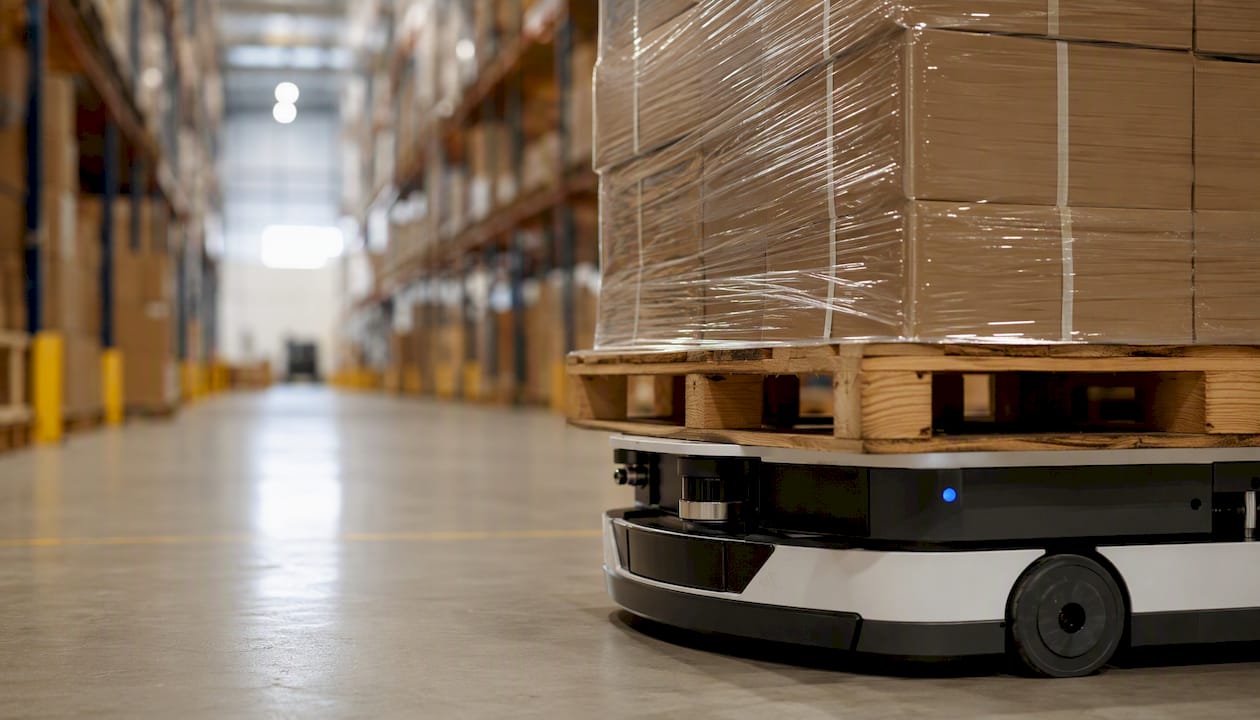
Warehouse and logistics. Automated guided vehicles (AGVs) and autonomous mobile robots (AMRs) move pallets and totes without fixed tracks. Conveyor sorters route packages to the right shipping lane. IIoT sensors track inventory location in real time. The control layer here is often a warehouse management system rather than a traditional PLC, though PLCs still run conveyors and sorters.
Energy and utilities. Power plants and water treatment facilities rely on SCADA and DCS for continuous process control across geographically distributed assets. Remote terminal units (RTUs) at substations feed data to a central control room. Predictive maintenance algorithms flag transformer anomalies before they become outages.
High-mix job shops. Small manufacturers with dozens of part numbers use flexible robotic cells with quick-change tooling and offline programming software. A single robot might tend a CNC lathe, a mill, and a deburring station in sequence, switching between jobs based on a work order from the MES.
For real-world robotics ROI examples across these sectors, the pattern is consistent: the payback comes from throughput gains and scrap reduction, not headcount reduction alone.
Why do organizations invest? Benefits and the business case
The World Economic Forum frames industrial automation as a response to three converging pressures: productivity demands, supply-chain resilience, and sustainability goals. That framing matters because it shifts the conversation from "replacing workers" to "building a more resilient operation."
Core benefits organizations consistently report:
- Higher throughput and consistency: Automated lines run at rated speed around the clock without fatigue-related variation.
- Improved quality: Sensors and vision systems catch defects in real time, reducing scrap and rework.
- Worker safety: Robots handle hazardous tasks — welding fumes, heavy lifting, high-temperature environments — reducing injury rates.
- Lower operating cost over time: Once capital is recovered, automated systems cost less per unit than manual processes at scale.
- Predictive maintenance: Sensor data analyzed by ML models flags equipment degradation before failure. According to a McKinsey estimate cited by the World Economic Forum, connected sensors can reduce maintenance costs by roughly 10–15%.
- Sustainability gains: Precise process control reduces energy consumption and material waste. Schneider Electric's analysis ties automation directly to corporate sustainability targets.
ROI timelines vary widely. A simple conveyor upgrade with basic PLC control might pay back within a relatively short time frame. A full flexible robotic cell with vision and IIoT integration typically requires several years to pay back. The drivers of faster payback are high production volume, high labor cost in the replaced task, and low integration complexity. For a structured look at when automation delivers value, the assessment phase is where that calculation gets made.
What challenges should you plan for before automating?
Cost and ROI risk
The capital cost of automation is visible; the integration cost often is not. Budget for the full project, not just the equipment.
Legacy system integration
Most plants are not greenfield. Connecting a new PLC or IIoT layer to a 20-year-old DCS with proprietary protocols requires gateways, protocol converters, and sometimes full replacement of field wiring. Schneider Electric notes that supply-chain resilience and sustainability goals are driving automation investment, but legacy asset integration remains the most common project delay.
Skills gap and workforce readiness
Automation changes job content more than it eliminates jobs. Technicians who once adjusted machines manually now need PLC programming basics, network troubleshooting, and data literacy. Hiring or training for those skills takes time and should be planned before go-live, not after.
Vendor lock-in and interoperability
Proprietary ecosystems can trap you. A plant built entirely on one vendor's PLC, SCADA, and historian is dependent on that vendor's pricing and roadmap. Specifying OPC UA compliance and open data formats from the start gives you exit options.
OT cybersecurity
Connecting OT systems to enterprise networks and the cloud opens attack surfaces that did not exist when PLCs ran on isolated serial networks. Industrial security guidance covers physical access control as one layer, but the network layer is where most OT breaches originate.
Pro Tip: Treat OT security as a design requirement, not a retrofit. Segment OT and IT networks with a demilitarized zone (DMZ), require encrypted communications on any IIoT device that touches the cloud, and enforce device identity management from day one of the project scope. Adding these controls after commissioning costs three to five times more and leaves the system exposed during the gap.
What is a PLC and how does it work?
A Programmable Logic Controller is a ruggedized industrial computer purpose-built for real-time control. Arm's definition describes the core operation simply: the PLC reads inputs from sensors, executes control logic, and sends outputs to actuators, all within a deterministic scan cycle measured in milliseconds.
The input-logic-output loop works like this:
- Inputs: Digital signals (a limit switch is open or closed) and analog signals (a pressure transmitter sends a 4–20 mA current proportional to pressure) arrive at input cards.
- Logic: The CPU runs a ladder logic or structured text program that compares inputs to setpoints and calculates the required output state. This scan repeats continuously, typically every 1–100 milliseconds.
- Outputs: Digital outputs switch relays, solenoids, or motor starters. Analog outputs drive variable-speed drives or control valves.
PLCs are built to survive factory environments: wide temperature ranges, vibration, electrical noise, and humidity. They run without a keyboard or monitor attached, and they keep running for years without rebooting. That durability is why they dominate the control level of virtually every automation architecture.
Common control tasks a PLC handles include conveyor sequencing, batch recipe execution, safety interlock management, and motor speed regulation via VFDs. At the supervisory level, the PLC communicates upward to SCADA via Ethernet using protocols like EtherNet/IP or OPC UA.
Globally recognized PLC vendors include Schneider Electric (Modicon), Siemens (SIMATIC), and Rockwell Automation (Allen-Bradley). Each has its own programming environment and hardware ecosystem, which is one reason interoperability standards like OPC UA matter so much when you are running a multi-vendor plant.
Is industrial automation a good career? Roles, skills, and paths
The short answer is yes, and demand is growing faster than the talent pipeline can fill it. Here is how the role landscape breaks down:
- Automation engineer: Designs and programs control systems, selects hardware, and commissions new installations. Typically requires electrical or mechatronics engineering background.
- Controls engineer: Focuses on PLC/DCS programming, loop tuning, and control system architecture. Often the most hands-on technical role.
- PLC programmer: Writes and maintains ladder logic, function block diagrams, and structured text programs. Can be a specialist role or part of a broader controls engineer position.
- Systems integrator: Manages the full project from design through commissioning, often working across multiple client sites and industries.
- Maintenance technician: Troubleshoots and repairs automated equipment. Needs electrical fundamentals, PLC basics, and mechanical aptitude.
- IIoT / data analyst: Connects OT data to analytics platforms, builds dashboards, and develops predictive maintenance models. A newer role that bridges IT and OT.
- Project manager: Coordinates scope, schedule, budget, and stakeholder communication across automation projects. Technical background helps but is not always required.
Key technical skills employers look for: PLC programming (IEC 61131-3 languages), electrical fundamentals (reading schematics, panel wiring), industrial networking (Ethernet, OPC UA, Modbus), basic robotics (teach pendant operation, safety standards), and data literacy (SQL, Python basics, historian queries).
Soft skills matter more than most job postings admit. Automation projects involve electricians, mechanical engineers, IT teams, and operations managers who all speak different technical dialects. The ability to translate between them is often what separates a good automation engineer from a great one.
Pro Tip: Start with PLC fundamentals — free simulators like CODESYS let you practice ladder logic without hardware. Add industrial networking next (Cisco's industrial networking courses are widely respected), then layer in Python scripting for data work. That sequence builds the T-shaped skill profile most employers want.
For a broader view of automation's strategic role in workforce planning, the skills gap is one of the most cited barriers to adoption.
How does a company start an industrial automation project?
Most failed automation projects share a common root cause: they started with a technology decision instead of a problem definition. Here is a roadmap that works in the opposite direction.
-
Assess objectives and constraints. Define what you are trying to achieve: throughput, quality, safety, cost, or some combination. Audit current processes, identify bottlenecks, and document existing equipment and data systems. Measure baseline OEE, MTBF, and MTTR — these become your success metrics, as MachineMetrics recommends.
-
Define scope and ROI metrics. Narrow the project to a specific line, cell, or process. Quantify the expected benefit (units per hour, defect rate, labor cost) and the acceptable payback period. This is where you decide whether fixed, programmable, or flexible automation fits the production profile.
-
Run a proof of concept or pilot. Before committing full capital, test the core technology on a representative subset of the process. A robotic pick-and-place pilot on one SKU tells you far more than a vendor demo. Pilots also surface integration surprises early, when they are cheap to fix.
-
Design and integrate. Develop the detailed engineering: electrical schematics, PLC programs, network architecture, safety analysis (SIL/PLe assessment), and SCADA configuration. This phase involves the most stakeholders and the most coordination risk.
-
Test and validate. Factory acceptance testing (FAT) at the integrator's facility, then site acceptance testing (SAT) after installation. Test every alarm, every interlock, and every edge case before handing over to operations.
-
Scale and hand over to operations. Train operators and maintenance staff before go-live. Document every configuration parameter. Establish a change-management process so future modifications do not break validated logic.
-
Continuous improvement. Use the data the system now generates. Track OEE weekly, review alarm logs monthly, and feed anomaly data into predictive maintenance models. The automation tools and vendor selection guidance at this stage helps teams avoid locking into a single vendor's analytics stack.
When evaluating integrators and vendors, ask these questions before signing anything:
- Who owns the source code and configuration files at project completion?
- What are the support SLAs for critical system failures?
- How is OT cybersecurity addressed in the design (segmentation, encryption, device identity)?
- Which communication protocols does the system support, and is OPC UA compliance included?
- What is the upgrade path if the underlying hardware platform reaches end of life?
Budget and timeline expectations: a single-cell automation project with a clear scope typically runs 6–12 months from kickoff to production handover. A plant-wide integrated system can take 2–4 years. Contingency of 15–20% on both budget and schedule is realistic for first-time automation projects.
How Yslootahtech approaches industrial automation projects
Yslootahtech's methodology follows the same phased logic the roadmap above describes, with a specific emphasis on secure integration and data architecture from the first assessment call.
The approach covers:
- Assessment and scoping: Mapping current processes, identifying automation opportunities, and defining measurable KPIs before any technology is selected.
- Custom design: Engineering control system architecture, selecting hardware and protocols, and designing the IIoT data layer to connect field systems to cloud analytics.
- Secure integration: Applying security-by-design principles: network segmentation, encrypted communications, and device identity management built into the project specification, not added afterward.
- Testing and validation: FAT and SAT protocols, alarm rationalization, and safety verification before handover.
- Training and ongoing support: Operator and maintenance training, documentation, and a support structure that keeps systems running after the integrator leaves.
Yslootahtech's capability areas span AI and machine learning for predictive maintenance, robotics integration, cloud and IIoT connectivity, and enterprise application integration. That breadth matters on projects where the automation layer needs to connect to an ERP or a cloud analytics platform, not just run a PLC program.
The human side of industrial automation
Automation done well does not remove people from the process. It removes people from the dangerous, repetitive, and cognitively numbing parts of the process and puts them in roles where judgment, creativity, and adaptability actually matter. The plants that get the most from their automation investments are the ones that treat the technology as a tool for their workforce, not a replacement for it.
Industry 4.0 makes this argument stronger, not weaker. When a sensor network feeds real-time data to a dashboard, a maintenance technician can make a better decision in five minutes than they could have made in five hours with a clipboard. The machine handles the data collection; the human handles the interpretation and the response. That division of labor is where the real productivity gain lives. For organizations thinking about automation's long-term strategic role, the workforce planning question deserves as much attention as the technology selection.
Yslootahtech can help you move from assessment to operation
Industrial automation projects stall most often at two points: the initial scoping, where scope creep and unclear ROI metrics derail the business case, and the integration phase, where legacy systems and cybersecurity gaps add months and budget. Yslootahtech addresses both directly.
From a structured assessment of your current processes to custom control system design, secure IIoT integration, and AI-driven predictive maintenance, Yslootahtech delivers end-to-end automation projects built on open standards and security-by-design principles. The team has delivered industrial automation and robotics projects across manufacturing, logistics, and energy sectors. To discuss your specific process and get a scoping consultation, contact Yslootahtech directly through the services page.
Sources
- What Is Industrial Automation? – Arm®
- Automation | engineering and technological concept | Britannica
- Here are three reasons why industrial automation matters | World Economic Forum
- OPC UA Interoperability For Industrie4 and IoT (PDF) - OPC Foundation
- Industrial Automation: How it Works, Types, and Benefits - MachineMetrics