Future of Work Technology: What Leaders Must Know in 2026

Future of work technology is the integrated set of AI systems, automation platforms, cloud infrastructure, and connected tools that reshape how organizations structure, measure, and execute work. For decision-makers, the immediate takeaway is this: prioritize augmentation over replacement, run modular pilots with measurable outcomes, and build governance before you scale. MIT Sloan's Work of the Future initiative argues that AI delivers the greatest value when humans set intent and evaluate outputs, not when machines replace judgment. The Microsoft Work Trend Index reinforces this: organizational capability explains twice the AI impact of individual effort. Surveys show many companies plan to adopt AI, big data, or cloud technology within the near future. The window to build that capability deliberately is now.
Table of Contents
- What future of work technology actually includes
- Why augmentation, not replacement, is the right frame
- What is production-ready now versus years away
- How to adopt: a practical roadmap
- Where these technologies deliver value today
- Risks and governance you cannot skip
- How to evaluate vendors and integration partners
- Yslootahtech's capabilities and approach
- Key Takeaways
- The augmentation bet is the right one
- Yslootahtech can help you move from strategy to pilot
- Useful sources and further reading
What future of work technology actually includes
The phrase covers nine distinct technology categories, each with a different maturity curve and business use.
- Generative AI and copilots (Microsoft Copilot, OpenAI ChatGPT and APIs): draft, summarize, analyze, and generate content at scale. Primary value: knowledge work acceleration.
- Robotic Process Automation (UiPath and similar platforms): execute rule-based digital tasks without human intervention. Primary value: back-office throughput and error reduction.
- Cloud and edge infrastructure (AWS and equivalents): elastic compute, storage, and data pipelines that make everything else possible. Primary value: cost flexibility and global reach.
- Collaboration suites (Microsoft Teams, Google Workspace): persistent communication, document co-authoring, and meeting intelligence. Primary value: distributed-team coordination and async work.
- IoT and smart sensors: occupancy tracking, asset monitoring, environmental controls. Primary value: space and energy optimization in hybrid offices.
- AR/VR and immersive collaboration: remote training, spatial design review, and virtual presence. Primary value: reducing travel costs and accelerating skills transfer.
- Specialized robotics (Boston Dynamics platforms, industrial arms): physical task automation in structured environments such as warehouses and manufacturing lines. Primary value: throughput and safety in constrained settings.
- Cybersecurity and identity: zero-trust architectures, endpoint detection, and identity governance. Primary value: protecting the expanded attack surface that every other technology creates.
- AI infrastructure (NVIDIA GPUs and accelerators): the compute layer that trains and runs large models. Primary value: enabling every AI-driven capability above.
Choosing which automation tools fit your business depends on workflow type, data readiness, and risk tolerance, not on which vendor has the best demo.
Why augmentation, not replacement, is the right frame
The dominant strategic frame in 2026 is augmentation: AI agents handle execution while humans retain agency over intent, judgment, and evaluation. This matters because the alternative, wholesale replacement thinking, consistently underdelivers.

The business case for augmentation is concrete. Productivity lifts come from compressing research, drafting, and analysis cycles. Decision speed improves when agents surface relevant data before a meeting rather than after. Employee experience improves when repetitive cognitive tasks are offloaded. And new roles appear: LinkedIn reported at least 1.3 million AI-related job opportunities created over the previous two years, from data annotators to forward-deployed AI engineers.
NBER research shows that new technologies create a temporary skill premium that initially favors more-educated workers, then diffuses as expertise spreads. Organizations that build internal capability early capture that premium; those that wait buy it from the market at a higher price.
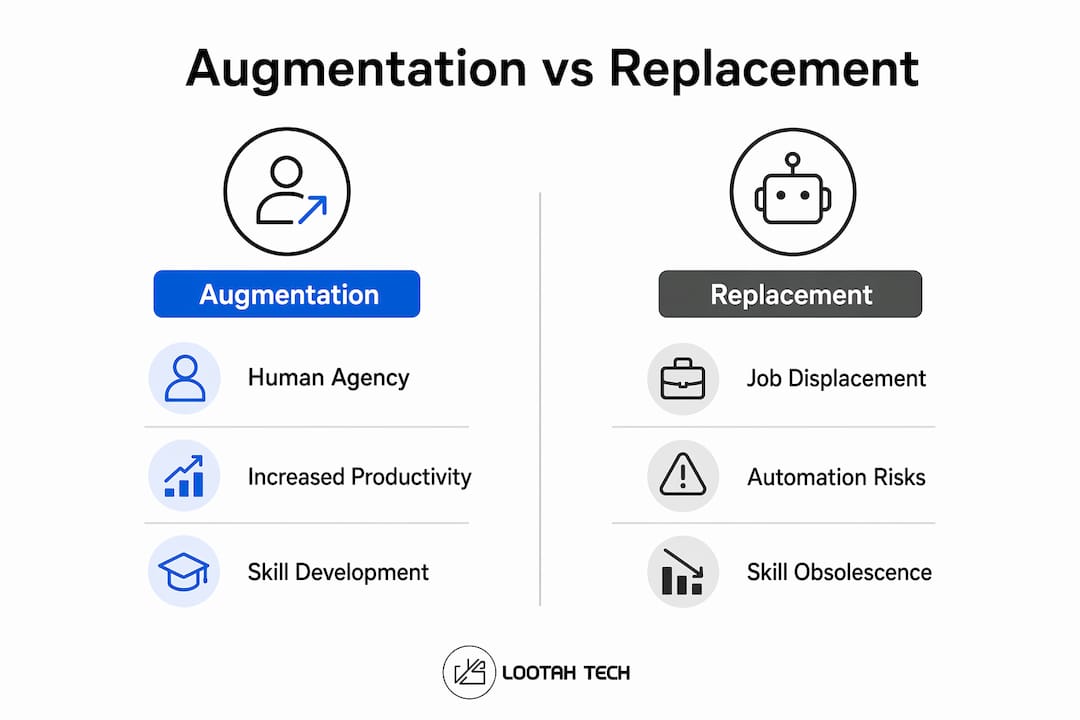
The risks are real but manageable: model bias, data privacy exposure, security gaps, and the capability-formation risk Harvard identifies, where automating entry-level cognitive tasks erodes how junior staff develop expertise. The answer is not to avoid AI; it is to redesign talent pipelines alongside the technology.
What is production-ready now versus years away
| Technology category | Maturity stage | Notes |
|---|---|---|
| Generative AI / copilots | Now | Production-ready; requires governance and prompt standards |
| RPA (rule-based automation) | Now | Mature; best for stable, high-volume digital processes |
| Cloud infrastructure (AWS, etc.) | Now | Fully production-ready across most enterprise workloads |
| Collaboration suites (Teams, Workspace) | Now | Widely deployed; AI features maturing rapidly |
| Industrial robotics (constrained environments) | Now | Production-ready in factories and warehouses |
| IoT / smart-sensor workplace systems | Near-term (1–3 years) | Adoption accelerating; integration complexity remains |
| AR/VR immersive collaboration | Near-term (1–3 years) | Hardware improving; enterprise use cases expanding |
| Agentic AI (multi-step autonomous workflows) | Medium-term (3–7 years) | Early pilots viable; reliability and governance still maturing |
| General-purpose autonomous robotics | Long-term (7+ years) | Harvard analysis and robotics researchers confirm decades-long horizon |
Match pilot scope to maturity. Production-ready tools warrant operational redesign and full deployment budgets. Early-stage technologies deserve time-boxed, low-risk pilots with explicit exit criteria.
How to adopt: a practical roadmap
Gartner's analysis is blunt: only about 1 in 50 AI initiatives delivers transformative value. Modular, process-level redesigns are far more likely to exceed revenue goals than broad, untested rollouts. Start narrow, measure fast, and scale what works.
Adoption checklist:
- Set intent and outcomes. Define what business problem you are solving before selecting any technology.
- Inventory tasks and workflows. Map which tasks are repetitive, data-rich, and low-risk enough for a first pilot.
- Select a pilot team. Choose a team with a clear process owner, not the most enthusiastic early adopters.
- Choose technology patterns. Match the tool category to the task type (generative AI for drafting, RPA for data entry, IoT for space tracking).
- Define metrics and governance. Set KPIs before launch; assign a human accountable for agent outputs.
- Iterate and scale. Encode what works into shared routines; expand only after the pilot metrics hold.
Sample pilot metrics and timelines:
| Metric | What to measure | Typical time-to-signal |
|---|---|---|
| Time saved per task | Minutes per transaction before vs. after | 4–6 weeks |
| Error reduction | Error rate on target process | 6 weeks |
| Throughput | Volume processed per FTE per day | 6 weeks |
| User satisfaction | Pulse survey score (5-point scale) | 4 weeks |
| ROI horizon | Net cost savings vs. implementation cost | 3–6 months |
Pilot budgets for a focused process-level AI or RPA engagement typically run from tens of thousands to low six figures depending on integration complexity. Expect the first measurable signal within 60 days if the scope is tight.
Where these technologies deliver value today
- Sales and marketing: Generative AI drafts proposals, personalizes outreach, and summarizes call recordings. Teams using AI-assisted content workflows report significant research time reductions, as demonstrated in AI-driven content production environments.
- Customer service: AI-powered chat and voice agents handle tier-1 queries; human agents focus on complex cases. Outcome: faster resolution, lower cost per contact.
- HR and talent: Automated screening, onboarding workflows, and skills-gap analysis. Outcome: faster time-to-hire, more consistent candidate experience.
- Operations and supply chain: RPA handles purchase orders, invoice matching, and inventory reconciliation. Outcome: reduced manual processing time and error rates.
- IT operations: AI-driven monitoring detects anomalies before they become outages. Outcome: reduced mean time to resolution.
- Facilities and hybrid work: IoT desk-booking and occupancy analytics right-size office footprints. Outcome: lower real estate cost, better employee experience on in-office days.
- Manufacturing: Industrial robotics and vision systems handle quality inspection and material handling in constrained environments. See Yslootahtech's ROI-first robotics framework for deployment guidance.
- Healthcare: AI-assisted diagnostics support clinicians; surgical robotics remain human-driven with intelligent assistance, not autonomous.
Risks and governance you cannot skip
Governance is the gating factor for safe scale. The Microsoft Work Trend Index makes this explicit: organizations that turn agent outputs into institutional learning outperform those that treat AI as a personal productivity tool. Without governance, bad outputs compound at scale.
Key risks to address:
- Model bias in hiring, lending, or customer-scoring workflows
- Data privacy exposure when proprietary data enters third-party model APIs
- Security gaps from expanded API surfaces and agent permissions
- Regulatory exposure (sector-specific AI rules are accelerating in the US)
- Auditability gaps when agents make decisions without traceable logs
- Capability-formation risk: junior staff missing experiential learning when AI handles entry-level cognitive work
Pro Tip: Build a deliberate mentoring and task-rotation program alongside any AI deployment that touches entry-level roles. Harvard's research on capability formation shows this is where organizations quietly erode their own talent pipelines.
Governance checklist:
- Assign a named human owner for every agent workflow
- Set a review cadence (weekly for new pilots, monthly for stable deployments)
- Require audit logs for all agent decisions affecting customers or employees
- Run red-team tests before production launch
- Document local wins and encode them into shared team routines
- Create a formal incident-response path for agent errors
How to evaluate vendors and integration partners
Evaluate on fit to workflow, integration ease, governance support, and evidence of measurable outcomes. Feature lists are marketing; audit logs and SLAs are facts.
- Interoperability: Does the vendor expose clean APIs? Can it connect to your existing systems without a full rip-and-replace?
- Security posture: What certifications does the vendor hold (SOC 2, ISO 27001)? How is your data isolated?
- SLAs and uptime: What is the contractual uptime commitment and the remediation path when it fails?
- Audit log access: Can you export a full log of agent decisions for compliance review?
- Human-in-the-loop support: Does the platform make it easy to route edge cases to a human reviewer?
- Upgrade path: How does the vendor handle model updates, and do you get advance notice of breaking changes?
- Pricing transparency: Is pricing usage-based, seat-based, or outcome-based? What does overage cost?
Sample RFP questions: "How do you enable human review of agent outputs at scale?" "What telemetry is exposed to our security team?" "Can you show a documented case where a client measured ROI within 90 days?"
When a workflow requires deep integration with proprietary systems, custom data models, or industry-specific compliance requirements, in-house custom development often outperforms a partner-led integration. Yslootahtech's AI integration guide covers when to build versus buy in detail.
Yslootahtech's capabilities and approach
Yslootahtech brings end-to-end capability across the full technology stack that future-of-work projects require:
- Custom software and application development for AI-integrated workflows
- Mobile and web application design with UX/UI built around actual user behavior
- AI and machine learning integration, including generative AI APIs and agentic workflow design
- Cloud architecture and migration (multi-cloud and hybrid environments)
- Cybersecurity, identity governance, and compliance readiness
- Robotics development and industrial automation for constrained environments
- Enterprise application integration across ERP, CRM, and data platforms
In a representative engagement, a mid-market operations team came to Yslootahtech with a high-volume invoice reconciliation process consuming significant analyst hours weekly. The team mapped the workflow, identified the rule-based steps suitable for RPA, and designed a human-review checkpoint for exception handling. Within eight weeks, the pilot showed measurable throughput gains and error reduction. The client scaled the solution across three additional finance processes within six months.
Next steps Yslootahtech offers: discovery workshops to map your current workflows and identify pilot candidates, pilot scoping sessions to define metrics and governance before any technology is selected, and ongoing advisory to translate pilot results into scaled deployments.
Key Takeaways
Future of work technology delivers the most value when organizations design work around human judgment and agent execution together, not as competing forces.
| Point | Details |
|---|---|
| Augmentation beats replacement | MIT Sloan and Microsoft research confirm AI delivers the most value when humans set intent and evaluate outputs. |
| Nine technology categories matter | Generative AI, RPA, cloud, collaboration suites, IoT, AR/VR, robotics, cybersecurity, and AI infrastructure each serve distinct workflow needs. |
| Most AI pilots fail without governance | Gartner finds only 1 in 50 AI initiatives delivers transformative value; modular, process-level pilots with clear KPIs outperform broad rollouts. |
| Robotics timelines are long | General-purpose autonomous robotics remain a long-term horizon; industrial robotics in constrained environments are production-ready now. |
| Yslootahtech accelerates adoption | Yslootahtech offers discovery, pilot scoping, and full-stack development to move organizations from strategy to measurable outcomes. |
The augmentation bet is the right one
We have worked through enough technology cycles to know that the organizations that win are not the ones who deploy the most tools. They are the ones who redesign work deliberately, measure outcomes honestly, and build the human capability to evaluate what their agents produce. The hype around AI replacement is loud, but the evidence points the other way: human judgment, applied at the right moment in a well-designed workflow, is what separates a productive AI deployment from an expensive experiment. If you are ready to have that conversation about where to start and what to measure, we would like to hear from you.
Yslootahtech can help you move from strategy to pilot
Organizations that have read this far usually have the same question: where do we actually start? Yslootahtech works with business leaders to answer that question with a structured discovery engagement, not a generic software pitch.
The starting point is a workflow audit: mapping your highest-volume, highest-friction processes against the technology maturity table above to find the pilots most likely to deliver a measurable return within 60–90 days. From there, Yslootahtech's team handles application development and systems integration, AI and automation configuration, UX/UI design for user-facing workflows, cybersecurity hardening, and the governance scaffolding that keeps pilots from becoming liabilities. The engagement is scoped to your timeline and budget, not a multi-year retainer. Contact Yslootahtech to schedule a discovery call and get a pilot scope document within two weeks.
Useful sources and further reading
| Source | Why it is useful |
|---|---|
| MIT Sloan: Future of Work | Foundational augmentation-first framing and research on human-AI collaboration |
| Microsoft Work Trend Index 2026 | Empirical data on agent adoption, organizational capability, and job creation signals |
| Harvard AWP 276: Automation and Agentic AI | Robotics maturity analysis and capability-formation risk framework |
| Gartner: Future of Work Trends | Industry guidance on AI ROI rates and modular redesign strategies |
| NBER: New Work and the Skill Premium | Labor-market research on how new technologies create and diffuse skill premiums |
| Deskbird: Workplace Technology | Practical data on IoT, hybrid office adoption intent, and space optimization |
| Yslootahtech: Automation Decision Guide | ROI-first frameworks for industrial automation and robotics deployment |