What Is Automation? Benefits, Types, and How It Works

TL;DR:
- Automation uses technology to perform tasks with minimal human input, transforming industries from manufacturing to customer service. It includes various types such as fixed, RPA, intelligent automation, and hyperautomation, each suited to different process complexities. Implementing and continuously refining automation based on clear workflows enhances efficiency, accuracy, and safety while allowing humans to focus on strategic roles.
Automation is the use of technology to perform tasks with minimal human input, spanning everything from a smart thermostat adjusting your home temperature to robotic process automation (RPA) software processing thousands of invoices overnight. Over 90% of companies reported rising demand to adopt automation by late 2025, a figure that reflects how deeply this technology has embedded itself across industries. Automation integrates AI, machine learning, and RPA to handle repetitive, rule-based work at a speed and accuracy no human team can match consistently. Understanding what automation is, how it works, and where it applies gives you a genuine advantage in any professional context.
What is automation and how is it defined?
Automation is defined as technology performing tasks with minimal human guidance to boost efficiency and reduce errors. The formal definition covers a wide spectrum: from simple mechanization (a conveyor belt moving parts) to advanced autonomous systems that mimic human intelligence through AI and machine learning. The term "automation" itself comes from the Greek word "automatos," meaning self-acting, and the concept has evolved from mechanical looms in the Industrial Revolution to today's AI-powered software bots.
What separates modern automation from older mechanization is intelligence. A traditional machine repeats one fixed action. A modern automated system, like an RPA bot or an AI-driven workflow, can read data, make conditional decisions, and trigger follow-up actions across multiple software platforms without a human clicking a single button. This distinction matters because it changes what you can automate and how far you can take it.
What are the main types of automation and how do they differ?
Automation falls into four primary categories, each suited to different operational contexts.
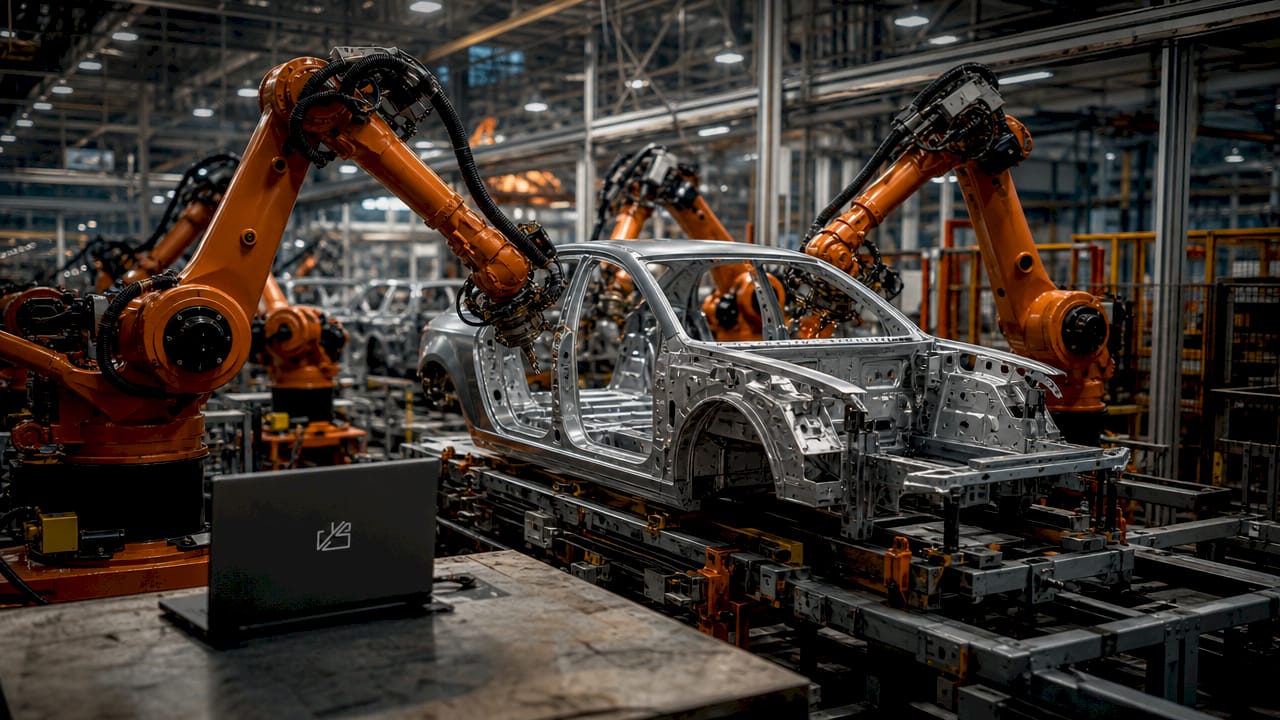
Fixed automation executes one specific task repeatedly with no variation. Assembly lines in automotive manufacturing, where a robotic arm welds the same joint thousands of times per shift, are the clearest example. It delivers maximum throughput for high-volume, unchanging tasks.
Programmable automation allows reprogramming for different product configurations. CNC (Computer Numerical Control) machines in metal fabrication switch between part designs by loading a new program. This suits batch production where product types change periodically.
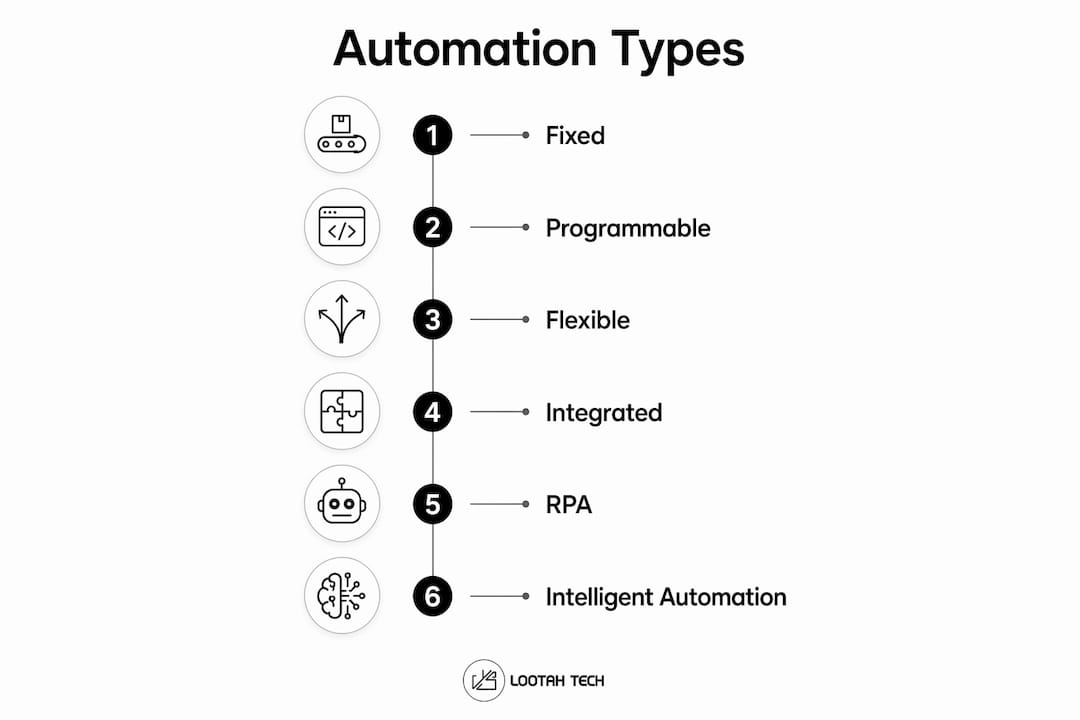
Flexible automation handles multiple tasks simultaneously with minimal changeover time. Modern robotic cells in electronics manufacturing can switch between assembling different circuit board models in real time.
Integrated automation connects entire production or business systems into one coordinated network. A smart warehouse where inventory sensors, robotic pickers, and shipping software all communicate without human coordination is a working example of integrated automation.
Beyond these industrial categories, two software-focused types dominate business operations today.
| Type | Core mechanism | Typical use case |
|---|---|---|
| RPA (Robotic Process Automation) | Software bots mimic human clicks and keystrokes | Invoice processing, data entry, HR onboarding |
| Intelligent automation | RPA combined with AI and ML for decision-making | Fraud detection, dynamic pricing, claims triage |
| Hyperautomation | Multiple tools (RPA, AI, ML) working in concert | End-to-end business process transformation |
| Industrial automation | Hardware robots, sensors, and control systems | Manufacturing, logistics, quality inspection |
| Business process automation | Workflow rules and APIs connecting software systems | Approval workflows, CRM updates, reporting |
RPA uses software bots to handle repetitive, rule-based digital tasks by mimicking human interactions on computers. It works best for high-volume tasks that do not require complex decision-making. Intelligent automation adds a layer of AI so the system can handle exceptions, learn from patterns, and make judgment calls. Hyperautomation uses multiple tools including RPA, AI, and ML to automate most business and IT processes at scale, representing the most advanced discipline in the field today.
Pro Tip: Before selecting an automation type, map your process end-to-end. Fixed automation is a poor fit for variable workflows, and RPA applied to a broken process will only produce errors faster. Match the tool to the task structure, not the other way around.
What are the key benefits and impacts of automation?
Automation reallocates human effort by offloading repetitive tasks, reducing stress, and enabling focus on strategic activities. This is the most underappreciated benefit. When your team stops manually copying data between systems, they gain hours per week for analysis, client relationships, and problem-solving. The productivity gain is real, but the quality-of-work gain is equally significant.
The concrete benefits break down across several dimensions:
- Error reduction: Automated systems do not misread a field or transpose digits when tired. In healthcare, automated diagnostic tools reduce misclassification rates in imaging analysis. In finance, automated reconciliation catches discrepancies that human reviewers miss under deadline pressure.
- Cost efficiency: Reducing manual labor hours on repetitive tasks lowers operational costs without reducing headcount for strategic roles. Many organizations redirect those savings into product development or customer experience improvements.
- Speed and scalability: An RPA bot can process thousands of records in the time a human team processes dozens. When demand spikes, you scale the bot, not the headcount.
- Safety improvements: In manufacturing and logistics, robots handle hazardous tasks including heavy lifting, chemical handling, and precision cutting, reducing workplace injuries.
- Consistency and quality: Automated quality control systems in electronics manufacturing inspect components at speeds and resolutions no human inspector can sustain across an eight-hour shift.
One persistent myth is that automation eliminates jobs entirely. Automation aims to augment human capabilities, improve accuracy, and reduce human error and stress, not to replace the workforce wholesale. The more accurate picture is role transformation: routine task execution shifts to machines, while humans move into oversight, exception handling, and creative problem-solving. You can explore how IT automation drives efficiency in practice to see this dynamic play out in technology environments specifically.
How does automation technically work?
Feedback controls and programmed commands are the core components enabling machines to perform automated actions. Automation systems typically combine mechanical, electrical, and electronic devices with software to create a closed loop: input triggers action, action produces output, output is measured, and the measurement feeds back to adjust the next action. A thermostat is the simplest version of this loop. An AI-driven supply chain system is the most complex.
Software automation operates through three primary mechanisms.
APIs (Application Programming Interfaces) connect separate software systems so they can exchange data automatically. When a customer places an order on an e-commerce platform, an API call can simultaneously update inventory, trigger a shipping label, and log the transaction in an accounting system, all without a human touching any of those systems.
RPA bots operate at the user interface layer, mimicking mouse clicks and keyboard inputs. They are particularly useful when APIs are not available, such as when connecting a legacy system that has no modern integration layer.
Macros and scripts automate repetitive sequences within a single application. A Python script that pulls data from a database, formats it into a report, and emails it every Monday morning is a simple but effective form of software automation.
Modern automation workflows are carefully designed systems executing multi-step processes with minimal human oversight. Workflow automation manages the flow of information and tasks across processes via predefined rules. The role of AI and machine learning in this layer is to handle variability: when inputs do not match the expected pattern, an AI-enhanced system can classify the exception and route it appropriately rather than failing or stalling.
A critical technical reality: automating inefficient workflows only accelerates errors. If your manual process has gaps, inconsistencies, or undocumented exceptions, automation will surface all of them at scale. Process documentation and cleanup must come before implementation, not after. You can find a structured approach to this in Yslootahtech's guide on transforming automation workflows.
Pro Tip: Watch for the automation paradox: when operators rely so heavily on automated systems that they lose the manual skills needed to intervene during failures. Build regular manual practice and human-in-the-loop checkpoints into any automated system from day one.
Where is automation applied across industries and everyday life?
Automation is integrated across IT, healthcare, and AI-powered customer service, far beyond its manufacturing origins. The breadth of application is what makes understanding automation so practically relevant for professionals in nearly every field.
Here is where automation shows up most visibly today:
- Manufacturing and logistics: Robotic arms on assembly lines, autonomous mobile robots (AMRs) in Amazon warehouses, and automated quality inspection systems using computer vision.
- Healthcare: AI diagnostic tools analyzing radiology images, automated appointment scheduling, and robotic surgical assistants like the da Vinci Surgical System.
- Customer service: AI chatbots handling tier-one support queries on platforms like Zendesk and Intercom, reducing resolution time and freeing human agents for complex cases.
- Finance and accounting: Automated invoice processing, fraud detection algorithms monitoring transactions in real time, and RPA bots reconciling accounts across multiple banking systems.
- Human resources: Automated candidate screening tools, which improve recruitment efficiency for tech startups by filtering applications based on predefined criteria before a recruiter reviews a single resume.
- Software development: Continuous integration and continuous deployment (CI/CD) pipelines automate code testing, building, and deployment, tools like GitHub Actions and Jenkins being standard in modern development teams.
- Smart homes and IoT: Devices like Google Nest thermostats, Philips Hue lighting systems, and Ring security cameras automate environmental controls based on occupancy, time, and user preferences.
The emerging frontier is hyperautomation applied to entire business functions. Organizations are connecting CRM systems, ERP platforms, and communication tools into unified automated workflows where a single customer action triggers coordinated responses across sales, support, and fulfillment simultaneously. For professionals tracking where this is heading, Yslootahtech's analysis of AI trends for enterprises covers the strategic implications in detail.
Key takeaways
Automation delivers its greatest value when applied to mature, well-documented processes with clear inputs, outputs, and rules.
| Point | Details |
|---|---|
| Core automation definition | Automation uses technology to perform tasks with minimal human input, spanning software bots to industrial robots. |
| Match type to task | Fixed, RPA, intelligent, and hyperautomation each suit different process structures and complexity levels. |
| Benefits go beyond cost | Automation improves accuracy, safety, and employee focus on strategic work, not just operational cost. |
| Process maturity first | Automating a broken process accelerates errors; document and clean workflows before implementation. |
| Human oversight is non-negotiable | Human-in-the-loop design prevents skill atrophy and maintains control during system failures or exceptions. |
Why automation strategy matters more than automation tools
After working with organizations across digital transformation projects, the pattern I see most often is this: companies invest in the right tools and still get poor results. The reason is almost always the same. They automated the process they had, not the process they needed.
The most successful automation projects I have observed share one characteristic. The team spent more time redesigning the workflow than configuring the software. They asked what the process should look like if you built it from scratch today, then automated that version. The teams that skipped this step ended up with faster versions of their old problems.
The other thing worth saying plainly: automation is not a one-time project. It is an ongoing practice. The automation you deploy today will need adjustment as your business changes, as software platforms update, and as AI capabilities expand. Organizations that treat automation as a destination rather than a discipline tend to see their implementations degrade within 18 months.
My honest recommendation is to start with one high-volume, well-documented process, prove the value, and build your team's confidence and capability before scaling. The technology is mature enough that the limiting factor is almost never the tool. It is the clarity of your process and the discipline of your implementation.
— YS
Put automation to work for your business
If you are ready to move from understanding automation to actually implementing it, Yslootahtech builds the digital infrastructure that makes it possible. From custom application development that incorporates workflow automation from the ground up, to AI and machine learning integration that powers intelligent automation across your operations, the team brings deep technical expertise to every project.
Yslootahtech works with businesses across manufacturing, fintech, healthcare, and enterprise IT to design and deploy automation solutions that fit their actual workflows, not generic templates. If your organization is evaluating where automation fits in your digital strategy, the right starting point is a conversation about your processes, not your software stack.
FAQ
What is the simplest automation definition?
Automation is the use of technology to perform tasks with minimal human intervention. It covers everything from a basic scheduled email to a fully autonomous robotic manufacturing line.
What are the main types of automation?
The main types are fixed, programmable, flexible, and integrated automation for hardware systems, and RPA, intelligent automation, and hyperautomation for software-driven processes. Each type suits a different level of task complexity and variability.
Is automation necessary for businesses in 2026?
Over 90% of companies reported rising demand to adopt automation by late 2025, making it a competitive baseline rather than an optional upgrade. Businesses that do not automate repetitive processes face speed and cost disadvantages against those that do.
Does automation replace human workers?
Automation reallocates human effort rather than eliminating it entirely. Routine task execution shifts to machines, while humans move into oversight, exception handling, and higher-value strategic roles.
What is the automation paradox?
The automation paradox occurs when operators rely so heavily on automated systems that they lose the manual skills needed to intervene during failures. Maintaining human-in-the-loop checkpoints prevents this risk and keeps teams capable of managing exceptions.