Top AI Platforms for Enterprises: 2026 Decision Guide

TL;DR:
- Enterprise AI platforms prioritize agent orchestration and governance over model quality to achieve production readiness. Managed integration partners like Yslootahtech accelerate deployment by handling architecture, compliance, and custom agent development for regulated industries. Prioritizing long-running, auditable agents connected to enterprise systems ensures successful AI adoption in complex environments.
The shortlist every IT leader should evaluate first: Yslootahtech (managed integration partner), Microsoft Azure AI, Google Cloud Vertex AI, Amazon Bedrock, IBM watsonx, OpenAI ChatGPT Enterprise, and Salesforce Einstein. The single factor separating platforms that reach production from those that stall in pilot is agentic orchestration paired with enterprise governance — not model quality alone.
Here is where each shortlist entry fits:
- Yslootahtech — Best for enterprises that need end-to-end integration, custom agent development, and managed operations across regulated environments. SOC 2 and ISO/IEC 27001 alignment built into delivery.
- Microsoft Azure AI / Microsoft 365 Copilot — Best for organizations already running Microsoft 365 who want embedded productivity agents with enterprise data protection.
- Google Cloud Vertex AI / Gemini Enterprise — Best for model-agnostic deployments needing long-running agent runtimes, persistent memory, and strong data connectors.
- Amazon Bedrock / Bedrock AgentCore — Best for highly regulated or cost-sensitive enterprises that need FedRAMP eligibility, model diversity, and production-grade guardrails.
- IBM watsonx — Best for finance and healthcare organizations requiring on-prem or hybrid deployment with explainability and governance tooling.
- OpenAI ChatGPT Enterprise — Best for teams that need frontier model performance and a fast developer path to agentic workflows.
- Salesforce Einstein — Best for customer-centric organizations embedding AI directly into CRM and service workflows.
Trust signals worth noting upfront: Amazon Bedrock publishes FedRAMP, ISO, and SOC compliance scopes; Microsoft 365 Copilot includes enterprise data protection within Microsoft Graph boundaries; and Yslootahtech delivers governance-aligned managed services for enterprises that cannot afford a failed pilot.
Table of Contents
- Which platform fits your enterprise needs at a glance?
- Detailed platform profiles: strengths, limitations, and when to pick each
- How we evaluated these platforms
- How do you choose the right enterprise AI platform?
- What does an enterprise AI rollout actually cost and take?
- When should you hire a managed partner instead of going platform-only?
- Key Takeaways
- Orchestration and governance are the 2026 priorities
- Yslootahtech helps you build and operate enterprise AI in production
- Further reading and useful sources
Which platform fits your enterprise needs at a glance?
The table below covers the full shortlist plus the broader field of enterprise AI tools across the dimensions that matter most to procurement and architecture teams.
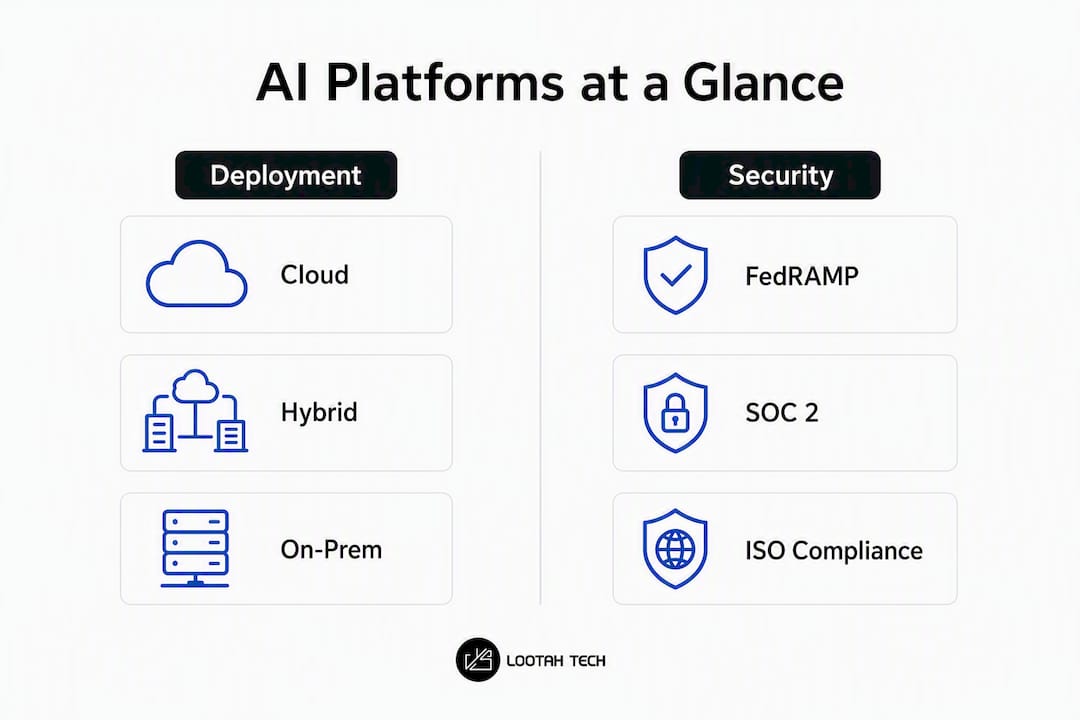
| Platform | Best For | Deployment | Agent Orchestration | Security & Compliance | Pricing Model |
|---|---|---|---|---|---|
| Yslootahtech | Regulated enterprises needing managed integration & custom agents | Cloud / Hybrid / On-prem | Full custom agent dev & orchestration | SOC 2, ISO 27001 aligned; governance by design | Managed engagement / project |
| Microsoft Azure AI / Copilot | Microsoft 365 shops wanting embedded productivity agents | Cloud (Azure) / Hybrid | Copilot Studio; agent builder | SOC 2, ISO 27001, FedRAMP High | Per-user subscription + consumption |
| Google Cloud Vertex AI | Model-agnostic fleets with long-running workflows | Cloud / Hybrid | Agent Runtime, Agent Registry, Memory Bank | SOC 2, ISO 27001, FedRAMP | Consumption-based |
| Amazon Bedrock / AgentCore | Regulated, scale-driven enterprises | Cloud / Hybrid | AgentCore; multi-agent orchestration | FedRAMP High, HIPAA, SOC 2, ISO | Consumption-based |
| IBM watsonx | Finance, healthcare; on-prem/hybrid governance | Cloud / Hybrid / On-prem | watsonx Orchestrate | SOC 2, ISO 27001, FedRAMP | Subscription + consumption |
| Databricks AI | Data-heavy enterprises; unified ML lifecycle | Cloud / Hybrid | MLflow + agent orchestration | SOC 2, ISO 27001 | Consumption-based (DBU) |
| Anthropic / Claude Enterprise | Safety-critical deployments; controlled agents | Cloud | API-based agent tooling | SOC 2, ISO 27001 | Token-based consumption |
| OpenAI ChatGPT Enterprise | Frontier model performance; rapid agent prototyping | Cloud | Assistants API; agent tooling | SOC 2, no training on customer data | Per-user + consumption |
| Salesforce Einstein | CRM-embedded AI and CX automation | Cloud | Agentforce; prebuilt CRM agents | SOC 2, ISO 27001 | Bundled with Salesforce licenses |
| Kore.ai | Conversational CX and internal workflow automation | Cloud / On-prem | XO Platform; multi-agent | SOC 2, ISO 27001, HIPAA | Subscription |
| Moveworks | ITSM automation; employee support agents | Cloud | Prebuilt ITSM agent workflows | SOC 2, ISO 27001 | Subscription |
| ServiceNow | Cross-enterprise workflow automation | Cloud / Hybrid | Now Assist; agentic workflows | SOC 2, FedRAMP, ISO 27001 | Subscription |
| Microsoft Copilot | Microsoft 365 productivity embedding | Cloud | Copilot Studio | SOC 2, ISO 27001, FedRAMP | Per-user subscription |
| Google Gemini Enterprise | Multimodal enterprise productivity | Cloud | Gemini for Workspace agents | SOC 2, ISO 27001 | Per-user subscription |
| Glean | Enterprise knowledge search and RAG | Cloud / Hybrid | Glean Agents | SOC 2, ISO 27001 | Subscription |
| Sierra | Customer-facing conversational agents | Cloud | Prebuilt CX agent platform | SOC 2 | Consumption-based |
| Ringover AI Assistant / Empower | Sales and contact center intelligence | Cloud | Call analytics agents | SOC 2 | Subscription |
| Oracle AI | ERP-embedded AI for Oracle workloads | Cloud / On-prem | Oracle Digital Assistant | SOC 2, ISO 27001, FedRAMP | Bundled with Oracle licenses |
| SAP Business AI | ERP and supply chain AI for SAP environments | Cloud / Hybrid | SAP AI Core agents | SOC 2, ISO 27001 | Bundled with SAP licenses |
| H2O.ai | AutoML and custom model development | Cloud / On-prem | H2O AI Cloud agents | SOC 2, ISO 27001 | Subscription + consumption |
| Cognigy.AI | Contact center conversational AI | Cloud / On-prem | Cognigy Agentic AI | SOC 2, ISO 27001, HIPAA | Subscription |
| watsonx Orchestrate | Task automation across enterprise apps | Cloud / Hybrid | Multi-step agent orchestration | SOC 2, ISO 27001 | Subscription |
| Yellow.ai Agentic AI | Omnichannel CX automation | Cloud | Dynamic Automation Platform | SOC 2, ISO 27001 | Subscription |
| Aisera AI Agent | IT and HR service automation | Cloud | Agentic AI workflows | SOC 2, ISO 27001 | Subscription |
| Sprinklr Service | Unified CX and contact center AI | Cloud | Sprinklr AI+ agents | SOC 2, ISO 27001 | Subscription |
| Omilia Cloud Platform | Voice-first conversational AI | Cloud | Omilia Pathfinder agents | SOC 2, PCI DSS | Consumption-based |
| Amelia Platform | Enterprise virtual assistant | Cloud / On-prem | Amelia agent builder | SOC 2, ISO 27001 | Subscription |
| boost.ai | Banking and insurance conversational AI | Cloud / On-prem | Conversational AI platform | SOC 2, ISO 27001 | Subscription |
| Microsoft Copilot Studio | Low-code agent builder for Microsoft stack | Cloud | Copilot Studio agents | SOC 2, ISO 27001, FedRAMP | Per-session consumption |
| Genesys Cloud CX | Contact center AI and journey orchestration | Cloud | Genesys AI agents | SOC 2, ISO 27001, FedRAMP | Subscription |
| CBOT Platform | Banking and telecom chatbot automation | Cloud / On-prem | CBOT agent builder | SOC 2, ISO 27001 | Subscription |
| Generative Studio X | No-code generative AI app builder | Cloud | Agent workflow builder | SOC 2 | Subscription |
| Talkdesk | AI-powered contact center platform | Cloud | Talkdesk Autopilot agents | SOC 2, ISO 27001, HIPAA | Subscription |
| Amazon Lex | Conversational interface builder on AWS | Cloud | Lex bot orchestration | SOC 2, FedRAMP, HIPAA | Consumption-based |
| Parloa Platform | Voice and chat agent automation | Cloud / On-prem | Parloa Agent Management Platform | SOC 2, ISO 27001 | Subscription |
| Tars Platform | Lead gen and support chatbot builder | Cloud | Tars agent workflows | SOC 2 | Subscription |
| DRUID AI Platform | Enterprise conversational AI | Cloud / On-prem | DRUID agent studio | SOC 2, ISO 27001 | Subscription |
| Agent Assist | Real-time agent support in contact centers | Cloud | Google CCAI Agent Assist | SOC 2, ISO 27001, FedRAMP | Consumption-based |
| Avaamo Conversational AI | Healthcare and enterprise virtual agents | Cloud / On-prem | Avaamo agent builder | SOC 2, HIPAA, ISO 27001 | Subscription |
| Amazon SageMaker | ML model build, train, and deploy | Cloud / Hybrid | SageMaker Pipelines | SOC 2, FedRAMP, HIPAA | Consumption-based |
| Microsoft Azure AI Services | Cognitive and vision APIs on Azure | Cloud / Hybrid | Azure AI Studio agents | SOC 2, ISO 27001, FedRAMP | Consumption-based |
Detailed platform profiles: strengths, limitations, and when to pick each
Enterprise evaluation has shifted from picking the best model to picking the platform that can manage a fleet of autonomous agents and connect them to systems of record. That framing shapes every profile below.
Yslootahtech
Yslootahtech sits in a different category from the hyperscalers: it is a managed integration and custom agent development partner, not a platform you license and self-operate. For enterprises that have identified a platform (Azure, Bedrock, Vertex AI) but lack the internal AI engineering capacity to connect it to SAP, Salesforce, or a proprietary data lake, Yslootahtech closes that gap.

Strengths: End-to-end ownership of integration architecture, custom agent logic, and production operations. Governance and compliance alignment built into delivery rather than bolted on. Fast time-to-value for regulated deployments where a failed pilot carries real organizational cost.
Limitations: Not a self-service platform; requires an engagement model. Best suited for organizations with a defined use case and a budget for managed services.
Pro Tip: If your enterprise has fewer than three dedicated AI engineers and a compliance requirement, a managed partner like Yslootahtech typically reaches production faster than a self-run platform purchase.
Microsoft Azure AI / Microsoft 365 Copilot
Microsoft's integrated tooling accelerates production use by combining Copilot Studio for agent development with enterprise data protection inside Microsoft Graph. The result is a governance layer that most Microsoft-heavy organizations already partially own.

Strengths: Deep Microsoft 365 integration; Copilot Studio for low-code agent building; enterprise data protection; FedRAMP High eligibility.
Limitations: Tightly coupled to the Microsoft ecosystem; organizations with multi-cloud or non-Microsoft data estates face friction. Per-user pricing scales steeply at large headcounts.
Google Cloud Vertex AI / Gemini Enterprise
Google Cloud recommends pairing platform capabilities with custom agents and architecture for enterprise workloads. Agent Runtime supports long-running workflows that persist for days, while Agent Registry provides fleet-level identity and control — two features that matter enormously once you move past single-turn chatbots.
Strengths: Model-agnostic; Agent Runtime and Memory Bank for persistent, long-running agents; strong data connectors; hybrid deployment options; both no-code Agent Designer and pro-code ADK.
Limitations: Complexity of the platform requires skilled architects. Pricing can be opaque across model and compute dimensions.
Amazon Bedrock / Bedrock AgentCore
Bedrock's guardrails and compliance scopes — FedRAMP High, HIPAA eligibility, SOC 2, ISO — make it the default choice for defense, healthcare, and financial services enterprises that cannot compromise on data isolation. AgentCore handles production agent lifecycle management, including memory, identity, and tool execution.
Strengths: Broadest model selection; mature compliance posture; AgentCore for production orchestration; model distillation and prompt routing for cost control.
Limitations: AWS-native architecture creates dependency. Teams unfamiliar with AWS IAM and VPC configurations face a steep ramp.
IBM watsonx / watsonx Orchestrate
watsonx targets regulated industries with explainability tooling and on-prem deployment options that hyperscalers rarely match. watsonx Orchestrate handles multi-step task automation across enterprise applications, making it a strong fit for finance and healthcare workflows where auditability is non-negotiable.
Strengths: On-prem and hybrid deployment; strong governance and explainability; data-centric tooling; HIPAA and FedRAMP eligibility.
Limitations: Smaller model ecosystem than AWS or Google. Integration outside the IBM stack requires custom work.
Databricks AI / Lakehouse
Databricks is the right answer when the enterprise's primary challenge is data engineering at scale, not just model inference. The unified lakehouse approach means ML pipelines, feature stores, and model registries share the same data layer — eliminating the data-copying overhead that kills production ML projects.
Strengths: Unified data and ML lifecycle; scalable MLOps; strong governance via Unity Catalog; multi-cloud.
Limitations: Less suited for conversational or CX-facing agent use cases. Requires strong data engineering capability internally.
Anthropic / Claude Enterprise
Anthropic's safety-first model design gives procurement teams something concrete: model behavior controls and alignment guarantees that most foundation model providers cannot match. Claude's long context window (up to 200K tokens) is a practical advantage for document-heavy enterprise workflows.
Strengths: Safety and alignment controls; long context window; SOC 2 and ISO 27001; no customer data used for training.
Limitations: API-first; no native orchestration layer. Enterprises need to build or buy orchestration on top.
OpenAI ChatGPT Enterprise
The Assistants API and function-calling tooling give engineering teams a fast path to agentic workflows. ChatGPT Enterprise adds data isolation, admin controls, and a no-training-on-customer-data guarantee — the three procurement gates most IT security teams require.
Strengths: Frontier model performance; strong developer ecosystem; rapid prototyping; SOC 2 Type II.
Limitations: Cloud-only; no on-prem option. Vendor concentration risk is real given OpenAI's market position.
Salesforce Einstein / Agentforce
Einstein's advantage is not model quality — it is depth of CRM integration. Agentforce agents have native access to Salesforce data, workflows, and automation without custom connectors. For a sales or service organization already on Salesforce, that removes months of integration work.
Strengths: Prebuilt CRM and industry-specific agents; Agentforce for autonomous CX automation; bundled licensing.
Limitations: Limited value outside the Salesforce ecosystem. Custom model fine-tuning options are constrained.
Kore.ai, Moveworks, and ServiceNow
These three occupy the enterprise workflow automation tier. Kore.ai's XO Platform handles conversational CX and internal automation with a large library of prebuilt industry templates. Moveworks packages ITSM automation tightly enough that large enterprises report meaningful deflection rates without heavy customization. ServiceNow's Now Assist embeds AI into workflow orchestration that IT and operations teams already run — making it the lowest-friction AI addition for ServiceNow shops.
Contact center and conversational AI platforms
Cognigy.AI, Yellow.ai, Aisera, Sprinklr Service, Omilia, Amelia, boost.ai, Genesys Cloud CX, Talkdesk, Parloa, DRUID, Avaamo, CBOT, and Ringover (AI Assistant and Empower) all target contact center and CX automation. Cognigy and Genesys lead on enterprise scale and compliance depth. Talkdesk and Sprinklr add strong analytics layers. Omilia and Parloa specialize in voice-first automation. Avaamo and Amelia carry HIPAA eligibility for healthcare deployments. boost.ai focuses on banking and insurance. Ringover's AI Assistant and Empower add real-time call intelligence and coaching for sales teams.
Developer and builder tools
Amazon Lex, Microsoft Copilot Studio, Generative Studio X, Tars, and Agent Assist serve teams building conversational interfaces or augmenting human agents. Amazon Lex integrates natively with AWS Lambda and Connect. Copilot Studio provides low-code agent building within the Microsoft stack. Google's Agent Assist (CCAI) delivers real-time support to live agents during calls. Glean and Sierra round out the field: Glean for enterprise knowledge search and RAG across internal content, Sierra for customer-facing conversational agents with a no-code build experience.
Oracle AI, SAP Business AI, H2O.ai, Amazon SageMaker, Microsoft Azure AI Services
These platforms serve specific buyer profiles. Oracle AI and SAP Business AI are the right answer when the enterprise runs Oracle or SAP as its system of record — the AI is embedded in the ERP, not bolted on. H2O.ai targets data science teams that need AutoML and custom model development with on-prem options. Amazon SageMaker remains the most complete managed ML platform for teams building and deploying custom models at scale. Azure AI Services provides the cognitive and vision API layer for enterprises building AI features into custom applications on Azure.
How we evaluated these platforms
The core evaluation lens: agent orchestration capability, enterprise governance, integration breadth, and security certification posture. A platform that scores well on model benchmarks but cannot connect to your ERP or produce an audit log is not production-ready.
Rating criteria
- Agent orchestration — Does the platform support multi-agent coordination, long-running workflows, and agent identity management?
- RAG and knowledge connectors — Can it connect to enterprise data sources (data lake, SharePoint, Salesforce, SAP) without custom ETL?
- Governance and observability — Are there built-in evaluation, guardrail, and monitoring tools that close the pilot-to-production gap?
- Security certifications — SOC 2 Type II, ISO/IEC 27001, FedRAMP High, HIPAA eligibility where applicable.
- Integration breadth — CRM, ERP, data warehouse, identity provider connectors available out of the box or via certified partners.
- Deployment flexibility — Cloud-only, hybrid, or on-prem options for regulated data residency requirements.
- Pricing model — Consumption-based, per-user, or bundled; total cost of ownership at scale.
- Partner ecosystem — Certified implementation partners, professional services depth, SLA commitments.
- Scalability and SLA — Published throughput, latency targets, and uptime commitments.
Testing methods and trust signals
Evaluation drew on sandboxed proof-of-concept testing, compliance documentation review, customer case-study analysis, and third-party analyst recognitions including Gartner Peer Insights ratings and Forrester Wave placements. Integration checks verified connector availability against a reference enterprise stack (Salesforce CRM, SAP ERP, Snowflake data warehouse, Azure AD identity).
The proof an IT leader should demand from every vendor: a SOC 2 Type II report dated within the last 12 months, an architecture diagram showing customer data isolation, reference implementation notes from a comparable regulated deployment, and written contractual language confirming customer data is not used to train foundation models.
Gartner's Peer Insights ratings for conversational AI platforms provide a useful cross-check on vendor claims, particularly for contact center and CX-focused tools. Forrester's predictions for 2026 flag AI agents as a force reshaping business models — reinforcing why orchestration, not model selection, is the primary evaluation axis.
How do you choose the right enterprise AI platform?
Focus selection on three things: orchestration capability, integrations to your specific systems of record, and provable governance. Everything else is secondary.
Procurement checklist (sequential POC steps)
- Define the use case precisely. A vague "AI assistant" project fails. Name the system of record, the workflow, and the measurable outcome.
- Shortlist on deployment model first. If data residency or regulatory constraints require on-prem or hybrid, eliminate cloud-only platforms before evaluating features.
- Run a targeted POC. Connect the platform to one real data source, execute one real workflow, and measure latency, accuracy, and cost at realistic volume.
- Request compliance evidence. SOC 2 Type II report, ISO/IEC 27001 certificate, FedRAMP authorization letter where applicable. Do not accept "we are pursuing certification."
- Test observability. Can you see every agent action, every tool call, and every model decision in an audit log? If not, stop.
- Evaluate the integration layer. Run a connector test against your CRM, ERP, or data warehouse. Count the custom development hours required.
- Score the partner ecosystem. How many certified implementation partners exist? What is the vendor's professional services SLA?
Questions to ask every vendor during RFP
- Where does my data reside, and can I specify the region contractually?
- Does your platform use customer data to train or fine-tune foundation models?
- How does your agent lifecycle management handle versioning, rollback, and deprecation?
- What observability tooling is native versus requiring third-party integration?
- What is your SLA for agent runtime uptime, and what are the remedies for breach?
Red flags that should stop a procurement
- No clear isolation of customer data from multi-tenant model training.
- No native audit logs for agent actions and tool calls.
- Vendor refuses hybrid or on-prem options when your regulatory posture requires them.
- No published SOC 2 Type II report or ISO/IEC 27001 certificate.
- Reference customers are all in a different industry or at a different scale.
Pro Tip: Build a lightweight scoring rubric before the POC: weight orchestration at 30%, security/compliance at 25%, integrations at 20%, governance/observability at 15%, and pricing at 10%. Run every vendor through the same rubric. The numbers force honest conversations.
For a deeper look at data privacy requirements that should inform your RFP language, Yslootahtech's 2026 guide covers contractual protections and residency requirements in detail.
What does an enterprise AI rollout actually cost and take?
A production-grade agentic AI deployment typically requires several months across phased rollouts, depending on integration complexity and the number of systems of record involved.
Implementation phases
- Discovery and architecture (weeks 1–4): Map the use case, data sources, compliance requirements, and integration points. Produce an architecture diagram and a risk register.
- Proof of concept (weeks 4–10): Connect to one real data source, build one agent workflow, and validate accuracy, latency, and cost at target volume.
- Integration and data plumbing (weeks 8–20): Build production connectors to CRM, ERP, data lake, and identity provider. This phase is where most projects underestimate effort.
- Guardrails and testing (weeks 16–24): Implement content filters, PII detection, output validation, and adversarial testing. Document results for compliance review.
- Staged production (weeks 20–32): Roll out to a limited user group, monitor closely, and iterate on agent behavior before full deployment.
- Monitoring and iteration (ongoing): Establish a model ops cadence for drift detection, cost monitoring, and agent version management.
Cost buckets to budget for
- Platform and model usage: Consumption-based costs scale with volume; model routing and caching reduce this significantly.
- Compute: Inference infrastructure, especially for on-prem or hybrid deployments.
- Integration and custom development: Often the largest single cost bucket for enterprises with complex systems of record.
- Monitoring and security: Observability tooling, SIEM integration, and compliance audit support.
- Third-party connectors: Certified connectors for SAP, Salesforce, or Workday carry licensing costs separate from the AI platform.
Pro Tip: Model distillation, prompt caching, and routing to smaller models for simpler tasks can cut inference costs by a meaningful margin while keeping SLA targets intact. Build this into your architecture from day one, not as a retrofit.
For a full-stack view of enterprise deployment approaches, Yslootahtech's enterprise deployment guide covers monitoring, guardrailing, and evaluation in production.
When should you hire a managed partner instead of going platform-only?
Choose a managed partner when your program requires deep systems-of-record integrations, custom business logic, compliance attestations, or limited internal AI engineering capacity. A platform license without the engineering to connect it to production data is an expensive experiment.
The honest calculus: a platform-only purchase assumes your team can architect the integration layer, build and test the agents, implement governance controls, and maintain the system in production. Most enterprises underestimate how much of that work falls outside the platform's scope.
Yslootahtech's managed engagement model covers architecture and integration, custom agent development, security and compliance alignment, and ongoing operations. For an enterprise that has identified the right platform but lacks the internal capacity to reach production, that model compresses the timeline and reduces the compliance risk that comes with a self-run rollout.
When to favor in-house operation
- Your organization has three or more dedicated AI engineers with production MLOps experience.
- You have an existing model ops platform and observability stack.
- Your use case is low-risk and does not touch regulated data.
- You have the appetite to own vendor relationships and contract negotiations directly.
When to favor a managed engagement
- Fewer than three dedicated AI engineers internally.
- Integration touches regulated systems (EHR, core banking, SAP financial modules).
- Compliance attestation is required before production launch.
- Time-to-value pressure is high and a failed pilot carries organizational cost.
Managed services versus platform-only is not a permanent choice. Many enterprises start with a managed partner to reach production, then transition operations in-house once the architecture is stable and the team is trained. For real-world examples of how agentic fleets reach production in regulated environments, Yslootahtech's case study library covers implementation patterns across industries.
For additional perspective on AI productivity gains from agent-based deployments, third-party analysis shows meaningful ROI when agents are connected to real workflows rather than operating as standalone tools.
Key Takeaways
Agentic orchestration paired with enterprise governance is the single factor that separates platforms reaching production from those that stall in pilot.
| Point | Details |
|---|---|
| Orchestration beats model quality | The platform managing your agent fleet and connecting it to systems of record matters more than which foundation model it runs. |
| Compliance evidence is non-negotiable | Demand SOC 2 Type II, ISO/IEC 27001, and FedRAMP documentation before any procurement decision, not after. |
| Integration is the largest cost | Custom connectors to CRM, ERP, and data lakes typically consume more budget than platform licensing itself. |
| Phased rollouts reduce risk | A 3–9 month phased deployment with a targeted POC before full production is the standard for regulated enterprise AI. |
| Yslootahtech as managed partner | For enterprises lacking internal AI engineering depth, Yslootahtech delivers integration, custom agents, and governance-aligned operations to reach production faster. |
Orchestration and governance are the 2026 priorities
The enterprises that will extract real value from AI in 2026 are not the ones that picked the best model. They are the ones that built an orchestration layer capable of running auditable, long-running agents connected to the systems where their business actually operates.
The pattern I see repeatedly: organizations invest in a frontier model, run an impressive demo, and then spend six months discovering that connecting the model to their SAP instance, their Salesforce org, and their identity provider is the actual engineering problem. The model was never the bottleneck. The integration and governance layer was.
Platforms like Google Cloud Vertex AI and Amazon Bedrock have made meaningful progress on agent runtime and lifecycle management. But the gap between "platform capability" and "production deployment" remains wide for most enterprises, particularly in regulated industries. That gap is where a managed partner earns its value.
Prioritize platforms that can demonstrate long-running, auditable agents connected to your specific systems of record. Require proof, not promises. And if your internal team cannot build and operate that architecture at the speed your business requires, a managed engagement is not a compromise. It is the faster path.
Yslootahtech helps you build and operate enterprise AI in production
Enterprises evaluating the platforms above face a consistent challenge: the platform is available, but the integration, governance, and operational work to reach production is not. Yslootahtech's managed services cover exactly that gap.
Yslootahtech offers architecture and integration design, custom agent development, security and compliance alignment, and ongoing managed operations for enterprise AI deployments. The engagement model is built for organizations that need production-grade results without building a full internal AI engineering team from scratch. Whether you are connecting an agent to a regulated data source, building custom business logic on top of Azure or Bedrock, or need compliance attestation before launch, Yslootahtech delivers the full stack.
Start with a short discovery call to map your use case, your systems of record, and your compliance requirements. From there, Yslootahtech scopes a phased engagement that gets you to a working POC within weeks, not quarters. Explore custom application development and managed AI services at Yslootahtech, or contact the team directly to request a discovery assessment.
Further reading and useful sources
- Gartner Peer Insights — Conversational AI Platforms: Verified enterprise buyer reviews across the conversational AI and agent platform market. Useful for cross-checking vendor claims with practitioner experience.
- Amazon Bedrock documentation: Primary source for Bedrock's compliance scopes (FedRAMP, HIPAA, SOC 2, ISO), AgentCore capabilities, and guardrail tooling. Essential reading before any AWS-based agent procurement.
- Google Cloud AI platform: Covers Agent Runtime, Memory Bank, Agent Registry, and the Agent Designer for no-code builds. The primary reference for Vertex AI and Gemini Enterprise architecture.
- Microsoft 365 Copilot for Business: Details enterprise data protection, Copilot Studio agent development, and Microsoft Graph integration. Start here if your estate is Microsoft-first.
- OpenAI for Business: Covers ChatGPT Enterprise data isolation, the Assistants API, and the agentic workflow tooling available to enterprise developers.
- Yslootahtech — AI Trends for Enterprises: 2026 Strategic Guide: Architecture planning and trend context for CIOs preparing for advanced AI implementations.
- Yslootahtech — AI Integration Guide for Business Leaders in 2026: Tactical integration checklist for connecting AI platforms to systems of record.
- Yslootahtech — AI Cybersecurity Strategies: Platform-level security, monitoring, and compliance guardrail assessment for IT leaders.