The Role of Technology in Logistics: 2026 Guide
TL;DR:
- Integrated supply chain technology improves logistics efficiency by enabling real-time decision making and reducing costs. AI automates routine freight decisions, allowing human focus on exceptions and increasing operational speed. Logistics leaders must prioritize energy planning and continuous technological adaptation to maintain resilience and competitive advantage.
Technology defines modern logistics. The role of technology in logistics is to automate decisions, create real-time visibility, and orchestrate the movement of goods across complex global networks. Logistics managers who treat technology as a support function rather than a core operational driver are already falling behind. This guide covers the systems, trends, and practical steps that matter most in 2026, including where AI is delivering real results and where the next bottlenecks are forming.
How does integrated supply chain technology improve logistics efficiency?
Integration is the single biggest driver of logistics performance improvement. Fragmented overnight data feeds have given way to API-first, event-driven messaging and AI orchestration that enables continuous, real-time decision making. That shift means a delay at a port triggers an automatic rerouting decision in seconds, not the next morning. Organizations that have completed this integration report measurable results.
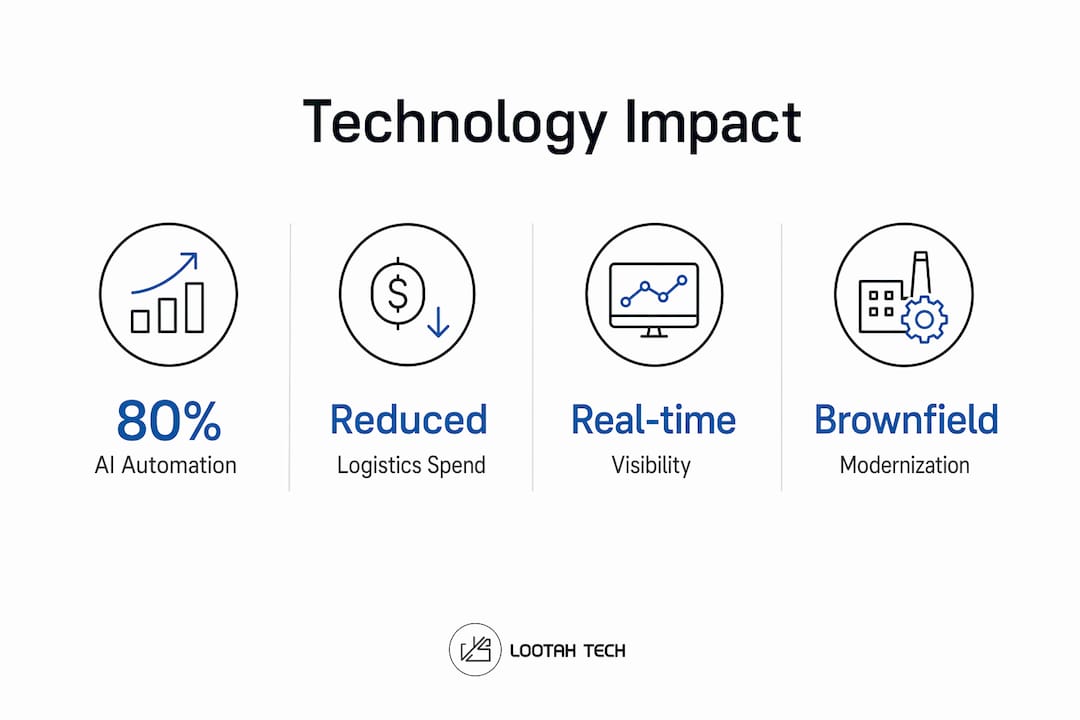
Advanced logistics technology delivers 10–25% reductions in annual logistics spend and inventory fill rates above 98%. Those numbers reflect what happens when transportation management systems, warehouse management systems, and real-time visibility platforms share a single data layer instead of operating in silos.
The core technology categories driving these results are:
- Real-time transportation visibility platforms: These track shipments at the event level and trigger automated alerts or rerouting when exceptions occur. Supply chain visibility has evolved from passive monitoring into automated counter-measures executed before human intervention is needed.
- Transportation management systems (TMS): A modern TMS handles carrier selection, load optimization, and freight audit in one connected workflow.
- Warehouse management systems (WMS): WMS platforms direct labor, manage slotting, and coordinate robotic picking systems in real time.
- Digital twins: These virtual replicas of physical networks let logistics teams simulate disruption scenarios and test network changes without operational risk.
| Technology | Primary function | Key performance impact |
|---|---|---|
| Real-time visibility platform | Shipment tracking and exception alerts | Reduces dwell time and detention costs |
| Transportation management system | Carrier selection and load optimization | Cuts freight spend by 8–15% |
| Warehouse management system | Labor direction and inventory accuracy | Raises fill rates above 98% |
| Digital twin | Network simulation and scenario planning | Reduces disruption recovery time |
The table above reflects what integrated platforms deliver when they share data continuously. The performance gap between integrated and fragmented operations widens every year.
What is AI's practical impact on logistics decision-making?
AI has moved from pilot projects to production workflows in logistics. Only 13% of logistics providers have embedded AI into core operations, while 56% are still exploring or testing it. That gap represents a significant competitive window for organizations willing to move from testing to deployment.
The most concrete evidence of AI's value is in freight decision automation. Production-grade AI now automates up to 80% of routine freight decisions, shifting human roles toward exception management. That means your team stops manually selecting carriers for standard lanes and starts focusing on the 20% of decisions that require judgment.
The practical path from AI testing to embedded operations follows a clear sequence:
- Identify high-volume, low-variability decisions. Carrier selection on established lanes, appointment scheduling, and invoice matching are the best starting points. These decisions have clear rules and large data sets.
- Deploy AI with defined guardrails. Agentic AI systems execute decisions autonomously within set parameters. A system might auto-book a carrier if the rate is within 5% of the benchmark and capacity is confirmed.
- Build a human exception layer. Route all decisions outside the guardrails to a human reviewer. This keeps AI operating at speed while maintaining control.
- Measure and expand. Track automation rates, exception volumes, and cost outcomes. Use that data to widen the guardrails as confidence grows.
Pro Tip: Before deploying any AI tool, map the decision it will automate and define the exact conditions under which it should escalate to a human. Guardrails set before deployment prevent costly errors and build organizational trust faster than any pilot program.
AI adoption barriers are less about technical complexity or cost and more about unclear ROI and internal readiness. The organizations closing the gap fastest are those that define success metrics before deployment, not after.
What technology trends are reshaping logistics in 2026?
The logistics sector in 2026 is not chasing entirely new technologies. It is getting serious about deploying the ones already proven. Four trends define the current period.

Brownfield modernization over full resets. Warehouse investments in 2026 prioritize improving existing assets with layered software and robotics rather than building new facilities from scratch. This approach maximizes uptime and preserves capital. A distribution center that adds a warehouse execution system and autonomous mobile robots on top of its existing WMS can double throughput without a greenfield build.
Distributed fulfillment and local-for-local sourcing. Supply chain disruptions have pushed logistics networks toward regional redundancy. Companies are placing inventory closer to demand rather than centralizing it in mega-distribution centers. This reduces lead times and exposure to single-point failures.
Autonomous vehicles in constrained environments. Autonomous vehicle technology scales first in low-variability environments such as port drayage and warehouse shuttle runs, not on generalized public roads. Ports and large campuses are where autonomous deployment delivers real ROI today.
Energy constraints as a hidden bottleneck. Grid strain, electrification demands, and AI compute requirements are creating energy availability problems that logistics planners have not historically tracked. A large automated warehouse running AI inference workloads and electric material handling equipment draws significantly more power than its predecessor. Logistics teams need to add energy capacity to their site selection and network design criteria now.
| Trend | Maturity level | Primary benefit |
|---|---|---|
| Brownfield modernization | Mainstream | Capital efficiency, faster deployment |
| Distributed fulfillment | Growing | Resilience, shorter lead times |
| Autonomous vehicles (constrained) | Early production | Labor cost reduction in defined zones |
| Energy infrastructure planning | Emerging | Avoids future operational bottlenecks |
The trends that matter most are not the flashiest ones. Brownfield modernization and energy planning will determine operational performance far more than any single new technology announcement.
How can logistics professionals use technology for competitive advantage?
The role of logistics managers is changing. Modern logistics professionals must act as managers of resilience systems, balancing cost efficiency with the ability to recover quickly from disruptions. That requires a different relationship with technology than most teams currently have.
The practical steps that separate high-performing logistics teams from the rest are:
- Define ROI before selecting tools. Unclear ROI is the leading barrier to AI adoption in logistics. Before evaluating any platform, write down the specific metric you expect to move and by how much.
- Build internal capability alongside vendor relationships. Technology vendors provide tools. Your team needs to understand how those tools make decisions. Dependency without understanding creates fragility.
- Prioritize integration over features. A TMS that connects cleanly to your WMS and visibility platform outperforms a feature-rich system that operates in isolation.
- Treat digital transformation as an ongoing process. There is no finish line. The organizations winning in logistics today run continuous improvement cycles on their technology stack, not one-time implementations.
Pro Tip: Run a quarterly technology audit. List every system your team uses, identify the data each one produces, and check whether that data flows automatically to the next system in the process. Every manual data transfer you find is a cost and a risk.
AI has shifted from potential to proven value in logistics. Industry leaders who embed it into daily workflows now will have a compounding advantage over those who wait for the technology to mature further.
Key Takeaways
Technology integration, AI deployment, and resilience planning are the three forces defining logistics performance in 2026. Organizations that act on all three simultaneously will outperform those treating them as separate initiatives.
| Point | Details |
|---|---|
| Integration drives measurable results | Connected platforms reduce logistics spend by 10–25% and push fill rates above 98%. |
| AI automates the majority of routine decisions | Production-grade AI handles up to 80% of freight decisions, freeing teams for exception management. |
| Brownfield modernization beats full resets | Layering software and robotics on existing assets delivers faster ROI than new builds. |
| ROI clarity unlocks AI adoption | Define the metric you expect to move before selecting any AI tool or platform. |
| Energy is the next logistics constraint | Grid capacity and power availability must enter site selection and network design criteria now. |
What I've learned watching logistics technology actually get deployed
Most articles on logistics technology read like vendor brochures. They list capabilities without acknowledging the gap between what a platform promises and what an organization can actually absorb. I've watched that gap cause more failed implementations than any technical limitation.
The AI adoption numbers tell the real story. Only 13% of providers have embedded AI into core operations. That is not because the technology is immature. It is because most organizations underestimate the internal work required before any tool can deliver value. Data quality, process documentation, and change management are unglamorous. They are also the actual determinants of success.
The trend I find most underreported is energy. Logistics teams are adding electric forklifts, autonomous robots, and AI inference workloads to facilities that were designed for a fraction of that power draw. The grid constraints are real and they are arriving faster than most network design processes account for. The teams that add energy capacity to their site selection criteria today will avoid expensive surprises in 18 months.
My honest advice to logistics managers: stop waiting for the perfect platform and start with the decision you make most often. Automate that one decision well, measure the outcome, and build from there. The organizations I've seen succeed with AI in business did not deploy everything at once. They picked one high-volume, low-variability process and made it work before expanding.
Technology fluency is now a core competency for logistics leaders, not a nice-to-have. The managers who understand how their systems make decisions will outperform those who treat technology as a black box, regardless of which platform they choose.
— YS
Yslootahtech's approach to logistics technology adoption
Logistics operations run on data, decisions, and speed. Yslootahtech builds the technology infrastructure that makes all three work together.
Yslootahtech's AI and machine learning services are designed for organizations that need to move from AI testing to embedded operations. The team brings experience across custom software development, enterprise platform integration, and AI-driven workflow automation. Whether you need a connected visibility layer, a decision-automation system, or a full digital transformation roadmap, Yslootahtech provides the technical depth and ongoing support to make it operational. Dubai-based and globally capable, the team works with logistics and supply chain organizations that need technology built for their specific operational reality, not a generic off-the-shelf solution.
FAQ
What is the role of technology in logistics?
Technology automates decisions, creates real-time visibility, and connects transportation, warehouse, and inventory systems into a single operational layer. Organizations using integrated logistics technology report 10–25% reductions in logistics spend and fill rates above 98%.
How does AI improve logistics operations?
Production-grade AI automates up to 80% of routine freight decisions, including carrier selection, load optimization, and appointment scheduling. Human teams shift to managing exceptions rather than executing standard transactions.
What are the biggest barriers to AI adoption in logistics?
Unclear ROI and internal capability gaps are the primary barriers, not technical complexity or cost. Organizations that define success metrics before deployment close the adoption gap faster than those that evaluate tools first.
What does brownfield modernization mean in logistics?
Brownfield modernization means improving existing warehouse assets with layered software and robotics rather than building new facilities. This approach delivers faster deployment, lower capital requirements, and minimal disruption to ongoing operations.
Why is energy becoming a logistics challenge?
Grid strain, electrification of material handling equipment, and AI compute demands are increasing power requirements at logistics facilities. Energy availability is emerging as a site selection and network design factor that logistics planners must account for now.