The Role of IoT in Digital Transformation: 2026 Guide

IoT sits at the center of every serious digital transformation effort today. The network of physical devices, sensors, and connected systems that make up the Internet of Things does not just collect data. It rewires how businesses operate, make decisions, and create value. McKinsey estimates that IoT generated $1.6 trillion in economic value by 2020, yet capturing that value at scale remains the central challenge for most enterprises.
How IoT drives digital transformation across your business
IoT functions as both a microcosm and an enabler of digital transformation. That framing, developed by Georgia Tech's CDAIT research group, captures something most technology roadmaps miss: an IoT deployment is not a technology project sitting alongside your transformation. It is a transformation project, with all the organizational complexity that implies.
The core contributions IoT makes to transformation are:
- Real-time data collection from physical environments, assets, and processes
- Workflow automation triggered by sensor data without human intervention
- Predictive analytics that shift operations from reactive to anticipatory
- Ecosystem connectivity linking machines, systems, and people across the value chain
- Customer experience improvements through connected products and personalized services
- New business model creation built on data-as-a-service and outcome-based pricing
When these capabilities work together, the result is not incremental improvement. It is a fundamentally different operating model.
What digital transformation really means, and which IoT technologies power it
Digital transformation is the long-term process of rewiring how an organization operates by embedding digital technology across people, processes, and culture. McKinsey describes it as a continuous effort, not a project with an end date. Most executives will be on this journey for the rest of their careers. The goal is pervasive digital change that creates value across three vectors: cost reduction, revenue growth, and experience improvement.
IoT is distinct from digital transformation but tightly linked to it. Think of IoT as the sensory layer that feeds the broader transformation. Without connected devices generating real-world data, most digital transformation strategies are working with incomplete information.
The IoT technologies that matter most for business transformation include:
- Sensors and actuators: temperature, pressure, motion, and environmental sensors that capture physical-world data
- Connectivity networks: cellular (including 5G), Wi-Fi, Bluetooth, LPWAN protocols like LoRaWAN
- Edge computing: processing data close to the source to reduce latency and bandwidth costs
- Cloud platforms: centralized storage, analytics, and application hosting at scale
- AI and machine learning: pattern recognition and predictive modeling applied to IoT data streams
- Integration middleware: APIs and platforms that connect IoT data to ERP, CRM, and other enterprise systems
The IoT and big data combination is particularly powerful because it shifts business processes from physical-product focus to data-based services. That shift is what separates companies doing IoT pilots from companies actually transforming.
How IoT enables transformation in practice, with real examples
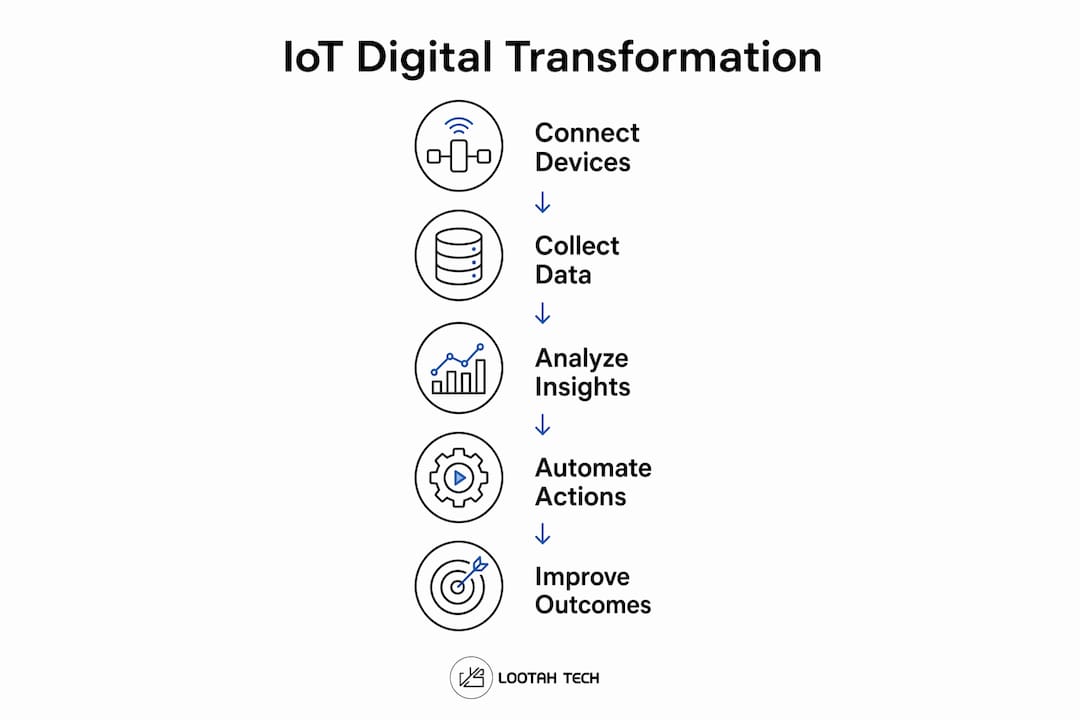
The mechanisms through which IoT drives change are concrete and well-documented across industries.
Predictive maintenance in manufacturing is the clearest example. Traditional industrial automation runs on rigid, hierarchical systems where each layer has predefined functions. IoT breaks that structure by enabling real-time monitoring across the full production floor. Sensors detect anomalies in equipment behavior before failure occurs, allowing maintenance teams to act on data rather than schedules. The result is reduced downtime and lower maintenance costs.

Smart supply chains use IoT to track inventory, shipments, and environmental conditions in real time. A cold-chain logistics company can monitor temperature inside every refrigerated truck and trigger an alert the moment conditions drift outside acceptable ranges. That capability alone can prevent product loss worth millions annually.
Connected healthcare is another area where IoT's role is reshaping core processes. Wearable devices and remote monitoring systems give clinicians continuous visibility into patient health outside hospital walls. Telemedicine platforms built on IoT data streams are improving medical decisions and expanding access to care, particularly in rural markets.

Smart buildings and cities use embedded sensors to manage energy, lighting, traffic, and security. Sensor-based systems in transportation networks optimize traffic flow, alert drivers to parking availability, and report road anomalies automatically.
Key IoT-driven transformation capabilities across sectors:
- Continuous asset monitoring and anomaly detection
- Automated inventory replenishment triggered by real-time stock levels
- Remote equipment diagnostics and over-the-air updates
- Energy consumption tracking and automated reduction
- Patient health monitoring outside clinical settings
- Route optimization and fleet management
A practical sequence for deploying these capabilities:
- Identify the highest-value operational pain point where real-time data would change decisions
- Deploy sensors and connectivity infrastructure for that specific use case
- Connect IoT data to existing enterprise systems via APIs
- Build analytics and alerting on top of the data stream
- Automate responses where the decision logic is clear and repeatable
- Measure business outcomes, not just technical metrics
- Scale to adjacent use cases once the first deployment proves its value
What your business actually gains from IoT-enabled transformation
The benefits of integrating IoT into digital transformation strategies are tangible, not theoretical.
Operational efficiency improves because IoT eliminates the lag between an event occurring and a human noticing it. Manufacturing facilities using IoT-enabled ERP integration have reduced both operational costs and decision-making time, according to case studies from Malaysia cited in peer-reviewed research on IoT in business decision-making.
Data-driven decision-making gets sharper. IoT, combined with AI and big data analytics, transforms how businesses decide by enabling predictive and adaptive strategies rather than relying on static historical data. A retailer with IoT-connected shelves knows exactly when stock is running low and can trigger reorders automatically, rather than waiting for a weekly inventory count.
Customer experience improves when products become connected services. A manufacturer that ships IoT-enabled equipment can offer outcome-based contracts, monitoring performance remotely and guaranteeing uptime rather than just selling hardware.
New revenue streams open up. IoT data itself becomes a product. Insurers use telematics data from connected vehicles to price policies based on actual driving behavior. Utilities use smart meter data to offer demand-response programs that pay customers to reduce consumption at peak times.
Sustainability performance becomes measurable and manageable. IoT sensors tracking energy use, emissions, and waste give organizations the data they need to meet ESG commitments with evidence rather than estimates.
- Reduced unplanned downtime through predictive maintenance
- Lower energy costs via automated building and equipment management
- Faster response to supply chain disruptions
- Stronger customer retention through connected product experiences
- Measurable ESG progress backed by real sensor data
Pro Tip: When calculating IoT ROI, include the value of decisions you no longer have to make manually. Automated alerts and responses free up skilled workers for higher-value tasks, and that labor reallocation often exceeds the direct cost savings from efficiency gains. AI integration can amplify this further, as explored in research on AI-driven productivity.
The real challenges blocking IoT adoption at scale
The obstacles to IoT-driven transformation are mostly organizational, not technical. McKinsey's research is direct on this: change management, cost, talent, and cybersecurity have held back the IoT market more than any technology limitation. Operational factors are what separate companies that capture IoT value from those stuck in pilot mode.
Pilot purgatory is the most common failure mode. Organizations launch a proof-of-concept, get promising results, and then cannot scale it. The reason is almost always that the pilot was treated as a technology experiment rather than a business transformation. Scaling IoT requires redesigning workflows, governance, and performance management, not just expanding the sensor network.
Interoperability is a persistent technical headache. The IoT market is dominated by fragmented, proprietary vendor ecosystems. A solution that works beautifully within one vendor's platform often cannot communicate with another vendor's devices. Fragmented ecosystems drive up maintenance costs and limit the ability to integrate use cases over time.
Security and privacy risks grow with every connected device added to a network. Each sensor is a potential entry point for attackers. IoT data markets face challenges around anonymization and secure computation, and the risk of unethical use of behavioral data from worker monitoring is real and documented.
Change management is where most projects underestimate the work required. Workers whose jobs change because of IoT monitoring often resist the technology, particularly when increased visibility feels like surveillance rather than support. Proactive leadership that addresses both management and worker perspectives is not optional.
Key challenges to plan for:
- Interoperability gaps between vendor ecosystems
- Cybersecurity vulnerabilities across device networks
- Organizational resistance to new monitoring and automation
- High upfront infrastructure and integration costs
- Talent gaps in IoT architecture, data engineering, and analytics
- Data privacy compliance across jurisdictions
Strategic best practices for IoT-enabled digital transformation
The organizations that capture real value from IoT share a few consistent practices. None of them are primarily technical.
Anchor every deployment in a business outcome. The Georgia Tech CDAIT framework is clear: successful IoT projects start with the desired business result and work backward to the technology. Starting with the technology and hoping a use case emerges is how pilots die.
Redesign the operating model, not just the infrastructure. IoT changes what information is available and when. If the workflows and decision processes do not change to use that information, the sensors are just generating data nobody acts on. McKinsey's recommendation is to change the entire organization, not just the IT function.
Require interoperability in vendor contracts. Specifying interoperability as a buying criterion forces vendors to build for integration rather than lock-in. It is one of the highest-leverage procurement decisions an enterprise can make, and most organizations skip it entirely.
Treat change management as a co-equal investment. Balanced investment in technology and change management is critical for transformation success. Experts recommend at least equal spending on process redesign and user training alongside technology development.
Deploy multiple use cases simultaneously. Running several IoT use cases in parallel forces the operating model changes that a single pilot never triggers. It also surfaces integration challenges early, when they are cheaper to fix.
Build cybersecurity in from the hardware layer. Starting security at the device level and working up through the network and application stack is far more effective than retrofitting security onto a deployed system.
Key practices for sustained IoT transformation success:
- Define measurable business outcomes before selecting technology
- Assign cross-functional ownership, not just IT ownership
- Prioritize use cases by business impact and time-to-value
- Build interoperability requirements into every vendor contract
- Track value realization continuously and adjust the strategy when results diverge from targets
- Invest in IoT-specific talent or partner with specialists who have it
Pro Tip: Avoid the trap of treating IoT as an IT-only initiative. The digital transformation for CIOs framing is useful here: the chief information officer improves internal operations, but capturing IoT value at scale requires the CFO tracking business outcomes, the CHRO managing talent and change, and the chief risk officer governing data privacy and security. No single function owns this.
Key Takeaways
IoT drives digital transformation by connecting physical operations to data-driven decision-making, but capturing that value requires operating model redesign, not just technology deployment.
| Point | Details |
|---|---|
| IoT as transformation, not a tech project | IoT deployments are digital transformation projects and must be treated as such to achieve business benefits at scale. |
| $1.6 trillion in captured value | IoT had generated substantial economic value by 2020, yet most enterprises still struggle to scale beyond pilots. |
| Operational factors block scale | Change management, cost, talent, and cybersecurity hold back IoT value capture more than any technology limitation. |
| Interoperability is a procurement decision | Specifying interoperability in vendor contracts prevents ecosystem fragmentation and reduces long-term maintenance costs. |
| Outcomes first, technology second | Successful IoT transformation anchors every deployment in a defined business outcome and redesigns workflows to act on the data. |
How Yslootahtech can accelerate your IoT transformation
Yslootahtech works with enterprises across industries to design and deploy IoT-enabled digital transformation programs that go beyond pilots. From custom IoT application development and cloud integration to AI-powered analytics and cybersecurity architecture, the team brings end-to-end capability to every engagement. If your organization is ready to move from proof-of-concept to production-scale transformation, Yslootahtech's AI and machine learning services provide the analytical layer that turns IoT data into decisions. Reach out to discuss where IoT fits in your digital strategy.