Robotics in Industry: 10 Real-World Examples That Deliver ROI
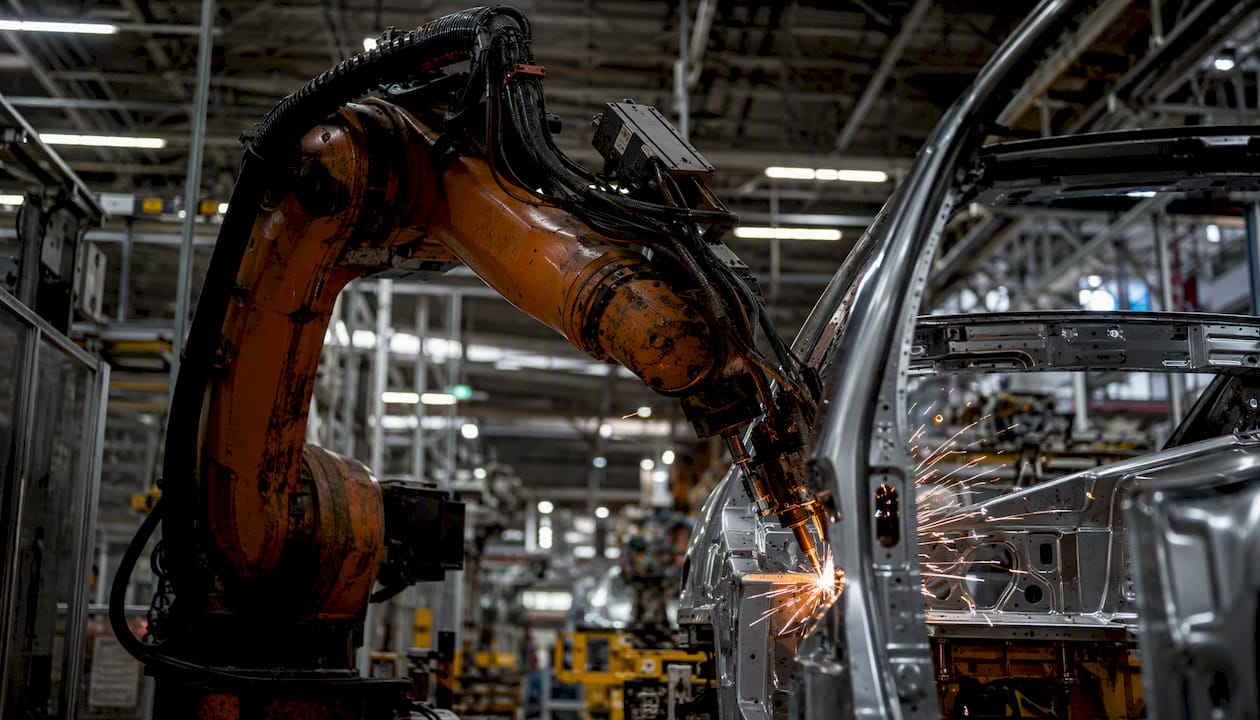
Industrial robots automate repetitive, precise, and hazardous tasks across virtually every manufacturing sector — from automotive welding cells running 24/7 to pharmaceutical labs where cobots handle sterile sample prep without human contact. The International Federation of Robotics (IFR) tracks over 3.9 million industrial robots currently operating worldwide, with deployments spanning automotive, electronics, food processing, logistics, and agriculture. Vendors like Universal Robots and ABB serve the cobot and full-scale automation markets respectively, while companies like Yslootahtech help organizations scope, integrate, and deploy these systems end-to-end.
Here is what this article covers:
- Core task patterns where robots consistently outperform manual processes: welding, pick-and-place, machine tending, inspection, and mobile transport
- Robot types you will encounter in specs and vendor proposals: articulated, SCARA, delta, AMR/AGV, and cobots
- 10 industry-specific examples with robot types, measurable outcomes, and US-relevance notes
- End-effectors and sensors that determine whether a robot can actually do the job
- ROI signals, implementation timelines, and the most common integration traps
- Near-term trends in AI-powered vision, mobile autonomy, and collaborative systems
Key Takeaways
Industrial robots deliver the clearest ROI on tasks that are repetitive, precise, or hazardous — and the fastest paybacks come from cobots on high-volume lines where cycle time and quality data are already tracked.
| Point | Details |
|---|---|
| Match robot type to task first | Articulated arms for welding and painting; delta for high-speed pick-and-place; cobots for flexible, human-adjacent assembly. |
| Cobot payback runs 10–14 months | Documented at thyssenkrupp Bilstein's Ohio facility using UR10 cobots for machine tending and inspection. |
| Pilot with two KPIs, not ten | Measure cycle time and first-pass yield in weeks 1–8; add metrics only after the baseline is clean. |
| EOAT and integration are the real cost | Budget 20–30% of robot purchase price for end-of-arm tooling, sensor calibration, and PLC/MES connectivity. |
| Yslootahtech for pilot-to-production | Yslootahtech provides AI vision, systems integration, and project delivery to close the gap between proof-of-concept and production sign-off. |
Table of Contents
- What types of industrial robots are there, and where does each fit?
- Which cross-industry task patterns give robots the clearest advantage?
- Robotics in industry examples: 10 sectors with concrete use cases
- What end-effectors and sensors does a robot actually need to do the job?
- How do you measure ROI and run a successful robotics pilot?
- What trends are reshaping industrial robotics right now?
- When robotics makes sense and when to pause
- Yslootahtech helps you move from pilot to production
- Sources
What types of industrial robots are there, and where does each fit?
Industrial robots are programmable machines capable of movement on three or more axes. The type you choose shapes everything downstream — payload, reach, cycle time, and integration cost.
- Articulated (6-axis): The workhorse of heavy manufacturing. Six rotational joints give it near-human range of motion. Typical tasks: arc and spot welding, painting, complex assembly, machine tending. Payload ranges from 3 kg to over 1,000 kg.
- SCARA (Selective Compliance Articulated Robot Arm): Fast lateral movement with rigid vertical compliance. Ideal for horizontal assembly, screw driving, and circuit board insertion. Payload typically 1–20 kg.
- Delta (parallel): Three arms connected to a common base, optimized for speed. The go-to for high-speed pick-and-place in food packaging and electronics. Cycle times under one second are common.
- Cartesian/gantry: Linear X-Y-Z motion on overhead rails. Used in large-format CNC tending, palletizing, and dispensing where the work envelope is rectangular and predictable.
- Cylindrical: Rotational base plus a linear arm. Less common today but still found in older machine tending and simple assembly cells.
- Cobots (collaborative robots): Designed to work alongside people without heavy safety fencing. Force-limiting sensors stop motion on contact. Brands like Universal Robots, FANUC's CRX series, and KUKA's LBR iisy lead this segment. Payload typically 3–20 kg.
- AGVs/AMRs (Automated Guided Vehicles / Autonomous Mobile Robots): Floor-level transport. AGVs follow fixed magnetic or optical paths; AMRs navigate dynamically using lidar and SLAM. Both move materials between workstations, storage, and shipping docks.
Each type has a sweet spot. Trying to use a SCARA for heavy welding or a delta for floor transport is a fast path to a failed pilot.
Which cross-industry task patterns give robots the clearest advantage?
Yaskawa Motoman frames the selection logic simply: robots earn their place on tasks that are Dirty, Dull, or Dangerous — the "Three D's." That heuristic holds up across sectors, but the specific application patterns matter more than the label.
- Spot and arc welding: Articulated robots with welding torches deliver consistent bead quality at speeds no human welder can sustain for eight hours. Cycle time and spatter reduction are the primary KPIs.
- Painting and surface finishing: Robots apply coatings with uniform thickness and zero overspray variation. Articulated arms with spray guns dominate automotive paint booths; the enclosed environment also removes workers from solvent exposure.
- Precision assembly: SCARA and small articulated robots handle sub-millimeter component placement. Electronics and medical device manufacturing rely on this heavily.
- Pick-and-place: Delta robots at high speed or cobots at moderate speed, depending on fragility. Vision-guided variants handle random bin orientation.
- Palletizing and packaging: Articulated or Cartesian robots stack cases, bags, or trays at end-of-line. Throughput and consistent stack geometry are the measurable wins.
- Machine tending: A robot loads and unloads CNC machines, injection molders, or stamping presses. The machine runs lights-out; the robot never fatigues or misloads.
- Inspection and vision-guided QA: 2D and 3D cameras mounted on robot arms or fixed above conveyors catch dimensional defects, surface flaws, and missing components. Cobots with vision systems can achieve 100% inspection coverage where human sampling misses defects.
- Kitting and order fulfillment: AMRs carry bins to pick stations; robotic arms or cobots pick items into kits. Warehousing and e-commerce distribution centers run this pattern at scale.
- Deburring and surface treatment: Articulated robots with force/torque sensors follow complex part contours to remove burrs consistently — a task that causes repetitive strain injuries in manual operations.
- Clinical and lab automation: Cobots handle pipetting, sample transfer, and centrifuge loading in pharmaceutical and diagnostic labs, reducing contamination risk and freeing technicians for higher-value work.
Where automation struggles: highly variable or fragile parts with no consistent geometry, extremely low-volume custom work where fixturing costs exceed the labor savings, and legacy lines where the mechanical infrastructure cannot support robot integration without major rework.
Robotics in industry examples: 10 sectors with concrete use cases
These are not hypothetical deployments. Each example reflects real robot types, documented outcomes, and conditions you are likely to encounter in US manufacturing and operations.
1. Automotive manufacturing
Automotive accounts for the largest share of industrial robot installations globally, per the IFR World Robotics 2024 Executive Summary. Three applications define the sector:
Spot welding cells use articulated robots — typically FANUC, KUKA, or ABB — to join body panels at hundreds of weld points per vehicle. A single cell runs continuously with sub-second cycle times per weld.
Paint booths deploy articulated arms with spray guns in enclosed, solvent-heavy environments. Robots apply primer, base coat, and clear coat with film thickness tolerances measured in microns.
Mobile heavy-load handling is where the next generation is emerging. Renault Group developed Calvin, a mobile robot using physical AI, IMUs, force sensors, and RGBD cameras to lift approximately 30 kg per grip and adapt to changing tasks on the production line. Calvin is designed to improve operator ergonomics on high-mix lines where a fixed robot arm would require constant reprogramming.
2. Automotive subcontractors and Tier 1 suppliers
Tier 1 suppliers run their own automation programs, often with cobots rather than full industrial cells. Vitesco Technologies deployed Universal Robots cobots for assembly tasks, reducing cycle times and improving ergonomics from the line, per the Vitesco case story.
At thyssenkrupp Bilstein's Ohio facility, UR10 cobots handle machine tending, assembly, and inspection. Payback periods for cobot deployments in this class typically run 10–14 months. No heavy safety fencing required — the cobots share floor space with operators.
3. Electronics and semiconductors
Delta and SCARA robots are common in electronics manufacturing, achieving fast and precise pick-and-place cycles. Cleanroom-rated articulated arms handle wafer transfer in semiconductor fabs, where contamination from a human hand would destroy a $10,000+ wafer.
Precision soldering robots use vision systems to locate pad positions and apply solder with consistent dwell time and temperature — two variables that human operators struggle to hold constant across a full shift.
4. Warehousing and logistics
AMRs have reshaped distribution center economics. Rather than conveyor-based fixed automation, AMRs navigate dynamically around workers and obstacles, carrying goods-to-person pods or tote bins to pick stations. The role of technology in logistics has shifted from conveyor infrastructure to software-driven fleets.
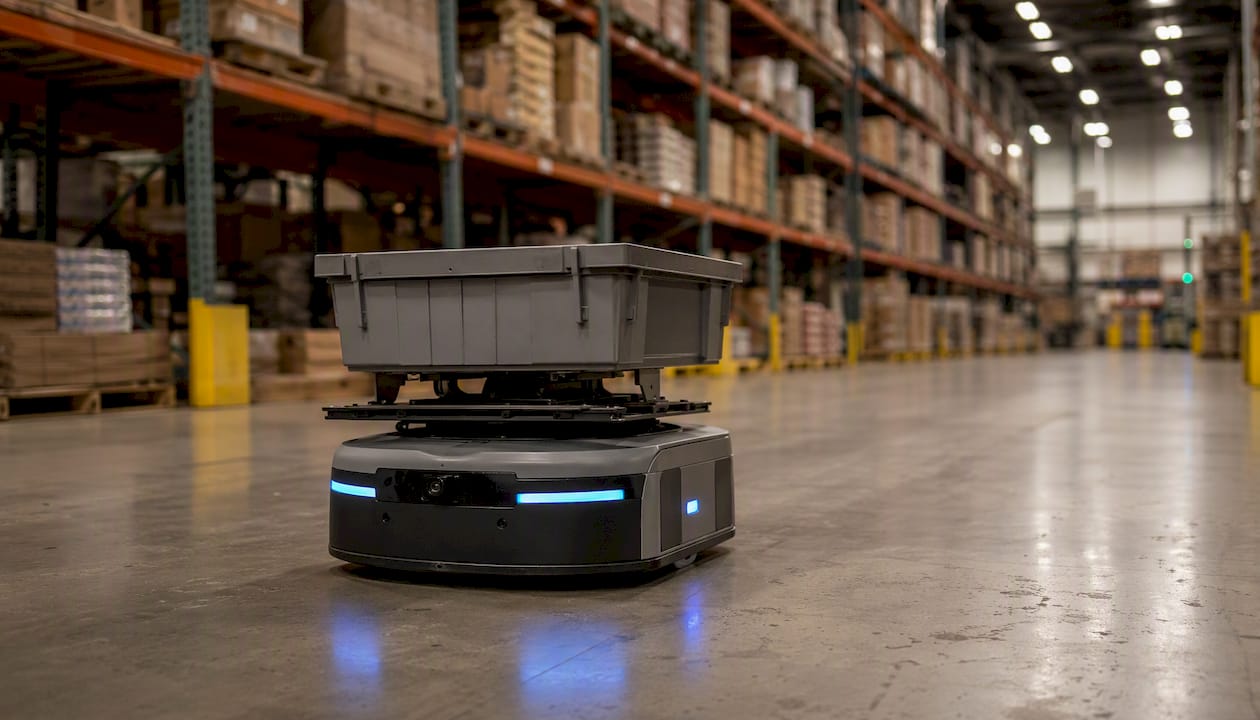
Robotic palletizing at end-of-line replaces one of the most injury-prone manual tasks in warehousing. An articulated robot with a vacuum or mechanical gripper stacks mixed-SKU cases at rates exceeding 20 cycles per minute, with consistent layer patterns that reduce shipping damage.
5. Food and beverage / CPG
Sanitary design requirements and product variability make food automation harder than automotive. Delta robots with food-grade vacuum grippers handle high-speed portioning and packaging of uniform items — chocolate bars, baked goods, frozen patties. Cobots with soft grippers manage more delicate products like fresh produce or pastries where a rigid gripper would cause bruising.
Palletizing at the end of beverage lines is one of the highest-ROI applications in food manufacturing. A single articulated robot replaces two to three manual palletizers per shift while eliminating the back injuries that make that role one of the highest workers' comp cost centers in the plant.
The MDPI Applied Sciences review notes that food and agriculture remain adoption gaps precisely because of the variability challenge — irregular shapes, fragile surfaces, and wet environments push the limits of current gripper and vision technology.
6. Pharmaceuticals and clinical labs
Sterile handling is where cobots earn their place in pharma. A cobot loading vials into a filling line operates inside an ISO 5 cleanroom enclosure, eliminating the gowning burden and contamination risk of a human operator. Vision-guided inspection robots check fill levels, cap seating, and label placement at 100% coverage — something statistical sampling cannot match.
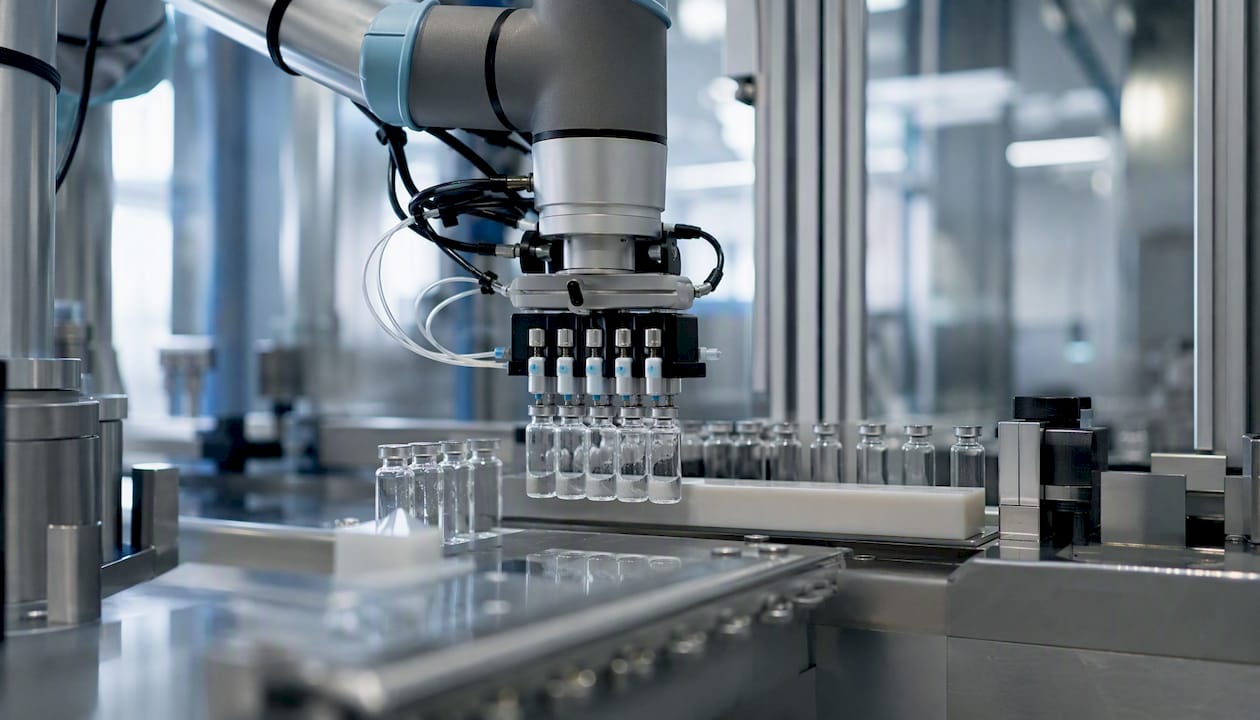
In clinical diagnostics labs, cobots handle pipetting, centrifuge loading, and sample tube sorting. The measurable outcome is throughput per technician-hour, not just cycle time. Labs running 24/7 testing schedules see the biggest gains.
7. Agriculture
Autonomous tractors from manufacturers like John Deere use GPS, lidar, and computer vision to execute field operations — planting, spraying, and harvesting — with centimeter-level accuracy. The labor savings are significant in regions where seasonal agricultural labor is scarce.
Fruit-picking cobots are still maturing. Soft gripper prototypes can harvest strawberries and apples without bruising, but cycle times remain slower than skilled human pickers in unstructured orchard environments. The MDPI review identifies improved AI-based perception and robot-oriented crop design as the two levers most likely to close that gap.
8. Construction and heavy industry
Robotic welding on structural steel fabrication lines mirrors automotive welding cells — articulated arms with welding torches, vision systems for seam tracking, and consistent bead quality that passes X-ray inspection. Prefabrication shops run these cells with minimal staffing.
3D concrete printing using gantry robots is moving from prototype to production for modular housing components. The robot extrudes concrete layer by layer from a CAD file, eliminating formwork and reducing material waste. Several US construction firms are piloting this for wall panels and utility structures.
9. Metal and machinery manufacturing
CNC machine tending is the entry point for most metal shops considering robotics. A cobot or small articulated robot loads raw stock, closes the door, and unloads finished parts — freeing the machinist to run multiple machines simultaneously. Automation's effect on asset value is measurable: a tended CNC machine running lights-out adds utilization hours that directly affect the asset's productive capacity and resale profile.
Deburring robots with force/torque sensors follow complex part contours on castings and forgings. The sensor feedback lets the robot maintain consistent contact force even when part dimensions vary within tolerance — something a rigid programmed path cannot do. For shops evaluating CNC and metalworking assets, understanding which machines are automation-ready shapes both retrofit and acquisition decisions.
10. Pharmaceutical and medical device assembly
Medical device assembly combines the precision demands of electronics with the sterility requirements of pharma. SCARA robots assemble catheter components, syringe barrels, and implant subassemblies under vision guidance. The traceability requirement — every assembly step logged and linked to a serial number — drives integration with MES and ERP systems, which is where the integration complexity actually lives, not in the robot itself.
What end-effectors and sensors does a robot actually need to do the job?
The robot arm is the easy part. The end-of-arm tooling (EOAT) and sensor stack determine whether the system works in production.
Common end-effectors and their tasks:
- Mechanical grippers (parallel jaw, three-finger): Rigid parts with consistent geometry — machined components, boxes, metal stampings.
- Vacuum grippers (single cup, multi-cup arrays): Flat or slightly curved surfaces — PCBs, cardboard cases, glass panels. Fast and simple; fails on porous or wet surfaces.
- Adaptive/soft grippers: Irregular or fragile objects — fresh produce, pastries, consumer goods. Slower cycle times but far more flexible.
- Magnetic grippers: Ferrous metal parts in stamping and sheet metal handling.
- Welding torches: Spot or arc welding; matched to the robot's payload and the wire/gas delivery system.
- Spray guns: Painting and coating; require precise flow control and path programming to avoid runs and thin spots.
Sensors and perception:
- 2D cameras: Label inspection, barcode reading, basic position correction. Low cost, high speed.
- 3D/RGBD cameras: Bin picking, complex assembly guidance, surface inspection. Adds depth data that 2D misses.
- Lidar: AMR navigation and obstacle avoidance. Also used for large-part dimensional inspection.
- Force/torque sensors: Deburring, assembly insertion, and any task where contact force matters. Renault's Calvin uses these alongside IMUs for compliant heavy-load handling.
- IMUs (inertial measurement units): Mobile robots and dynamic load handling — tracking orientation and acceleration in real time.
Pro Tip: The hidden cost in most robot projects is not the arm — it is EOAT design, changeover tooling, and sensor calibration. Budget 20–30% of the robot's purchase price for end-of-arm tooling and integration, and plan for at least one design iteration before production sign-off.
Off-the-shelf EOAT from suppliers like Schunk, Piab, or OnRobot covers the majority of standard tasks. Custom tooling is justified only when part geometry or process requirements genuinely cannot be met by catalog options — and that decision should be made after testing, not during the proposal stage.
How do you measure ROI and run a successful robotics pilot?
The business case for industrial robotics applications rests on a handful of KPIs that are measurable before and after deployment. Tracking the right ones from day one prevents the common failure mode: a technically successful robot that no one can prove paid off.
- Cycle time reduction: Baseline the manual or legacy cycle time per unit before the pilot. Post-deployment, measure robot cycle time under production conditions, not demo conditions.
- First-pass yield: Defect rate before and after. Vision-guided inspection cobots at Vitesco Technologies and thyssenkrupp Bilstein achieved measurable quality improvements alongside cycle time gains.
- Labor-hours saved per shift: Not headcount reduction — labor-hours redirected to higher-value tasks. This is the metric that gets workforce buy-in.
- Uptime and OEE (Overall Equipment Effectiveness): A robot running lights-out adds utilization hours. Track planned vs. actual uptime from week one.
- Ergonomic injury rate: For tasks involving repetitive motion, heavy lifting, or awkward postures, track near-misses and recordable incidents. The OSHA cost of a single back injury often exceeds the robot's annual lease cost.
Rollout sequence that works:
- Pilot (weeks 1–8): Isolate one task, one cell, one shift. Use off-the-shelf EOAT. Measure two KPIs only. The goal is not perfection — it is a clean data set that proves or disproves the business case.
- Scale (months 3–6): Replicate the validated cell. Add vision or sensor upgrades identified during the pilot. Begin workforce training on robot operation and basic maintenance.
- Sustain (ongoing): Establish KPI ownership, a safety review cadence aligned with ISO/TC 299 standards, and a change control process for any modification to the robot's task or tooling.
Red flags to address before you start:
- Inconsistent input parts (dimensional variation beyond the robot's tolerance) will cause more rejects than the baseline.
- Legacy PLCs without modern communication protocols add integration time and cost. Budget for a gateway or PLC upgrade.
- Safety fencing vs. cobots: cobots remove the fencing requirement but introduce a payload and speed ceiling. If the task needs more than 20 kg or very fast cycle times, a traditional guarded cell is likely the right answer.
- Workforce reskilling is not optional. Operators who understand the robot's logic catch faults faster and reduce downtime. Plan for it from day one, not after go-live.
Pro Tip: Run the pilot with the actual operators who will own the cell long-term. Their observations during the pilot catch integration issues that engineers miss — and their ownership of the outcome is what sustains performance after launch.
For a structured framework on evaluating automation ROI and decision criteria, the considerations map directly onto the pilot-to-scale sequence above.
What trends are reshaping industrial robotics right now?
The IFR and the MDPI review both point to the same near-term inflection points. Here is where the market is moving and what it means for your next capital decision.
Trend signals:
- Cobots and Industry 5.0: Collaborative robots are growing faster than the overall market. The shift is from robots replacing humans to robots working alongside them — with the human providing judgment and the robot providing consistency and endurance.
- AI-powered vision and bin picking: Deep learning models now handle random bin orientation for a much wider range of part geometries than rule-based vision systems could. Real-world AI applications in vision-guided pick-and-place are moving from pilot to production in electronics and logistics.
- AMR fleet orchestration: Single AMRs are giving way to coordinated fleets managed by software platforms that integrate with WMS and MES. The hardware is commoditizing; the software layer is where differentiation lives.
- Sensor fusion: Combining lidar, RGBD cameras, force/torque, and IMUs — as Renault's Calvin does — enables robots to operate in less structured environments. This is the technical foundation for agriculture, construction, and field service robotics.
- Soft grippers for food and delicate goods: Pneumatic and tendon-driven soft grippers are closing the gap on cycle time while handling fragile products that rigid grippers damage. Adoption in food and pharma is accelerating as hygienic designs become available.
| Trend | Primary sectors | Maturity level | Near-term priority |
|---|---|---|---|
| Cobot adoption | All manufacturing, Tier 1 suppliers | Production-ready | High — start now |
| AI vision / bin picking | Electronics, logistics, automotive | Production-ready | High for high-mix lines |
| AMR fleet management | Warehousing, distribution, pharma | Production-ready | High for large facilities |
| Soft grippers | Food, pharma, agriculture | Early production | Medium — pilot in 2026 |
| 3D concrete printing | Construction, modular building | Pilot/early scale | Low unless in prefab |
| Sensor fusion / mobile AI | Automotive, agriculture, construction | Emerging | Long-term roadmap |
The World Robotics interactive database lets you benchmark robot density by country and sector — useful when making the case internally that your industry peers are already ahead.
For short-term pilots, cobots and AI vision are the clearest bets: production-ready technology, available from multiple vendors, with documented ROI in the 10–14 month range. AMR fleet investments make sense once you have a facility large enough that the software orchestration layer pays for itself. Soft grippers and sensor fusion are worth tracking and prototyping now, but budget them as R&D, not production capex.
When robotics makes sense and when to pause
The strongest argument for robotics is not the technology — it is the task. Every deployment that has gone sideways shares a common root cause: the organization automated a process before it understood that process well enough to define what "correct" looks like. A robot will execute a poorly defined task with perfect consistency, which means it will produce defects at scale rather than at the rate of one distracted human.
The practitioners who get the best results start with a task audit, not a vendor demo. They map cycle times, defect rates, and injury records for every candidate task before a robot enters the conversation. That data tells you which tasks are genuinely worth automating and which ones look attractive until you see the fixturing cost or the part variation.
Scale matters too. A single cobot on a 500-unit-per-month line rarely pays back in under two years. The same cobot on a 5,000-unit-per-month line often pays back in under six months. The math is simple, but it gets skipped when the decision is driven by a trade show demo rather than a production analysis.
Organizational readiness is the third variable most teams underweight. A robot requires a maintenance owner, a safety review process, and an operator who understands the system well enough to restart it after a fault. If those roles are not assigned before go-live, the robot sits idle waiting for an engineer who is already overcommitted. The strategic role of automation in industry is not just about the machine — it is about the governance structure around it.
The right time to pause is when the task is not yet stable, the volume does not justify the fixturing investment, or the team does not have a clear owner for the system post-deployment. None of those are permanent blockers — they are sequencing problems. Fix the process, build the volume, assign the owner, then automate.
Yslootahtech helps you move from pilot to production
Most robotics projects stall between a successful proof-of-concept and a production-ready cell. The gap is almost never the robot itself — it is systems integration: connecting the robot to your MES, PLC, ERP, and quality systems so the data flows and the process is auditable.
Yslootahtech's engineering team covers the full integration stack: AI and machine vision for perception-guided tasks, custom software for robot orchestration and MES connectivity, and end-to-end project delivery from feasibility scoping through production sign-off. Whether you are evaluating a cobot pilot for a single cell or planning a multi-robot deployment across a production line, the starting point is a scoping assessment that maps your candidate tasks, estimates cycle-time gains, and identifies integration dependencies before you commit capital.
Visit the Yslootahtech robotics services page to request a scoping assessment, or explore the AI and machine learning capabilities that power vision-guided and adaptive robot systems. Contact the team directly to get a project timeline and indicative cost range for your specific application.
Sources
- Industrial Robots | International Federation of Robotics (IFR)
- Calvin, a new-generation robot is born — Renault Group
- Vitesco Technologies case story — Universal Robots
- Industrial Robot Applications | Yaskawa Motoman
- Advanced applications of robotic technologies in industrial fields — MDPI Applied Sciences
- Industrial robot — Wikipedia