What Is RAG Architecture and When Should You Use It?
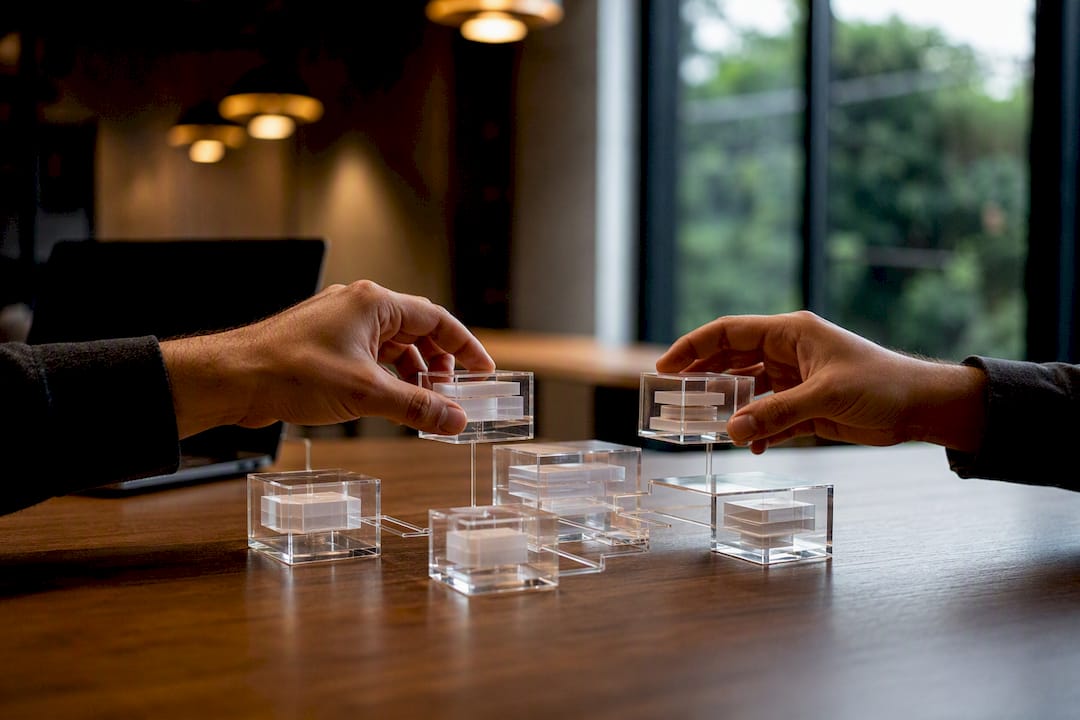
Retrieval-augmented generation (RAG) augments a large language model by retrieving external context at query time to ground and update its responses. Use RAG when your problem depends on fresh, private, or fast-changing information and you need traceability back to a source document. Skip it, or pair it with fine-tuning, when the task is about behavior (tone, format, a narrow skill) rather than knowledge.
The trade-off is straightforward once you see it stated plainly:
- Primary benefits: current information without retraining, source citations for verification, and lower hallucination rates on knowledge-heavy questions.
- Primary trade-offs: added latency from the retrieval step, infrastructure cost for vector stores and embedding pipelines, and quality that depends heavily on chunking and retrieval precision.
Pro Tip: If you're unsure whether your problem is a knowledge gap or a behavior gap, ask whether the answer changes next month. If yes, that's RAG territory.
Key Takeaways
RAG works because it separates what a model knows from what it can look up, letting fresh and private data ground answers without retraining the model itself.
| Point | Details |
|---|---|
| Match the tool to the problem | Use RAG for fast-changing or private knowledge; use fine-tuning for stable behavior; combine both for domain-specific accuracy gains. |
| Chunking decides recall | Paragraph-aware splitting with overlap outperforms fixed-size chunks on both precision and recall. |
| Hybrid retrieval is the default | Pairing dense vectors with lexical search like BM25 catches acronyms and codes that embeddings miss. |
| Version your embedding model | Blue-green index swaps prevent downtime when you upgrade or replace the embedding model. |
| Yslootahtech builds this end to end | Yslootahtech designs RAG pipelines with governance and embedding lifecycle management built in from the start, not bolted on later. |
Table of Contents
- RAG Architecture Components: The Retriever and the Generator
- How Does a RAG Pipeline Work End to End?
- Which RAG Architecture Styles Fit Complex Queries?
- How Do You Build a Minimal Production RAG Pipeline?
- RAG vs Fine-Tuning: Which Should You Choose?
- What Breaks RAG in Production and How Do You Prevent It?
- How Do You Evaluate a RAG System's Performance?
- How Yslootahtech Approaches RAG for Enterprise Clients
- Why the Four Engineering Choices Matter More Than the Framework
- Get RAG Architecture Built Right the First Time
- Frequently Asked Questions About RAG Architecture
- Sources
RAG Architecture Components: The Retriever and the Generator
Every RAG system is really two systems glued together, and each half has its own failure modes.
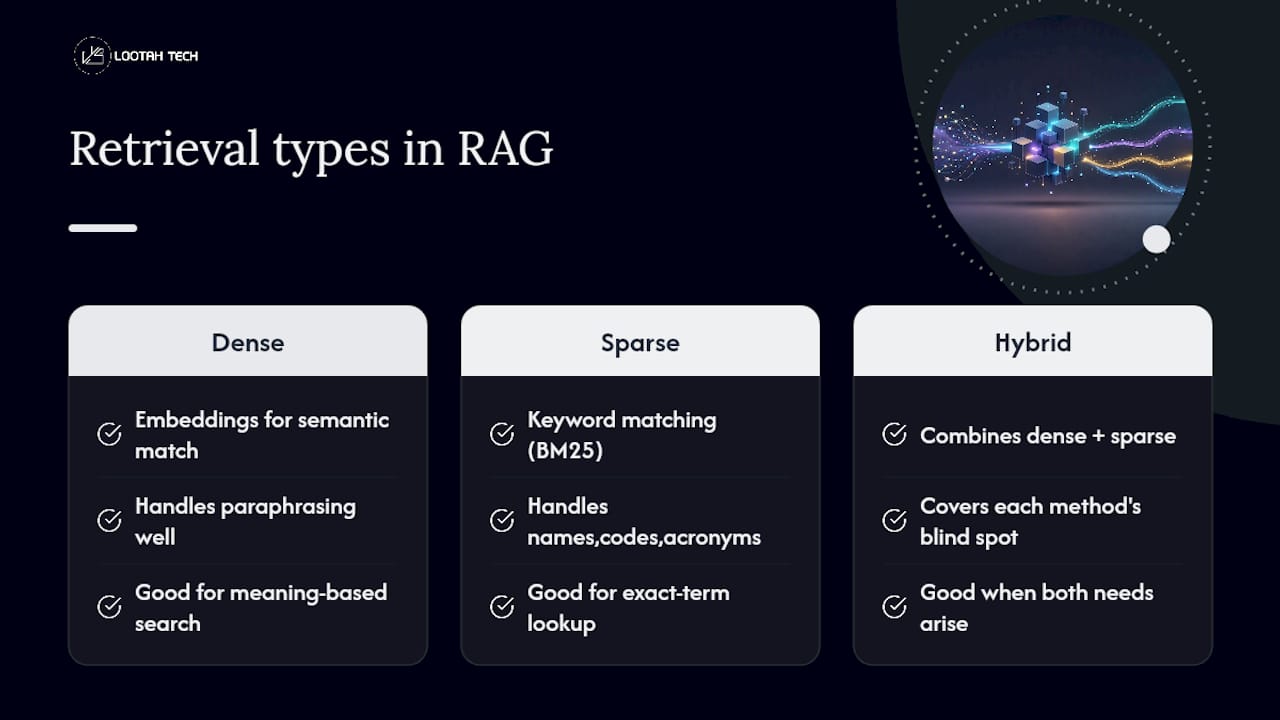
The retriever encodes documents and queries into vectors, indexes them for approximate nearest neighbor (ANN) search, and returns the top candidates. You'll choose between dense retrieval (embedding-based, good at paraphrase and semantic similarity) and sparse retrieval (keyword-based methods like BM25, good at exact matches on names, codes, and acronyms). Most enterprise pipelines end up blending both because dense retrieval alone quietly fails on product SKUs, legal citations, and anything a customer might type verbatim.
Embedding models are not a "pick once and forget" decision. Swapping models means re-embedding your entire corpus, which is expensive at scale and easy to underestimate during planning.
- Encoding and indexing determine what's even findable.
- Vector store choice affects filtering by metadata (date, department, access level), not just similarity search.
- The generator's fusion strategy, whether Fusion-in-Decoder (FiD), Fusion-in-Encoder (FiE), or simple concatenation, decides how retrieved passages actually influence the output tokens.
Pro Tip: Treat your embedding model as swappable infrastructure from day one. Versioned indexes and blue-green swaps prevent painful downtime when you eventually re-embed a large corpus.
How Does a RAG Pipeline Work End to End?
A production RAG request moves through four distinct stages, each with its own latency budget.
- Query encoding and retrieval. The user query is embedded and compared against the vector index, typically pulling a moderate number of candidates before filtering.
- Reranking. A cross-encoder reranker scores the retrieved set for relevance to the specific query, reducing the candidate set significantly for prompt inclusion. Metadata filters regarding permissions and recency also apply here.
- Context assembly. The remaining passages are compressed or summarized if long, then assembled into a prompt template alongside the user's question and system instructions.
- Generation. The model produces an answer, ideally with citations or backlinks to source passages for verification, and indicators when retrieval confidence was low.
Latency adds up fast across these stages. Retrieval and reranking together often cost more wall-clock time than the generation step itself, which is why teams narrow the retrieval scope aggressively rather than retrieving broadly and hoping the generator sorts it out.
Which RAG Architecture Styles Fit Complex Queries?
Not every RAG deployment needs the same fusion strategy, and picking the wrong one either wastes compute or starves the model of context.
- Naive concatenation stuffs retrieved passages directly into the prompt. It's simple and works fine for a handful of short documents, but it scales poorly and lets irrelevant text dilute the signal.
- Fusion-in-Decoder (FiD) and Fusion-in-Encoder (FiE) process passages more deliberately, letting the model weigh evidence across documents rather than treating the prompt as one flat blob of text. The original NeurIPS 2020 RAG paper showed this kind of architecture, pairing a seq2seq generator with a dense non-parametric index, outperforming parametric-only models on knowledge-intensive tasks.
- Token-level retrieval (RETRO-style) retrieves at finer granularity, useful when different parts of a long answer need different source material rather than one document dominating the whole response.
- GraphRAG routes retrieval through a knowledge graph instead of flat vector search, which helps with multi-hop questions ("what did the subsidiary of the company that acquired X do in 2019?") that plain similarity search handles badly.
- Agentic or modular RAG lets the system decide, at query time, whether to retrieve once, retrieve iteratively, or query multiple sources, better suited to open-ended research tasks than a fixed single-pass pipeline.
A 2026 survey on retrieval-augmented generation frames these as different fusion types, query-level, logits-level, latent-level, and parametric, each with real architectural implications for factuality and controllability, not just style preference.
How Do You Build a Minimal Production RAG Pipeline?
Here's the sequence that actually gets a RAG system into production without a rebuild six months later.
- Ingest and normalize documents. Strip boilerplate, standardize formats, and preserve structure (headings, tables) that later helps chunking stay coherent.
- Chunk with metadata attached. Split on paragraph or semantic boundaries rather than fixed character counts, and tag each chunk with source, date, and access-level metadata.
- Choose an embedding model and version your index. Decide up front how you'll handle a future model swap; a versioned index makes that a rollout, not a rebuild.
- Select a vector store and a hybrid search approach. Combine dense vector search with lexical methods like BM25 so exact-match terms (part numbers, names, error codes) aren't lost to semantic smoothing.
- Add a reranker. A cross-encoder pass over the top candidates meaningfully improves precision before anything reaches the prompt.
- Assemble and compress context. Summarize or extractively trim long passages so you're not burning tokens on redundant text.
- Build prompt templates with citation formatting. Decide now how source attribution appears in the output. Retrofitting citations later is painful.
- Wire in caching. Cache embeddings and, where queries repeat, cached retrieval results to cut both cost and latency.
- Test before you ship. Run offline benchmarks against held-out queries, generate synthetic queries to stress-test edge cases, and get human validation on a sample of real outputs.
Pro Tip: Build your evaluation set before you build the pipeline. Teams that write test queries after the system is live tend to write queries the system already handles well, which hides the actual gaps. DeepLearning.AI's RAG course materials walk through retriever function and embedding pipeline implementation at the code level if you want a hands-on reference.
RAG vs Fine-Tuning: Which Should You Choose?
The honest answer is "it depends on what's changing," and often the right answer is both.
- Choose RAG when you need traceable answers or information that changes frequently. Retrieval indexes can update in minutes, while fine-tuning a model can take hours to days depending on model size, according to AWS's guidance on RAG versus fine-tuning.
- Choose fine-tuning when you need stable, consistent behavior on a repeated task and can't afford the per-query latency of a retrieval hop.
- Combine both when you need domain-adapted behavior and access to current facts. A 2024 study on an agricultural dataset found fine-tuning alone improved accuracy by about 6 percentage points, and layering RAG on top added another 5 percentage points, an additive rather than redundant gain.
Cost-wise, fine-tuning is a periodic training expense; RAG is a recurring per-query cost from retrieval infrastructure and reranking. Budget for both if you're combining approaches, and check our enterprise AI platform guide for how this plays out across managed platforms.
What Breaks RAG in Production and How Do You Prevent It?
Most RAG failures trace back to four decisions, not exotic model problems. A production-focused framework identifies chunking, the retrieve-and-rerank stack, embedding-model lifecycle, and context-window strategy as the choices that decide whether a deployment pays off, more than any taxonomy label you put on the architecture.
- Chunking is the quiet killer. Chunks too large dilute relevance signal; chunks too small lose context. Paragraph-aware splitting with modest overlap generally beats fixed-size windows on both recall and precision.
- Hybrid retrieval plus reranking is now the pragmatic default for enterprise corpora, since it catches the acronyms, product codes, and proper nouns that pure dense retrieval routinely misses, according to an Atlan operational guide to RAG architecture.
- Embedding-model upgrades need a blue-green swap strategy. Re-embedding a large corpus without a rollback path is a self-inflicted outage.
- Context-window management works best as narrow-then-expand: retrieve tightly first, only pull in more context on demand, and cache prompts where the same context recurs across queries.
- Governance has to live at retrieval time, not just at the output. Access controls and audit trails on what got retrieved matter as much as what got generated, since stale indexes and ungoverned retrieval are common enterprise failure modes.
Pro Tip: Log every retrieval trace alongside its generated answer. When a user disputes an answer six weeks later, that trace is the only way to reconstruct what the model actually saw.
How Do You Evaluate a RAG System's Performance?
Evaluation needs to check both halves of the pipeline separately, because a great generator fed bad context still produces bad answers.
- Context precision and recall measure whether the retriever surfaced the right passages at all.
- Faithfulness checks whether the generated answer actually reflects the retrieved context rather than drifting into unsupported claims.
- Answer relevance, latency, and cost per query round out the operational picture.
| Metric | What it catches |
|---|---|
| Context precision/recall | Retriever pulling wrong or missing documents |
| Faithfulness | Generator hallucinating beyond retrieved context |
| Answer relevance | Technically faithful but unhelpful responses |
| Latency and cost per query | Pipeline stages that don't scale economically |
Run held-out queries and synthetic benchmarks before launch, then layer in human annotation for the cases automated metrics can't judge well. In production, track fallback rates (how often the system can't retrieve anything useful) and watch for drift as your document corpus grows. A tool built for auditing AI citation accuracy can help formalize how you check that generated answers actually trace back to real sources.
How Yslootahtech Approaches RAG for Enterprise Clients
Yslootahtech builds RAG-backed applications as part of its broader AI and machine learning and application development work, following the same ingest, index, govern, integrate pattern outlined throughout this piece.
The engineering choices that decide whether a RAG deployment survives contact with real users, chunking, embedding lifecycle, and access governance, are exactly where enterprise projects tend to underinvest. Getting them right the first time avoids a costly rebuild later.
That governance layer, in particular, tends to separate a demo from a system a client's compliance team will actually sign off on.
Why the Four Engineering Choices Matter More Than the Framework
Most RAG writeups spend their energy on architecture diagrams, agentic loops, graph retrieval, fusion strategies, and treat the plumbing as an afterthought. That's backwards. The research and the failure patterns both point the same direction: chunking strategy, the retrieve-and-rerank stack, embedding-model lifecycle, and context-window management decide whether a system works, regardless of which fusion pattern sits on top.
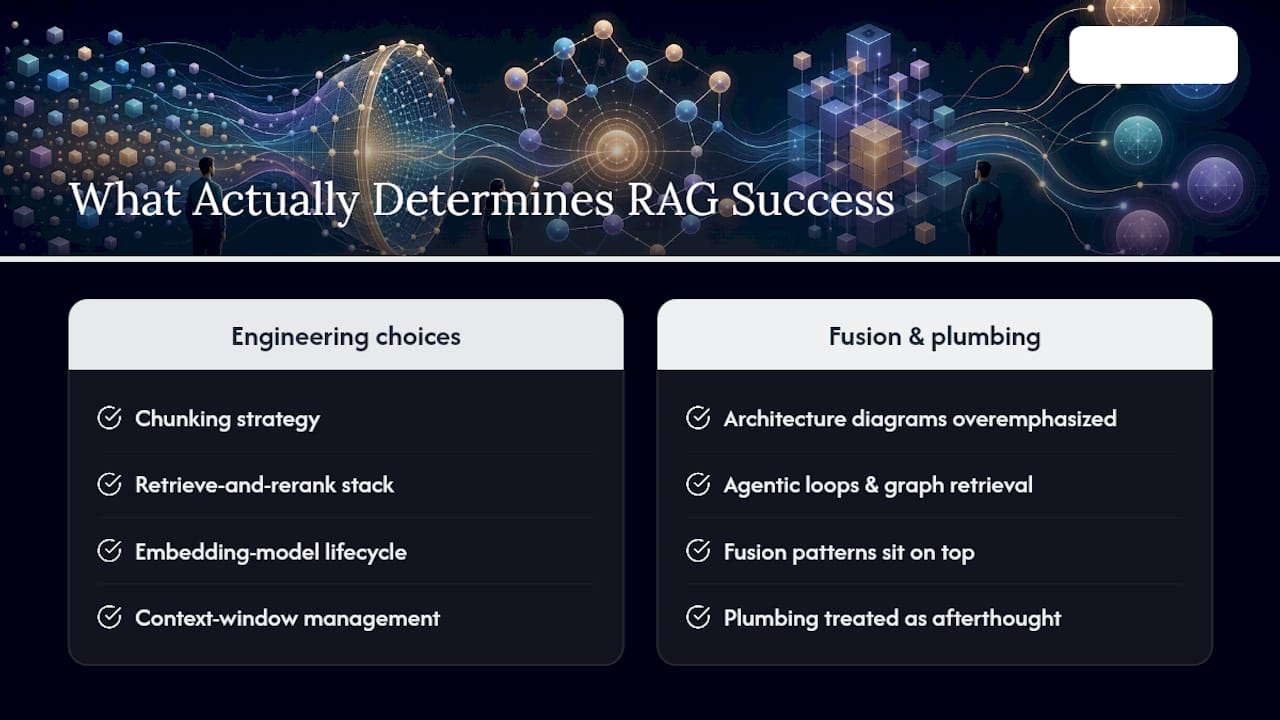
Conventional advice treats RAG as a solved pattern you can drop into any stack. It isn't. A naive implementation with poor chunking and no reranker will underperform a well-tuned "basic" RAG system every time, no matter how sophisticated the generator is. If you're building one, prioritize the boring parts first: get chunking and hybrid retrieval right before you reach for GraphRAG or agentic orchestration. Sophistication doesn't fix bad inputs.
The version that combines retrieval with a fine-tuned model, where the budget allows it, consistently outperforms either approach alone. That's not a taxonomy preference. It's what the evidence shows.
Get RAG Architecture Built Right the First Time
Reading about chunking strategy and embedding lifecycles is one thing; building a pipeline that survives real user traffic and a compliance review is another. Yslootahtech designs and ships RAG-backed applications as part of its AI and machine learning practice, handling the retrieval infrastructure, governance layer, and the front-end experience where citations and answers actually reach your users.
If your team is weighing RAG against fine-tuning, or trying to figure out where a RAG pipeline fits inside an existing product, Yslootahtech's application development and website development teams handle the integration work end to end, including how retrieved answers get presented through UX/UI design that makes citations legible instead of buried. Reach out to scope your project and get a plan for what a production-ready RAG deployment would actually take.
Frequently Asked Questions About RAG Architecture
Is RAG architecture better than fine-tuning for enterprise use cases? Neither wins outright. RAG suits fresh or private data that needs traceability; fine-tuning suits stable, repeated tasks. A 2024 study on an agricultural dataset found combining both added roughly 5 percentage points of accuracy on top of fine-tuning's own 6-point gain, which is why many enterprise deployments use both together.
What is the difference between dense and sparse retrieval in a RAG pipeline? Dense retrieval uses embeddings to find semantically similar passages, which handles paraphrasing well. Sparse retrieval, like BM25, matches on exact keywords, which handles names, codes, and acronyms better. Hybrid retrieval combines both to cover each other's blind spots.
How much latency does RAG add compared to a standard LLM call? Retrieval and reranking typically add more wall-clock time than the generation step itself, since the system has to encode the query, search an index, and rerank candidates before the model ever starts generating. Narrowing the initial retrieval scope and caching repeated queries both help control this.
What is context-window strategy in RAG architecture design? It's the practice of retrieving narrowly first and expanding only on demand, rather than stuffing the maximum context window with retrieved passages every time. This keeps token costs down and reduces the chance that irrelevant text dilutes the generator's focus.
Do I need a knowledge graph for RAG, or is vector search enough? Plain vector search handles most single-hop questions fine. GraphRAG becomes worthwhile when queries require multi-hop reasoning, chaining facts across multiple related entities, which flat similarity search tends to answer poorly.
Sources
- ArXiv 2024 study on combining RAG and fine-tuning
- RAG vs fine-tuning guidance — AWS
- RAG Architecture in 2026: The Four Choices That Decide Payback
- Retrieval-augmented generation: a survey (Springer, 2026)