Open Banking UAE: What Banks and Fintechs Must Know

Open finance in the UAE is a mandatory, CBUAE‑managed framework. Licensed banks, insurers, and other financial institutions must expose customer account and product data through a centralized API Hub, and only with explicit user consent. That single sentence covers the legal foundation. Everything else is implementation detail, and the details are where most institutions either move fast or get stuck.
Three things matter immediately if you're a compliance lead, a CTO, or a fintech founder reading this before a board meeting:
- Scope is mandatory, not optional. Onboarding happens in phases, and banks and insurers go first.
- Licensing has teeth. You need a minimum capital position, professional indemnity insurance, and governance controls before you touch the API Hub.
- Consent and connectivity run through named infrastructure. The API Manager, Ozone Connect, and centralized consent tools like Al Tareq are not optional add‑ons. They are how you connect.
Before doing anything else, pull up the Open Finance Regulation on the CBUAE Rulebook and the Nebras API specifications repository. Everything in this guide traces back to those two sources.
Key Takeaways
UAE open finance compliance succeeds when licensing, API integration, and consent governance are built together from the start, not bolted on sequentially.
| Point | Details |
|---|---|
| Mandatory scope | Licensees and Persons Deemed Licensed must join the CBUAE Open Finance Framework through phased onboarding. |
| Capital and insurance | Applicants need minimum capital of at least AED 1,000,000 plus professional indemnity insurance. |
| Centralized architecture | TPPs connect through the API Hub and Ozone Connect, never directly to an LFI's core systems. |
| Consent is non-negotiable | Data scraping, re-sharing outside scope, and commercializing shared data are all explicitly prohibited. |
| Technical partner value | Yslootahtech supports API integration, UX/UI consent flows, and sandbox conformance testing for LFIs and fintechs building toward CBUAE certification. |
Table of Contents
- What Does Open Finance Cover Under UAE Regulation?
- How Do the Trust Framework and API Hub Work Together?
- Which Entities Must Comply With UAE Open Finance Rules?
- What Does an Open Finance License Actually Require?
- Where Do You Find the UAE Open Finance API Specifications?
- How Does UAE Open Finance Handle Consent and Data Security?
- When Does the UAE Open Finance Rollout Reach Your Institution?
- What's a Realistic Implementation Roadmap for Compliance?
- What New Products and Risks Does Open Finance Create?
- What Actually Slows Down UAE Open Finance Projects
- How Yslootahtech Supports Open Finance Readiness in the UAE
- Where to Find Official UAE Open Finance Resources
- Frequently Asked Questions About Open Banking in the UAE
- Sources
What Does Open Finance Cover Under UAE Regulation?
The Open Finance Regulation doesn't just cover current accounts and debit cards. It defines a broader Open Finance Framework that includes two categories of activity: Data Sharing (giving a third party read access to account information) and Service Initiation (letting a third party trigger a payment or product action on the customer's behalf). Together these make up an Open Finance Service, and any firm offering one needs an Open Finance License.
The regulation separates entities into two groups. Licensees are financial institutions and providers explicitly brought into scope by CBUAE rules. Persons Deemed Licensed are firms already holding a Central Bank license for a related activity, who are treated as automatically covered once they notify the regulator and receive approval. That distinction matters because it determines whether you apply for a new license from scratch or simply confirm your existing one extends to open finance obligations.
The scope of products is wide. It reaches well past the checking account most people associate with "open banking":
- Current and savings accounts
- Credit and debit cards
- Personal and business loans, including mortgages
- Insurance policies and related products
- E-wallets and stored value instruments
This breadth is why the Open Finance Regulation establishes the UAE Open Finance Framework as a single structure spanning a Trust Framework, an API Hub, and Common Infrastructural Services, with participation mandatory for every Licensee in scope.
Compare that to markets like the UK or the EU, where open banking rules grew out of payment services directives and stayed narrowly focused on payment accounts for years before expanding. The UAE skipped that gradual approach. It built a centralized model from day one, covering a wider product set through one API Hub and one Trust Framework rather than a patchwork of bilateral agreements between banks and third parties. For integration teams, that means fewer negotiated contracts but heavier dependence on a single piece of shared infrastructure.
How Do the Trust Framework and API Hub Work Together?
Three components make up the technical backbone: the Trust Framework, the API Hub, and a set of Common Infrastructural Services. Understanding how they interact tells you exactly where your development team needs to plug in.
The Trust Framework is essentially the rulebook and directory that makes participants trust each other without direct relationships. It includes a participant directory listing every registered Licensee and Open Finance Provider, digital certificates that authenticate each party cryptographically, an API Portal where technical documentation and credentials live, and consent services that record and validate customer authorization.
The API Hub is the traffic controller. Third-Party Providers (TPPs) never call a bank's systems directly. Instead, requests move through a defined chain:
- A TPP sends a request to the API Hub.
- The Hub validates the request against the Trust Framework (checking certificates, consent status, and participant registration).
- The validated request passes to Ozone Connect, the LFI-facing interface that translates Hub-standard calls into what the bank's core systems expect.
- The Licensed Financial Institution (LFI) processes the request and returns a response.
- The response travels back through Ozone Connect and the Hub to the originating TPP.
The centralized design means no TPP ever establishes a direct pipe into a bank's core banking system. Every call is proxied, validated, and logged by the Hub. That's a deliberate governance choice: it standardizes the experience for TPPs while keeping banks from having to negotiate dozens of one-off integrations.
The API Manager function inside the Hub handles harmonization: it aggregates calls, normalizes formats, and shields LFIs from having to support multiple TPP-specific data shapes. This is what the Nebras-Open-Finance/api-specs repository documents in detail, splitting the specifications into Standards (what TPPs build against) and Ozone Connect (what LFIs implement).
Common Infrastructural Services round out the architecture:
- Centralized consent management (recording, revoking, and auditing user permissions)
- Event notifications (alerting participants to status changes or errors)
- A sandbox environment for pre-production testing
- Conformance testing tools to certify API implementations before go-live
Which Entities Must Comply With UAE Open Finance Rules?
If your institution touches customer financial data or initiates payments on a customer's behalf, you're almost certainly in scope somewhere in the phased rollout. The regulation names a specific set of entity types, though not all of them onboard at the same time.
| Entity type | Compliance status |
|---|---|
| Banks (locally incorporated and branches of foreign banks) | Priority phase, mandatory Licensee |
| Insurers and insurance brokers | Priority phase, mandatory Licensee |
| Finance companies | Later phase, mandatory once designated |
| Payment service providers | Later phase, mandatory once designated |
| Stored value facility (SVF) operators | Later phase, mandatory once designated |
| Exchange houses | Later phase, mandatory once designated |
| Loan crowdfunding platforms | Later phase, subject to CBUAE announcement |
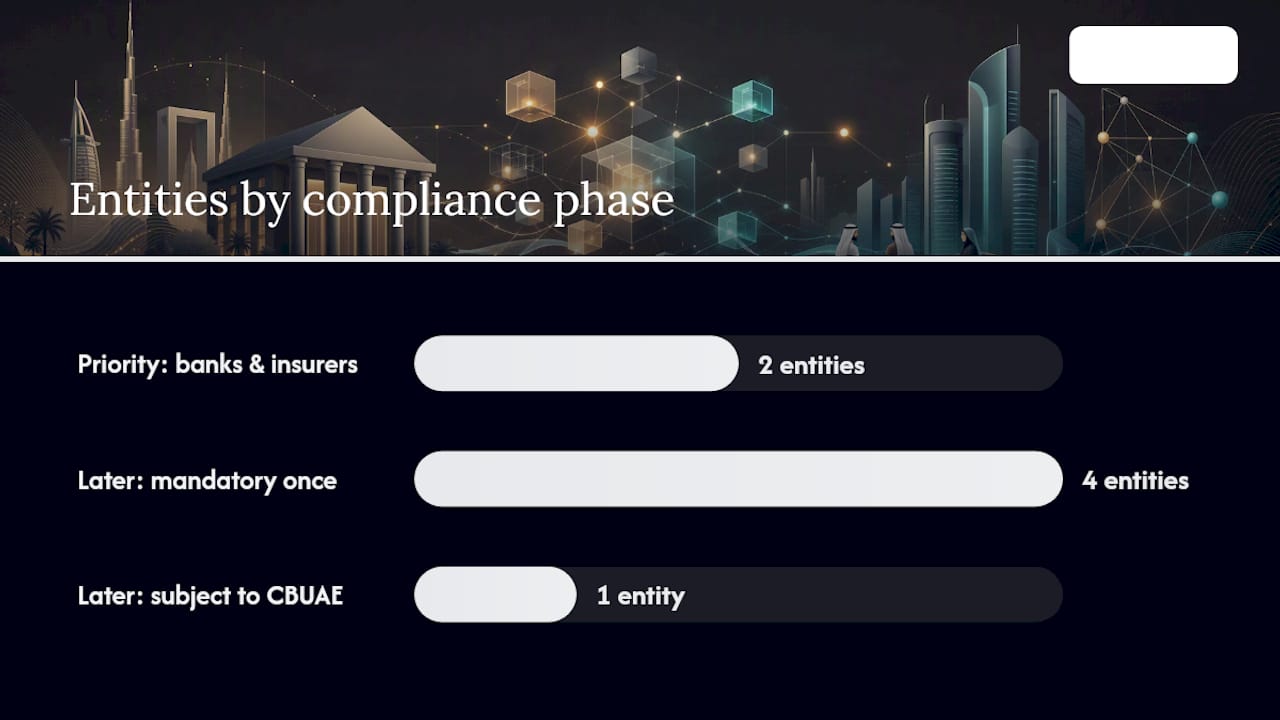
Banks and insurers move first. That's consistent across every legal briefing on the topic, including analysis from Clifford Chance noting that Tier 1 banks receive priority engagement from the regulator. Everyone else waits for CBUAE to formally announce their onboarding window.
Here's the wrinkle that trips up compliance teams: if you already hold a CBUAE license for a related activity, you might qualify as a Person Deemed Licensed rather than needing an entirely new Open Finance License. That status isn't automatic. You must submit written notice to the Central Bank and receive approval. If CBUAE doesn't respond within 60 working days, legal guidance from Two Birds indicates the notification is treated as impliedly rejected, meaning silence doesn't equal a green light. Plan your notification timeline with that clock in mind, not against it.
What Does an Open Finance License Actually Require?
Getting licensed isn't a checkbox exercise. The CBUAE evaluates governance maturity as closely as it evaluates your balance sheet, and the application process reflects that.
A typical application path looks like this:
- Submit a formal application detailing the specific Open Finance Service you intend to offer (Data Sharing, Service Initiation, or both).
- Provide governance documentation: board oversight structure, risk management framework, and internal control policies.
- Map your technical systems, showing how customer data flows internally and how it will connect to the API Hub.
- Demonstrate financial soundness, including proof of minimum capital.
- Secure professional indemnity insurance at the level CBUAE specifies.
- Undergo CBUAE review, which may include requests for additional risk controls before approval.
Pro Tip: Start your governance documentation in parallel with your technical build, not after it. Institutions that treat licensing as a paperwork afterthought after finishing the API integration usually discover gaps in their risk framework that force a rebuild of controls they thought were done.
The capital threshold is the number every finance director wants first: applicants need a minimum capital of at least AED 1,000,000, and the Central Bank can raise that figure based on a risk-based assessment of the applicant's activities. A firm handling Service Initiation for high-value transactions, for instance, may face a higher capital bar than one offering read-only Data Sharing.
Insurance isn't optional either. Licensees must carry professional indemnity insurance at limits the CBUAE sets, protecting against claims arising from errors, negligence, or data mishandling in the course of providing Open Finance Services.
One limitation worth flagging clearly: an Open Finance License does not let you hold client funds, and it doesn't substitute for other regulatory licenses your business model might need. If your fintech also wants to issue e-money or operate as a payment institution, that requires separate authorization. Treat the Open Finance License as an addition to your regulatory stack, not a replacement for it.
Where Do You Find the UAE Open Finance API Specifications?
Developers building against the UAE framework have one canonical reference point: the Nebras-Open-Finance/api-specs repository. It's organized around the two sides of the API Hub.
Standards documents the TPP-facing contracts. This is what your integration team builds against if you're a fintech consuming bank data or initiating payments. Ozone Connect documents the LFI-facing side, the interface banks and insurers implement to expose their systems to the Hub. The repository also spells out how the API Hub itself validates and proxies traffic between the two, confirming that TPPs never establish a direct connection to an LFI's systems.
A working developer checklist looks roughly like this:
- Register as a participant in the sandbox environment before writing production code.
- Obtain digital certificates issued through the Trust Framework's participant directory.
- Build OAuth-based consent flows that integrate with the centralized consent service rather than rolling your own authorization logic.
- Map your internal data models to the OData/JSON schemas defined in the Standards or Ozone Connect specs, depending on which side you're building.
- Run conformance testing against the sandbox before requesting production credentials.
- If you're an LFI working with multiple TPP integrations, evaluate whether an API aggregator layer simplifies your internal maintenance burden.
The sandbox-to-production workflow generally follows this sequence: register as a participant, obtain your certificates, run sandbox test cases against the published specs, complete conformance certification, then move to production onboarding. According to insight from the API specs maintainers, teams should treat the Standards and Ozone Connect mapping as their baseline test suite rather than writing test cases from scratch. If your internal team hasn't built against OAuth-based consent or handled certificate lifecycle management before, this is a strong candidate for bringing in outside application development expertise rather than learning it under a compliance deadline.
How Does UAE Open Finance Handle Consent and Data Security?
Consent isn't a checkbox on a form. Under the UAE model, Open Finance Providers cannot process personal financial data without explicit, informed consent, and that consent flows through centralized tools rather than provider-by-provider agreements.
The centerpiece is Al Tareq, the standardized authentication and consent service referenced throughout CBUAE guidance. Rather than each bank building its own consent screen and authorization logic, the framework routes consent capture through this shared layer, which creates a more consistent user experience and a single audit trail regulators can inspect.
Three rules define the consent boundary:
- No data scraping. Providers cannot pull customer data through screen scraping or credential harvesting; every access point runs through the authorized API Hub channel.
- No re-sharing beyond scope. Data obtained under one consent grant can't be silently forwarded to a different provider or used for a purpose the customer didn't authorize.
- No commercialization. The regulation explicitly forbids monetizing customer data received from another participant, which rules out selling aggregated insights derived from shared account information.
On the authentication side, expect two-factor or stronger authentication tied to digital certificates issued through the Trust Framework, plus secure messaging standards for notifications and status updates between participants.
Pro Tip: Build your consent audit trail from day one, not as a retrofit. Regulators will ask for evidence of when consent was granted, what scope it covered, and when it was revoked. Institutions that bolt this on after launch usually end up rebuilding their logging architecture.
Data locality deserves attention too. Cross-border data flows connected to Open Finance Services generally require explicit approval, and firms should assume encryption in transit and at rest is a baseline expectation, not a differentiator. For a deeper look at building these controls into your broader security posture, Yslootahtech's guide on data security for Middle East businesses walks through the operational side of audit trails and access logging.
When Does the UAE Open Finance Rollout Reach Your Institution?
The regulation gazetted in 2024, and DLA Piper's briefing confirms CBUAE paired it with a parallel Sandbox Conditions Regulation specifically to give firms a safe testing ground before mandatory compliance kicks in.
Here's the practical sequence most institutions should expect:
- Priority phase, banks and insurers receive direct communication from CBUAE outlining their onboarding window and requirements.
- Notification phase for deemed licensees, firms already holding a related CBUAE license submit written notice and wait through the 60 working day review period.
- Sandbox and conformance phase, participants register, build against the Standards or Ozone Connect specs, and run conformance testing before requesting production access.
- Later phases, payment service providers, stored value operators, exchange houses, and finance companies join as CBUAE formally announces each wave.
If you're a Tier 1 bank, you've likely already had contact from the regulator. If you're a smaller finance company or a fintech waiting for your phase, the smartest move isn't waiting passively. Engage CBUAE early to clarify where you sit in the queue, start a gap analysis against your current architecture, sketch an API development plan against the published specs, and begin evaluating integration vendors now so you're not scrambling once your notification window opens.
What's a Realistic Implementation Roadmap for Compliance?
Moving from "we know we need to comply" to "we're live on the API Hub" typically breaks into six phases. Treat this as a working roadmap, adjusting timelines based on how much of your core banking infrastructure already supports API-based access.
- Discover (weeks 1 to 3). Audit your current data architecture. Identify every account and product type in scope, and map where that data currently lives across core banking and CRM systems.
- Design (weeks 3 to 6). Define your dedicated interface architecture. Decide whether you're building direct API endpoints or working through an aggregator layer, and design your consent integration against the centralized services.
- Build (weeks 6 to 14). Develop against the Standards or Ozone Connect specifications depending on whether you're a TPP or an LFI. This phase includes certificate provisioning, OAuth consent flow integration, and mapping internal schemas to the required OData/JSON formats.
- Test in sandbox (weeks 12 to 18, overlapping with build). Register in the sandbox environment and run test cases against real API contracts before touching production data.
- Certify (weeks 16 to 20). Complete conformance testing and submit for certification. This is where gaps in your certificate lifecycle management or consent audit trail tend to surface.
- Operate (ongoing from go-live). Monitor API performance, maintain certificate renewals, track event notifications, and keep consent records current as CBUAE guidance evolves.
Pro Tip: Certificate lifecycle management is the single most underestimated operational task in this entire process. Digital certificates expire, and a lapsed certificate can silently break your connection to the API Hub without an obvious error message. Build renewal reminders into your monitoring stack from the start.
If you're evaluating outside help for any of this, a solid RFP checklist should ask potential vendors to demonstrate: prior experience with API-based core banking integration, a documented approach to OAuth and consent management, a testing methodology that maps to the sandbox and conformance requirements, and a support plan for certificate renewals and ongoing monitoring after go-live. Ask for a proposed project timeline broken into the same phases above, since a vendor who can't estimate weeks per phase probably hasn't done this integration before. For institutions rebuilding legacy systems to support this kind of connectivity, the enterprise app development considerations in Yslootahtech's UAE enterprise guide cover a lot of the same architectural ground, from system mapping to integration testing.
Broader organizational readiness matters just as much as the technical build. Firms that treat this as a pure IT project, without change management for the business units affected, tend to hit friction later. That's covered in more depth in the digital transformation playbook Yslootahtech published for UAE organizations navigating large-scale change, which addresses exactly this kind of cross-functional rollout risk.
What New Products and Risks Does Open Finance Create?
Open finance changes what's technically possible for both incumbents and challengers, and the shift is bigger than "customers can share their data now."
For consumers and businesses, the upside is tangible. Product personalization improves once providers can see a fuller financial picture with consent. Account-to-account payments get faster and cheaper compared to card rails. Aggregation services, think apps showing every account across every bank in one dashboard, become viable at scale rather than through fragile workarounds. Credit decisions speed up when lenders can verify income and spending patterns directly through consented data rather than manual document review.
For fintechs and vendors, this opens legitimate new business lines. Embedded finance products, where a non-bank platform offers lending or payment services natively, become easier to build. Data-driven advisory services, aggregation dashboards, and cash flow forecasting tools all get better inputs.
But the risks are real and worth naming plainly:
- Consent fatigue. If every provider asks for broad permissions repeatedly, customers start clicking "accept" without reading, undermining the entire point of informed consent.
- Operational dependency on the Hub. Because the model is centralized, an outage or slowdown at the API Hub level affects every participant simultaneously, unlike a decentralized model where one bank's API going down is isolated.
- New fraud vectors. Faster onboarding and account-to-account payments also mean faster fraud execution if authentication controls aren't tight.
Pro Tip: Monitor consent grant and revocation rates as a leading indicator, not just a compliance metric. A spike in revocations often signals a UX problem in how you're requesting permissions, not a customer trust issue you can fix with better marketing copy.
One guardrail worth remembering when you're scoping new commercial models: the regulation explicitly bars monetizing shared customer data. Build your revenue model around service fees and product value, not data resale, because that door is closed by design.
What Actually Slows Down UAE Open Finance Projects
Every institution moving through this framework hits some version of the same wall, and it's rarely the API itself.
The Standards and Ozone Connect specifications are documented clearly enough that a competent development team can build against them without much guesswork. What derails timelines is internal data governance: knowing exactly which system holds the authoritative version of a customer's account data, and getting that system to speak the same schema the Hub expects. Institutions that skip a proper data mapping exercise before writing code usually discover the mismatch during conformance testing, which is the most expensive place to find it.
Certificate lifecycle management is the second recurring pitfall. A team builds a working integration, passes conformance, goes live, and six months later a certificate quietly expires because nobody owned the renewal process. The fix isn't complicated: assign ownership and automate the renewal alert, but almost nobody does it until after the first outage.
Test automation is the third gap. Manual testing against the sandbox works fine for an initial certification push, but ongoing changes to internal systems need regression testing against the Hub's contracts, not a one-time conformance check treated as permanent proof of compliance.
None of these are exotic problems. They're the same operational discipline gaps that show up in any regulated API integration, just with CBUAE's name attached to the deadline.
How Yslootahtech Supports Open Finance Readiness in the UAE
If your team is staring down a CBUAE onboarding notice without the internal bandwidth to map data flows, build Ozone Connect endpoints, and manage certificate lifecycles at the same time, that's exactly the gap Yslootahtech fills. Unlike hiring a generalist agency that treats this as a website project, Yslootahtech works from the technical side first: API integration, secure authentication flows, and the UX/UI design work that makes consent screens clear instead of confusing for the end customer.
Our application development team builds and tests against the published Standards and Ozone Connect specifications directly, and we support sandbox testing and conformance work so your certification doesn't stall on a schema mismatch discovered too late. We also bring cloud infrastructure and cybersecurity practices to the table, covering the encryption, audit logging, and access control layers CBUAE expects around consent data.
If you're not sure where your institution sits in the onboarding timeline or what a realistic build timeline looks like for your systems, start with a gap analysis conversation. Reach out through Yslootahtech's application development services page to scope what a dedicated interface build would take for your specific core banking setup.
Where to Find Official UAE Open Finance Resources
Start with the source that matches your role. Legal and compliance teams should read the Open Finance Regulation on the CBUAE Rulebook first, since it's the authoritative legal text defining Licensees, scope, and obligations.
Developers and technical leads need the Nebras-Open-Finance/api-specs repository, which documents Standards, Ozone Connect, and API Hub contracts in working detail.
For program and legal context beyond the raw regulation text, Clifford Chance's briefing on licensing requirements, Pinsent Masons' guide to consent rules, and DLA Piper's overview of the phased rollout and sandbox regulation all fill in practical context the primary regulation doesn't spell out in plain language. Dubai's broader fintech infrastructure push, including developments like the dedicated crypto and Web3 tower announced in Dubai, signals how seriously the emirate is investing in the ecosystem around this framework.
Frequently Asked Questions About Open Banking in the UAE
Is open banking mandatory for all UAE financial institutions? It's mandatory for entities within scope of the Open Finance Regulation, rolled out in phases. Banks and insurers are first, with payment providers, exchange houses, and finance companies joining in later phases CBUAE announces individually.
What's the difference between open banking and open finance in the UAE? Open banking typically refers narrowly to payment accounts. The UAE's Open Finance Framework covers a wider set of products, including loans, mortgages, insurance, and stored value instruments, alongside standard bank accounts.
How much does an Open Finance License cost to obtain? The regulation sets a minimum capital requirement of AED 1,000,000, which CBUAE can raise based on a risk assessment of your specific activities, plus professional indemnity insurance at limits the Central Bank specifies. Application and legal costs vary by firm and aren't publicly standardized.
Can a fintech connect directly to a bank's systems under this framework? No. Every request from a Third-Party Provider routes through the API Hub, which validates it against the Trust Framework before passing it to the bank via Ozone Connect. Direct bank-to-TPP connections outside this structure aren't part of the compliant model.
What happens if a bank already holds a CBUAE license, does it need a new one for open finance? It may qualify as a "Person Deemed Licensed" instead of applying fresh. That requires submitting written notice to CBUAE and receiving approval, and silence for 60 working days is treated as an implied rejection, so timing the notification matters.
Where can developers find the official UAE open finance API specifications? The Nebras-Open-Finance/api-specs repository on GitHub is the working reference, split into TPP-facing Standards and LFI-facing Ozone Connect documentation.
This article is general information, not a substitute for advice from a qualified financial advisor. Consult a qualified financial professional about your own circumstances before acting on anything here.
Sources
- Open Finance Regulation | CBUAE Rulebook
- UAE OPEN FINANCE REGULATION - Q&AS
- Open finance in the UAE: laws and regulation
- Nebras-Open-Finance/api-specs
- New fintech regulations in the United Arab Emirates Open Finance Regulation | DLA Piper