LLM Integration Patterns That Cut Costs for Enterprise Architects

Six patterns cover almost every production use case for large language models: inline endpoint, queue worker, internal gateway, retrieval/RAG, event-driven enrichment, and flagged parallel shadowing. The pattern to pick depends on one question set: is a human actively waiting, does the answer need to be grounded in your own data, and are you replacing deterministic logic or augmenting it? Start with an inline call or a queue worker for your first pilot, then centralize into a gateway once usage spreads across teams.
TL;DR:
- Inline endpoint patterns are ideal for user-facing features where responses must be delivered within milliseconds, with streaming and strict timeouts recommended for reliability.
- Queue worker patterns suit bulk, non-interactive tasks like classification or embedding generation, but are unsuitable for responses needed within a second or two.
- An internal gateway helps control costs, manage model routing, and centralize telemetry, making it essential when multiple teams call models directly or when spending oversight is needed.
- Retrieval-based approaches are necessary for factual grounding in scenarios involving personal data or frequently updated information, with pgvector suitable for moderate needs and dedicated vector databases for larger scale.
- Event-driven enrichment adds metadata asynchronously without blocking core operations, but requires schema validation and robust observability to prevent silently degrading performance.
Table of Contents
- What Are LLM Integration Patterns and Why Do They Matter?
- When Should You Use the Inline Endpoint Pattern?
- How Does the Queue Worker Pattern Handle Bulk LLM Tasks?
- Why Add an Internal LLM Gateway to Your Architecture?
- Where Does RAG Fit in LLM Deployment Strategies?
- What Is Event-Driven Enrichment and When Should You Use It?
- How Do You Safely Replace Logic with Flagged Parallel Runs?
- Which LLM Integration Pattern Fits Your Feature?
- What Production Constraints Should You Design Around First?
- How Should You Manage Cost and Route Between Models?
- What Failure Modes Should You Plan For?
- How Do You Scale and Load Balance LLM Traffic?
- How Do You Manage Model Updates and Versioning?
- What Should Your First LLM Pilot Actually Look Like?
- How YS Lootah Tech Supports LLM Integration Projects
- Sources
- FAQ
What Are LLM Integration Patterns and Why Do They Matter?
Treat an LLM as a slow, unreliable, occasionally brilliant collaborator, not a function call. That framing changes everything about LLM architecture design. A traditional API returns in milliseconds with deterministic output; a model call can take seconds, return different text for the same input, and fail in ways your existing error handling was never built to catch. Good integrating LLM models work starts with isolating that unpredictability so it doesn't leak into the rest of your system.
The first architectural fork is synchronous versus asynchronous. A synchronous call fits a chat widget or a code-completion feature, where the user is watching a cursor blink. An asynchronous call fits a nightly job that classifies ten thousand support tickets, where nobody is waiting and retries are cheap. Conflating the two is the most common mistake teams make early on, usually because the first prototype was a synchronous demo and nobody revisited the assumption once volume grew.
The second fork is centralization. Calling a provider's API directly from three different services works fine at first, then quietly turns into a maintenance problem once you need to swap models, track spend, or add a fallback. A GenAI gateway plus circuit breakers and tiered fallbacks is widely considered the most resilient way to decouple your application's health from a single provider's uptime, according to architectural guidance on LLM system design.
A few primitives show up in nearly every pattern below:
- Streaming delivers tokens as they generate, cutting perceived latency for anything a user watches in real time.
- Caching avoids repeat spend on identical or near-identical prompts.
- Retrieval (RAG) grounds answers in your own data instead of relying on a model's training set alone.
- Isolation boundaries (timeouts, circuit breakers, fallbacks) keep a slow or failing model call from taking down the request that triggered it.
Retrieval deserves special mention because it's the foundation for anything requiring factual grounding: internal documentation, customer records, or pricing that changes weekly. Without it, you're trusting the model's memory, and that memory has a cutoff date.
When Should You Use the Inline Endpoint Pattern?
Inline endpoint integration is the right call whenever a real person is staring at the screen waiting for a response: chat interfaces, code completion, live search assistance. The model sits directly in the synchronous request path, and every millisecond of latency is visible to the user.
Three things separate a working inline integration from a fragile one:
- Stream the response. Token-by-token delivery reduces the "is this thing frozen" feeling and lets users start reading before generation finishes. AWS's guidance on serverless LLM patterns treats streaming as close to mandatory for chat-style features, not a nice extra.
- Set a token budget and a hard timeout. An open-ended generation call is a cost and latency risk. Cap output length and enforce a timeout that fails gracefully rather than hanging the request.
- Design a fallback for when the model is slow or down. A cached prior answer, a simpler rules-based response, or an honest "try again in a moment" message all beat a spinning loader with no end.
Pro Tip: When running inline calls inside serverless functions, set the SDK's read timeout below the function's total execution timeout. That gap gives you room to catch a slow response and return a partial or fallback answer before the platform kills the function outright.
How Does the Queue Worker Pattern Handle Bulk LLM Tasks?
Queue worker integration is the default for anything that doesn't block a user: ticket summarization, document classification, embedding generation for a knowledge base. The request lands in a queue, a worker picks it up, calls the model, and writes the result back, all without anyone watching a spinner.
This pattern earns its keep on reliability, not speed:
- Make every job idempotent. If a worker retries a job after a partial failure, running it twice should never duplicate a summary or double-charge an API call.
- Route failed jobs to a dead-letter queue after a bounded number of retries with exponential backoff, rather than retrying forever or silently dropping the job.
- Reuse your existing batch infrastructure. Teams running Kafka or a similar durable event system already have the partitioning and consumer-group machinery this pattern needs, so there's rarely a reason to build something new from scratch, per Kafka's own documentation on durable delivery semantics.
The trade-off is latency: queue workers are wrong for anything that needs an answer in under a second or two. They're right for almost everything else, which is why most enterprise LLM implementation patterns lean async by default and reserve synchronous calls for genuinely interactive features.
Why Add an Internal LLM Gateway to Your Architecture?
The signal to build a gateway is simple: more than one team or service is calling a model directly, and nobody has full visibility into total spend or failure rates. At that point, an internal gateway (sometimes called a GenAI service) becomes the single choke point for every outbound call.
A well-built gateway typically includes:
- A model router that picks the right model per request, balancing cost against capability.
- Circuit breakers with tiered fallbacks, so a provider outage degrades gracefully instead of cascading into every dependent feature.
- Multi-level caching to cut redundant spend on repeated or near-duplicate prompts.
- Centralized telemetry and auth, giving you one place to see cost, latency, and error rates across every consuming team.
One recurring insight from teams that build gateways later rather than earlier: start small with inline or queue worker patterns first, instrument usage heavily, and only extract a gateway once real cross-team demand shows up. Building the gateway before you have two or three consumers usually means guessing at requirements you don't have data for yet.
The design principle underneath all of this is provider abstraction. Your application code should call "the gateway," never "OpenAI" or any specific vendor directly. That single layer of indirection is what lets you swap models, add a second provider for failover, or renegotiate pricing without touching a single line of business logic. It's also the layer where cost ceilings get enforced, capping spend per team, per feature, or per day before a runaway prompt loop turns into a surprise invoice.
Where Does RAG Fit in LLM Deployment Strategies?
Retrieval-augmented generation is required the moment an answer needs to reference something the model wasn't trained on: your product catalog, a customer's account history, or documentation updated last week. Without retrieval, you're asking the model to guess, and guesses that sound confident are the most dangerous kind of wrong answer.
The retrieval decision that trips up most teams is vector storage. Two reasonable paths exist:
- pgvector inside Postgres is a pragmatic starting point if you already run Postgres. No new infrastructure, no new operational surface, and it's genuinely fine for moderate scale and simple filtering.
- A dedicated vector database earns its complexity once you need heavy metadata filtering, hybrid search, or query volume that starts to strain a general-purpose database doing double duty.
Neither choice is wrong on day one. The mistake is picking the dedicated vector database before you have evidence pgvector can't keep up.
Behind the storage decision sits an ingestion pipeline that matters just as much: chunk documents sensibly (too large and retrieval gets noisy, too small and you lose context), embed on write so new content is searchable immediately, rerank results before they hit the prompt, and keep the index synchronized with your source of truth so stale embeddings don't quietly poison answers. GitHub's breakdown of production LLM application architecture frames retrieval, embedding models, and vector stores as core components sitting alongside the LLM itself, not optional add-ons bolted on later.
What Is Event-Driven Enrichment and When Should You Use It?
Event-driven enrichment attaches an LLM consumer to events already flowing through your system, generating metadata, tags, or summaries without touching the synchronous request path at all. A new support ticket fires an event; a listener calls the model to classify urgency and sentiment; the result gets written back as metadata anyone downstream can use.
This pattern is ambient rather than blocking. Nobody is waiting on it, and if it's slow or briefly down, the core system keeps running with slightly less enrichment.
Two things keep it from becoming a liability:
- Validate the schema on every response. Treat LLM output as untrusted input, exactly the way you'd treat a third-party API you don't control. A model that returns malformed JSON or an unexpected field should never crash a downstream consumer.
- Wire it into your existing observability and retry semantics. If an enrichment call fails, it should retry with backoff and log clearly, using the same durable event infrastructure (Kafka or equivalent) you'd use for any other async consumer.
This is one of the lowest-risk patterns for effective LLM utilization precisely because failure is invisible to end users, which makes it a good second or third pilot after you've proven out something synchronous.
How Do You Safely Replace Logic with Flagged Parallel Runs?
Flagged parallel execution, often called shadowing, is how you replace deterministic logic with an LLM without betting the feature on day one. Run both the old logic and the new model call side by side, store both outputs, but only serve the old result to users.
- Log every disagreement between the two outputs. This disagreement set is your evaluation dataset, built from real production traffic instead of a hand-picked sample.
- Sample and label disagreements against a golden set, ideally with human review for the first few hundred cases and an LLM-as-judge setup for scale after that. Feeding a prompt, a golden answer, and the system output to a high-capability judge model is a practical way to score accuracy and groundedness across releases, per guidance on LLM system design evaluation.
- Roll out gradually behind a feature flag, tied explicitly to golden-set metrics crossing a threshold, not a launch date on a calendar.
- Build a governance loop. Labeling feeds evaluation, evaluation feeds retraining or prompt-tuning triggers, and the cycle repeats every time you change models or prompts.
This is the pattern for anything with real business risk attached, like pricing decisions or content moderation, where an unreviewed model swap could cause real damage.
Which LLM Integration Pattern Fits Your Feature?
A short set of questions usually narrows the choice to one or two patterns immediately.
- Is a user actively waiting on the response? If yes, look at inline endpoint first. If no, default to queue worker.
- Must the answer be grounded in private or real-time data? If yes, add retrieval/RAG on top of whichever sync or async pattern you chose.
- Are you replacing existing deterministic logic rather than adding a new capability? If yes, shadow it first with flagged parallel runs before any user sees the new output.
- Do multiple teams or services already call a model directly? If yes, that's your signal to extract an internal gateway, regardless of which patterns those teams are using underneath it.
- What's the volume and cost sensitivity? High volume with tight cost constraints pushes you toward async processing, aggressive caching, and a gateway with real cost ceilings, not ad hoc calls scattered through the codebase.
A compact mapping for common scenarios:
| Scenario | Recommended pattern(s) |
|---|---|
| Customer-facing chat assistant | Inline endpoint + RAG, streaming required |
| Nightly ticket classification | Queue worker |
| Replacing a fraud-scoring rule engine | Flagged parallel, then gateway once live |
| Tagging content as it's created | Event-driven enrichment |
| Three teams calling the same model | Internal gateway |
The red flag worth remembering: if you're not sure whether a feature is high-risk or low-risk, default to async and shadowing. It's far easier to move from shadow mode to live traffic once you trust the data than to walk back a synchronous feature that shipped too fast and burned user trust.
What Production Constraints Should You Design Around First?
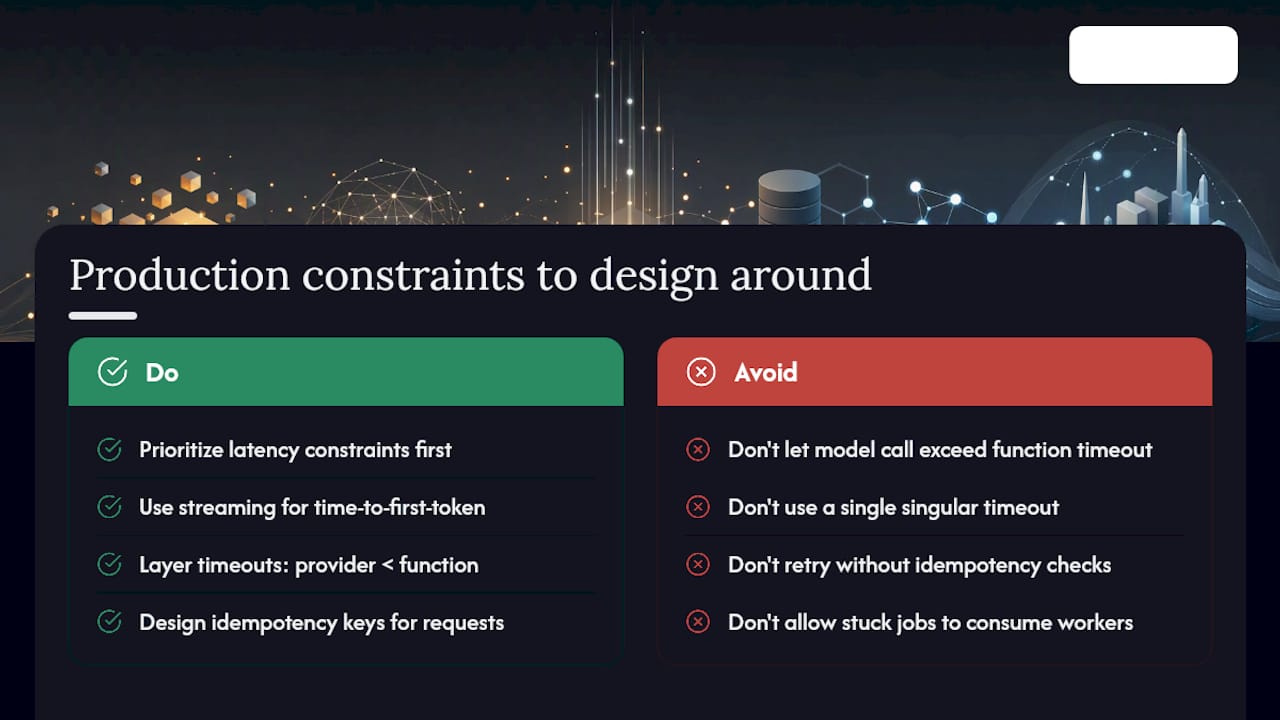
Latency is the constraint that shapes everything else. A model call that takes three to eight seconds is unremarkable in isolation but catastrophic if it sits inside a sixty-second serverless function timeout alongside three other sequential steps. Streaming is the single most effective mitigation, because it moves the perceived latency clock to "time to first token" instead of "time to full response," and AWS's serverless integration guidance treats it as close to a default requirement for anything interactive.
Timeouts need to be layered, not singular. Set the model provider's read timeout below your function or service's overall execution timeout, so you have room to catch a slow response and return something, even a partial answer, before the platform kills the request outright. That gap is what separates a graceful degradation from a hard failure a user actually sees.
Retries introduce their own risk if you're not careful: retrying a call that partially succeeded, like one that generated content but failed on the write-back step, can produce duplicate work or double-billed API usage. That's why idempotency has to be designed in from the start, typically with an idempotency key tied to the original request, checked before any retry executes. For asynchronous jobs, exponential backoff paired with a dead-letter queue after a bounded retry count keeps a single stuck job from consuming your entire worker pool.
How Should You Manage Cost and Route Between Models?
Cost control starts with routing, not with picking a single "good enough" model for everything. A router sitting in your gateway can send simple classification tasks to a smaller, cheaper model while reserving your most capable (and expensive) model for tasks that genuinely need it, like complex reasoning or long-context summarization.
Cost ceilings need to live at multiple levels: per request (a token budget that caps generation length), per feature (a daily spend cap tied to a specific product surface), and per team (so one group's runaway prompt loop doesn't consume the whole organization's budget). Multi-level caching compounds these savings further, catching identical or near-identical prompts before they ever reach a paid API call.
Model choice itself is not a one-time decision. Providers update pricing and capability regularly, and a model that was the right cost-to-performance trade-off six months ago may not be today. Building the router as a configuration layer, rather than hard-coding a model name into application logic, is what makes it possible to shift traffic to a cheaper or better model without a code deployment.
What Failure Modes Should You Plan For?
The three failure modes that matter most are provider outages, latency spikes, and silent quality degradation, and each needs a different mitigation.
Provider outages call for circuit breakers with tiered fallbacks: when error rates or timeouts cross a threshold, the breaker trips and traffic routes to a secondary model, a cached response, or a simplified rules-based path instead of hammering a dead endpoint. This is the core resilience pattern behind enterprise LLM system design, and it's what keeps a single vendor's bad day from becoming your outage.
Latency spikes need timeout budgets set per call, not per request chain, so a slow model call doesn't cascade delays through every downstream step waiting on it.
Silent quality degradation is the sneakiest failure mode because nothing crashes. A model update quietly starts hallucinating more, or a prompt that worked well starts drifting off-topic, and nothing in your logs flags it as an error because technically a response came back. Continuous monitoring against a golden set, ideally scored with an LLM-as-judge process, is the only reliable way to catch this before users notice.
How Do You Scale and Load Balance LLM Traffic?
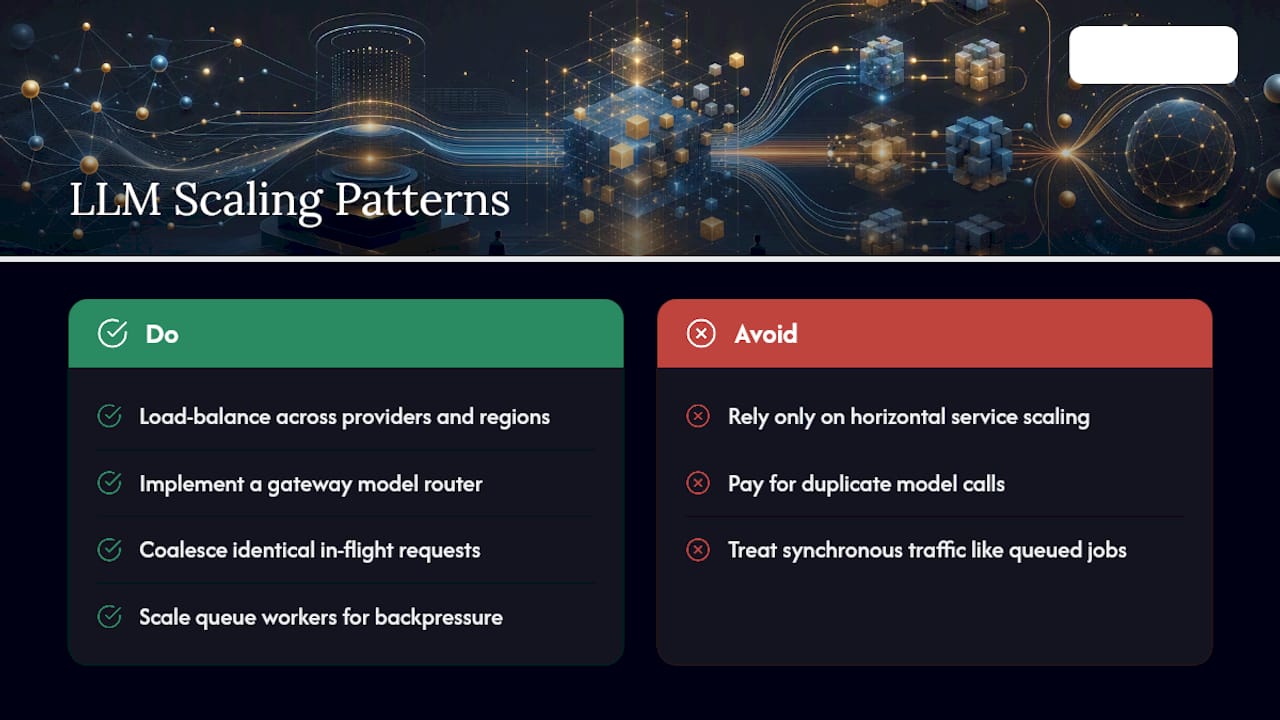
Scaling an LLM-dependent system looks different from scaling a normal API layer, mainly because the expensive resource isn't your infrastructure, it's the model call itself. Horizontal scaling of your own services does nothing if every request still queues behind the same rate-limited provider endpoint.
Load balancing across multiple model providers or multiple deployment regions of the same provider helps absorb traffic spikes and reduces the blast radius of any single endpoint's rate limits. A gateway with a model router is the natural place to implement this, since it already sits between your application and every outbound call.
In-flight request coalescing is an underused technique worth adopting early: if five identical requests arrive within a short window, batch them into a single model call and fan the result back out, rather than paying for five separate generations. This matters most for RAG-heavy features, where popular queries repeat constantly throughout the day.
For queue-based patterns, scaling is more straightforward: add worker capacity and let your existing durable queue infrastructure handle backpressure. The harder scaling problem is almost always on the synchronous side, where you can't just add workers, you have to manage a hard latency ceiling that users will notice if you miss it.
How Do You Manage Model Updates and Versioning?
Every LLM integration eventually faces the same problem: the model behind your API endpoint changes, sometimes without much warning, and outputs shift in ways your tests didn't anticipate. Pin model versions explicitly wherever your provider allows it, rather than defaulting to a "latest" alias that can change underneath you without a deployment on your end.
Before rolling out a new model version, run it through the same golden-set evaluation you'd use for any other change, ideally in shadow mode alongside the current version so you can compare outputs on real traffic before committing. This is the same discipline used in flagged parallel patterns, just applied to a model swap instead of a logic swap.
Version your prompts alongside your models. A prompt tuned for one model's quirks often behaves differently on another, so treating prompts as versioned artifacts, tracked in source control next to the code that calls them, prevents a quiet mismatch between the prompt you tested and the one running in production. Rolling back a bad model update should be as simple as rolling back a bad deployment: flip a config value in your gateway, not hunt through scattered service code for hardcoded model names.
What Should Your First LLM Pilot Actually Look Like?
Start with one narrow, measurable feature, not an ambitious platform rebuild. Support-ticket summarization or a chat hinting feature both work well because success is easy to score: latency, acceptance rate, and error or hallucination rate against a golden set. Expect the first 90 to 180 days to be mostly instrumentation and dataset growth, with a controlled cutover only once those numbers hold steady.
— YS
How YS Lootah Tech Supports LLM Integration Projects
Picking the right pattern is only half the work. Building the gateway, wiring up retrieval, and getting the observability right for production traffic is where most in-house teams lose months to trial and error. Yslootahtech offers services including application development that can add LLM capabilities to existing enterprise systems, as well as AI and machine learning engagements.
If your LLM feature is customer-facing, the interface layer matters as much as the backend pattern behind it, which is where UX/UI design work often pairs with the integration itself, shaping how streaming responses and fallback states actually feel to a user. For teams still weighing platform choices before committing to an architecture, Yslootahtech's enterprise AI platform guide is a useful starting reference. The practical next step is a scoping conversation: bring one feature idea, and the company can help map it to a pattern, a rough timeline, and a realistic budget before any code gets written.
Sources
- Designing Serverless Integration Patterns for Large Language Models (LLMs) | AWS Compute Blog
- Add an LLM to Your Backend: 6 Integration Patterns | Learn Backend
FAQ
What Are LLM Integrations?
An LLM integration is the architecture connecting your application to a language model, covering everything from a direct synchronous API call to a full gateway with routing, caching, and fallback logic.
What Are the Different Types of Integration Patterns?
The six canonical patterns are inline endpoint, queue worker, internal gateway, retrieval/RAG, event-driven enrichment, and flagged parallel shadowing, each suited to different combinations of user waiting time, data grounding needs, and risk tolerance.
How Do You Integrate an LLM into an Existing Application?
Start by identifying whether a user is waiting synchronously or the task can run async, add retrieval if answers need grounding in your own data, then centralize calls into a gateway once more than one team depends on the model.
What Are Common API Integration Patterns for LLMs?
Beyond direct inline calls, common patterns include queue-based workers for batch processing, a gateway layer for routing and fallbacks, and event-driven consumers that enrich data without touching the main request path.
Should You Use pgvector or a Dedicated Vector Database?
Postgres with pgvector is a practical starting point for moderate retrieval needs, while a dedicated vector database becomes worth the added complexity once you need heavy filtering, hybrid search, or higher query volume.