Building an Identity Access Management Roadmap That Works

The best identity access management roadmap is phased, foundation-first, and mapped to a real compliance deadline, not a wish list of tools. Get the basics locked down (a single identity source, MFA, clean provisioning) before you touch automation or analytics, and the whole program moves faster with fewer surprises.
At a glance, a working roadmap moves through five stages:
- Assess: inventory every identity, app, and privileged account you actually have
- Plan: score initiatives by risk, cost, and compliance urgency
- Foundation & quick wins: single sign-on, MFA, and provisioning hygiene
- Governance & scale: access reviews, RACI ownership, and PAM rollout
- Optimize/modernize: analytics, automation, and a path toward zero trust architecture
Sequenced this way, most organizations see fewer audit findings, faster provisioning, and an identity program that scales instead of buckling under its own manual processes.
Key Takeaways
A phased, foundation-first IAM roadmap that treats PAM as its own workstream and maps every deliverable to a compliance control reduces audit findings faster than any tool-first approach.
| Point | Details |
|---|---|
| Sequence foundations before automation | Fix identity source, MFA, and provisioning hygiene before adding governance tooling or analytics. |
| Score initiatives by risk and cost | Use a weighted formula across risk, business impact, cost, and complexity to pick quick wins first. |
| Give PAM its own workstream | Build just-in-time access, session monitoring, and credential vaulting as a discrete track, not an IAM add-on. |
| Track operational and risk KPIs together | Combine provisioning speed with metrics like percent of privileged accounts under MFA. |
| Partner for execution, not just planning | Yslootahtech's audit, pilot, scale model helps teams execute custom integrations, PAM pilots, and provisioning automation. |
Table of Contents
- What Is an Identity Access Management Roadmap?
- How Do You Assess Current IAM Maturity?
- What Are the Phases of an IAM Roadmap?
- How Should You Prioritize IAM Initiatives?
- Who Should Own IAM Governance?
- Why Does PAM Deserve Its Own Workstream?
- What KPIs Actually Measure IAM Progress?
- What Mistakes Derail Most IAM Programs?
- What Does a Sample 12-Month IAM Roadmap Look Like?
- What I Wish More Teams Understood About Sequencing
- How Can Yslootahtech Help You Execute an IAM Roadmap?
- Where to Learn More About IAM Standards
- Frequently Asked Questions About IAM Roadmaps
- Sources
What Is an Identity Access Management Roadmap?
An identity access management roadmap is a sequenced plan for how an organization builds, governs, and matures the systems that decide who (or what) can access which resources, and under what conditions. It is not a procurement list. It is the order of operations that determines whether your IAM investment reduces risk or just adds another dashboard nobody trusts.
The objective is threefold: tighten security posture, satisfy compliance frameworks before an auditor asks, and cut the operational drag of manual access requests. Identity and access management exists to guarantee the right people, machines, and applications reach the right resources at the right time, and its core functions, administration, authentication, authorization, and auditing, form the four pillars any roadmap has to build around.
A handful of principles separate roadmaps that survive contact with reality from ones that stall at month four:
- Foundation first. Fix your identity source and provisioning workflows before layering on governance tooling or analytics.
- Business-driven priorities. Let risk and revenue impact set the sequence, not vendor sales cycles.
- Least privilege by default. Every new integration should ask "does this identity need this access," not "can we grant it."
- Lifecycle automation over manual tickets. Joiner, mover, leaver events should trigger access changes automatically, not through a help desk queue.
- Measurable outcomes at every phase. If you cannot show a KPI moved, the phase is not actually done.
Pro Tip: Map every roadmap phase to a specific compliance control on day one. ISO 27001's Annex A access control clauses, NIST's identity management functions, and GDPR's data minimization requirements each demand different evidence. Build the mapping early and your later audits become a documentation exercise instead of a scramble.
Frameworks like NIST and ISO 27001, along with sector-specific standards from bodies such as the PCI Security Standards Council, give you the compliance anchors your roadmap deliverables should point back to. Treat these standards as the scoring rubric for whether a phase is genuinely finished, not paperwork to backfill after the fact.
How Do You Assess Current IAM Maturity?
You cannot plan a roadmap for a program you have not measured. Before assigning a single deliverable, run a discovery pass covering every category of identity your organization actually has, not just the ones IT provisioned directly.
Start with an inventory checklist:
- Human identities across employees, contractors, and partners
- Applications and systems, including shadow IT nobody formally approved
- Nonhuman identities: service accounts, API keys, and workload identities
- Privileged accounts across domain admins, cloud root accounts, and break-glass credentials
- Existing identity providers, directories, and any orphaned legacy systems still holding live credentials
Once the inventory is done, score your organization against a maturity model. You do not need a bespoke framework: a simple five-level scale works for most organizations and gives leadership a number they can track quarter over quarter.
| Maturity Level | Characteristics | Typical Next Step |
|---|---|---|
| Baseline | Manual provisioning, no MFA enforcement, multiple identity silos | Centralize on one identity provider |
| Foundational | Single sign-on live, MFA on some accounts, basic access requests | Extend MFA to all privileged roles |
| Governed | Formal access reviews, RBAC defined, audit trail exists | Automate recertification cycles |
| Automated | Lifecycle events trigger provisioning automatically, PAM in place | Integrate PAM with SIEM/SOAR |
| Optimized | Continuous monitoring, risk-based access, analytics-driven governance | Extend toward zero trust network access |
Most organizations land somewhere between baseline and foundational on their first honest assessment, and that is fine. The scorecard's real value is not the label, it is the gap it exposes between where you are and where your compliance deadline requires you to be, which becomes the backbone of the roadmap's next phase.
What Are the Phases of an IAM Roadmap?
A five-phase sequence, discover, centralize the foundation, automate lifecycle, govern and certify, then modernize toward zero trust, gives you a structure flexible enough for a 200-person company or a multinational, and rigid enough to stop teams from skipping steps out of impatience. Industry roadmap frameworks converge on this same sequencing because skipping phases reliably creates technical debt that costs more to unwind later than it saved upfront.
Here is what each phase actually looks like on the ground.
1. Discover (weeks 1 to 6)
Goal: Build a complete, accurate map of every identity, application, and access path in the environment.
Deliverables: Identity inventory, application access matrix, privileged account list, gap analysis against your target maturity level.
Sample tasks: Pull user lists from HR and every directory; reconcile against active application access; flag orphaned accounts and shared credentials; identify nonhuman identities tied to automation scripts and CI/CD pipelines.
Acceptance criteria: A signed-off inventory that IT, security, and at least one business unit owner have reviewed for accuracy.
Timeline: Four to six weeks for a mid-sized organization; longer if legacy systems lack API access for automated discovery.
2. Centralize the foundation (months 2 to 5)
Goal: Consolidate identity into a single authoritative source and roll out baseline authentication controls.
Deliverables: Single identity provider (IdP) live, MFA enforced on all privileged and remote-access accounts, SSO enabled for top-tier applications.
Sample tasks: Migrate directory services into one IdP; enforce conditional access policies; retire duplicate identity stores; document SSO vs MFA coverage gaps so leadership sees exactly which applications still rely on standalone passwords.
Timeline: Twelve to sixteen weeks, though hybrid environments with legacy Active Directory forests routinely run longer.
3. Automate lifecycle (months 4 to 8, overlapping)
Goal: Replace manual provisioning tickets with automated joiner, mover, leaver workflows tied to HR system events.
Deliverables: Automated onboarding and offboarding, role-based access control (RBAC) model for at least the highest-risk application tier, provisioning audit trail.

Sample tasks: Integrate HR system with the IdP; define role templates by department and seniority; build automated deprovisioning triggers for terminations; pilot with one business unit before enterprise rollout.
Tying identity lifecycle events directly back to HR systems is one of the highest-leverage moves in the entire roadmap. It is also where IAM programs cut the most manual error and audit slippage, because a terminated employee's access disappears the moment HR closes the record instead of whenever a ticket gets processed.
4. Govern and certify (months 7 to 10)
Goal: Stand up formal access governance: reviews, certifications, and a defensible audit trail.
Deliverables: Quarterly access recertification process, segregation-of-duties policy, governance dashboard, RACI matrix finalized.
Sample tasks: Launch access review campaigns by application owner; document exception approval workflows; build compliance-mapping documentation tying controls to ISO 27001 or NIST clauses; run the first full audit dry run.
Acceptance criteria: First recertification cycle completed with documented sign-off from business owners, not just IT.
5. Modernize toward zero trust (months 9 to 12+)
Goal: Layer in continuous verification, risk-based access decisions, and analytics that catch anomalies before they become incidents.
Deliverables: Risk-based conditional access policies, integration with SIEM/SOAR for identity signals, initial zero trust network access pilot for remote workers.
Sample tasks: Deploy behavioral analytics on top of existing IdP logs; pilot zero trust network access for a single high-risk user group; extend automated access reviews using risk scoring instead of blanket quarterly cycles.
A quick note on sequencing across environments: cloud-native organizations can often compress the discover and centralize phases because SaaS applications ship with modern identity federation out of the box. Hybrid and legacy environments, particularly ones running on-premises Active Directory alongside cloud workloads, need extra buffer in phases two and three. Nonhuman and workload identities (service accounts, API keys, CI/CD credentials) deserve their own line item in every phase; they are frequently the largest unmanaged risk category and the easiest to miss during discovery because nobody "owns" a service account the way they own a user account. For guidance on sequencing cloud and hybrid workloads specifically, see cloud security best practices for IT professionals.
How Should You Prioritize IAM Initiatives?
Score every candidate initiative against four factors: risk reduction, business impact, implementation cost, and rollout complexity. A simple weighted formula works better than intuition here, because intuition tends to overrate whatever project is loudest in the room, not whatever project actually closes the biggest exposure.
A workable scoring approach: assign each initiative a 1 to 5 rating on risk reduction and business impact, then divide by a 1 to 5 rating on cost and complexity. Initiatives with high scores on the top and low scores on the bottom are your quick wins. Initiatives that score high across the board are your heavy-lift, high-value projects that deserve dedicated budget and a named owner from month one.
Three quick wins consistently pay off early and build the executive credibility you need for bigger asks later:
- MFA for privileged and admin roles, since it closes the single most exploited gap with minimal user disruption.
- Removing stale and orphaned accounts, which shrinks your attack surface immediately and costs almost nothing beyond audit time.
- Centralizing on one identity source, which makes every subsequent phase, from provisioning automation to access reviews, dramatically simpler to execute.
Teams that lead with these fast, visible wins tend to earn the executive backing and budget for the larger governance investments that follow, because leadership can see risk drop before committing to a multi-quarter program.
| Factor | Quick Win Example | Heavy Lift Example |
|---|---|---|
| Risk reduction | High (closes known exploit path) | High (closes systemic gap) |
| Cost | Low | High |
| Complexity | Low | High |
| Typical timeline | 2 to 6 weeks | 3 to 9 months |
Compliance deadlines should override pure scoring math when they conflict. If an auditor is arriving in ten weeks and your access review process does not exist, that initiative jumps the queue regardless of its complexity score, because a failed audit finding carries costs, and reputational damage, no scoring matrix captures.
Who Should Own IAM Governance?
Governance breaks down in most organizations for one simple reason: nobody agreed in advance who decides what, so every decision becomes a meeting. A working governance model needs five layers: an executive sponsor who owns budget and removes political blockers, a program lead who runs day-to-day execution, security owners who set policy, line-of-business owners who approve access for their teams, and IAM operations staff who run the actual systems.
A RACI matrix turns that structure into something people can actually reference during a dispute.
| Task | Responsible | Accountable | Consulted | Informed |
|---|---|---|---|---|
| Access provisioning | IAM operations | Program lead | Line-of-business owner | Security owner |
| Access recertification | Line-of-business owner | Security owner | IAM operations | Executive sponsor |
| Emergency/break-glass access | IAM operations | Executive sponsor | Security owner | Program lead |
| Compliance-mapping updates | Security owner | Program lead | Legal/compliance | Executive sponsor |
Build a decision gate at the end of every roadmap phase: a short checklist confirming acceptance criteria are met, KPIs moved in the expected direction, and the next phase has a named owner and budget before work begins. If a phase does not clear the gate, pause and fix the gap rather than layering the next phase on top of an unfinished one. That single discipline prevents more roadmap failures than any tool purchase. Executives presenting this structure upward can pair it with the executive cybersecurity workflow for framing the ask in business terms rather than technical ones.
Why Does PAM Deserve Its Own Workstream?
Privileged access management is not a feature you bolt onto your IAM platform. It is a separate discipline with its own tooling, its own risk profile, and its own operational cadence, and treating it as an afterthought is one of the more expensive mistakes a roadmap can make.
PAM reduces attacker opportunity by isolating privileged accounts, enabling just-in-time administrative access instead of standing privilege, and layering in auditing and monitoring specific to high-risk activity. The core capabilities worth building into your PAM/PIM pilot:
- Just-in-time activation so privileged access exists only for the duration it is needed, not permanently.
- Session monitoring and recording for every privileged action, creating an audit trail auditors can actually use.
- Credential vaulting that removes shared passwords from spreadsheets and sticky notes for good.
- Multi-level approval workflows for high-risk actions like domain admin escalation or production database access.
Modern PAM platforms commonly support time-limited entitlements, multi-level approvals, and audit logging that integrates directly with SIEM or cloud audit logs, which matters enormously when an auditor asks for proof rather than a policy document. PAM also needs to plug into your change management process; a privilege grant that bypasses your change ticket system creates an audit gap no amount of logging fixes after the fact.
Pro Tip: If you are running a legacy Active Directory environment with a bastion forest design, test replication and Kerberos ticket behavior in a staging window before go-live. Time-limited group membership generates time-limited Kerberos tickets, and replication latency between the bastion forest and production domain controllers can lock administrators out mid-task if you have not validated the timing.
Pilot your PAM rollout on one business-critical system group, not the whole environment. Success criteria for that pilot: zero standing privileged accounts left ungoverned, 100% of privileged sessions logged, and an approval workflow that adds friction measured in minutes, not days.
What KPIs Actually Measure IAM Progress?
You need two categories of metrics running side by side: operational health and risk exposure. A dashboard that only tracks provisioning speed tells leadership nothing about whether risk is actually going down, and a dashboard that only tracks risk tells nobody whether the program is operationally functional. Combining both is what makes the reporting credible.
A practical KPI set for most programs:
- Percent of high-risk and privileged accounts with MFA enforced
- Average time to provision and deprovision access
- Percent of scheduled access recertifications completed on time
- Number of privileged sessions actively monitored versus total privileged accounts
- Mean time to remediate an identity-related security incident
Report weekly at the operations level, monthly to executive sponsors, and quarterly in a compliance-focused summary that ties directly to your ISO 27001 or NIST control mapping. That cadence keeps the program visible without burying leadership in noise they cannot act on. Tie each KPI back to a business metric wherever possible: faster deprovisioning is not just an IT stat, it is a direct measure of how quickly a terminated employee's access actually disappears. For a broader operational checklist that complements these KPIs, see the cybersecurity checklist for IT managers.
What Mistakes Derail Most IAM Programs?
The single most common failure mode is skipping foundational work to chase visible, advanced capabilities. Deploying analytics or automated governance tooling before you have cleaned up provisioning and authentication is a well-documented cause of program failure, and it tends to increase both complexity and security risk rather than reduce it.
Other pitfalls worth watching for:
- Building governance tooling on a dirty identity inventory. Access reviews are worthless if the underlying account list is wrong.
- Treating PAM as an IAM feature instead of its own workstream. It gets underfunded and under-scoped as a result.
- No named executive sponsor. Without one, the program loses budget the first time priorities shift elsewhere.
- Ignoring nonhuman identities. Service accounts and API keys often outnumber human identities and rarely get the same scrutiny.
- Measuring activity instead of outcomes. Completing tasks is not the same as reducing risk; track KPIs, not ticket counts.
A short operational health check catches most of these early: are decision gates actually being enforced between phases, does every initiative have a named owner, and can you produce evidence, not just a policy statement, for your last compliance control? If any answer is no, pause before adding scope.
Pro Tip: Speed and discipline are not opposites, but teams often treat them that way. Move fast on quick wins that reduce risk immediately, and stay deliberately slow on anything that changes your identity source of truth. Technical debt in IAM compounds faster than in almost any other part of the security stack.
What Does a Sample 12-Month IAM Roadmap Look Like?
Adapt the timeline below to your organization's size and starting maturity level; a 200-person company might compress this into eight months, while a multinational with legacy systems may need eighteen.
Each milestone needs a deliverable checklist behind it: IdP hardening should include conditional access policy documentation, provisioning automation needs a rollback plan tested before go-live, and the PAM pilot needs its success criteria signed off before scaling beyond the pilot group. Staff the program with at minimum a program lead, one identity engineer, one security analyst dedicated to governance, and a part-time liaison from HR and each major business unit, more if your legacy environment adds complexity to phases two and three.
What I Wish More Teams Understood About Sequencing
Executive sponsorship rarely comes from a slide deck. It comes from showing a risk number drop within the first ninety days, which is exactly why quick wins matter more than their technical simplicity suggests. Teams that lead with a heavy-lift governance platform before proving basic value almost always lose momentum around month five, right when budget conversations for the next fiscal year start.
The change management piece gets underrated too. A provisioning automation rollout that saves IT time but confuses line-of-business managers about who approves what will get quietly circumvented within weeks. Communicate every phase change to the people whose daily workflow it touches, not just to security leadership.
How Can Yslootahtech Help You Execute an IAM Roadmap?
Building the roadmap on paper is the easy part. Executing it, integrating a new IdP with legacy applications, automating provisioning against a quirky HR system, standing up a PAM pilot without breaking domain admin access, is where most internal teams run out of bandwidth. Yslootahtech works through exactly this problem with an audit, pilot, scale engagement model: we assess your current identity maturity, build and test a pilot on your highest-risk workstream, and only then scale to the full environment, so you are never betting the whole program on an untested integration.

Our teams handle the custom connectors and workflow automation that off-the-shelf IAM platforms rarely cover out of the box, provisioning scripts tied to your specific HR system, approval workflows for privileged access requests, and self-service portals that reduce help desk load. If your roadmap calls for custom application development to bridge your identity provider with legacy systems or industry-specific software, that is a gap we close directly rather than leaving you to stitch together separate vendor tools. Reach out for an assessment of your current identity maturity level and a scoped pilot plan for your first ninety days.
Where to Learn More About IAM Standards
- Microsoft Entra identity fundamentals: authoritative definitions of the four IAM pillars.
- IBM's IAM overview: practical guidance on lifecycle automation and governance.
- Google Cloud's Privileged Access Manager documentation: real-world PAM capability specifics, including entitlements and logging.
- PCI Security Standards Council: compliance anchor for organizations handling payment data.
- Protiviti's IAM pitfalls whitepaper: field-tested failure modes worth avoiding before you scope your roadmap.
Frequently Asked Questions About IAM Roadmaps
How long does a full identity access management roadmap take to implement? Most organizations need nine to eighteen months to move from baseline maturity to a governed, automated state, depending on how many legacy systems and nonhuman identities are in scope.
What is the difference between IAM and PAM? Identity and access management covers all identities and access decisions across an organization; privileged access management is a discrete workstream focused specifically on high-risk, elevated accounts like domain admins and root credentials.
Should SSO or MFA come first in the roadmap? Neither should wait on the other. MFA on privileged accounts is typically the fastest win and should launch in month one, while SSO rollout to business applications runs in parallel as part of foundation-building. The sso vs mfa question is really a false choice: they solve different problems and belong in the same early phase.
What is a zero trust maturity model and how does it relate to an IAM roadmap? A zero trust maturity model measures how consistently your organization verifies identity, device, and context before granting access, rather than trusting anything inside a network perimeter. It sits at the modernization end of the IAM roadmap, built on top of the identity lifecycle and governance foundations established in earlier phases.
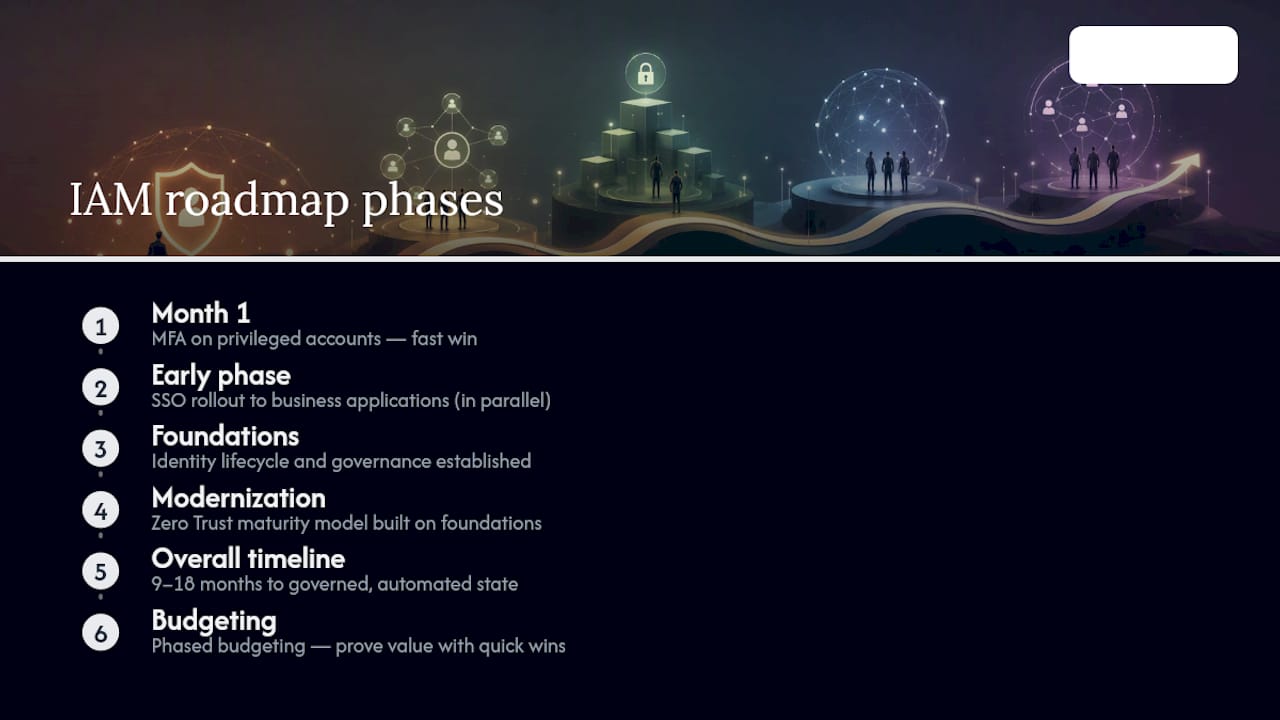
How much does an IAM roadmap typically cost to execute? Cost varies widely based on organization size, existing tooling, and how many legacy integrations are involved; a phased approach lets you budget incrementally rather than committing to a large upfront platform purchase before proving value with quick wins.
Sources
- Top 10 pitfalls in IAM programs (Protiviti whitepaper)
- Identity fundamental concepts (Microsoft Entra documentation)
- Privileged Access Manager overview | Identity and Access Management (Google Cloud Documentation)
- What is Identity and Access Management (IBM)