Enterprise Software Comparison 2026: Shortlist for IT Leaders

TL;DR:
- Enterprise software in 2026 hinges on platform fit with existing ecosystems and effective change management. Custom development remains vital for organizations with unique processes, proprietary IP, or complex integrations. Proper planning reduces costs and ensures implementation success in the complex global enterprise landscape.
For most large enterprises, the 2026 shortlist comes down to four platforms: SAP S/4HANA for complex global operations, Oracle NetSuite for cloud-native consolidated financials, Microsoft Dynamics 365 for Microsoft-centric stacks, and Workday for HR-heavy enterprises. When your processes are genuinely unique, your IP needs protection, or deep integrations are non-negotiable, custom development from Yslootahtech is the stronger call.
TL;DR: Best picks by buyer profile
- Large multinational enterprise (complex supply chain, high transaction volume): SAP S/4HANA
- Finance-led upper mid-market (consolidated reporting, multi-entity): Oracle NetSuite / Oracle Fusion Cloud ERP
- Microsoft-centric organization (Azure, Office 365 already deployed): Microsoft Dynamics 365 (Finance or Business Central)
- HR-centric enterprise (global payroll, 1,000+ employees): Workday
- Fast-growing SMB or mid-market (low TCO, modular): Odoo or Acumatica Cloud ERP
- Manufacturing or distribution (shop-floor to finance): Epicor, SYSPRO, or Infor CloudSuite
- Enterprise work management / project collaboration: monday.com (enterprise), Wrike, or ClickUp
- Unique processes, IP protection, or deep integration requirements: Yslootahtech custom software and integration services
Implementation cadence: Vendor marketing often promises several months for deployment. Realistic deployments for complex global enterprises typically take longer, with hidden costs in professional services, data migration, and change management. Budget accordingly.
TCO bands (high-level): SMB deployments typically start at lower annual costs; mid-market rollouts are significantly more expensive; large enterprise implementations involve substantial first-year costs including partner fees.
Table of Contents
- Enterprise software comparison 2026: at-a-glance table
- Vendor profiles: what each platform actually delivers in 2026
- How to choose enterprise software in 2026: a practical checklist
- What the research says about implementation success in 2026
- How this comparison was built
- Key Takeaways
- The mistake most buyers make when selecting enterprise software
- When custom software beats packaged ERP: Yslootahtech's approach
- Useful sources for further research
Enterprise software comparison 2026: at-a-glance table
Pricing is heavily negotiated and module-dependent. The bands below reflect published and practitioner-reported ranges — treat them as a starting budget, not a quote.
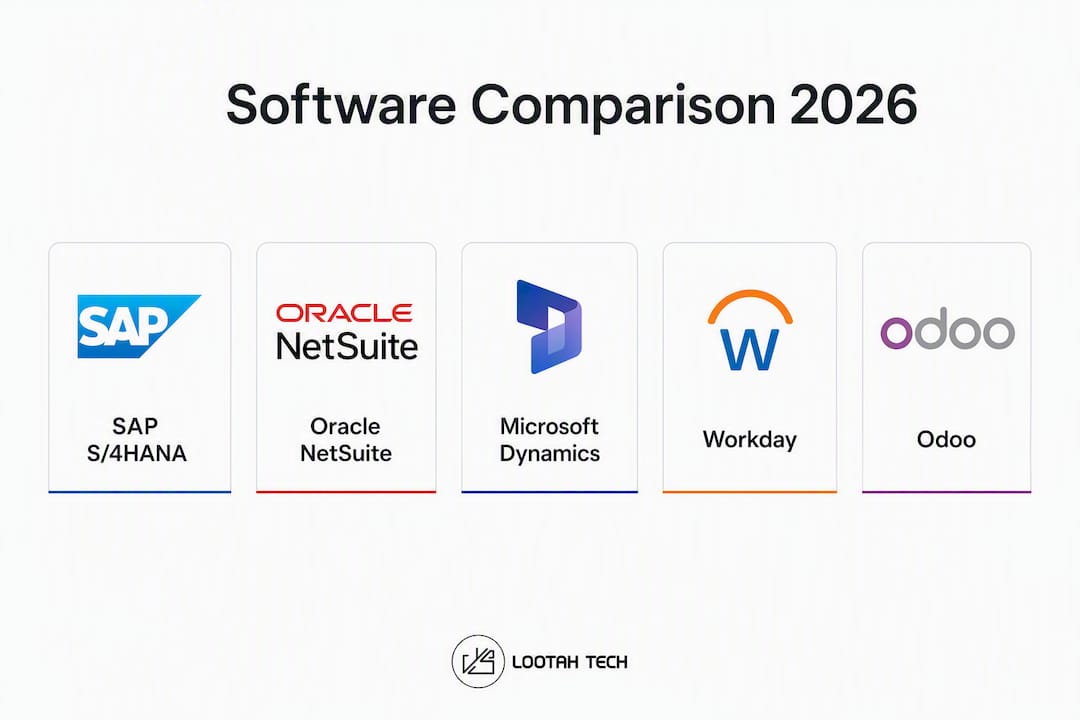
| Platform | Best for | Typical cost band (year 1) | Deployment | Standout modules / AI | Integrations / API | Implementation complexity | Support ecosystem |
|---|---|---|---|---|---|---|---|
| Yslootahtech | Unique processes, IP protection, complex integrations | Project-based (custom scope) | Cloud, hybrid, or on-prem | Custom AI, full-stack integration, UX/UI | Built to spec | Moderate (scoped project) | Direct, long-term support |
| SAP S/4HANA | Large multinational enterprise | High cost typical of complex ERP | Cloud, hybrid, on-prem | Finance, SCM, HR, embedded AI (Joule) | Extensive partner ecosystem | Very high | Global SI network |
| Oracle NetSuite | Mid-market to enterprise, consolidated financials | Cost varies widely for mid-market and enterprise deployments | Cloud-native | Finance, CRM, SCM, SuiteAnalytics AI | Strong REST APIs | Moderate–high | Oracle + partner network |
| Oracle Fusion Cloud ERP | Finance-heavy large enterprises | Costs are substantial, reflecting enterprise-grade functionality | Cloud-native | Finance, HCM, SCM, AI-driven analytics | Extensive | High | Oracle support tiers |
| Microsoft Dynamics 365 | Microsoft-centric organizations | Pricing depends on scope and modules | Cloud, hybrid | Finance, SCM, CRM, Copilot AI | Power Platform, Azure | Moderate–high | Microsoft + partner network |
| Workday | Enterprises 1,000+ employees, global HR/payroll | Costs reflect enterprise-grade HCM and finance modules | Cloud | HCM, Finance, Payroll, AI skills graph | Strong APIs | High | Workday + certified partners |
| Odoo | SMBs and fast-growing mid-market | Pricing targets cost-sensitive buyers with modular flexibility | Cloud, on-prem | Finance, CRM, SCM, HR, eCommerce | App marketplace | Low–moderate | Community + Odoo partners |
| Infor CloudSuite | Manufacturing, distribution verticals | Costs range commensurate with industry-specific ERP | Cloud | Industry templates, SCM, Finance, AI | Industry connectors | High | Infor + SI partners |
| Acumatica Cloud ERP | Mid-market, flexible licensing | Pricing varies based on computing resources and usage | Cloud, hybrid | Finance, Distribution, CRM, AI | REST APIs, partner marketplace | Moderate | Partner-led |
| Epicor | Manufacturers, distributors | Costs reflect integrated shop-floor to finance ERP | Cloud, on-prem | MES, Finance, SCM, AI forecasting | Industry integrations | Moderate–high | Epicor + VARs |
| Sage Intacct | Finance-led mid-market, multi-entity | Pricing typically aligns with mid-market finance ERP needs | Cloud | Multi-entity finance, reporting, AI | API-first | Low–moderate | Sage + partner network |
| monday.com (enterprise) | Work management, project-centric teams | Pricing varies with enterprise feature tier | Cloud | Work OS, dashboards, AI automation | 200+ integrations | Low | monday.com support |
| ServiceNow | ITSM, cross-enterprise workflows | Costs scale with enterprise ITSM scope | Cloud | ITSM, ITOM, HR Service Delivery, AI | Extensive | High | ServiceNow + partners |
| HubSpot | Marketing/sales-led organizations | Pricing depends on hub configurations and features | Cloud | CRM, Marketing Hub, AI content tools | 1,000+ integrations | Low | HubSpot support |
| Zoho One | Cost-sensitive, broad app coverage | Pricing designed for cost-conscious businesses | Cloud | CRM, Finance, HR, Analytics | Zoho ecosystem | Low | Zoho support |
| Jira | Software/product engineering teams | Pricing varies with user count and deployment type | Cloud, on-prem | Issue tracking, Agile, AI suggestions | Atlassian ecosystem | Low–moderate | Atlassian support |
| Wrike | Enterprise project/program management | Costs depend on tier and scale | Cloud | Work management, Gantt, AI risk | 400+ integrations | Low–moderate | Wrike support |
| ClickUp | Flexible work OS for teams | Pricing adjusts for user count and features | Cloud | Tasks, docs, goals, AI writing | 1,000+ integrations | Low | ClickUp support |
| Asana | Program management, ease of use | Pricing reflects tier and user base | Cloud | Tasks, portfolios, AI Studio | 300+ integrations | Low | Asana support |
| Smartsheet | Portfolio/program planning, grid UX | Costs scale with user and feature plan | Cloud | Sheets, dashboards, AI formulas | — | Low | Smartsheet support |
| Trello | Lightweight teams, departmental workflows | Pricing reflects light usage and feature set | Cloud | Kanban boards, Power-Ups | Atlassian ecosystem | Very low | Atlassian support |
| Airtable | Composable apps, flexible data models | Pricing varies by usage and tier | Cloud | Low-code database, AI fields | REST API | Low | Airtable support |
| IFS Cloud | Asset-intensive industries (aerospace, defense) | Pricing corresponds to complex deployments | Cloud, on-prem | Asset lifecycle, FSM, Finance, AI | Industry connectors | High | IFS + partners |
Key trade-offs worth calling out:
- Time-to-value vs. depth: Odoo, Acumatica, and monday.com get you live faster. SAP S/4HANA and Oracle Fusion deliver deeper functionality but demand 12–24 months and significant internal staffing.
- TCO drivers: License fees are rarely the largest line item. Professional services, data migration, and internal change-management routinely double the vendor invoice.
- AI maturity varies sharply: SAP's Joule, Microsoft Copilot, and Oracle's embedded analytics are production-ready. Many mid-market vendors label basic automation as "AI." Ask vendors for specific AI governance and update rollback policies before signing.
- Ecosystem lock-in: Choosing a platform that aligns with your existing tech stack (Azure/Office 365 for Dynamics 365, Oracle infrastructure for Fusion Cloud) materially reduces integration work and technical debt.
- Custom vs. packaged: When your process is the product, packaged software forces compromise. That is the scenario where Yslootahtech's custom builds consistently outperform off-the-shelf alternatives.
Pricing figures are best-effort estimates drawn from published vendor documentation, Capterra listings, and practitioner reports. Actual costs depend on negotiated terms, module selection, and partner rates. Always request itemized quotes covering license, implementation, training, and year-2 maintenance before committing.
Vendor profiles: what each platform actually delivers in 2026
Yslootahtech (custom software and integration services)
Best for: Organizations with proprietary processes, IP to protect, or integration requirements that packaged ERP cannot meet without heavy customization. Deployment: Cloud, hybrid, or on-prem, built to spec. Standout: End-to-end custom application development, deep system integrations, UX/UI design, and long-term support. Implementation: Scoped by project; typically faster than large ERP rollouts for targeted use cases. Pro: You own the roadmap and the codebase. Con: Requires clear requirements upfront; not the right fit for buyers who want a pre-built, out-of-the-box solution.
SAP S/4HANA / SAP Cloud ERP
The gold standard for complex, high-volume global operations. Finance, SCM, HR, manufacturing, and embedded AI (Joule) are all production-ready. Implementation is very high complexity, typically 12–24 months for global rollouts. The global SI partner network is unmatched. The trade-off: cost and change-management burden are substantial, and smaller organizations rarely recoup the investment.

Oracle NetSuite / Oracle Fusion Cloud ERP / NetSuite ERP
NetSuite is cloud-native and strong for mid-market to enterprise consolidated financials. Published pricing starts around $999/month for the base platform plus per-user and per-module fees; small deployments run $12K–$60K/year, while real-world mid-market rollouts commonly cost $120K–$300K+ per year. Oracle Fusion Cloud ERP targets larger, finance-heavy enterprises with deeper HCM and SCM modules. Both carry strong REST APIs and a broad partner network. Implementation runs 12–24 months for complex enterprise projects.
Microsoft Dynamics 365 (Finance, Business Central, Dynamics 365 Finance)
Three products, one ecosystem. Business Central (formerly Microsoft Dynamics NAV) suits mid-market companies that want a familiar Microsoft interface. Dynamics 365 Finance targets large enterprises needing global financial management. Both connect natively to Power Platform, Azure, and Copilot AI. For organizations already running Azure and Office 365, ecosystem alignment cuts integration cost significantly. Implementation complexity is moderate to high depending on customization depth.

Workday
Workday dominates enterprise HCM at 1,000+ employees and pairs it with a capable finance module. The unified HR and finance data model is genuinely differentiated. For organizations under 1,000 employees, the fit-for-cost rarely justifies the license and implementation investment. Implementation timelines run 12–24 months for global deployments.
Odoo
Odoo delivers roughly 80% of ERP functionality at 10–20% of the cost of traditional incumbents, making it the default recommendation for fast-growing SMBs and cost-sensitive mid-market buyers. The modular app marketplace lets you start small and expand. Community support is broad; enterprise support requires an Odoo partner. On-prem and cloud options are both available.
Infor CloudSuite
Purpose-built industry templates for manufacturing, distribution, and services make Infor CloudSuite worth evaluating when vertical depth matters more than horizontal breadth. Implementation is high complexity; the partner ecosystem is smaller than SAP or Oracle but more specialized.
Acumatica Cloud ERP
Usage-based licensing (priced on computing resources, not per-user seats) is Acumatica's clearest differentiator for growing mid-market companies. REST APIs and a strong partner marketplace support flexible integrations. Implementation is partner-led and typically runs 3–9 months for standard deployments.
Epicor
Epicor's shop-floor-to-finance integration is its core strength for manufacturers and distributors. MES capabilities, industry-specific workflows, and AI-driven demand forecasting are production-ready in 2026. Available cloud and on-prem. Implementation runs 6–12 months for mid-market; longer for complex multi-site deployments.
Sage Intacct / Sage Group / Sage X3
Sage Intacct is the finance-first choice for multi-entity mid-market organizations. Multi-entity consolidation, dimensional reporting, and an API-first architecture make it a strong pick for accounting-led buyers. Sage X3 extends into manufacturing and distribution for larger Sage customers. Implementation is relatively fast at 3–6 months for standard configurations.
monday.com (enterprise) / monday.com (enterprise offering)
monday.com's work-management building blocks are genuinely flexible and fast to deploy. The enterprise tier adds governance, SSO, and advanced reporting. It is not an ERP replacement; it is the right tool for operational workflows, project tracking, and cross-team collaboration. Over 200 integrations cover most common enterprise stacks.
Epsilon3
A niche operational workflow platform that appears on enterprise software shortlists for aerospace, defense, and complex procedure-driven operations. Best evaluated when your use case involves structured procedure management rather than broad ERP functionality.
Productive
Professional services automation and project financials in one platform. Productive suits agencies, consultancies, and services firms that need project profitability tracking, resource utilization, and billing in a single tool. Not a full ERP; strong PSA.
SYSPRO
Manufacturing and distribution ERP with deep shop-floor capabilities. Suited to mid-market manufacturers that want ERP without the complexity of SAP or Oracle. Available cloud and on-prem. Implementation typically runs 6–12 months.
IFS Cloud
Strong service lifecycle management and asset management make IFS Cloud the preferred choice for aerospace, defense, utilities, and field-service-heavy organizations. Implementation is high complexity; the partner ecosystem is specialized rather than broad.
Blue Link ERP
Inventory-first ERP for small distributors and product businesses. Straightforward implementation and focused functionality make it a practical choice when you do not need the overhead of a full mid-market ERP.
BatchMaster ERP
Formula and recipe management, batch traceability, and compliance features for food, beverage, and chemical manufacturers. A narrow but well-executed vertical solution.
DigitBridge
A niche entrant for specific e-commerce and retail operational workflows. Evaluate against vendor documentation for your exact use case.
SAP Business One
SAP's SMB-focused ERP brings SAP-grade finance and reporting to smaller organizations without the full S/4HANA implementation burden. A reasonable bridge for SMBs that expect to grow into the broader SAP ecosystem.
Deltek Vantagepoint
Project accounting and industry workflows for AEC (architecture, engineering, construction) and professional services firms. Strong project-centric financials and resource management. Implementation runs 4–9 months for standard deployments.
QAD Adaptive
Manufacturing ERP with adaptive supply chain capabilities. Suited to manufacturers that need supply chain flexibility and lean manufacturing support. Cloud-first in 2026.
DELMIAWorks / DELMIAWorks Manufacturing ERP (Formerly IQMS)
MES and ERP integration in a single platform for discrete and process manufacturers. Strong shop-floor data collection and quality management. Dassault Systèmes ownership brings broader PLM connectivity.
CMiC
Construction-specific ERP covering project controls, job cost accounting, and field operations. The go-to for general contractors and capital project organizations that need finance and field data in one system.
Aptean Distribution ERP (formerly Apprise ERP)
Distribution-centric workflows covering inventory, order management, and warehouse operations for wholesalers and distributors. Focused functionality with a mid-market price point.
Kenandy ERP
Configurable cloud ERP for manufacturers built on Salesforce. Suits manufacturers already invested in the Salesforce ecosystem who want manufacturing modules without leaving that platform.
WinMan ERP Software
SMB-focused ERP for manufacturers and distributors with standard processes. Practical functionality without enterprise-level complexity or cost.
Aptean Food & Beverage ERP JustFood Foundation Edition
Traceability, compliance, and recipe management for food and beverage manufacturers. Regulatory compliance features (FDA, FSMA) are built in rather than bolted on.
Visual EstiTrack
Niche estimation and job tracking ERP for small job shops and custom manufacturers. Suited to operations where quoting accuracy and job costing are the primary pain points.
Inecta Food ERP
Cloud-based ERP for food manufacturers and processors with built-in compliance and traceability. A practical alternative to larger food-industry platforms for mid-sized operations.
CSB-System
ERP for food, beverage, and consumer goods industries with integrated supply chain and production management. Strong in European markets; available in the US for multinational food processors.
Wrike
Enterprise project and program management with Gantt charts, workload management, and AI-driven risk detection. Strong for PMOs and cross-functional program teams. Over 400 integrations.
ClickUp
Highly configurable work OS covering tasks, docs, goals, and AI writing assistance. The breadth of configuration options is its strength and its learning curve.
Asana
Ease of adoption is Asana's clearest advantage. Portfolio management, AI Studio for workflow automation, and a clean UX make it the default recommendation for teams prioritizing fast rollout over deep customization.
Smartsheet
Grid-based UX that feels familiar to Excel users. Strong for program and portfolio planning at enterprise scale. AI formula suggestions and automated workflows are production-ready in 2026.
Trello
Card-based task management best suited to departmental workflows and lightweight teams. The enterprise tier adds SSO and admin controls, but Trello is not the right tool for complex program management.
Airtable
Low-code database and workflow builder for teams that need composable apps and flexible data models. AI field generation and automation are available in the enterprise tier.
ServiceNow
The dominant enterprise ITSM and workflow platform. IT service management, IT operations management, HR service delivery, and AI-powered virtual agents are all mature in 2026. High implementation complexity; the partner ecosystem is extensive.
HubSpot
CRM and marketing automation that scales into enterprise through its hub architecture. Over 1,000 integrations and strong AI content tools make it the default for marketing and sales-led organizations. Not an ERP replacement.
Zoho One
Broad app coverage (CRM, finance, HR, analytics, and more) at a price point well below enterprise incumbents. The right choice for cost-sensitive organizations that need breadth over depth.
Jira
The standard for software development and product teams requiring issue tracking, Agile boards, and CI/CD integrations. AI-powered sprint planning suggestions are available in 2026. Part of the Atlassian ecosystem alongside Confluence and Trello.
Niche and emerging entrants: Expandabled ERP, ERP-ONE+, OpenPro, Bizowie Cloud ERP, ADaM, PearlChain, PK7, Q2S ERP, Total ETO, and WM Synergy each serve specific verticals or regional markets. Evaluate these against vendor documentation and reference customers in your industry before shortlisting. They rarely appear in analyst quadrants, so practitioner references carry more weight than marketing claims.
How to choose enterprise software in 2026: a practical checklist
The matrix approach — weighting business outcomes over raw feature lists — consistently outperforms feature-chasing in reducing TCO misalignment. Here is the sequence that works.
- Define business outcomes first. Write down three to five specific outcomes the software must deliver (e.g., reduce month-end close from 10 days to 3, consolidate financials across 12 entities, automate purchase-order approval). Every vendor evaluation flows from this list.
- Map outcomes to required modules. Identify which functional modules (finance, SCM, HR, CRM, BI) each outcome requires. This prevents buying a full ERP when a focused tool would suffice.
- Assess integration risk. List every system the new platform must connect to (ERP, CRM, HRIS, data warehouse, legacy apps). Score each integration as native, API-supported, or custom. A high custom-integration count is a signal to consider Yslootahtech's integration services or a custom build.
- Estimate honest TCO. License fees are the starting point, not the total. Add implementation partner fees, internal staff time, data migration, training, and year-2 maintenance. For enterprise application deployment, internal resource costs routinely match or exceed the vendor invoice.
- Validate implementation capacity. Identify your internal project lead, PMO support, and subject-matter experts before signing. Vendors will not staff your project team.
- Run a pilot or phased rollout. A 90-day pilot on one business unit or process is worth more than any demo. Insist on it before full commitment.
RFP questions to ask every vendor:
- What is the all-in year-1 cost including implementation, training, and data migration?
- What is the standard SLA for P1 incidents, and what is the escalation path?
- How are platform updates deployed, and can we delay a release?
- How is embedded AI governed? Who controls model retraining and what is the rollback policy?
- What security certifications do you hold (SOC 2 Type II, ISO 27001, FedRAMP)?
- What is your partner network size in our region, and can you provide three reference customers in our industry?
- What are the change-order rate caps in your implementation contract?
Red flags:
- Opaque pricing that requires a sales call before any figure is shared
- Mandatory module bundles that include functionality you will never use
- No fixed-scope implementation milestones (time-and-materials only)
- A partner ecosystem with fewer than 10 certified partners in your region
- AI features that cannot be explained in terms of the underlying model or governance policy
Procurement tips: Negotiate implementation days as a fixed-scope deliverable, not time-and-materials. Cap change-order rates at a defined percentage of the base contract. Lock renewal escalation rates at signing. Ask for a sandbox environment before go-live acceptance.
Pro Tip: Budget a dedicated internal change-management role before you sign anything. The single most common reason enterprise software implementations run over budget is not the vendor's fees — it is the internal bandwidth gap. Organizations that fund a full-time internal project lead and a change-management budget (typically 15–20% of total project cost) consistently hit go-live targets faster than those that treat it as a part-time responsibility.
What the research says about implementation success in 2026
Platform fit and change management are the two variables that most reliably predict whether an enterprise software implementation delivers its promised ROI. Feature richness is a distant third.
Large ERP implementations commonly take 12–24 months; vendor marketing timelines of 6–9 months are frequently optimistic for complex global deployments. The gap between the demo and the go-live is where most budget overruns occur, and the cause is almost always the same: underestimated data migration effort, insufficient internal staffing, and scope creep driven by feature requests that were not in the original requirements.
Hidden cost drivers that buyers consistently underestimate:
- Professional services: Implementation partner fees often equal or exceed the first-year license cost for mid-market and enterprise deployments.
- Data migration: Cleansing, mapping, and validating legacy data is labor-intensive. Budget 10–15% of total project cost for data migration alone.
- Per-module fees: Most platforms charge separately for advanced modules (analytics, AI, payroll, eCommerce). The base license rarely covers everything in the demo.
- Renewal escalations: Multi-year contracts often include annual escalation clauses of 5–10%. Negotiate a cap at signing.
- Post-go-live stabilization: The first 90 days after go-live require dedicated support resources. Plan for a stabilization sprint before declaring the project complete.
AI capabilities and update cadence are now key differentiators in 2026. Buyers must ask how embedded AI is governed, how often platform updates are deployed, and whether updates can be delayed for testing. Vendors that cannot answer these questions clearly are not ready for enterprise governance requirements.
Pro Tip: For cloud computing deployments, build a 90-day post-go-live stabilization sprint into the project plan and fund it with dedicated internal resources. Most organizations declare victory at go-live and then spend the next six months firefighting issues that a structured stabilization phase would have caught.
For buyers evaluating BI capabilities alongside their ERP selection, choosing the right BI solution is a parallel decision that affects total analytics cost and integration complexity.
How this comparison was built
Transparency about methodology is what separates a useful shortlist from a vendor-sponsored ranking.
Selection filters applied:
- Market relevance in the United States in 2026 (active sales, support, and partner presence)
- Feature maturity confirmed by analyst reviews (G2, Capterra) and vendor documentation
- Adoption footprint (reference customers, partner ecosystem size, review volume)
- Documented pricing or TCO signals from practitioner reports and published vendor pages
- AI capability claims validated against vendor documentation, not marketing copy
Sources used:
- G2's Best Software for Enterprise Businesses 2026 for adoption signals and user review data
- Capterra ERP listings for pricing bands and user-review signals
- Practitioner reports from MakerStack, WorkTech Desk, and ERPimplementation.eu for TCO and implementation data
- Vendor documentation for module coverage, deployment models, and AI governance
- Yslootahtech's enterprise deployment and AI strategy resources for practitioner context
How to read the comparison table:
- Pricing cells are best-effort estimates. Treat them as a budget anchor, not a vendor quote.
- "Implementation complexity" reflects practitioner-reported experience, not vendor marketing timelines.
- Some vendors (niche entrants: Expandabled ERP, ERP-ONE+, OpenPro, Bizowie, ADaM, PearlChain, PK7, Q2S ERP, Total ETO, WM Synergy) are excluded from the main table because publicly documented TCO and feature data is insufficient for a fair comparison. Evaluate them directly with the vendor.
The comparison matrix approach used here weights scalability, flexibility, TCO, UX, and AI capabilities as primary pillars. Raw feature counts are not a reliable proxy for fit.
Key Takeaways
The strongest predictor of enterprise software ROI in 2026 is platform fit with your existing tech stack and change-management capacity, not feature count or vendor brand.
| Point | Details |
|---|---|
| Shortlist by scale and stack | Match the platform to your company size and existing ecosystem before evaluating features. |
| Budget realistic TCO | Year-1 all-in costs routinely run 2x the license fee once implementation, migration, and training are included. |
| Plan for 12–24 months | Complex global ERP deployments rarely go live in under a year; vendor timelines are frequently optimistic. |
| Govern AI features explicitly | Ask vendors for AI governance policies, update rollback procedures, and model retraining schedules before signing. |
| Yslootahtech for custom needs | When unique processes, IP protection, or deep integrations make packaged ERP a poor fit, Yslootahtech's custom development is the recommended alternative. |
The mistake most buyers make when selecting enterprise software
The conventional wisdom says: build a feature matrix, score every vendor, pick the highest score. That process feels rigorous. It is also how organizations end up with a $2M SAP implementation that solves problems they do not have while missing the three integrations they actually need.
The real selection error is confusing feature breadth with fit. A platform that covers 200 modules is not better than one that covers 40 if your organization will use 15. The vendors with the longest feature lists are also the ones with the longest implementation timelines, the largest partner fees, and the steepest learning curves. Buying more platform than you need is not conservative — it is expensive.
The second mistake is treating AI as a tiebreaker. In 2026, every major vendor has an AI story. Most of it is real; some of it is rebranded automation. The question is not whether a platform has AI but whether the AI is governed in a way your compliance team can sign off on. Ask for the AI governance documentation before the demo ends. Vendors that cannot produce it are not ready for enterprise deployment.
The third mistake is underestimating the internal cost. The enterprise application deployment guide from Yslootahtech makes this point directly: implementation cost is not only the vendor and partner invoices. It is the internal bandwidth consumed by data migration, testing, training, and stabilization. Organizations that fund this work explicitly finish on time. Those that treat it as a side project of existing staff almost never do.
For organizations with genuinely unique processes, the cleanest path is often a custom build. Packaged software is designed for the median buyer. If your process is your competitive advantage, forcing it into a vendor's data model costs you more in workarounds and customization than a purpose-built system would have cost from the start. That is the scenario Yslootahtech is built for.
When custom software beats packaged ERP: Yslootahtech's approach
There are strong packaged options on this list. SAP, Oracle, Dynamics 365, and Workday are mature platforms with deep functionality and large partner ecosystems. For the majority of buyers, one of them is the right answer.
But there is a category of organization where packaged software consistently underdelivers: companies with proprietary processes that are the source of their competitive advantage, organizations with complex integration requirements across legacy and modern systems, and businesses that need to own their technology roadmap rather than depend on a vendor's release schedule.
Yslootahtech builds custom enterprise applications and integration layers for exactly these scenarios. The work covers custom application development, deep system integrations, UX/UI design for enterprise adoption, and long-term support, all scoped to your specific requirements rather than a vendor's standard module set. The result is a system you own, with a roadmap you control, and integrations that fit your actual architecture rather than a packaged platform's assumptions.
If your evaluation has surfaced integration complexity, proprietary process requirements, or a need to protect IP through owned software, the next step is a scoping conversation. Contact Yslootahtech's application development team to discuss your requirements and get a project-based assessment.
Useful sources for further research
Use these sources to validate claims, pull vendor documentation, and cite analyst data in your RFPs.
- G2 Best Software for Enterprise Businesses 2026 — Peer review data and adoption signals across enterprise software categories; cite in RFPs to show market adoption benchmarks.
- Capterra ERP Software Listings 2026 — Pricing bands and user reviews for ERP platforms; useful for initial budget anchoring and vendor shortlisting.
- AI Trends for Enterprises: 2026 Strategic Guide (Yslootahtech) — Covers embedded AI governance, update cadence, and strategic implications for enterprise buyers.
- Enterprise Application Deployment Guide 2026 for IT Leaders (Yslootahtech) — Practical deployment checklists and internal staffing guidance; use when building your implementation project plan.
- How to Choose the Right Business Intelligence Solution (ChristianSteven) — BI selection framework that complements ERP evaluation; useful when BI and analytics are a parallel workstream.
- Top Technology Trends: What Business Leaders Need for 2026 (Yslootahtech) — Strategic context on cloud, AI, and enterprise technology priorities for 2026 planning.