Best Depop.com Alternatives for Scaling Your Brand

TL;DR:
- Popular US resale platforms include eBay and Poshmark, each suited for different inventory types and buyer behaviors. Building a custom marketplace becomes worthwhile when platform fees and data ownership issues significantly impact margins at high sales volumes. Using cross-listing tools like Vendoo or List Perfectly helps manage multiple marketplaces efficiently and reduces oversell risks.
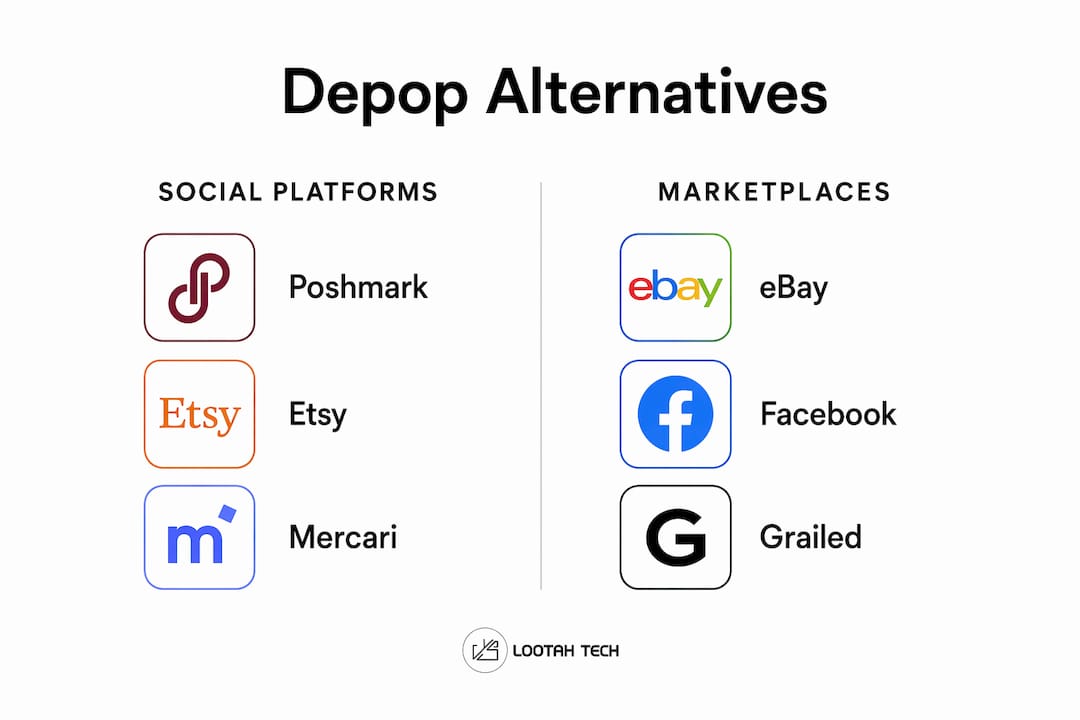
eBay, Poshmark, Mercari, Grailed, Etsy, and Facebook Marketplace are the strongest depop.com alternatives for US sellers right now. Each targets a distinct inventory type and buyer intent. If you're running 500+ SKUs, managing staff, or losing margin to platform fees, a custom storefront or marketplace build deserves a hard look.
Quick inventory-to-platform map:
- Luxury, vintage, and high-value items: eBay (global reach, authentication programs, advanced seller tools)
- Men's streetwear and designer pieces: Grailed (niche buyer pool, 9% commission, premium filters)
- Fast-moving mall brands (Aritzia, Lululemon): Poshmark (social sharing, flat shipping, strong community)
- All-category or mixed inventory: Mercari (10% flat fee, algorithmic discovery, simple onboarding)
- Handmade goods and vintage collectibles: Etsy (96 million buyers, Google Shopping integration)
- Local, bulky, or quick-turn items: Facebook Marketplace (zero local fees, massive reach)
When to build your own: Once platform fees, branding constraints, or lack of customer data ownership are costing you more than a custom build would, the math shifts. That threshold typically hits around consistent five-figure monthly gross merchandise volume with margin pressure above 15–20%.
Table of Contents
- How do the top depop.com alternatives compare side by side?
- How do you pick the right platform for your catalog and margins?
- What does selling look like day-to-day on each platform?
- Which cross-listing tools reduce your dependence on any single app?
- When does building your own marketplace make more sense?
- How do you migrate off Depop without losing listings or data?
- Key Takeaways
- The case for owning your channel before you need to
- Yslootahtech: custom marketplace and integration services
- Useful resources for further reading
How do the top depop.com alternatives compare side by side?
| Platform | Best for | Seller fees | Buyer protection | Discovery model | Scaling / analytics | Shipping support | Cross-listing |
|---|---|---|---|---|---|---|---|
| eBay | Vintage, luxury, high-volume | ~8–13.6% on clothing | eBay Money Back Guarantee | Algorithmic + SEO | Strong seller analytics | Integrated labels | API + Vendoo, List Perfectly |
| Poshmark | Mall brands, social sellers | 20% over $15 | Posh Protect program | Social sharing | Basic | Flat-rate prepaid | Vendoo, List Perfectly |
| Mercari | All-category casual | 10% flat | Mercari Protection | Algorithmic | Moderate | Integrated labels | Vendoo, List Perfectly |
| Grailed | Men's streetwear, designer | 9% + payment fees | Grailed Buyer Protection | Algorithmic + niche SEO | Limited | Seller-managed | Limited |
| Etsy | Handmade, vintage, crafts | payment processing fees apply | Etsy Purchase Protection | SEO + Google Shopping | Good | Integrated labels | Vendoo, List Perfectly |
| Facebook Marketplace | Local, bulky goods | 0% local; 10% shipped | Limited | Social + location | Minimal | Seller-managed | Limited |
| Shopify | Owned storefront | Monthly subscription + payment processing | Customizable | SEO + paid ads | Full analytics | Carrier integrations | Full API |
Fees differ materially across platforms, and headline seller commissions rarely tell the full story. Poshmark's 20% on items over $15 is steep, but it bundles shipping and a built-in social audience. Grailed's 9% looks lean until you add payment processing (3.49% + $0.49 domestic). eBay's tiered clothing rates (8% over $150, 13.6% under $150) reward higher-priced inventory.
The real cost of a marketplace is fees plus dispute overhead plus listing labor. A platform with a 5% lower commission but a weak dispute framework can cost more in chargebacks and staff time than the fee savings ever recover.
Poshmark's Posh Protect and eBay's Money Back Guarantee are the two most established buyer-protection frameworks in US resale. Both have long dispute-resolution track records. Grailed and Mercari offer protection programs, but their histories are shorter and complaint volumes have been higher relative to transaction counts.
How do you pick the right platform for your catalog and margins?
The single most important criterion: match your inventory to buyer intent. A Grailed buyer is hunting for a specific Supreme drop or Yohji Yamamoto coat. A Poshmark buyer is browsing a social feed. Listing the same item the same way on both platforms wastes listing labor and underperforms on both.
Checklist for evaluating each option:
- Audience fit: does the platform's buyer demographic match your price point and category?
- True margin: headline fee + payment processing + shipping cost + estimated dispute rate
- Listing effort: how many custom fields, photos, and tags does the platform require per SKU?
- Dispute risk: does the platform's protection program favor buyers or sellers for your category?
- Integration requirements: does the platform offer an API or webhook for your ERP, payment processor, or shipping carrier?
Red flags that should steer you away:
- No public API or severely rate-limited API (blocks automation at scale)
- Frequent unilateral fee changes with short notice periods
- Buyer-protection policies that routinely side with buyers on subjective "not as described" claims
- No bulk listing or CSV import tools (a dealbreaker above 200 SKUs)
- Thin dispute-resolution documentation or no escalation path beyond chat support
What does selling look like day-to-day on each platform?
Each platform demands a different operational mindset. Poshmark is a social network that happens to sell clothes. eBay is a search engine with a checkout. Grailed is a curated community with authentication expectations. Treating them identically is the fastest way to underperform on all of them.
Operational differences are significant: Poshmark rewards sellers who share listings multiple times daily and engage with followers. Mercari and eBay reward keyword-rich titles, accurate category mapping, and competitive pricing relative to sold comps.
For a catalog of 500–2,000 SKUs, rough staffing estimates look like this: Poshmark needs roughly one part-time person per 300 active listings just for sharing and community engagement. eBay at that volume is more manageable with automation, closer to one person handling 800–1,000 listings with the right tools. Grailed requires slower, more detailed listing creation but lower ongoing maintenance.
Pro Tip: On eBay, use the "sold listings" filter to set prices, not active listings. Buyers see what actually cleared, and pricing to sold comps rather than wishful asks cuts time-to-sale significantly.
Listing success is platform-specific. Copy-pasting a Depop listing across platforms consistently underperforms. Each platform's algorithm weights different signals: eBay weights title keywords and item specifics; Poshmark weights recency and social shares; Grailed weights brand, condition, and price relative to recent sales.
Which cross-listing tools reduce your dependence on any single app?
Use cross-listing tools the moment you're active on two or more marketplaces. The alternative is manual duplication, which scales badly and creates oversell risk.

Vendoo and List Perfectly are the two most widely used tools in US resale for this purpose. Vendoo handles template management, cross-posting, and automatic delisting when an item sells. List Perfectly adds bulk editing and a Chrome extension for faster imports. Both support eBay, Poshmark, Mercari, Etsy, Grailed, and Facebook Marketplace.
Safe cross-listing workflow:
- Build a master SKU list with canonical attributes (title, description, condition, price, images) before posting anywhere.
- Map each attribute to platform-specific fields (eBay item specifics, Poshmark category tags, Grailed brand/size fields).
- Set delist-on-sale rules in your cross-listing tool before going live. Test with 10–20 SKUs first.
- Schedule a daily sync check for the first two weeks to catch any failed delists or attribute mismatches.
- Review platform-specific performance weekly for the first month. Adjust titles and pricing per platform based on actual sell-through, not assumptions.
For automation at scale, Shopify with marketplace integrations can serve as the inventory source of truth, pushing listings out and pulling orders back in. That's the hybrid model most mid-sized sellers land on before committing to a full custom build.
When does building your own marketplace make more sense?
Build your own when recurring margin loss, zero customer data ownership, and brand constraints on marketplaces cost more than the time and capital a custom build requires. That's not a philosophical question. It's arithmetic.
| Phase | Typical timeline | Key deliverables |
|---|---|---|
| Discovery & architecture | 4–6 weeks | Requirements, tech stack, integrations map |
| MVP build | roughly 10 weeks | Catalog, payments, seller onboarding, search, basic moderation |
| Integrations | 4–8 weeks | Shipping carriers, ERP, payment gateway, analytics |
| Pilot | 4–6 weeks | Closed beta, QA, rollback plan |
| Scale | Ongoing | Performance tuning, feature expansion |
MVP must-haves: product catalog, payment processing, seller onboarding flow, search and filtering, order management, and basic analytics. Nice-to-haves for v1: reviews, wishlists, advanced moderation, and recommendation engines.
Pro Tip: Start with a Shopify-based storefront and headless integrations before committing to a ground-up custom build. Most brands discover their real requirements during 6–12 months of live operation. Building custom on top of proven infrastructure is faster and cheaper than building from scratch on assumptions.
How do you migrate off Depop without losing listings or data?
Preserve canonical data and centralize inventory as a single source of truth before you scale to multiple channels. Migrating while actively selling on a live platform without a rollback plan is how sellers lose listing history, pricing data, and customer records.
- Export all active and sold listings from Depop (CSV or API where available). Include images, descriptions, sold prices, and dates.
- Normalize attributes: standardize condition labels, category names, and size conventions across your catalog.
- Map Depop categories and tags to the taxonomy of each destination platform.
- Migrate images to a CDN or cloud storage before re-uploading. Never rely on platform-hosted image URLs as a permanent source.
- Set up webhooks or scheduled syncs between your inventory system and each marketplace before going live.
- Run a parallel period (7–14 days) where both old and new systems are active, with manual reconciliation to catch sync failures.
API rate limits will bite you during bulk migrations. eBay's Trading API, for example, enforces per-day call limits that can stall a large catalog import. Plan your migration in batches and build in retry logic before you start.
For e-commerce platform features that support multi-channel inventory management, the architecture decisions made at migration time determine how painful scaling becomes later.
Key Takeaways
The strongest path for most US sellers is a two-to-three marketplace strategy using cross-listing tools, with a custom build reserved for when platform fees and data constraints are measurably hurting the business.
| Point | Details |
|---|---|
| Match inventory to platform | eBay for vintage/luxury, Grailed for streetwear, Poshmark for mall brands, Mercari for mixed categories. |
| Model true margin, not headline fees | Add payment processing, shipping, and dispute costs before comparing platforms. |
| Cross-list from day one | Vendoo and List Perfectly prevent oversells and reduce listing labor across multiple marketplaces. |
| Build custom when the math justifies it | Consistent margin loss above 15–20% GMV to fees is the clearest trigger to evaluate a custom build. |
| Yslootahtech for custom builds | Yslootahtech designs and builds custom marketplaces and storefront integrations for brands ready to move beyond consumer resale apps. |
The case for owning your channel before you need to
Most brands wait too long to think seriously about owning their sales channel. They stay on marketplaces until the fee math is painful, the algorithm changes hurt revenue, or a platform policy decision affects their entire catalog overnight. By then, the migration is urgent rather than planned, and urgent migrations are expensive.
The smarter move is to treat marketplace presence as a distribution strategy, not a business model. Marketplaces are excellent for discovery and early-stage volume. They are poor long-term foundations for brands that need customer relationships, pricing control, and margin predictability. The brands that build their own channel while marketplace revenue is still strong have the runway to do it right.
Operational discipline matters more than platform choice in the short run. A seller who shares listings consistently, prices to sold comps, and tailors descriptions per platform will outperform a seller with better inventory on a better platform who treats all channels identically. But discipline on someone else's platform has a ceiling. Owning the channel removes it.
Yslootahtech: custom marketplace and integration services
If the marketplace comparison above has you thinking about what an owned channel would actually cost and look like, Yslootahtech builds exactly that. The concrete advantage over staying on Poshmark or eBay indefinitely: you own the customer data, control the fee structure, and build brand equity that compounds instead of evaporating when a platform changes its algorithm.

Yslootahtech's relevant services for brands at this stage:
- Custom marketplace development (catalog, payments, seller onboarding, search, moderation, analytics)
- AI-driven pricing and personalization for owned storefronts
- Marketplace API integrations (eBay, Poshmark, Mercari, Etsy, Shopify)
- Inventory sync architecture and cross-listing automation
- Migration planning and data architecture for brands moving off consumer resale platforms
To get an initial scoping estimate, use the contact form at yslootahtech.com. Discovery calls typically take 45 minutes, and a written estimate follows within five business days.
Useful resources for further reading
- Apps Like Depop: Crosslisting Alternatives That Actually Work — real seller breakdown of platform trade-offs and cross-listing strategy
- Best Depop Alternatives (App Vulture) — fee structures, buyer protection comparisons, and authentication program details
- Best Depop Alternatives in 2025 (Vendoo Blog) — cross-listing tool workflows and per-platform listing optimization
- Other Apps Like Depop for 2026 Fashion Finds (Closo) — operational differences and staffing implications per platform
- Apps Similar to Depop for Reselling (Closo) — comparison table with fees, unique edges, and limitations
- Yslootahtech E-Commerce Platform Features Guide — integration patterns and feature planning for owned storefronts
- Yslootahtech Automation Tools Decision Guide — automating cross-listing, order routing, and inventory reconciliation
- Build a Powerful Ecommerce Platform with Shopify — hosted storefront options and hybrid build approaches
This article is general information for planning purposes, not legal or financial advice. Confirm current fee structures and platform policies directly with each marketplace before making business decisions.