Build vs Buy Software: A Capability-Based Playbook for 2026

Buy commodity functions. Build the true differentiators you can staff and own. For most mid-size decisions in between, buy-and-extend is the pragmatic default in 2026.
That single rule resolves most of the anxiety around the build vs buy software debate, but it only works if you apply it capability by capability rather than as one company-wide verdict. Treat every internal build candidate to a 90-day thin-slice test: if a working prototype cannot ship real value inside that window, the build is probably wrong. Every decision also needs a 3- to 5-year total cost of ownership model, not a first-year price tag, because subscription renewals and build maintenance compound on very different curves.
Two 2026-specific forces change the math from five years ago:
- AI-assisted development has shortened build timelines for well-scoped internal tools, shifting some break-even points earlier than they used to sit.
- Vendor pricing has shifted toward consumption and AI add-on fees, which makes "buy" less predictable than the flat per-seat quotes of a few years back.
Key Takeaways
The strongest build vs buy software decisions score each capability individually against cost, risk, and control criteria, rather than picking one company-wide policy.
| Point | Details |
|---|---|
| Score by capability | Use the eight-criteria matrix on every function separately instead of one blanket build-or-buy policy. |
| Model 3 to 5 years | Sticker price misleads; build maintenance and buy renewal uplifts compound on different curves over time. |
| Run a 30-day sprint | Parallel pilots of a buy configuration and a thin-build prototype beat months of committee debate. |
| Watch the flip signals | Over 30% customization, strict regulatory control, or unique algorithmic IP usually points to build. |
| Yslootahtech supports both paths | Yslootahtech runs decision workshops, TCO modeling, and both build and buy-and-extend engagements. |
Table of Contents
- What Is the Build vs Buy Decision Framework?
- How Do You Model 3- and 5-Year TCO for Build vs Buy?
- What Are the Biggest Risks in Build vs Buy Decisions?
- Buy, Build, or Buy-and-Extend: Which Fits Your Situation?
- How Do You Run a 30-Day Build vs Buy Decision Sprint?
- Yslootahtech: A Partner for Build-or-Buy Decisions
- Which Editorial Perspective Should Guide Your Decision?
- Ready to Score Your Own Build vs Buy Decision?
- Where Can You Read More on Build vs Buy Frameworks?
- Sources
What Is the Build vs Buy Decision Framework?
A single yes-or-no answer is the wrong tool for this question. The better approach scores each requested capability against a consistent set of criteria and lets the score tell you whether to buy, build, or land somewhere in the hybrid middle. Harvard Business Review frames this as deciding by capability, weighing whether a function is a genuine competitive differentiator, how long you need it to last, and how well it needs to integrate with what you already run.
Score each capability from 1 to 5 across these criteria:
- Competitive differentiation — does this function give you an edge competitors can't buy off a shelf?
- Customization percentage — what share of your requirements fall outside standard configuration?
- Integration complexity — how many existing systems does this need to talk to?
- Time-to-market pressure — how fast do you need this live?
- Internal expertise — do you already have the engineers to build and maintain it?
- Regulatory requirements — does compliance demand control over data flow or audit trails a vendor can't guarantee?
- Scalability needs — will usage patterns change enough to strain a rigid vendor tier?
- Data sensitivity — how much risk comes from routing this data through a third party?
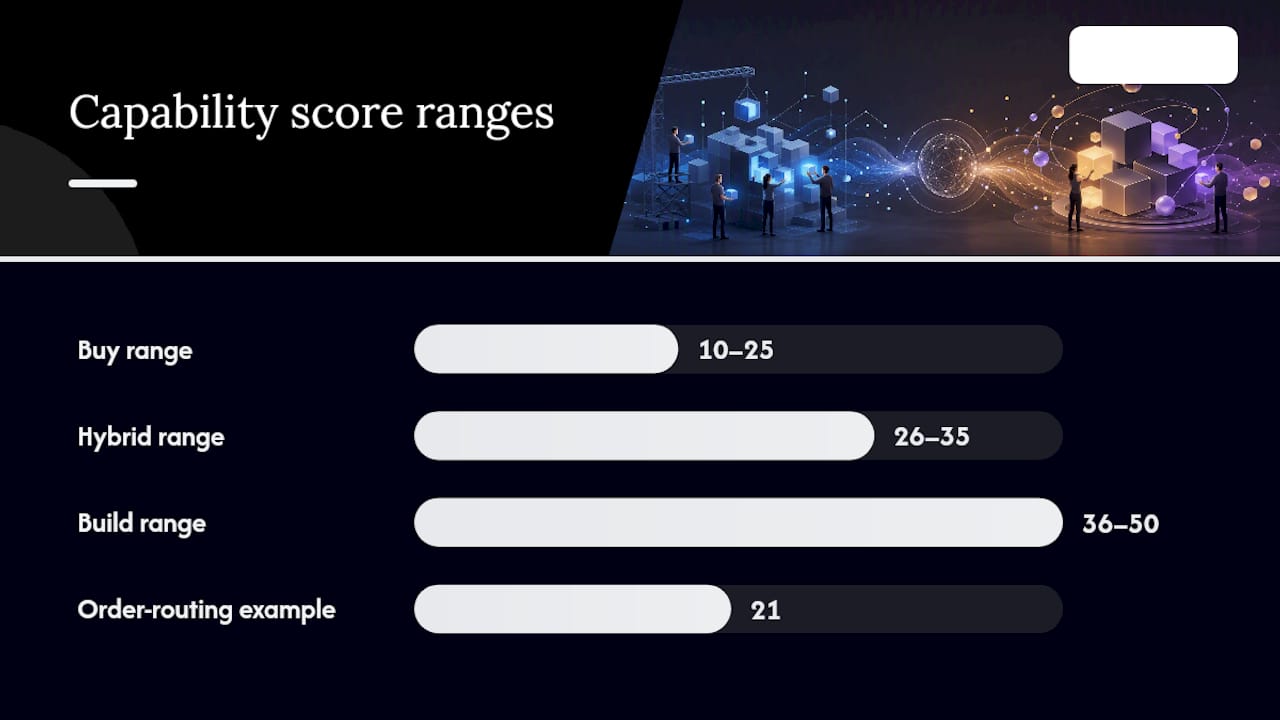
Add the eight scores. A total of 10 to 25 points toward buy. 26 to 35 suggests a hybrid, usually buy-and-extend. 36 to 50 justifies building. ARDURA's consulting framework recommends weighting integration complexity and internal expertise higher than the rest, since those two factors predict project failure more reliably than the others.
Try it on something ordinary: an internal order-routing rules engine. Low differentiation (2), moderate customization (3), high integration complexity because it touches your ERP and warehouse system (4), moderate urgency (3), decent internal expertise (3), low regulatory load (1), moderate scalability need (3), and moderate data sensitivity (2). That's 21, a clear buy or buy-and-extend, even though the engineering team will swear it "shouldn't be that hard" to build.
How Do You Model 3- and 5-Year TCO for Build vs Buy?
Sticker price is the least useful number in this whole decision. Total cost of ownership only tells the truth over a 3- to 5-year window, because build costs front-load and buy costs back-load.
Build costs to model:
- Discovery and requirements work
- Development hours (adjusted for AI-assisted coding productivity)
- Infrastructure and hosting
- Security review and compliance testing
- Documentation
- Ongoing maintenance, typically running a meaningful percentage of the original build cost every year for patching, upgrades, and bug fixes
Buy costs to model:
- License or subscription fees
- Implementation and configuration
- Integration work with existing systems
- Training and change management
- Internal admin headcount to manage the platform
- Renewal uplifts and add-on consumption or AI feature fees
Here's an illustrative example, not a quote. Say a mid-market company needs a customer onboarding tool. Buying a platform might run $40,000 to $70,000 in year one after implementation, then $50,000 to $90,000 a year after that once renewal uplifts and per-seat growth kick in. Over three years, buy often looks cheaper. Over five, if headcount or usage doubles, per-seat pricing can flip that math entirely, and the build starts looking like the better bet. Per-seat pricing is one of the quiet reasons SaaS costs balloon faster than most budget owners expect.
What Are the Biggest Risks in Build vs Buy Decisions?
Every path carries risk that has nothing to do with the invoice.
Building exposes you to scope creep, and to the quieter danger of nobody actually owning the thing once the person who built it moves teams. The mitigation is structural: design in modules with clear exit points so you can decommission or replace a piece without tearing down the whole system, and deliver in staged releases rather than one big-bang launch.
Buying carries its own version: vendor roadmaps that drift away from your needs, pricing that shifts after you're locked in, and integration points that break every time the vendor ships an update. Contract for renewal terms up front, insist on an API-first integration approach, and score vendor risk the same way you scored the build-vs-buy decision itself, because renewal uplifts and consumption-based AI fees are reshaping the buy-side economics in ways flat annual licenses never did.
- Build risk: under-resourced maintenance team. Mitigation: assign a named owner before writing the first line of code.
- Buy risk: vendor lock-in through proprietary data formats. Mitigation: require data export guarantees in the contract.
- Cross-path risk: SaaS sprawl from unchecked tool adoption. Mitigation: run every new request through governance review, no exceptions.
Pro Tip: Ask any vendor for their last two years of price-increase history before you sign, not just their current rate card. That pattern predicts your year-three cost better than the sales deck does.
Buy, Build, or Buy-and-Extend: Which Fits Your Situation?
Three real paths exist, not two. Buy means adopting a vendor's platform largely as-is. Buy-and-extend means buying a platform that covers most of your needs and adding custom logic through APIs or low-code tools for the rest. Build means writing the whole thing yourself.
Buy-and-extend increasingly wins the middle ground when a platform already covers roughly 80% of what you need and the remaining 20% can be handled through documented extension points rather than core code changes. It gives you a vendor's ongoing security patching and feature roadmap while still letting you shape the parts that matter to your workflow.
Certain signals should flip you away from the default:
- Customization needs exceeding roughly 30% of core functionality usually means extension will cost more than a clean build.
- Strict regulatory control over data residency or audit trails often rules out a vendor that can't guarantee it contractually.
- Genuinely unique algorithmic intellectual property, the kind that is your actual competitive edge, belongs in a build every time.
- Buy fits: payroll, expense management, standard CRM functions.
- Buy-and-extend fits: onboarding flows, reporting dashboards, workflow automation layered onto a base platform.
- Build fits: pricing engines, proprietary matching algorithms, anything core to how you beat competitors.
How Do You Run a 30-Day Build vs Buy Decision Sprint?
You don't need a six-month study to make this call. A tight sprint with real pilots beats months of committee debate.
- Week 1: Inventory every candidate capability and run it through the scoring matrix above. Produce a ranked shortlist of buy, hybrid, and build candidates.
- Week 2: Draft cost estimates and specs for the top buy candidates, and scope a thin-build prototype for anything scoring 36 or higher. Plan pilots for both.
- Weeks 3 and 4: Run the pilots in parallel, one buy configuration and one thin-build slice, measuring time-to-value, integration effort, and the maintenance burden each one reveals. Use the 90-day shippability test and your 3- to 5-year TCO model as the actual go or no-go gate, not gut feel.
By the end of the sprint you need three deliverables in hand: a completed scoring matrix, a TCO spreadsheet covering both paths, and a pilot report with a documented risk register. Skip any one of those three and you're back to guessing.
Yslootahtech: A Partner for Build-or-Buy Decisions
Yslootahtech is a Dubai-based technology company built around exactly this kind of decision. Our teams have delivered custom software projects across fintech, industrial management, and digital health, alongside cloud, cybersecurity, and AI integration work that touches both sides of the build-or-buy line.
Where we add the most value in this specific decision:
- Decision workshops that run the scoring matrix against your actual capability list, not a generic template
- Cost modeling that builds out your real 3- to 5-year TCO instead of a vendor's first-year quote
- Build-and-operate engagements for capabilities that score into build territory
- Buy-and-extend integration work when a platform covers most of your needs but the last 20% needs custom logic
- Ongoing maintenance contracts once a build ships, so ownership doesn't quietly disappear a year later
Which Editorial Perspective Should Guide Your Decision?
Most build-vs-buy advice still treats the question as a single company-wide philosophy, buy-first culture versus build-first culture, and that framing is dated. The research supports something narrower and more useful: score the capability, not the company. A business that buys its CRM and builds its pricing engine isn't being inconsistent. It's being correct twice.
The most overrated piece of conventional wisdom here is that building is always riskier than buying. It isn't, once AI-assisted development shortens a thin-slice build to weeks instead of quarters. What's underrated is vendor pricing risk. Teams model build costs obsessively and wave through a SaaS quote because it looks fixed, right up until the renewal uplift and the new AI feature tier arrive in year two.
If you take one thing from this playbook, run the 30-day sprint before you run another vendor demo. A scored matrix and two parallel pilots will tell you more in a month than six months of proposal review.
— YS
Ready to Score Your Own Build vs Buy Decision?
If the scoring matrix above pointed you toward build or buy-and-extend, the next step is turning that score into a working prototype, not another slide deck. Yslootahtech runs the exact decision sprint outlined here with client teams directly, scoring your real capability list, modeling your real 3- to 5-year TCO, and shipping a thin-build prototype inside the 90-day window before you commit to a full build.
Our website development team handles both full custom builds and buy-and-extend integration work, so the engagement matches whatever the scoring matrix actually tells you, rather than steering you toward one answer. For capabilities where the interface matters as much as the backend logic, our UX/UI design group can prototype the thin-build slice fast enough to fit inside week three of the sprint. Get in touch to schedule a decision workshop and walk out with a scored matrix and a cost model for your specific capability list.
Where Can You Read More on Build vs Buy Frameworks?
- Harvard Business Review on deciding by capability, not company policy
- Zylo's 2026 cost breakdown on buy-and-extend and hidden SaaS fees
- Statista's AI market outlook for AI's effect on build economics
Sources
- 3 Ways to Rethink Your Build-or-Buy Strategy
- Build vs Buy Software: The 2026 Decision Framework
- Build vs Buy Software: Pros and Cons, Costs, and How to Decide (2026)
- Statista: AI market outlook