Cut MTTR and Hit SLAs: Risk Based Vulnerability Management for IT

Vulnerability management is a continuous, risk-based program that repeatedly finds, prioritizes, remediates, verifies, and reports on security weaknesses. It is not a scan report or a once-a-quarter checkbox. The canonical lifecycle runs through five stages: identify, assess and prioritize, remediate, verify, and report and improve. Programs that run this loop well see lower mean time to remediate (MTTR) and measurably tighter SLA compliance across their asset base.
TL;DR:
- Effective vulnerability management relies on continuous, risk-based cycles that include identification, assessment, remediation, verification, and reporting, not just periodic scans.
- Governance must define scope, roles, SLAs, and exception protocols upfront, ensuring collaboration with change management to prevent remediation conflicts.
- Building a complete asset inventory tailored to different asset types and combining various scanning tools enhances detection accuracy in complex environments like cloud and containers.
- Prioritizing vulnerabilities based on exploitation likelihood and asset criticality prevents wasted effort on high-score but low-risk findings.
- Verifying remediations through automated scans and targeted tests, with proper documentation, is essential to confirm issues are truly resolved.
Table of Contents
- What Are the Stages of the Vulnerability Management Lifecycle?
- How Do You Govern a Vulnerability Management Program?
- How Do You Build a Complete Asset Inventory?
- How Do You Prioritize Vulnerabilities by Risk Instead of Score?
- What's the Right Way to Remediate and Handle Exceptions?
- How Do You Verify That a Fix Actually Worked?
- What Metrics Prove Your Vulnerability Management Program Works?
- Which Tools Do You Actually Need, and What Changes in the Cloud?
- How Does Vulnerability Management Connect to Patch Management and the SDLC?
- What Usually Breaks a Vulnerability Management Program?
- What Does a Practical Vulnerability Management Checklist Look Like?
- Starting or Fixing a Vulnerability Management Program: What Actually Matters
- Get Vulnerability Management Built and Run by a Technology Partner
- Sources
- FAQ
What Are the Stages of the Vulnerability Management Lifecycle?
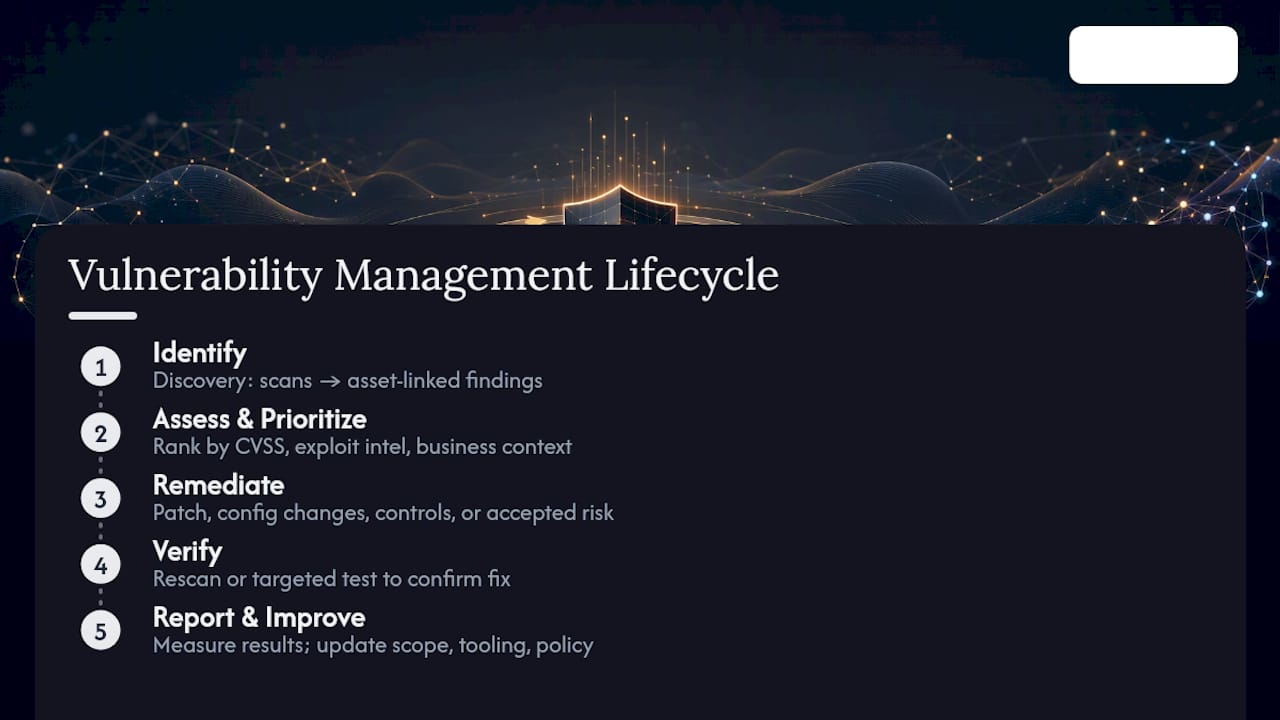
Each stage in the vulnerability management lifecycle produces a specific output that feeds the next one. Skip a stage, and the whole loop degrades into a scanning exercise with no teeth.
Identify starts with discovery: scanning networks, applications, containers, and cloud accounts to find what exists and what's wrong with it. The output is a raw finding list tied to specific assets.
Assess and prioritize takes that raw list and ranks it. This is where CVSS scores, exploit intelligence, and business context turn a spreadsheet of 4,000 findings into a short list of what actually needs attention this week.
Remediate is the fix: patching, configuration changes, compensating controls, or a documented risk acceptance. Verify confirms the fix worked, through a rescan, a targeted test, or in some cases a follow-up penetration test. Report and improve closes the loop by measuring what happened and feeding lessons back into scope, tooling, and policy.
The OWASP Vulnerability Management Guide frames this more simply as three interlocking cycles: detection, reporting, and remediation, each running at its own cadence. That framing matters because it warns against treating vulnerability management as a single linear project. OWASP is explicit that buying a scanner is not the same as running a program.
In practice, most teams run a full inventory and scope review annually or semi-annually, while scans against that scope run daily, weekly, or continuously depending on asset criticality. The data flows in one direction operationally (identify to report) but the findings from reporting should redraw scope for the next cycle. A vulnerability management program that never revisits scope eventually scans the wrong things thoroughly.
How Do You Govern a Vulnerability Management Program?
A vulnerability management program without written governance collapses the first time two teams disagree about whose job it was to patch something. CISA's CRR Resource Guide treats planning as a distinct phase with its own deliverables, not an afterthought bolted onto a scanning tool purchase.
A working policy needs to spell out, in writing, before the first scan runs:
- Scope: which asset classes, environments, and business units fall under the program, and which are explicitly excluded and why.
- Approved assessment methods: which scanners, credentials, and testing types are authorized against which asset types.
- Roles: who owns discovery, who owns triage, who owns the actual fix, and who signs off on exceptions.
- Remediation timelines: SLA windows by severity, measured from discovery date, not patch-availability date.
- Exception handling: how a risk acceptance gets requested, documented, time-boxed, and revisited.
SLA examples that hold up under audit typically look something like this: critical vulnerabilities remediated in 15 days, high in 30, medium in 60, and low in 90 to 120, with tighter windows for anything on the CISA Known Exploited Vulnerabilities (KEV) catalog. Exceptions to those windows should require sign-off from someone above the remediation owner, usually a security lead or risk committee, not the engineer doing the patching.
Governance also means coordinating with change management from day one. A patch that fixes a critical vulnerability but breaks a production database over a holiday weekend is not a win. CISA's planning guidance calls for defining measures, training, tooling, and stakeholder engagement up front, precisely so that remediation doesn't collide with change freezes or release schedules later.
How Do You Build a Complete Asset Inventory?
You cannot secure what you don't know exists, and incomplete inventory is the single most common reason vulnerability management programs miss critical exposure. Inventory ownership should sit with a named team, usually IT operations or asset management, with security holding a right to audit and flag gaps.
Different asset types need different scanning approaches, and no single scanner covers them all:
- Credentialed network scans log into systems with valid credentials, surfacing missing patches and misconfigurations that unauthenticated scans miss entirely.
- Non-credentialed scans simulate what an outside attacker sees, useful for perimeter validation but weaker at depth.
- Web application scanners target injection flaws, authentication weaknesses, and business logic issues in custom-built sites and portals.
- Software composition analysis (SCA) tools scan open-source and third-party libraries for known vulnerable versions, a growing exposure as supply chain dependencies stack up.
- Container image scanning checks base images and layers before and after deployment, catching issues that traditional network scans never touch.
- Cloud configuration checks flag misconfigured storage buckets, overly permissive identity policies, and exposed management interfaces.
A Vulnerability Management Program Guide from AppSecure makes the case that scanning diversity isn't optional once an organization runs containers, cloud infrastructure, and a software supply chain simultaneously. One scanner type will always miss something the others catch.
Automated scanning still has blind spots. Business logic flaws, chained exploits, and novel attack paths generally require manual testing or a scoped penetration test, particularly for internet-facing applications and anything touching sensitive data. If your scanning readiness itself is in question, a free website crawlability audit can reveal whether automated tools can even reach and assess your site properly before you invest in deeper testing.
How Do You Prioritize Vulnerabilities by Risk Instead of Score?
Raw CVSS scores rank vulnerabilities by theoretical severity, not by the odds anyone will actually exploit them, and that gap is where most remediation budgets get wasted chasing high scores nobody is targeting. NIST's CVSS scoring is a useful baseline, but treating a 9.8 CVSS finding on an isolated test server as more urgent than a 7.1 finding on an internet-facing payment system gets the priority backwards.
Risk-based vulnerability prioritization layers three additional signals on top of CVSS. The Exploit Prediction Scoring System (EPSS) estimates the probability a vulnerability will be exploited in the wild within the next 30 days. The CISA KEV catalog lists vulnerabilities with confirmed active exploitation, which should trigger accelerated SLAs regardless of CVSS score. And asset criticality, how much the affected system matters to revenue, compliance, or operations, determines how much risk a given exposure actually represents.
A practical prioritization checklist runs through: exploit availability and EPSS score, network exposure (internet-facing versus internal-only), data sensitivity on the affected system, existing compensating controls (a web application firewall, network segmentation), and remediation complexity (a one-line config change versus a multi-team migration).
The NCSC's vulnerability management guidance reinforces integrating government advisories and known-exploit lists directly into triage workflows rather than treating them as a separate feed someone checks occasionally. For organizations that need to translate technical severity into dollar terms for leadership, quantitative models like FAIR (Factor Analysis of Information Risk) convert exposure into estimated loss ranges, which tends to get budget approved faster than a CVSS heat map ever will.
What's the Right Way to Remediate and Handle Exceptions?
Not every finding gets patched, and pretending otherwise is how remediation backlogs balloon past anything a team can realistically clear. The decision runs in order: patch if a vendor fix exists and testing windows allow it; mitigate with a compensating control if patching isn't immediately possible; accept the risk formally if the exposure is genuinely low and documented as such.
A workable remediation sequence looks like this:
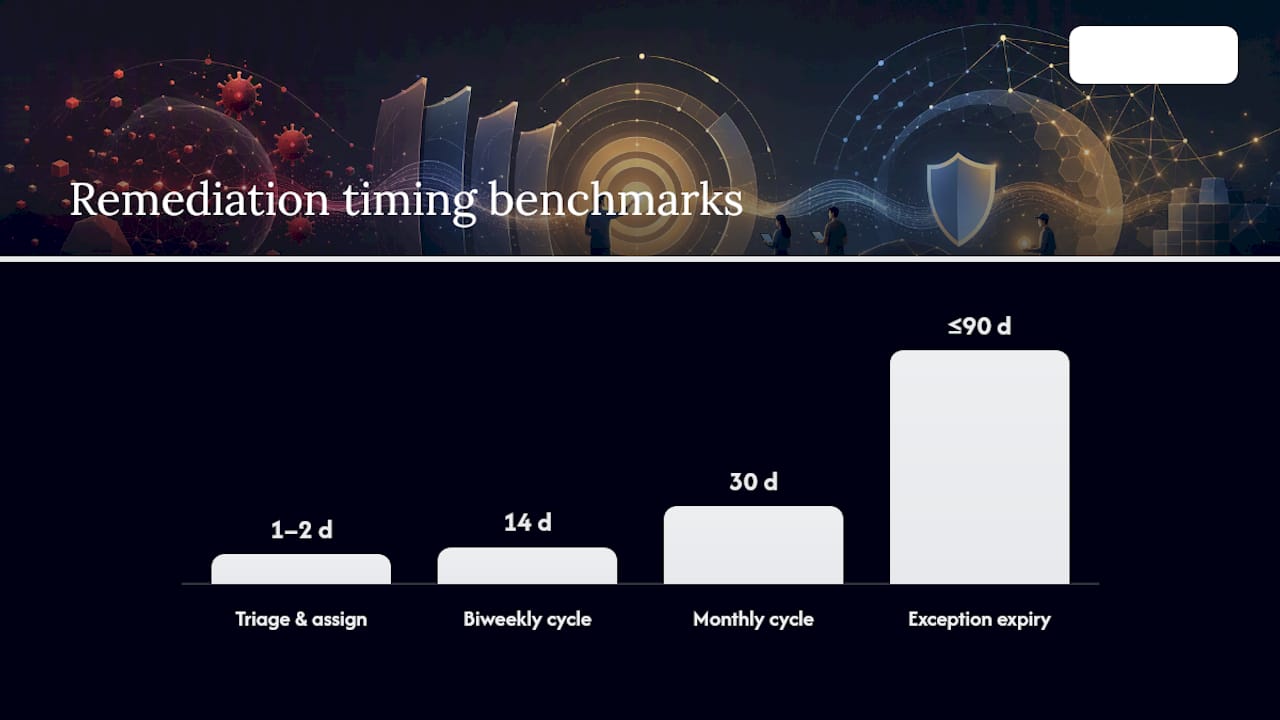
- Triage the finding against your risk-based prioritization criteria and assign an owner within 24 to 48 hours of confirmation.
- Patch in place for critical production systems where a full rebuild isn't feasible on the SLA timeline, using vendor-supplied hotfixes or configuration changes.
- Schedule standard patch cycles for lower-severity findings, typically monthly or biweekly depending on asset tier.
- Route to change management for anything touching production, with rollback plans documented before deployment.
- Log exceptions with an expiration date, compensating control description, and named approver whenever a fix can't happen on schedule.
AWS's prescriptive guidance on vulnerability management recommends running both approaches in parallel in cloud environments: patch-in-place for urgent zero-day response, and standard build-and-release cycles (rebuilding AMIs or container images) for routine patching. That dual-track approach avoids the trap of treating every fix as an emergency.
Exception governance needs an approval matrix scaled to severity: a low-severity exception might need only the asset owner's sign-off, while a critical-severity exception on an internet-facing system should require security leadership approval and a hard expiration date, no more than 90 days without review.
Pro Tip: Build your exception log as a living register, not a one-time form. Review it monthly alongside your SLA compliance metrics, because expired exceptions that nobody revisits are how "temporary" risk acceptances turn into permanent blind spots.
How Do You Verify That a Fix Actually Worked?
A patch that "should have worked" and a patch that's been verified are not the same thing, and the gap between them is where audits fall apart. Automated rescans against the same scope confirm the finding no longer triggers, typically run within 48 to 72 hours of a claimed fix for high and critical severity items.
For anything high-risk, particularly application-layer fixes and authentication changes, a targeted validation test beats a generic rescan. This might mean re-running the specific exploit proof-of-concept, or for a subset of the highest-risk findings, looping in penetration testing to confirm the fix holds under adversarial conditions rather than just passing an automated check.
Every verification result needs to land in the same repository that tracked the original finding, timestamped, with evidence attached (scan output, screenshots, tester notes). That audit trail is what turns "we think we fixed it" into something a compliance auditor or a cyber insurer will actually accept. Programs that skip this step tend to discover, months later, that a "resolved" finding never actually closed.
What Metrics Prove Your Vulnerability Management Program Works?
Mean time to remediate, broken down by severity tier, is the single most useful operational number a vulnerability management program produces, according to Wiz's breakdown of the vulnerability management lifecycle. A program that fixes critical findings in 12 days but takes 200 days on medium-severity ones has a real story to tell leadership, and MTTR is what tells it.
Track these operational metrics on a recurring cadence:
- MTTR by severity, measured from discovery to verified closure, not from patch release.
- Vulnerability age distribution, showing how many open findings are 30, 60, or 90-plus days old.
- SLA compliance rate, the percentage of findings closed within their assigned window.
- Scan coverage, the percentage of known assets actually scanned in the last cycle.
Programs that report MTTR trends alongside SLA compliance rates give executives a clear read on whether risk exposure is shrinking or growing quarter over quarter, according to Wiz's vulnerability management research.
Executive dashboards should translate these into a handful of trend lines: open critical findings over time, SLA compliance by business unit, and a risk-reduction trajectory rather than a raw vulnerability count, which tends to spike whenever you buy a new scanner and tells leadership almost nothing useful on its own.
Which Tools Do You Actually Need, and What Changes in the Cloud?
No single tool covers network infrastructure, web applications, open-source dependencies, containers, and cloud configuration at once. A working program stacks a network/infrastructure scanner, a web application scanner, an SCA tool for dependency tracking, container image scanning integrated into the build pipeline, and cloud security posture management for configuration drift.
Cloud environments change the operating model, not just the tool list. Assets are ephemeral: a container might exist for six hours. AWS's guidance stresses that ownership needs to distribute out to application teams rather than sitting centrally with security, since a central team can't realistically own remediation across hundreds of independently deployed services. Infrastructure-as-code (IaC) scanning catches misconfigurations before deployment, which is far cheaper than catching them after.
Orchestration is what keeps this from becoming five disconnected alert streams. The AppSecure program guide frames this as centralizing findings into one repository, deduplicating the same vulnerability reported by three different tools, enriching each finding with exploit and asset-criticality context, and routing the result automatically to the right owner's ticketing queue. Without that layer, teams drown in redundant, context-free alerts and start ignoring them.
How Does Vulnerability Management Connect to Patch Management and the SDLC?
Patch management is the mechanism; vulnerability management is the decision layer that tells patch management what to prioritize and by when. They're distinct functions that need to talk to each other constantly, not one team doing both jobs informally.
For custom applications, integration means feeding vulnerability findings directly into the software development lifecycle: automated ticket creation in the same backlog developers already use, build pipelines that fail on high-severity SCA findings before code ships, and container rebuilds triggered automatically when a base image gets a critical patch. Standard cadence patching works for routine findings; build-and-release rebuilds are the better path when a vulnerability sits deep in a base image or a dependency tree rather than a single configuration file.
What Usually Breaks a Vulnerability Management Program?
Most programs don't fail from lack of tooling. They fail from scope that was never fully defined, alert fatigue from unfiltered scanner output, and findings with no assigned owner sitting untouched for months.
The recurring failure patterns:
- Incomplete scope that quietly excludes shadow IT, forgotten cloud accounts, or acquired subsidiaries.
- Tool overload where five scanners produce five conflicting severity ratings for the same asset.
- No clear ownership, leaving findings orphaned between security and IT.
- Weak exception governance, where "temporary" risk acceptances never expire.
The fix is incremental, not a full rebuild. Roll out scope in phases, automate triage so humans only see prioritized findings, assign explicit owners before the first scan runs, and set SLAs that tighten gradually as the program matures. CISA's maturity model runs from Reactive through Managed, Defined, Quantitative, to Optimizing, and a Defined (Level 3) program with consistent process and risk-based prioritization is a realistic, credible target for most organizations rather than chasing full optimization immediately.
Pro Tip: Don't wait for a perfect asset inventory before starting your first prioritized scan cycle. OWASP's own guidance favors starting small and iterating, since a program stuck in the planning phase protects nothing.
What Does a Practical Vulnerability Management Checklist Look Like?
A functioning program can be checked against a short list before you call it operational:
- Written policy covering scope, approved methods, roles, and SLA timelines.
- Verified, continuously updated asset inventory with named ownership.
- Scan cadence matched to asset criticality, not a single fixed schedule for everything.
- Risk-based prioritization combining CVSS, EPSS, and KEV data.
- Documented verification step before any finding is marked closed.
- Exception log with expiration dates and named approvers.
This mirrors the operational pattern in Yslootahtech's enterprise cybersecurity workflow guide, which walks through a six-step approach to hardening enterprise environments end to end. For teams looking to translate technical severity into terms a board will act on, the cybersecurity risk assessment guide for SMB leaders covers how to frame that conversation. Neither replaces a full engagement, but both give you a working reference while you build your own program out.
Starting or Fixing a Vulnerability Management Program: What Actually Matters
The first 90 days should focus on three things: a real asset inventory, one prioritized scan cycle using risk-based criteria instead of raw CVSS, and a handful of visible quick-win remediations to build organizational trust in the process. Chasing full program maturity from day one is a mistake. Level 3, defined and risk-based, is the practical ceiling most teams should aim for in year one. Governance and stakeholder buy-in matter more than tooling. A program with strong executive sponsorship and mediocre tools will outlast a program with excellent tools and no one accountable for closing findings.
— YS
Get Vulnerability Management Built and Run by a Technology Partner
Reading a lifecycle framework is one thing. Standing up the policy, tooling, and remediation workflow behind it, while running your day-to-day operations, is another. A hands-on technology partner can bring cybersecurity expertise alongside cloud and enterprise application experience so your vulnerability management program gets built to fit your actual environment, not a generic template.
An engagement typically starts with an assessment of your current asset landscape and exposure, followed by policy creation covering scope, roles, and remediation SLAs, tooling selection and integration across network, application, and cloud layers, and documented runbooks your team can run without outside help going forward. Ongoing support is important so the program keeps maturing instead of stalling once the initial rollout is done.
If your team needs a partner to design and operationalize this from the ground up, start with a conversation through Yslootahtech's IT consulting services to scope what a working vulnerability management program looks like for your organization.
Sources
- CRR Resource Guide – Vulnerability Management (CISA)
- AWS Prescriptive Guidance: Vulnerability management
- NVD — CVSS (NIST)
FAQ
What Are the 5 Steps of Vulnerability Management?
The five steps are identify, assess and prioritize, remediate, verify, and report and improve. Each step feeds data into the next, and the "report and improve" stage loops findings back into scope and policy for the next cycle rather than ending the process.
What Are the Four Stages of Vulnerability Management?
Some frameworks compress the cycle into four stages: identify, prioritize, remediate, and verify, folding reporting into the remediation and verification stages rather than treating it separately. Both the four-stage and five-stage versions describe the same underlying loop; the difference is just how granularly reporting gets broken out.
What Are the Seven Steps of Penetration Testing?
Penetration testing typically follows planning and reconnaissance, scanning, gaining access, maintaining access, analysis, reporting, and remediation retesting. It sits inside the broader vulnerability management process as a verification and validation method for high-risk findings, not a replacement for continuous scanning.
What Are the Four Types of Vulnerabilities?
Security teams generally group vulnerabilities into network vulnerabilities, application (software) vulnerabilities, configuration vulnerabilities, and human or process vulnerabilities. A complete vulnerability management program needs different assessment techniques, from credentialed network scans to code-level SCA tools, to cover all four categories.
Is Patch Management the Same as Vulnerability Management?
No. Vulnerability management is the broader process of finding, prioritizing, and tracking security weaknesses, while patch management is one remediation mechanism within it. A vulnerability might be resolved through a patch, a configuration change, a compensating control, or a documented risk acceptance, and patch management only covers the first of those.
How Much Does Yslootahtech Charge for a Vulnerability Management Program?
Pricing depends on the scope of your environment, current tooling, and whether you need ongoing support or a one-time program build. Current details are available directly on Yslootahtech's IT consulting page.