30/60/90-Day Security Awareness Program for Business Leaders

A security awareness program is a structured, ongoing effort to change how employees behave around cybersecurity threats, not a once-a-year training video. Start now by picking one to three high-impact behaviors (reporting phishing, using a password manager, locking screens) and running a baseline phishing simulation before you build anything else. The rest of this guide covers design, delivery, and measurement in detail.
TL;DR:
- High-impact behaviors like reporting phishing and using password managers should be targeted first, with baseline phishing simulations run before expanding the program.
- A continuous, role-based, and varied delivery approach, including microlearning and security champions, is essential to sustain long-term behavior change.
- Measuring success through participation, behavior, and incident reduction, with industry benchmarks showing click rates below 5% after a year of regular simulations, is crucial.
- Leadership sponsorship, HR integration, and ongoing reinforcement are necessary to transition from compliance to a security culture.
- Implementing a phased 30/60/90-day plan that focuses on onboarding, microlearning, and metrics reporting helps ensure program momentum and measurable results.
Table of Contents
- Why Security Awareness Programs Matter
- Core Components Every Effective Program Must Include
- How to Design and Implement a Program Step by Step
- Which Delivery Methods Keep Engagement High?
- How Do You Measure Effectiveness?
- Moving From Compliance to Culture
- A 30/60/90-Day Starter Plan You Can Use Now
- Sustaining Behavior Change: What Most Programs Get Wrong
- How Yslootahtech Helps You Build a Program That Sticks
- Sources
Why Security Awareness Programs Matter
"Awareness" and "training" get used interchangeably, but they are not the same thing. Training teaches a skill; awareness keeps that skill active in someone's head months later, when they are tired, rushed, and staring at a convincing invoice email. That distinction is why a real program never ends. It runs continuously, the way a fitness routine works only if you keep showing up.
The Verizon Data Breach Investigations Report found that roughly 68% of breaches involve a non-malicious human element: a misdirected click, a reused password, a rushed approval. That single figure is the entire business case for investing in behavior change over firewalls alone.
Programs built around that reality tend to deliver:
- Fewer successful phishing clicks over time
- Higher rates of employees reporting suspicious emails instead of ignoring them
- Lower average cost per security incident, since early reporting shrinks damage
Core Components Every Effective Program Must Include
A program built only on an annual slideshow will fail regardless of budget. The components below cover the people, content, and support structures that make behavior change stick.
Role-based modules. Executives need different training than finance staff, and finance staff need different training than frontline retail workers handling customer payment data. New hires should complete an onboarding module within their first 30 days, a cadence CIS Control 14 explicitly recommends.
Varied delivery formats. Mix instructor-led sessions for complex topics, microlearning for quick reinforcement, phishing simulations for practice under real conditions, and just-in-time training triggered right after someone clicks a risky link.
Support infrastructure. This includes written policies employees can actually find, a clear incident-reporting channel, a network of security champions embedded in departments, and a regular communications cadence that keeps the topic visible between formal sessions.
Pro Tip: Assign one security champion per department instead of relying on IT to broadcast every message. Peer-to-peer reminders land better than another email from a name people don't recognize.
How to Design and Implement a Program Step by Step
Building a program in the right order saves months of rework. NIST SP 800-12 outlines a similar sequence: define scope, identify audiences, secure management support, deliver, maintain, then evaluate.
- Define scope and pick one to three measurable behaviors to target first. Trying to fix everything at once is how most programs stall in month two.
- Map your audiences and set a delivery cadence. A workable rhythm looks like onboarding training within 30 days, an annual baseline refresher, monthly phishing simulations, and weekly microlearning nudges.
- Assign clear owners. IT usually owns technical content, HR owns onboarding workflows, and Communications owns the messaging cadence. Without a named owner for each piece, the program quietly dies.
- Build a content pipeline before launch. Draft three to six months of material in advance so you are never scrambling the week before a deadline.
- Pilot with one department and collect baseline metrics. A 90 day pilot with click-through and reporting-rate data gives you a defensible before-and-after comparison.
- Iterate using what the data tells you. If accounting keeps failing invoice-fraud simulations, build a module specifically for that team rather than repeating generic content.
- Expand scope once you can show early wins. Use pilot results to justify budget for a company-wide rollout.
This sequence works whether you are standing up a program from nothing or fixing one that has drifted into a compliance checkbox. Our cybersecurity improvement steps for business leaders walks through a similar prioritization framework for broader security initiatives.
Which Delivery Methods Keep Engagement High?
The format has to match the moment. E-learning modules work for foundational knowledge that everyone needs. Instructor-led sessions earn their cost for complex topics like incident response roles, where questions matter. Microlearning, short two to five minute lessons, keeps concepts fresh between bigger events. Just-in-time training, triggered the moment someone clicks a simulated phishing link, teaches faster than any scheduled course because the lesson lands while the mistake is still fresh.
Run phishing simulations ethically: warn leadership in advance, avoid shame-based messaging in the follow-up, and treat every click as a coaching moment rather than a disciplinary one. Proofpoint's research notes that one-size-fits-all annual training performs worse than frequent, role-specific messaging.
Beyond format, engagement usually comes down to a few tactics:
- Gamification with leaderboards or small recognition for departments with strong reporting rates
- Content translated and localized for a multilingual workforce
- Accessibility built in from the start, not retrofitted later
- Communications that reinforce the same message across email, chat, and posters instead of relying on one channel
How Do You Measure Effectiveness?
Measurement should happen at four levels: participation (did people show up), knowledge (did they learn it), behavior (did they act differently), and outcomes (did incidents actually drop). Behavior is the one that matters most, because knowledge without behavior change is just a certificate nobody uses.
Industry benchmarks give you something to aim for:
| Metric | Target |
|---|---|
| Training completion rate | High completion rate |
| Phishing simulation click rate | Low click rate, commonly targeted below 5% |
| Suspicious email report rate | Above 50% |
Programs that pair regular simulations with immediate feedback have reported phishing click rates falling substantially from initial high levels toward low single-digit percentages within about 12 months, according to industry benchmark data. Use whichever metric is lagging to decide where to spend your next training dollar, and translate improvements into cost-avoidance numbers when building your case to executives. Our guide on building a cybersecurity plan for business leaders covers how to frame those numbers for a board audience.
Moving From Compliance to Culture
SANS describes five maturity stages: Non-Existent, Compliance-Focused, Promoting Awareness and Behavior Change, Long-Term Sustainment, and Security Culture. Most organizations sit somewhere in the middle, running training because an auditor requires it rather than because it changes anything. Organizations that narrow their focus to a small set of high-impact behaviors typically see measurable change within 6 to 12 months.
Aligning your program with recognized frameworks makes the climb easier to justify. NIST SP 800-50 frames awareness training as foundational to individual accountability, meaning employees can only be held responsible for security behaviors they were explicitly taught. CIS Control 14 backs that up with a concrete cadence recommendation.
Reaching the top stages requires more than a bigger training budget:
- Visible sponsorship from leadership, not just a signed-off policy document
- HR integration so onboarding workflows include security training automatically
- Communications partnership for consistent messaging across every channel
- Operations alignment so training reflects how people actually work, not a generic template
A 30/60/90-Day Starter Plan You Can Use Now
Most programs fail from trying to do too much in week one. This sequence keeps the first quarter focused.
Days 1 to 30: Launch a role-based onboarding module for new hires, publish your incident-reporting policy where employees can actually find it, and run your first baseline phishing simulation to establish where you stand.
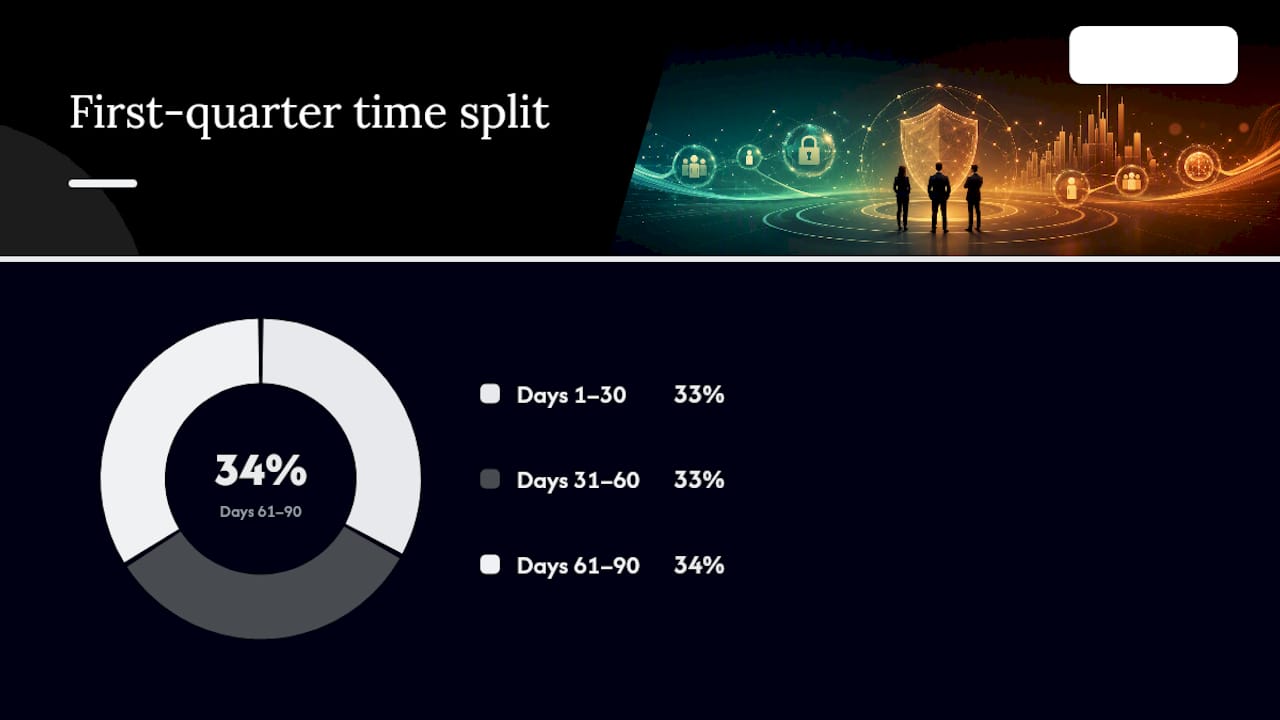
Days 31 to 60: Deliver weekly microlearning nudges, run a second simulation targeting the department that performed weakest in the baseline, and recruit your first security champions.
Days 61 to 90: Compile your first measurement report covering completion, click rate, and report rate, then present findings to leadership with a specific ask for the next quarter's budget.
| Milestone | Target by Day 90 |
|---|---|
| Onboarding module live | new hires |
| Baseline simulation completed | Full target population |
| First executive report delivered | One structured summary with next steps |
Pro Tip: Keep the week-by-week cadence visible on a shared calendar. Programs that lose momentum almost always lose it because nobody scheduled the next touchpoint.
Sustaining Behavior Change: What Most Programs Get Wrong
Most security awareness programs die of neglect, not bad content. Leadership signs off on a launch, attends the kickoff, then disappears until the annual audit. That absence tells employees everything they need to know about how seriously to take it.
The programs that actually change behavior treat security like an ongoing habit, not an event. They fold reinforcement into daily tools, Slack reminders, calendar nudges, a five-minute video before a team meeting, instead of relying on one dense session per year. The single biggest mistake I see is treating awareness training as an HR compliance checkbox rather than a risk-reduction lever with a measurable return. Once leadership starts asking for click rates and report rates the way they ask for revenue numbers, the culture shifts on its own.
— YS
How Yslootahtech Helps You Build a Program That Sticks
Some providers offer faster paths to measurable programs with custom content, dashboards, and integrations that connect with your existing systems, rather than generic templates applied across departments.

We design role-based training content, build the UX/UI for learning portals that employees actually want to open, and develop the application integrations that pull phishing simulation results and completion rates into one executive-ready dashboard. If your current setup relies on scattered spreadsheets and a vendor's default reports, that gap is usually where measurement breaks down first. For teams also modernizing their broader defenses, our cybersecurity checklist for IT managers pairs well with a new awareness rollout. AI-driven personalization is also reshaping how simulations adapt to individual risk profiles, an approach AmmarAI's use case library explores in more depth.
Reach out to schedule a program audit or a starter workshop, and we'll map out where your current training stands against the benchmarks in this guide.
Sources
- Verizon Data Breach Investigations Report
- SANS security awareness maturity model
- NIST SP 800-50 Rev. 1: Building a Cybersecurity and Privacy Learning Program
- CIS Controls v8.1 security awareness training policy template