Penetration Testing Scope for Security Teams: Checklist + scope.yaml

A penetration testing scope is the signed, written document that lists every asset, environment, and role a tester is authorized to attack, along with the exact techniques allowed and the objectives the test must answer. It succeeds when a tester can read it without ever needing to guess whether something is fair game. Everything else in scoping, from IP ranges to rules of engagement, exists to make that document precise enough to survive contact with reality.
TL;DR:
- Precise asset identifiers, such as full CIDR ranges, URLs, and cloud account IDs, are essential to prevent scope creep and ensure comprehensive testing.
- All out-of-scope assets, including third-party systems and vendor-controlled infrastructure, must be explicitly documented with ownership and permission confirmation beforehand.
- Testing objectives and methodology should match the scope, with grey box approaches often providing the best value for realistic attacker simulation while saving time.
- The scope document must include conditions for handling mid-engagement discoveries, clear testing windows, and escalation procedures to minimize risks and delays.
- A signed rules of engagement and established retesting plans are vital for actionable reports and demonstrating scope compliance to auditors or stakeholders.
Table of Contents
- What Belongs in a Penetration Testing Scope
- Handling Out-of-Scope Assets and Third-Party Systems
- Choosing Testing Objectives, Methodology, and Depth
- Setting Environments, Timing, and Communication Rules
- Writing Rules of Engagement and Securing Legal Sign-Off
- Reporting, Evidence, and What Counts as Retest-Ready
- A Practical Scoping Checklist and Scope File Template
- Common Scoping Mistakes and How to Fix Them
- Get Help Scoping and Running Your Next Penetration Test
- Standards Worth Reading Before You Scope Your Next Test
- Sources
- FAQ
What Belongs in a Penetration Testing Scope
A scope document earns its keep only when every asset in it is specific enough that a tester never has to guess. "The corporate network" is not a scope entry. "203.0.113.0/24" is.
The PTES pre-engagement guidance warns that vague or incomplete asset lists are a leading cause of scope creep, missed coverage, and legal exposure once testing begins. Most clients assume testers will simply "find everything," but a tester who stumbles onto an unlisted system has to stop and ask permission, which burns hours you already paid for.
Build the inventory around these asset classes:
- External IP ranges and CIDR blocks (e.g.,
198.51.100.0/28) - Domains and subdomains (e.g.,
app.example.com,api-staging.example.com) - Application URLs and specific API endpoints, including version paths
- Mobile app builds, named by platform and build number
- Cloud account IDs or subscription IDs (e.g., AWS account
123456789012) - Identity providers and the specific user roles to test (admin, standard user, guest, API service account)
Naming conventions matter more than most planners realize. A tester with an exact URL and a named role can move immediately; a tester with "the web app" has to spend the first day of the engagement just mapping what exists.
Handling Out-of-Scope Assets and Third-Party Systems
Out-of-scope items need the same precision as in-scope ones. Shared hosting environments, partner-managed systems, and vendor-controlled infrastructure (a payment gateway, a CDN, a managed SaaS backend) usually sit outside what your organization has legal authority to test, even when they touch your data.
A scoping playbook from OSec recommends building an explicit "ask-before-testing" list for anything discovered mid-engagement that wasn't part of the original inventory. That list gives testers a documented path to pause and request approval instead of quietly skipping something or, worse, testing it anyway.
Before kickoff, confirm ownership and permission for anything ambiguous:
- Cloud-hosted assets often require the provider's own authorization process (AWS, Google Cloud, and Azure each have separate forms for penetration testing notification)
- SaaS vendors frequently prohibit testing their platforms directly, even when your organization's data lives there
- Third-party APIs and integrations need written sign-off from the vendor, not just your internal legal team
- Contractors or agencies managing infrastructure on your behalf need to confirm what they will and won't allow
Document every exclusion by name. A scope that says what's excluded is far easier to defend later than one that just goes quiet on the topic.
Choosing Testing Objectives, Methodology, and Depth
Scope and methodology are the same decision viewed from two angles. What you're trying to prove determines how deep the test needs to go, and how much access the tester should start with.
- Compliance-driven tests (PCI DSS, SOC 2, ISO 27001) usually call for broad-sweep coverage across the defined cardholder or in-scope environment, often black box to simulate an outside attacker with zero prior knowledge.
- Launch-readiness tests for a new application benefit from grey box access, where the tester gets standard user credentials but not source code. This mirrors what a real attacker could obtain through a leaked account or basic reconnaissance.
- Post-incident verification tests are usually named-objective: confirm the specific vulnerability that caused the incident is actually closed, not a full re-sweep of the environment.
- White box tests, with full source access and architecture diagrams, make sense when you need maximum depth on a single high-value system and have the budget for the extra time it takes.
Grey box is often the best value for the money. It skips the reconnaissance phase a black box test burns hours on, while still testing genuine attacker conditions rather than a fully-informed audit. Use a named-objective test when the business question is narrow, such as "can an external attacker reach the payments database," and save broad sweeps for annual baselining.
Setting Environments, Timing, and Communication Rules
Testing production carries real risk, but it's also the only environment that tells you the truth about your actual attack surface. Staging environments drift from production over time. Different patch levels, different configurations, and different data volumes all mean a clean staging result doesn't guarantee the same result in production.
If you test staging instead of production, document every known difference in the scope file so the report's conclusions aren't overstated.
- Set testing windows with specific dates and times, including timezone, so nobody assumes UTC when you meant local time
- Define blackout dates around product launches, sales events, quarter-end financial closes, or any period where downtime is unacceptable
- Establish a communication cadence: daily status pings during active testing, immediate notification for critical findings
- Set a service-level agreement for critical findings. Twenty-four hours is a common standard for anything rated critical or high severity
- Define an emergency stop procedure and name the person who can invoke it on either side
None of this is paperwork for its own sake. A tester who finds a critical vulnerability at 2 a.m. on a Saturday needs to know exactly who to call and how fast they'll respond.
Writing Rules of Engagement and Securing Legal Sign-Off
Rules of engagement, often shortened to RoE, are the operational contract that sits underneath the scope document. The SANS rules-of-engagement worksheet lays out the minimum items every RoE should nail down before testing starts.
At minimum, an RoE needs:
- Permitted and forbidden techniques (is denial-of-service testing allowed? Social engineering? Physical access attempts?)
- Evidence collection rules: what screenshots or data exports are acceptable proof, and what's off-limits to extract
- Stop conditions that trigger an immediate pause, such as unexpected system instability
- The exact source IP addresses or ranges the testing traffic will originate from, so your security team doesn't panic and block it
- Liability and insurance language naming which party covers what if something breaks
A permission-to-test letter should name the specific systems covered, the testing dates, the individuals authorized to conduct the test, and a signature from someone with actual authority to grant it, not just a project manager.
Pro Tip: Build a lightweight change-control step into the RoE itself: a single email thread where new assets get added with a timestamp and a named approver, following a proven checklist and plan for SaaS rollout to keep changes under control. It turns "we forgot to document that" into a two-line audit trail.*
Reporting, Evidence, and What Counts as Retest-Ready
A penetration test that ends with a PDF nobody acts on wasn't worth running. The OWASP testing framework calls for both a technical report and an executive summary, delivered on a timeline you agree to upfront, typically five to ten business days after testing ends.
- The technical report should include reproduction steps, affected assets, severity ratings, and remediation guidance specific enough for an engineer to act on immediately
- The executive summary translates findings into business risk for people who don't read CVSS scores for a living
- Evidence handling needs a stated policy: what proof is retained, where it's stored, who can access it, and when it gets destroyed
- Retesting should happen within a defined window, often 30 to 90 days after the original report, with the tester providing specific evidence that each finding is actually closed
- Reopened findings need a clear process: does the retest fee cover round two, or does it trigger a new statement of work?
"Done" means every critical and high finding has documented remediation evidence, not just a status field that says "fixed."
A Practical Scoping Checklist and Scope File Template
Before any kickoff call, run through this list: confirmed objectives, a full asset inventory, named roles with provisioned credentials, environment notes (production vs. staging differences), signed RoE items, an emergency contact list, working test accounts for every role, and agreed retest terms.
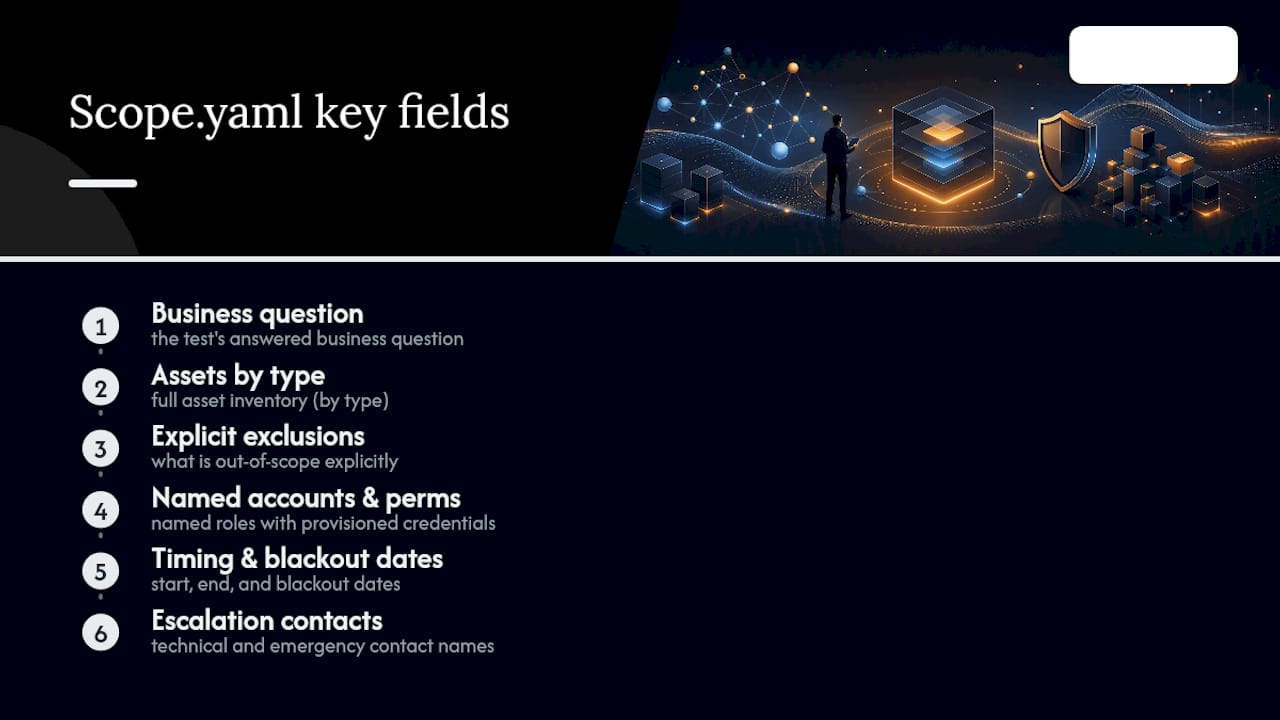
A minimal scope file might use these keys: objectives (the business question the test answers), in_scope (assets by type), out_of_scope (explicit exclusions), roles (named accounts and permission levels), testing_window (start, end, blackout dates), and contacts (technical and emergency escalation names).
Before the tester's first day, confirm allow-listing is in place, test accounts actually log in, and backup contacts are reachable if the primary one is on vacation.
Common Scoping Mistakes and How to Fix Them
The same failures show up across most poorly scoped engagements: asset lists too vague to act on, missing authentication roles, forgotten third-party dependencies, and test accounts that don't actually work when the tester tries to log in on day one. Testers without proper credentials for every relevant user type often leave large parts of an application's attack surface completely untested.
The fixes are straightforward. Force identifier precision on every asset, require role-specific credentials be tested before kickoff, maintain an explicit ask-before category for anything discovered mid-test, and run a readiness check 48 hours ahead of the start date.
If your team lacks the bandwidth to build this properly, bringing in outside help to tighten the scope before you sign anything with a testing vendor is usually cheaper than fixing a scoping mistake mid-engagement.
— YS
Get Help Scoping and Running Your Next Penetration Test
Most security teams don't lack the will to scope a test properly. They lack the hours. Yslootahtech's IT consulting team runs scoping workshops that turn a vague "we need a pentest" request into a signed scope file, a complete rules-of-engagement document, and a contact list your tester can actually use on day one.

A typical engagement produces a finished scope document with asset inventory, an RoE covering permitted techniques and escalation paths, coordinated sign-off from any third-party vendors involved, and a retest plan built in before testing even starts. For organizations building or hardening the applications being tested, Yslootahtech's application development team can also handle remediation work once findings come back. If your last penetration test report sat in a shared drive because nobody scoped it against a real business objective, that's the gap a scoping workshop closes. Reach out through the IT consulting page to schedule one before your next engagement.
Standards Worth Reading Before You Scope Your Next Test
Four references cover most of what a security planner needs when building a defensible scope. The PTES pre-engagement documentation walks through the full pre-engagement conversation, from defining objectives to setting the rules both sides agree to before testing starts.
NIST SP 800-115 goes deeper on the technical side, covering testing methods, planning considerations, and how evidence should be collected and handled throughout an assessment. The OWASP Web Security Testing Guide is the go-to reference for application and API-specific scope items, plus report structure expectations for web-facing systems.
The SANS rules-of-engagement worksheet offers a fill-in-the-blank checklist covering authorization, permitted techniques, and evidence rules. Naming these standards directly inside your RoE makes your methodology auditable, which matters the first time a compliance reviewer asks how you know the test was thorough.
Sources
- NIST Special Publication 800-115, Technical Guide to Information Security Testing and Assessment
- Pen Test Rules of Engagement Worksheet — SANS
FAQ
What Is the Scope of a Penetration Test?
The scope of a penetration test is the documented list of assets, environments, and objectives a tester is authorized to attack, along with the techniques permitted and the boundaries they must respect. It typically includes IP ranges, domains, applications, user roles, and testing windows, all confirmed and signed before testing begins.
Is Penetration Tester a Good Career?
Penetration testing remains a strong career path for people who enjoy hands-on technical problem solving and continuous learning, since attack techniques and defensive tools both evolve constantly. Demand tends to track closely with how seriously organizations take proactive security testing rather than waiting for compliance deadlines to force the issue.
What Are the Stages of a Penetration Test?
A typical penetration test moves through pre-engagement and scoping, reconnaissance, scanning and enumeration, exploitation, post-exploitation, reporting, and retesting. The PTES framework formalizes these stages and is one of the most widely referenced methodologies for structuring an engagement from start to finish.
Will AI Replace Penetration Testers?
AI tools are increasingly used to speed up reconnaissance and flag likely vulnerabilities, but judgment calls around business context, exploit chaining, and reporting still require a human tester. Organizations exploring AI-assisted security tooling tend to use it to augment testers rather than replace the scoping and analysis work a skilled person does.
How Precise Should Asset Identifiers Be in a Scope Document?
Asset identifiers should be exact enough that a tester never has to guess, meaning full CIDR blocks instead of network names, complete URLs instead of "the website," and specific cloud account IDs instead of "our AWS environment." Vague identifiers are one of the most common causes of scope creep and missed coverage during testing.